
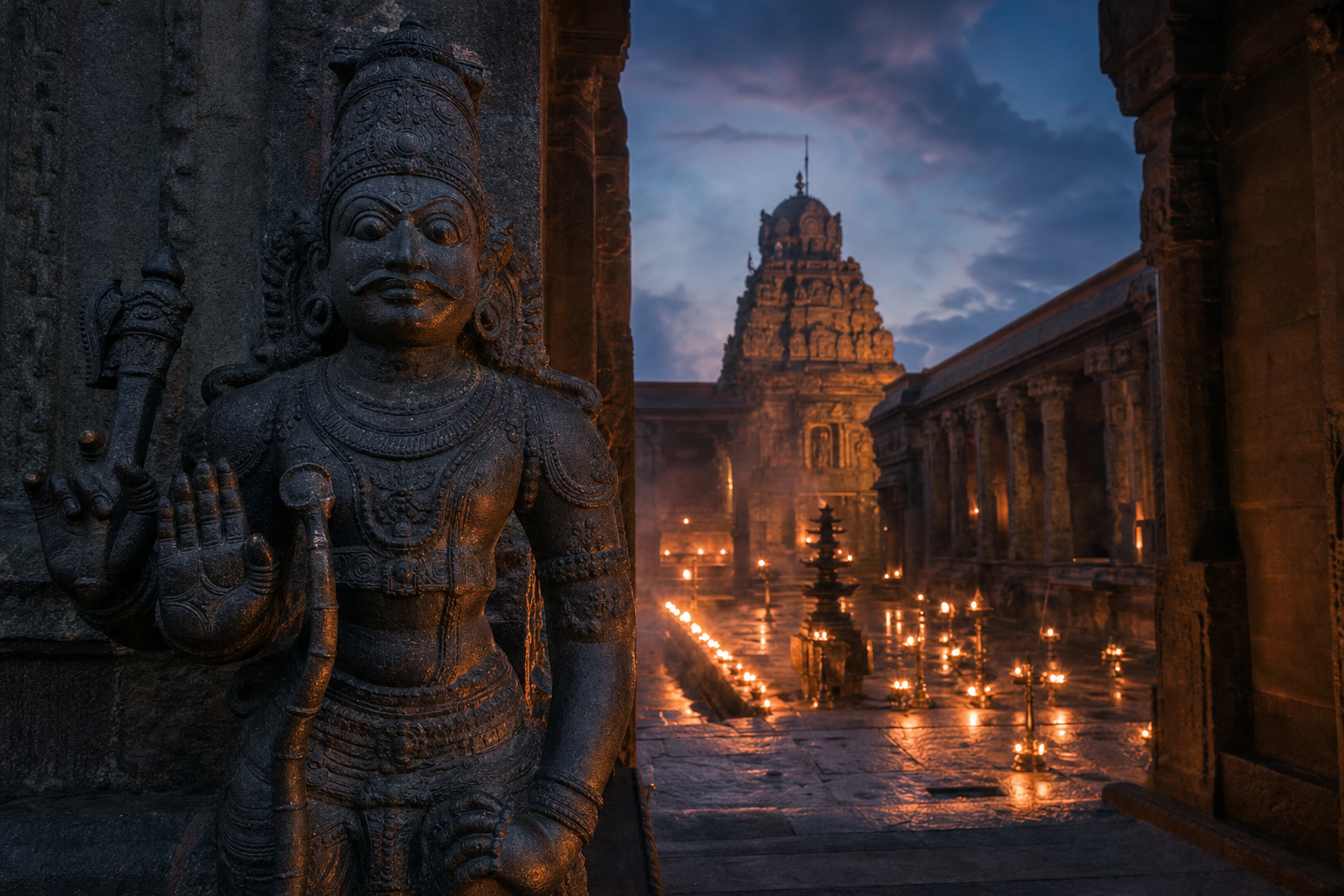
You enter a South Indian temple expecting serenity, beauty, and blessing. Then you meet a guardian with weapons, a shrine without a visible image, or an Ugra form whose intensity seems far removed from the gentleness usually associated with divine grace. How should you understand what you are seeing?
Begin with function, not appearance. Fierce divinity in these traditions is usually not anger released without restraint. It is protective force placed under sacred discipline. Once you ask what is being protected, where the deity is located, and what the ritual does to that force, the shrine becomes much easier to read – and much harder to dismiss as fear, superstition, or decorative mythology.
Key takeaways
- Ask what boundary, community, promise, or moral order the fierce deity protects. That function matters more than frightening visual features.
- A shrine without an anthropomorphic murti is not an empty shrine. Steps, weapons, lamps, stones, doors, and ritual boundaries can carry the deity’s presence.
- Protective fierceness may be stationed at a threshold or ritually cooled after danger has been overcome. These are different expressions of the same disciplined power.
- A vow before a guardian is an obligation, not a devotional experiment. Make only a promise you are prepared to keep.
- Offerings and procedures are local. Follow the temple’s actual practice rather than importing customs from another guardian shrine.
Fierceness is force governed by dharma
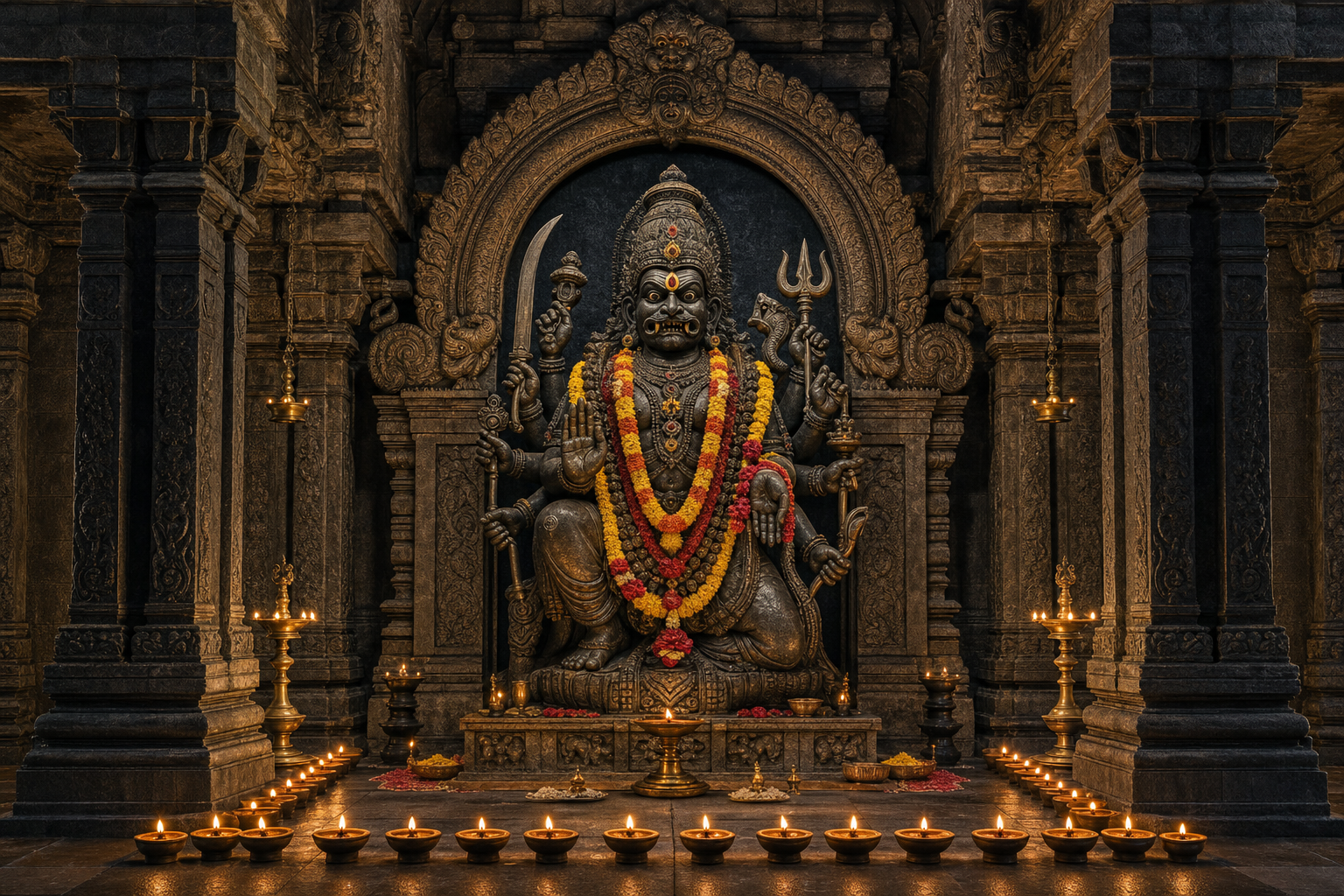
The quickest mistake is to treat every fierce form as a picture of divine rage. That reading isolates the face or weapon from the sacred system in which it operates. A guardian’s intensity usually has an object: intrusion, disorder, injustice, false speech, or danger to devotees. It also has a limit. The force serves dharma; it does not replace dharma.
This distinction helps you separate three things that are often confused. Cruelty delights in another being’s suffering. Human anger can become impulsive and self-serving. Divine fierceness, as expressed in protective temple traditions, is purposeful: it confronts a threat, safeguards an order, or restores the conditions in which ordinary worship can proceed.
That is why a fierce guardian need not compete with a temple’s principal deity. At Azhagar Kovil near Madurai, Pathinettam Padi Karuppasamy belongs to the protective ecology of a major Vaishnava complex dedicated to Sundararaja Perumal, also known as Kallazhagar. The guardian does not displace Perumal. He protects the threshold, attends to vows, and marks the standard of conduct expected from those who pass inward.
Mangalagiri presents another Vaishnava expression of the same principle. There, Narasimha’s Ugra energy is not treated as an embarrassing remainder after the defeat of Hiranyakashipu. It is acknowledged as necessary protection and then brought toward peace through a distinctive rite. Ferocity and compassion therefore belong to one moral sequence: danger is confronted, the vulnerable are protected, and force does not continue after its work is complete.
This also corrects the habit of dividing South Indian worship into a supposedly pure classical religion and a lesser world of local guardians. Karuppasamy may carry the immediacy associated with Tamil kaval deivam traditions, while Narasimha is deeply embedded in Vaishnava theology. Yet both can operate within established temple life. The more useful question is not whether a form appears classical or local. Ask how the deity, shrine, ritual authority, and community fit together.
At the threshold, protection becomes accountability
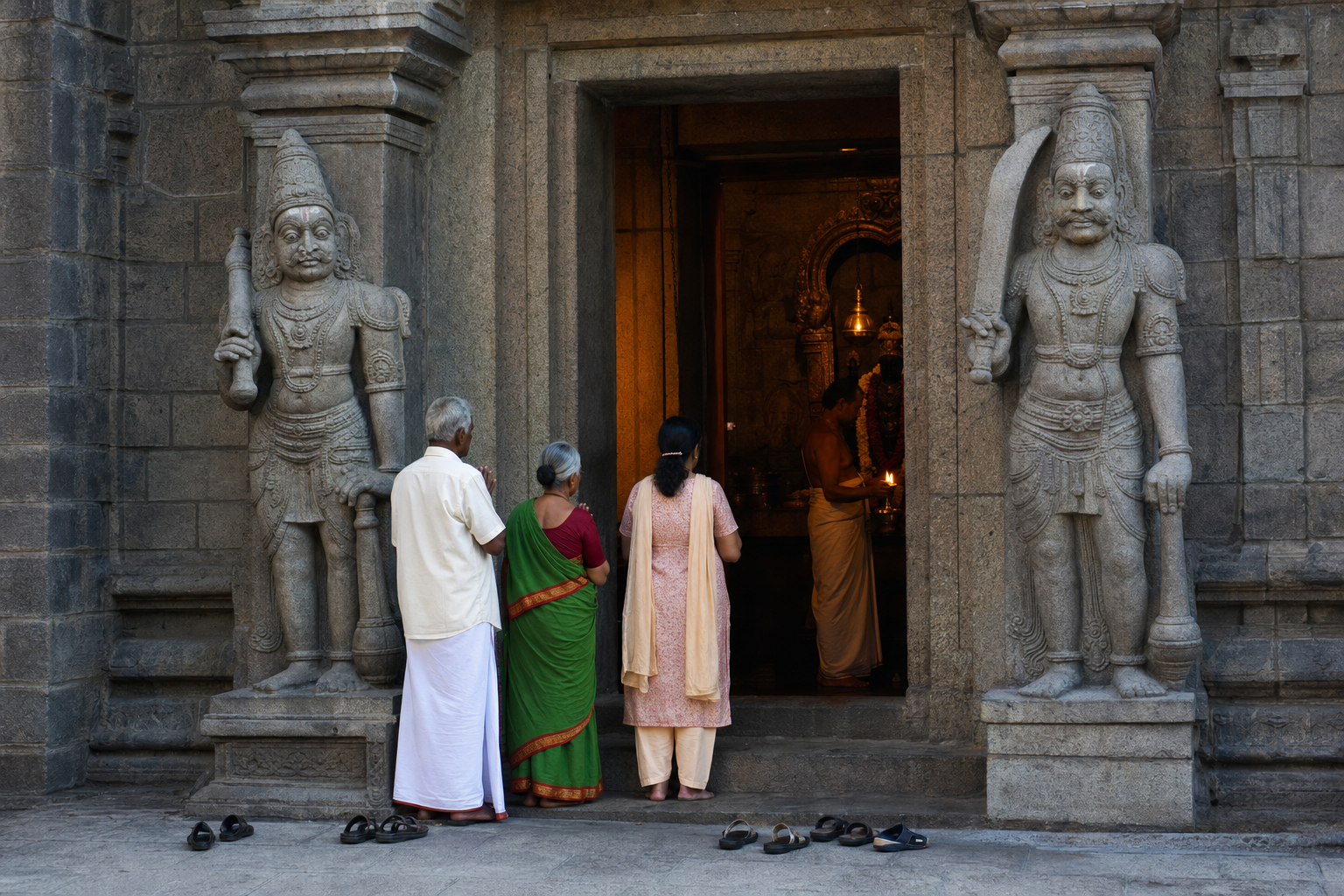
A guardian’s location is part of the theology. Pathinettam Padi Karuppasamy stands at a liminal point in the sacred geography of Azhagar Kovil, where temple, hill, forest, pathway, and human settlement meet. A central sanctum draws you toward divine presence. A threshold guardian turns your attention toward the condition in which you approach it.
The shrine is especially instructive because presence is conveyed without depending on a conventionally carved anthropomorphic image. Weapons, lamps, boundaries, vows, and the charged space of eighteen steps make the guardian recognizable. If you look only for a face and body, you may conclude that the shrine contains less. If you attend to movement and conduct, you discover that it asks more of you.
The sequence is simple but demanding: approach, pause, speak carefully, and cross. Ordinary conversation becomes accountable speech. An intention becomes a vow. Movement toward the inner temple becomes an ascent made under the eye of a guardian. Architecture performs the teaching before anyone explains it.
The number eighteen has attracted several devotional associations, including the eighteen chapters of the Bhagavad Gita, the eighteen-day war of the Mahabharata, the eighteen Puranas, and the eighteen Siddhars remembered in Tamil traditions. These associations can deepen reflection, but you should not force them into a single universal code. The surest meaning is already embodied in the place: the steps mark a complete passage from one condition of conduct to another.
Aniconic worship is not a theological deficiency waiting to be corrected by an image. South Asian traditions have long recognized presence through footprints, sacred trees, thrones, stones, emblems, and other charged signs. Early Buddhist symbolism could indicate the Buddha through a Bodhi tree, an empty throne, or footprints, while Jain devotion also preserved the importance of revered footprints. The comparison does not make these traditions identical. It does show why absence of portraiture should never be confused with absence of sacred presence.
For a visitor, the practical lesson is to slow down before deciding what the shrine means. Notice where other worshippers lower their voices. Look for lamps, weapons, doors, stones, steps, or a change in the direction of movement. Observe whether people state petitions, make vows, or simply bow before proceeding. At a threshold shrine, behavior is often the clearest iconography.
Karuppasamy’s association with justice should also change the kind of prayer you make. A guardian is not a supernatural instrument for winning a quarrel at any cost. If you ask for justice while hiding your own responsibility, you have misunderstood the encounter. The threshold asks whether your speech is truthful, your promise proportionate, and your desired outcome compatible with dharma.
At Mangalagiri, protective heat is brought toward peace
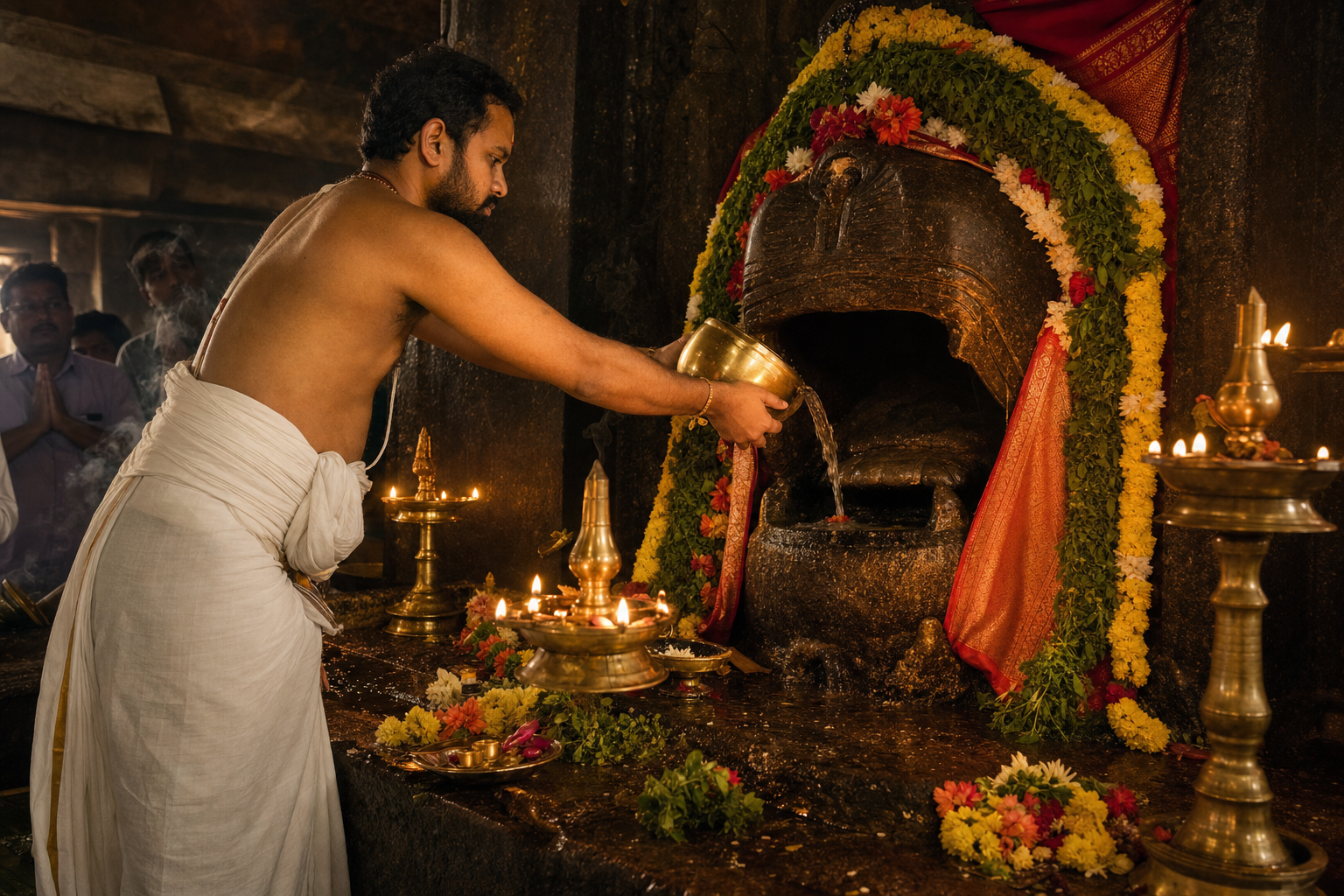
Not every fierce presence stands at an outer boundary. At Mangalagiri in Andhra Pradesh, the Ugra form of Panakala Lakshmi Narasimha occupies the hillside of an elephant-shaped sacred landscape. The larger kshetra is vertically organized through a foothill Lakshmi Narasimha temple, the hillside Panakala shrine, and the Gandala Narasimha shrine at the summit. Approach, ascent, and culmination shape the pilgrimage.
The defining ritual is the offering of panakam, a sweet jaggery-water preparation associated with cooling Narasimha’s fierce energy after the destruction of Hiranyakashipu. Priests pour it into the mouth-like opening of the hillside deity. The rite is centered in the forenoon, and the Ugra form’s liturgical rhythm does not extend the same offering into the evening.
The point is not that divine strength must be made weak. Cooling completes the protective act. Narasimha’s force has already answered a grave threat; the ritual directs that intensity toward shanta, or peace. Protection would become disorder if it could not stop. The sweet, cooling offering makes restraint visible and repeatable.
This gives you a precise way to think about sacred fierceness in your own moral life. Dharma does not always demand passivity. A boundary may need to be defended, a wrong named, or a vulnerable person protected. But intensity needs a stopping point. After decisive action comes de-escalation, self-command, and the restoration of ordinary life. Mangalagiri’s ritual grammar refuses both extremes: it neither denies force nor worships permanent agitation.
The contrast between the foothill temple and the hillside sanctum reinforces that lesson. The foothill complex presents the public monumentality of a towering Dravidian rajagopuram. The hillside shrine concentrates attention on an intimate, sensory offering at an unusual sacred opening. One announces the kshetra across the landscape; the other brings the worshipper close to a ritual transformation. To understand the whole place, you need both the monumental and the elemental.
If panakam darshan is central to your visit, plan around the temple’s forenoon practice and arrive early, especially during Brahmotsavam or Narasimha Jayanti. Do not treat the offering as a spectacle to be reproduced independently. Its meaning comes from the consecrated shrine, the priestly procedure, the local schedule, and its place within Narasimha worship.
A practical way to approach a fierce shrine
Read the shrine in five passes
- Locate it. Is the deity at an entrance, beside a path, on a hill, near the principal sanctum, or at the edge of a settlement? Position often tells you what kind of protection is being expressed.
- Identify the protected good. It may be a temple precinct, a pilgrimage route, the integrity of a vow, the safety of a community, or the transition from danger to peace.
- Read the material signs. Do not search only for an anthropomorphic murti. Weapons, lamps, stones, openings, steps, flags, or doors may organize the encounter.
- Watch what the ritual does. Does it station the deity at a boundary, invite testimony, bind a promise, cool intensity, illuminate a route, or mark safe passage?
- Confirm the local rule. Ask temple personnel what offerings, timings, photography rules, and forms of approach apply at this shrine. A custom seen elsewhere is not automatic permission here.
This sequence protects you from two opposite errors. The first is romanticism: treating every unfamiliar act as a timeless secret carrying the same meaning everywhere. The second is dismissal: reducing local practice to fear because its theology is expressed through a boundary, weapon, or vow rather than through a philosophical lecture. Careful observation gives the tradition room to speak in its own grammar.
Before you offer or make a vow
- Keep the promise narrow and truthful. Do not promise a costly offering, repeated pilgrimage, or major life change in the emotion of the moment unless you can realistically fulfil it.
- Do not bargain for adharma. A request to humiliate another person, escape your own responsibility, or secure an unjust advantage contradicts the guardian’s protective role.
- Use only accepted offerings. At Pathinettam Padi Karuppasamy, the practice within Azhagar Kovil is described through sattvic offerings such as flowers, coconuts, lamps, betel leaves, and incense. Do not import assumptions from other Karuppasamy shrines.
- Respect restrictions even when you do not understand them. If photography is discouraged or access is controlled, the right response is compliance, not an argument about tourist convenience.
- Let the authorized ritual remain authorized. At Mangalagiri, panakam is offered through the shrine’s established priestly procedure. Participation does not require improvisation.
Leave with one obligation
A fierce shrine should not merely leave you impressed. It should clarify what you must do next. If you asked for justice, identify the truthful action now required from you. If you prayed for protection, decide which boundary you must maintain without cruelty. If you witnessed the cooling of Ugra energy, name the conflict in which you need to stop after the necessary action has been taken.
That is where divine protection becomes a discipline rather than an aesthetic. Karuppasamy’s threshold teaches that protected space depends on accountable speech. Panakala Narasimha teaches that righteous intensity must return to peace. Neither lesson permits passivity, but neither licenses uncontrolled aggression.
On your next temple visit, choose one threshold and observe it before asking for anything. Find out what it guards, notice how your conduct changes as you cross it, and make no promise you would be unwilling to fulfil after the emotion of darshan has passed.
References
- DharmaRenaissance Blog – Eighteen Steps, One Presence: The Fierce Aniconic Power of Karuppasamy at Azhagar Kovil
- DharmaRenaissance Blog – Mangalagiri Panakala Lakshmi Narasimha: Elephant-Hill Legend, Rituals, History & Guide