
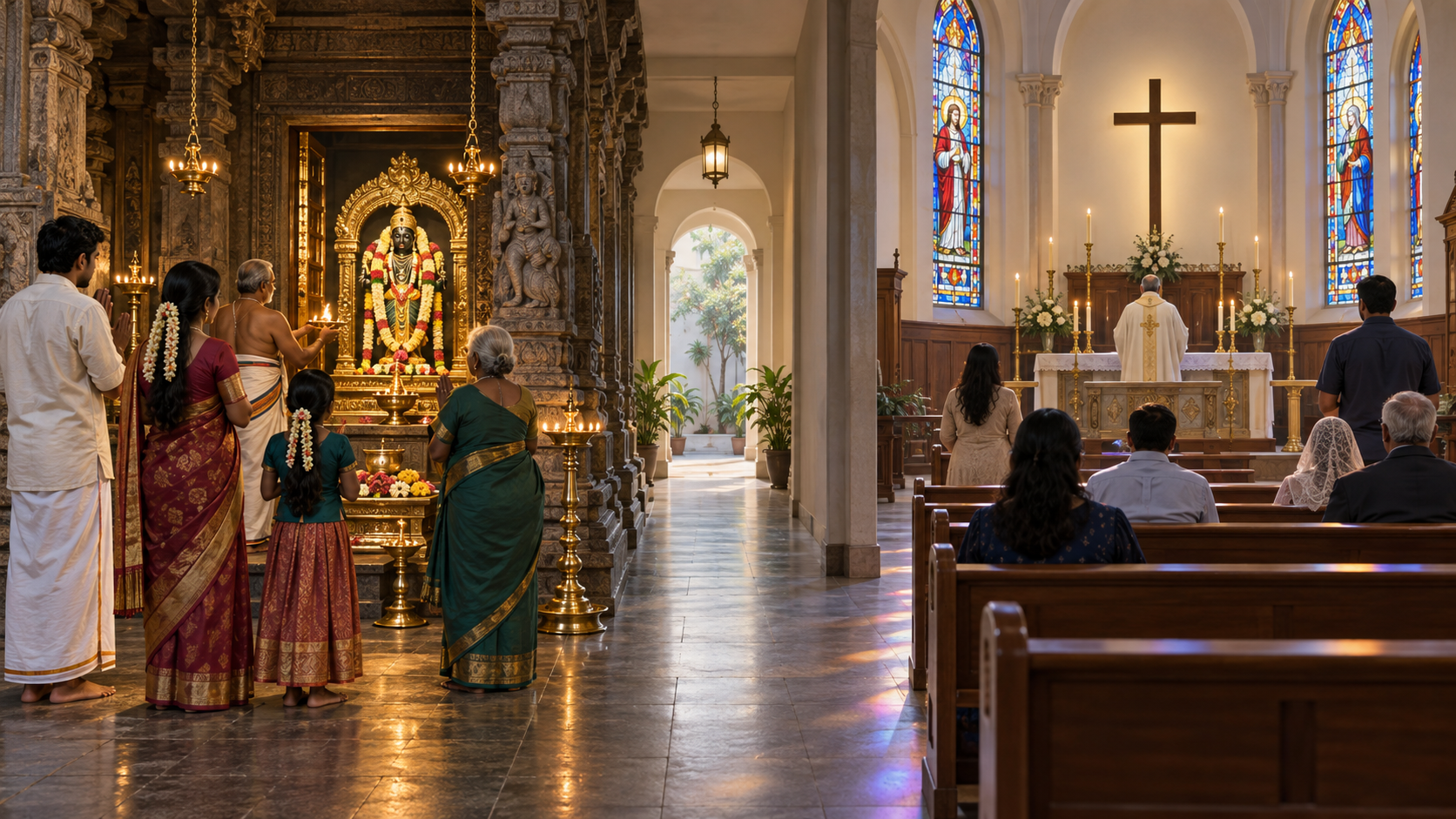
If someone calls a mandir “the Hindu version of a church,” you don’t have to reject the comparison entirely. Both can be places of prayer, reverence, teaching, music, charity, and community. But if you accept the comparison without qualification, you will miss what a Hindu temple is built to do.
The most useful distinction is not architectural. It is theological: a temple is ordinarily oriented around the consecrated presence and ritual service of a deity, while a church is ordinarily oriented around Christians gathering for worship. Once you see those different centers of gravity, the layout, schedule, clergy, images, and expected conduct become much easier to understand.
The shortest useful answer: abode and assembly
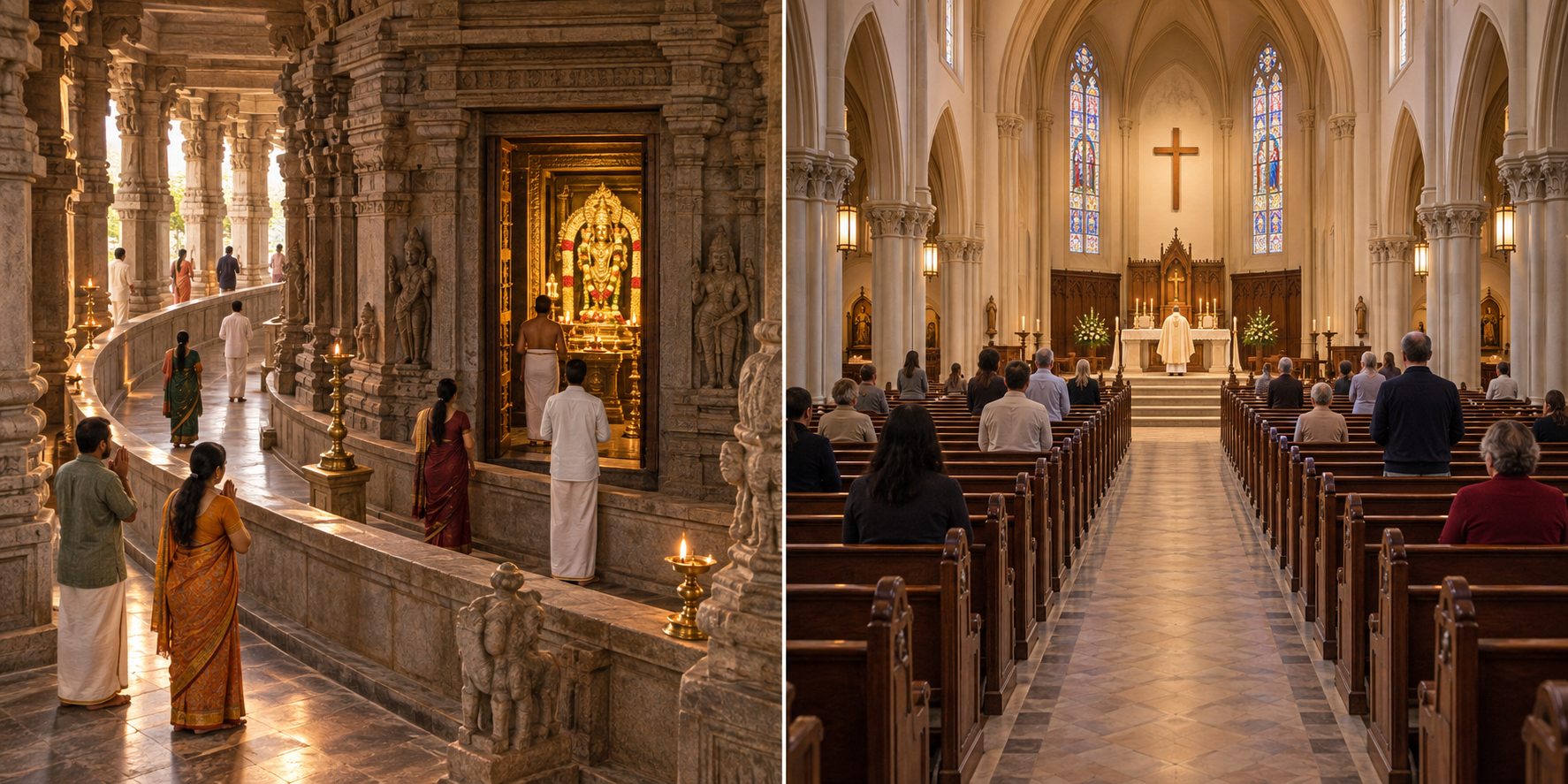
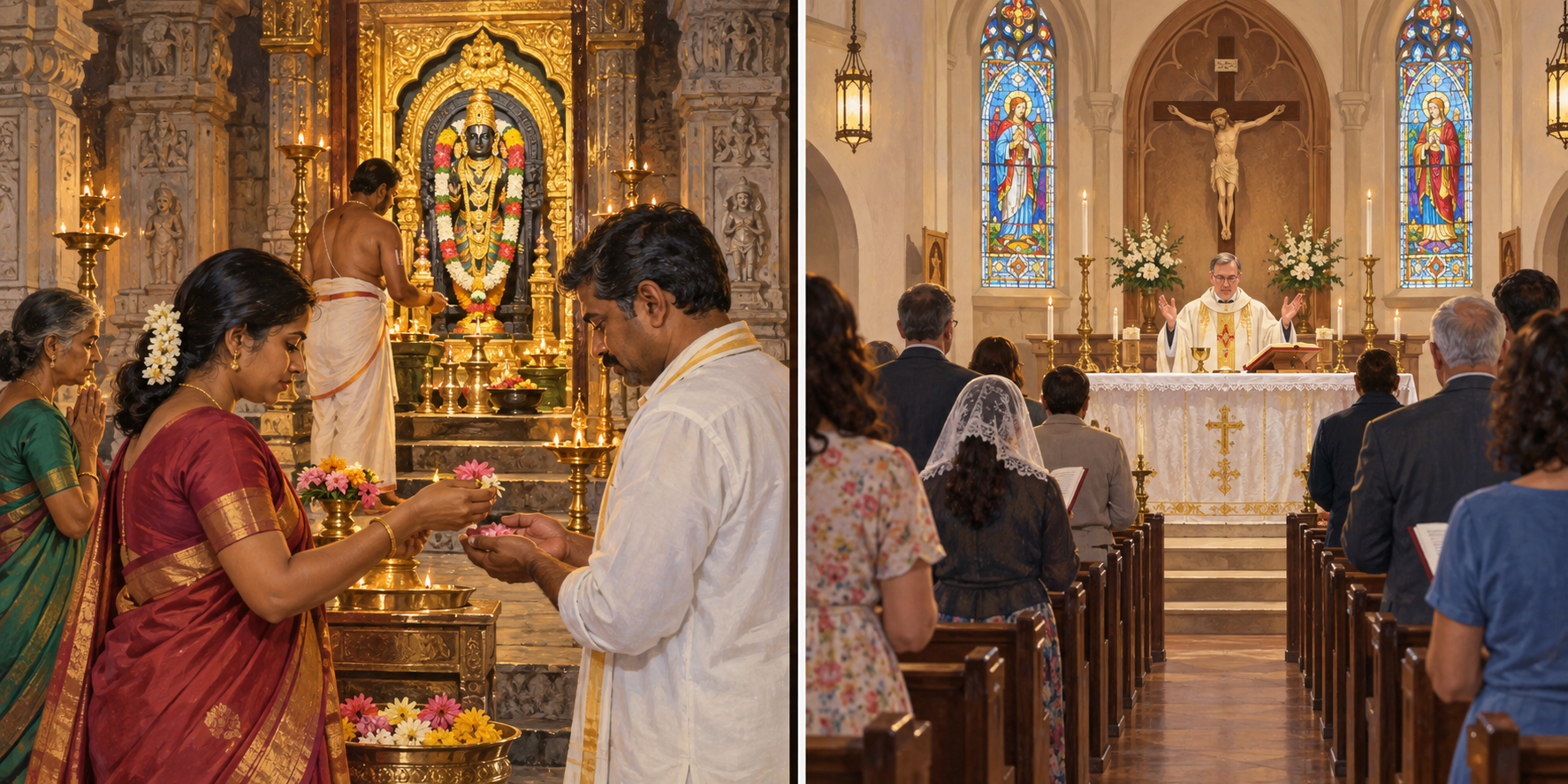
A Hindu temple is not merely a hall in which Hindus happen to meet. In many Hindu traditions, it is the dwelling place of a particular manifestation of the divine. The murti in the sanctum is therefore not incidental decoration, a teaching illustration, or a reminder that can be removed without changing the institution’s basic purpose. Consecration establishes the temple as a place where devotees approach the deity through darshan, puja, offerings, prayer, and ritual service.
A Christian church can also be a consecrated and deeply sacred place. Its altar, sacraments, icons, pulpit, or sanctuary may carry profound theological significance, depending on the denomination. Yet the word “church” also refers to the community of believers, and Christian worship is commonly structured as a gathered act: people assemble for common prayer, proclamation, hymns, liturgy, preaching, and sacraments.
This is why the apparent equivalence between temple and church dissolves when their underlying theologies are examined. A helpful shorthand is “abode and assembly,” but it is only a shorthand. A temple certainly gathers a community, and a church can remain holy when no congregation is present. The distinction identifies what organizes each sacred space, not everything that can happen within it.
| Question | Hindu temple: usual center of gravity | Christian church: usual center of gravity |
|---|---|---|
| What makes the place religiously distinctive? | A consecrated divine presence and the continuing worship associated with it | A Christian community’s worship, with the building’s sacred status understood differently across denominations |
| What is the central encounter? | Darshan of the deity and participation in or reception of puja | Common prayer, liturgy, preaching, scripture, or sacraments |
| Must everyone arrive together? | Not ordinarily; devotees may come during open hours around scheduled rituals | Often, because a service is normally held at a set time for an assembled congregation |
| What is the status of the central image? | A consecrated murti may be approached as the deity’s manifest presence, with explanations varying by tradition | The use and theology of images range from prominent icons and statues to almost none |
| What normally organizes the interior? | The sanctum and the devotee’s approach toward it | The place from which worship, proclamation, or sacraments are led |
Start with divine presence, not with the building
You can misunderstand a temple even while admiring its architecture. Towers, carvings, bells, lamps, and processional spaces matter, but they make sense in relation to the sanctum. The temple’s innermost logic is the relationship between the deity and the devotee.
This does not mean that Hindus believe an unlimited divine reality has been trapped inside stone. Hindu traditions explain the relation between the divine and the murti in different ways. What they share, in temple practice, is that a properly consecrated murti is not treated like an ordinary object. The deity is awakened, invoked, approached, adorned, offered food, praised, and honored according to the temple’s tradition. Rituals such as aarti and abhishekam belong within that relationship of presence and service.
Darshan captures the direction of the encounter. You go not only to look at sacred art but to stand before the deity and be seen. That reciprocal encounter explains why a devotee may enter, approach the sanctum, pray briefly, receive prasad, and leave without attending anything resembling a congregational service. The visit can be complete even though other devotees arrived and departed at different times.
A church is better understood by asking what the Christian community does when it assembles. In one church, preaching and scripture may visibly organize the service. In another, the altar and sacramental liturgy may be central. In another, icons, chanting, incense, and processions may shape the encounter. These are significant differences, so “church” should never be treated as the name of one uniform Christian model.
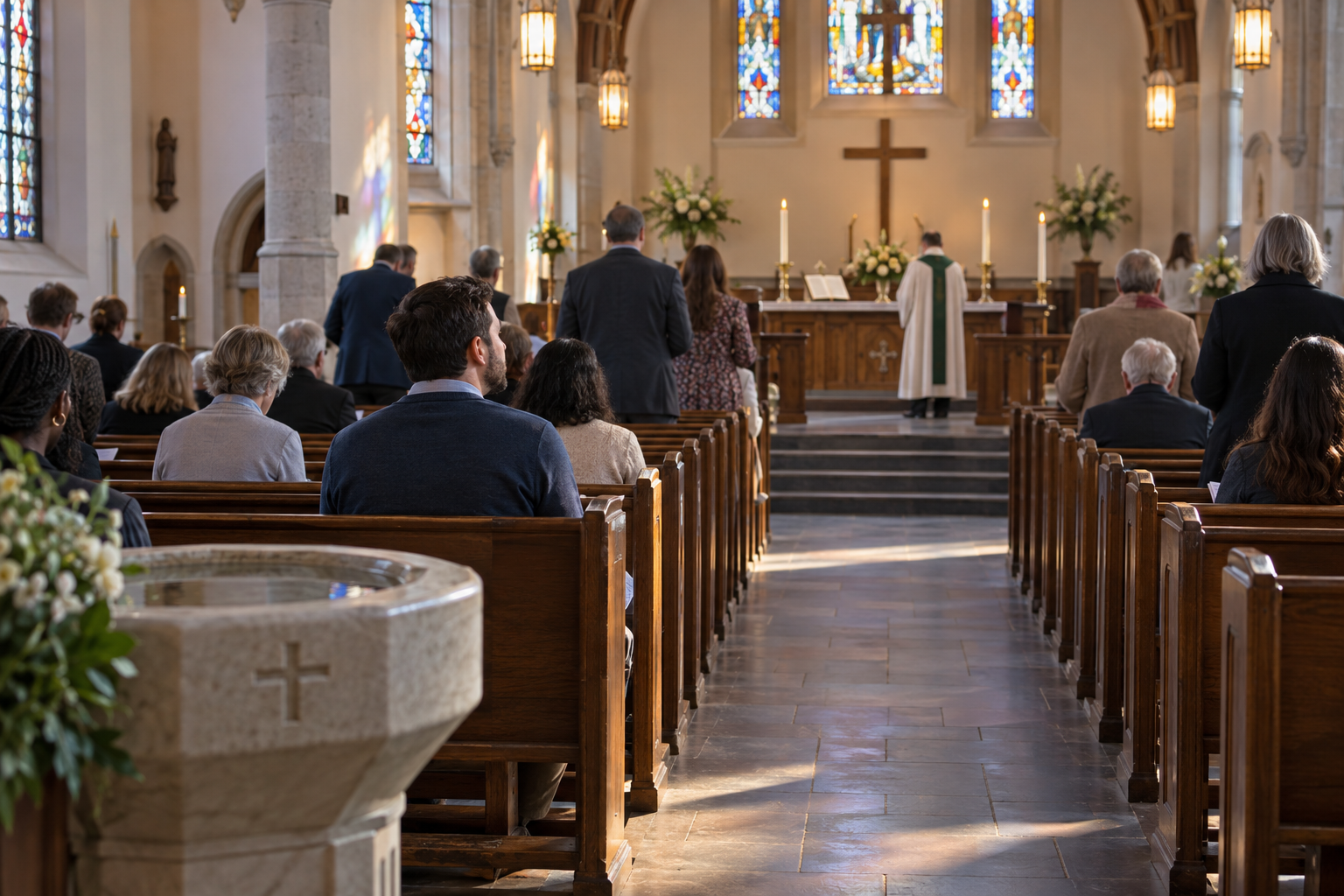
Even so, the congregation normally acts together in a recognizable order. People sing together, listen together, pray together, respond together, or receive a sacrament within a common liturgy. The building serves that gathered worship. This is quite different from a temple in which many devotees can perform individual acts of devotion at the same time while a priest conducts the deity’s scheduled worship.
What the distinction changes when you visit
Respect begins with identifying the kind of event you are entering. At a mandir, you may be entering during a continuing cycle of worship. At a church, you may be arriving for a service with a defined beginning and end. Treating either place like a generic auditorium will make you miss its religious order.
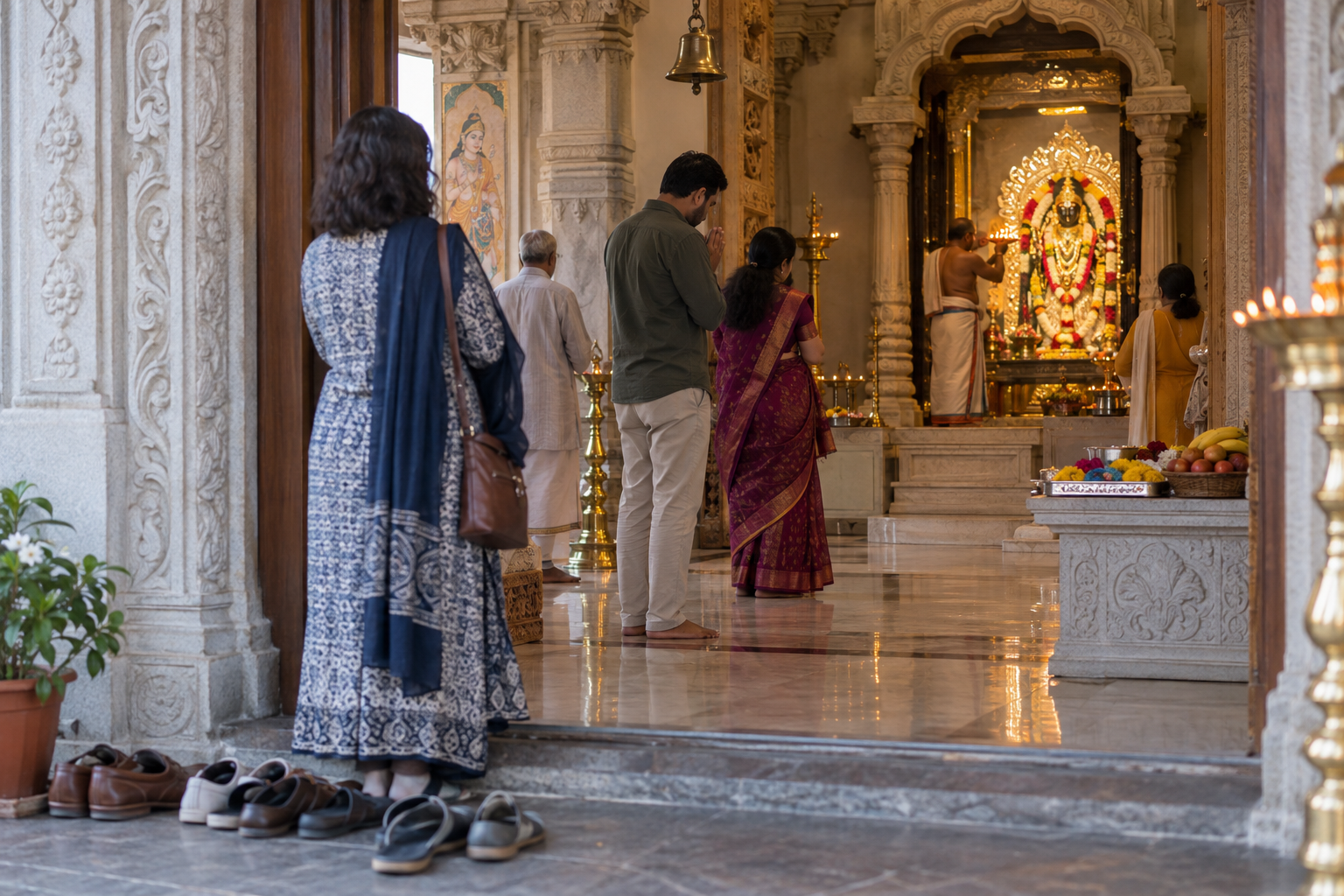
Before visiting a Hindu temple, check the temple’s own instructions. Customs vary by region, lineage, and presiding deity. Then use this sequence:
- Find the boundary for footwear. Remove your shoes where the temple directs, not wherever you happen to see an empty space.
- Look before moving. Notice where devotees form a queue, where offerings are accepted, and whether movement around the shrine follows a particular route.
- Approach the sanctum without assuming access. The innermost chamber is commonly reserved for authorized priests. A visitor receives darshan from the permitted area rather than entering simply because a doorway is open.
- Do not touch a murti, ritual vessel, lamp, or offering unless invited. Sacred objects operate within a ritual discipline; curiosity is not permission.
- Ask before photographing. Permission to photograph the building does not automatically include the sanctum, a ceremony, or worshippers.
- Receive without pretending. If prasad is offered, observe how others receive it and follow the local custom. If you are unsure, a quiet question to a volunteer is better than imitation.
The most common conceptual mistake is to wait for a “service” before taking the visit seriously. A priest may be conducting puja while people enter and leave. The absence of pews, a sermon, or synchronized participation does not mean nothing has begun. Worship is already taking place according to the temple’s own rhythm.
At a Christian church, first find out whether you are entering during open visiting hours or joining a scheduled service. If it is a service:
- Arrive before the announced time. A congregational service has a shared sequence, so late entry can be more disruptive than entering a temple during ordinary visiting hours.
- Use the congregation as a cue, not as a command. You may stand or sit when others do, but a respectful visitor need not repeat a creed, prayer, gesture, or response that expresses a belief the visitor does not hold.
- Do not assume communion is open to every visitor. Eligibility and practice differ substantially among Christian traditions. Ask the host or clergy member before the service rather than deciding while people are already approaching.
- Respect prayer before and after the formal service. Conversation may resume quickly in one church and remain quiet in another. Follow the local atmosphere.
- Ask separately about photography. A church that welcomes architectural photography during visiting hours may restrict it during worship, baptisms, weddings, funerals, or private prayer.
In both places, the safest question is specific: “What should a first-time visitor know before entering?” That invites useful instructions about footwear, dress, head covering, seating, restricted areas, offerings, communion, photography, and children without forcing the host to guess what you already understand.
Do not flatten either tradition to make the comparison work
The temple-church comparison becomes misleading when a tendency is turned into an absolute rule. Hinduism and Christianity both contain major internal differences. You need a framework that recognizes those differences without losing the central contrast.
First, do not say that temples are about deities while churches are merely social meeting halls. Catholic, Orthodox, and other Christians may understand a church as consecrated space, maintain sacramental forms of divine presence, and treat altars, icons, relics, or sanctuaries with intense reverence. The real distinction is not “holy building versus ordinary building.” It concerns how holiness, presence, worship, and community are related.
Second, do not say that Hindu temple worship is private or individualistic. Temples sustain public festivals, shared ritual, music, teaching, food distribution, pilgrimage, and communal identity. The point is narrower: devotees do not always need to gather at one moment and perform one synchronized order of worship for a temple visit to fulfil its purpose.
Third, do not equate a murti with every religious image in a church. A statue, stained-glass figure, icon, crucifix, and consecrated murti do not automatically carry the same theological status because they are all visible forms. Ask what a community believes is happening through the image. Is it instruction, remembrance, veneration, mediation, manifestation, presence, or some combination? Appearance alone cannot answer that question.
Fourth, do not assume that a temple priest is simply a Hindu pastor. Temple priests are especially responsible for maintaining prescribed worship and serving the deity according to a particular ritual tradition. Christian clergy may lead liturgy and sacraments, preach, teach, govern a congregation, and provide pastoral care, with the balance varying by denomination. The English word “priest” can therefore hide more than it reveals.
If you are teaching children, writing about religion, or planning an interfaith visit, replace one-to-one labels with five questions:
- What makes this place sacred to the people who worship here?
- Who or what occupies its theological center?
- What action is a visitor expected to witness or join?
- Does worship require a gathered congregation, or can devotees arrive independently?
- Which parts of the space, ritual, or meal are restricted, and why?
Those questions produce a more accurate conversation than asking which Hindu object “equals” a Christian one. They also let practitioners describe themselves rather than forcing their traditions into somebody else’s vocabulary.
Key takeaways for explaining the difference accurately
- Use “Hindu equivalent of a church” only as an opening approximation. Correct it immediately by explaining the temple’s consecrated deity and ritual life.
- Remember the different centers of gravity. A temple is commonly organized around divine presence, darshan, and service to the deity; a church is commonly organized around the assembled community’s worship.
- Do not call a murti a mere statue. Ask how consecration changes its status within the particular Hindu tradition.
- Do not treat Christianity as uniform. Protestant, Catholic, Orthodox, and other churches differ in their understandings of sacred space, images, sacraments, preaching, and liturgy.
- Read the schedule correctly. Temple worship can continue while devotees come and go; a church service usually expects people to assemble for a shared sequence.
- Ask local questions before applying general rules. Footwear, dress, access, offerings, communion, photography, and participation are governed by the particular institution.
The next time you enter either space, pause before looking for familiar equivalents. Ask what makes this place sacred, what form of encounter it enables, and what its worshippers believe they are doing. That small change turns a building tour into an honest encounter with another tradition – and helps you explain the mandir on its own Dharmic terms.
References

Leave a Reply
You must be logged in to post a comment.