
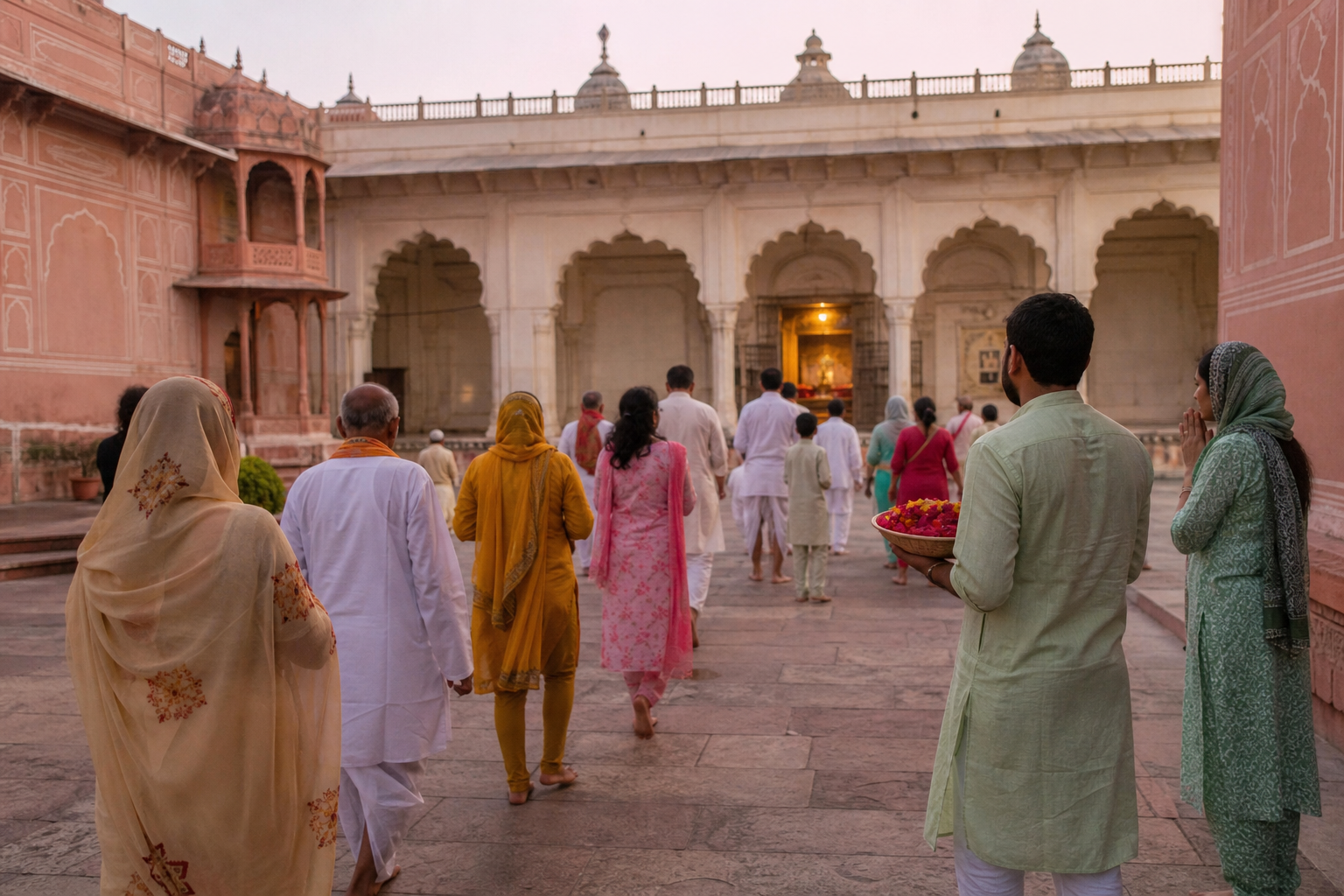
You may arrive at Govind Dev Ji Temple because it is one of Jaipur’s best-known sacred places, yet the real question is what to do once you are there. The temple stands within the historic City Palace Complex, but it is not merely a palace-era monument. It remains a living shrine shaped by prayer, kirtan, aarti, and continuing worship.
If you want more than a hurried viewing of the murti, approach the visit as an encounter with Krishna bhakti. That means preparing your attention, allowing the congregation to guide your pace, and carrying one element of the experience into daily life after you leave.
Key takeaways for a meaningful visit
- Remember that you are entering an active place of worship inside a heritage complex, not an attraction arranged around visitors.
- Let the movement through gateways and courtyards slow you down before darshan.
- During aarti or kirtan, participate through attention even if you do not know the words or ritual sequence.
- Wear respectful clothing, keep your conduct quiet, and follow the directions given by temple attendants.
- After leaving, continue the relationship through remembrance of Govind, devotional singing, gratitude, or an act of service.
Enter the palace precinct as a pilgrim, not a spectator
The City Palace setting creates an understandable temptation: you may start looking mainly for architectural details, photographs, and historical facts. Those things have value, but they should not take control of the visit. Govind Dev Ji Temple belongs to Jaipur’s cultural heritage precisely because worship remains alive there.
A simple inward intention can change how you enter. Before moving toward the sanctum, decide what you are bringing before Krishna. It may be gratitude, confusion, sorrow, a difficult decision, or nothing more elaborate than the wish to become attentive. You do not need a dramatic spiritual feeling. Bhakti begins with turning toward the divine rather than manufacturing an emotion.
Use the approach to the sanctum as preparation:
- Put away the distractions you can control before joining the flow of devotees.
- Notice how people move, pause, offer reverence, and make room for others.
- Let the sound of bells or devotional singing gather your attention instead of treating it as background noise.
- When the murti becomes visible, look steadily rather than trying to take in every surrounding detail.
- Offer your prayer simply, then allow other devotees their turn without struggling to prolong your place.
This is the practical meaning of darshan. You go to see the divine form, but you also place yourself where you may be seen by the divine. The shift is subtle: the visit stops being about collecting an image and becomes an act of relationship.
Respectful attire and mindful behavior are therefore not decorative customs. They protect the devotional attention of everyone sharing the space. Follow posted instructions and the guidance of temple attendants, especially where movement, offerings, or photography are concerned. If you are uncertain, observe before acting. Quiet attention is usually a better response than confident improvisation.
Let the temple’s architecture prepare the mind
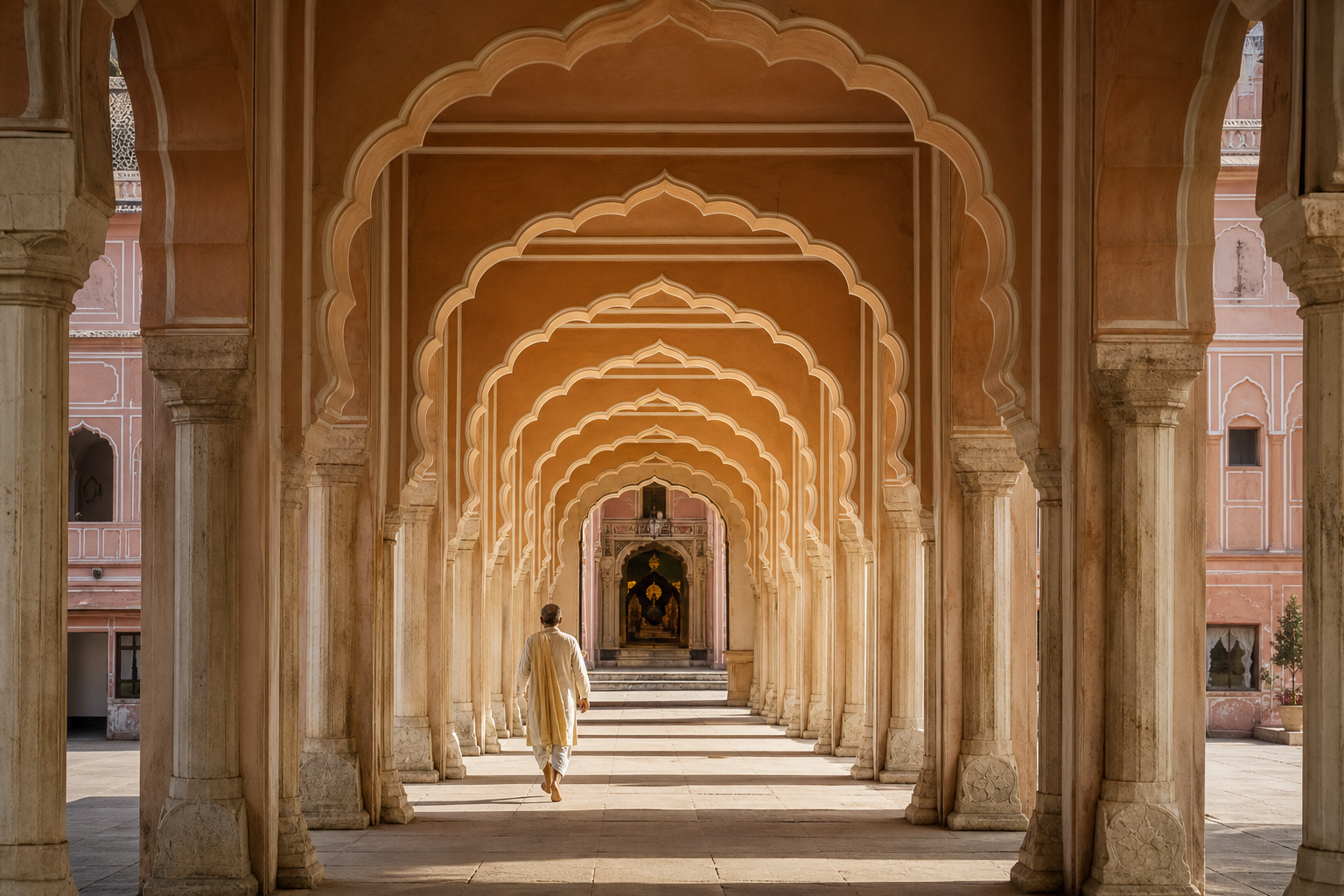
Govind Dev Ji Temple brings palace aesthetics and sacred space into the same experience. Its ornamental gateways, layered courtyards, and progression toward the sanctum create more than an attractive setting. They move you from the city’s activity toward a concentrated devotional center.
You can read that movement inwardly. The outer precinct contains many sights and competing points of attention. Closer to the sanctum, the purpose becomes clearer. The physical journey thus offers a useful discipline: release one distraction at each stage rather than carrying the entire day into darshan.
The palace setting also preserves a historical lesson about dharma. Royal patronage from Jaipur’s Sawai rulers helped maintain ritual continuity and protect sacred practices. Patronage did not create the devotion of the congregation, but it gave that devotion an enduring institutional home. A living tradition needs both inward faith and outward stewardship.
That distinction matters when you look at any historic temple. Stonework, gateways, and courtyards deserve preservation, but heritage is not limited to material fabric. The daily rhythm of worship, the knowledge of ritual, the singing of devotional compositions, and the habits passed through families are also forms of inheritance. If those disappear, an intact building can still lose much of what made it sacred.
As you walk through the complex, notice both kinds of continuity. Look at what has been built, and listen for what is still being practiced. That will tell you more about Govind Dev Ji Temple than architecture alone can reveal.
Receive aarti and kirtan as practices of shared bhakti
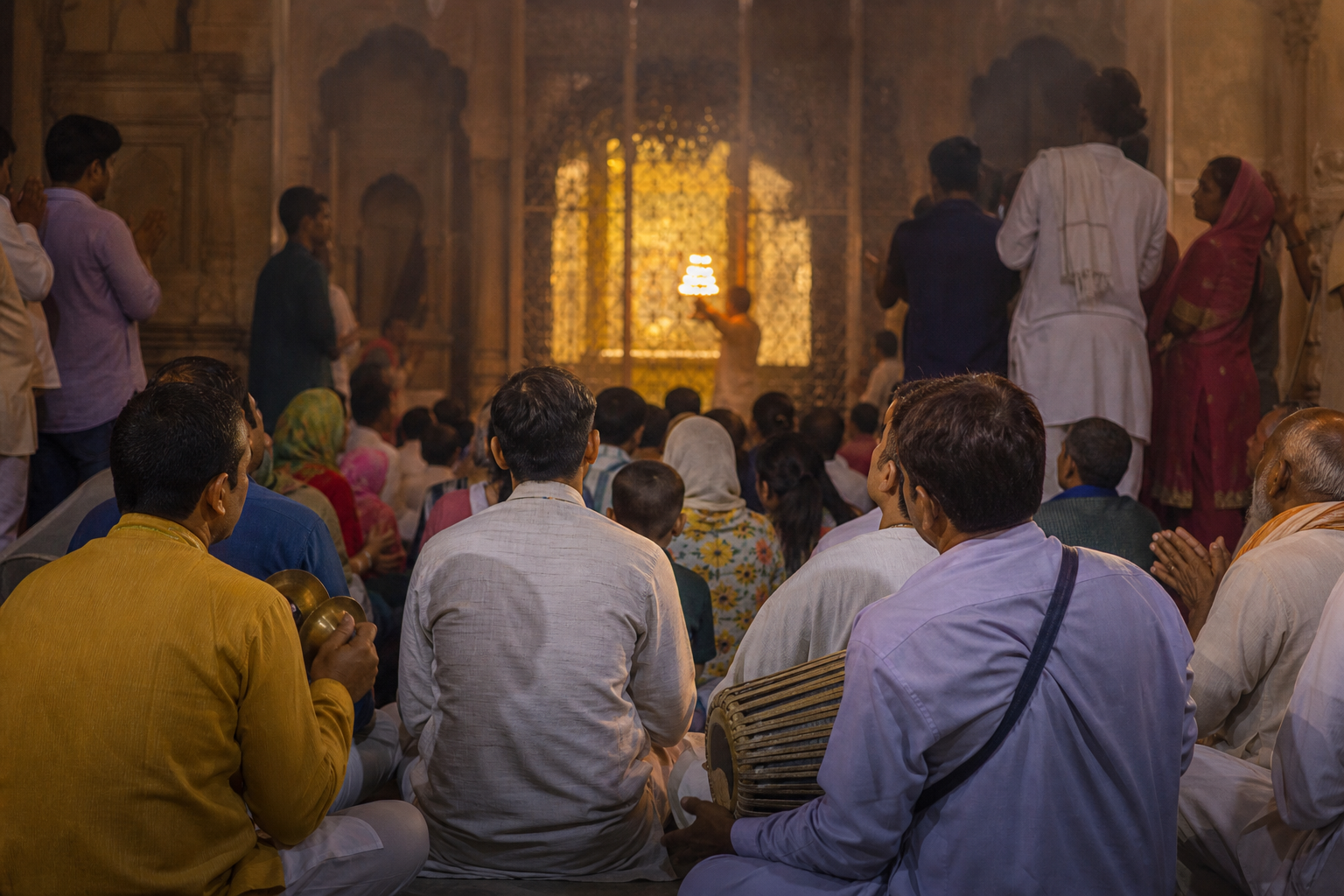
Krishna bhakti is personal, but it is rarely solitary in a temple. Collective prayer, aarti, bells, and kirtan create a common rhythm in which people with different burdens and levels of religious knowledge turn toward the same divine presence.
If an aarti begins while you are present, do not worry about performing every gesture perfectly. Stand where directed, avoid blocking the movement of devotees, and watch the ritual with attention. If others sing words you do not know, listening itself can be reverent participation. If you recognize a refrain, join without trying to make your voice prominent. Congregational devotion depends on many people contributing to one offering, not on any one person becoming its center.
Kirtan works through remembrance. Krishna’s name is repeated not because the divine needs reminding, but because the human mind does. The mind wanders toward plans, injuries, comparisons, and anxieties. The shared name gives it somewhere sacred to return.
The name Govind is especially suited to this relational form of devotion. It is one of Krishna’s cherished names and carries the intimacy central to bhakti: the divine is not approached only as an abstract principle, but as one who may be remembered, praised, loved, and trusted. During darshan, repeating “Govind” inwardly can keep your attention from scattering.
Do not measure the worth of the visit by whether you feel immediate calm or intensity. Devotees often associate the temple’s aarti, bells, and singing with upliftment, but bhakti is not a demand for a particular mood. Some visits feel peaceful; others expose restlessness. In either case, the useful question is whether you offered sincere attention.
Choose the kind of visit that matches your purpose
Govind Dev Ji Temple is woven into Jaipur’s festive life, with Janmashtami holding special importance. A Krishna-focused festival allows you to witness devotion as a public and intergenerational culture. Families gather, devotional arts remain active, and reverence is transmitted through participation rather than explanation alone.
That does not mean a festival visit is automatically the best choice for everyone. Decide what you are seeking. If you want to experience collective celebration, Janmashtami places Krishna bhakti at the center of community life. If your priority is unhurried observation and inward prayer, choose a regular visit when you can pay closer attention to the courtyards, the worship rhythm, and your own response.
Whichever you choose, verify current access and worship information locally before setting out. Do not build your plans around an unverified timetable. The temple is centrally situated and accessible from central Jaipur by major roads and public transport, but the spiritual quality of the visit depends less on how quickly you arrive than on whether you have left enough inward room to be present.
Visitors from other Dharmic traditions can also enter with integrity. Hinduism, Buddhism, Jainism, and Sikhism are distinct traditions and should not be blurred into a single system. Yet compassion, disciplined conduct, reverence, and service provide genuine points of ethical recognition. Respectful presence does not require pretending that all doctrines are identical. It requires honoring the sanctity of the place and allowing another Dharmic tradition to speak in its own form.
Carry Govind beyond the temple courtyard

A temple visit becomes spiritually useful when it alters what you remember afterward. You do not need to reproduce the full atmosphere of the shrine at home. Choose one practice small enough to keep without turning it into a performance.
- Remember the name: repeat “Govind” during a settled part of your daily routine, especially when the mind becomes scattered.
- Sing or listen attentively: make space for Krishna kirtan without treating it as mere background entertainment.
- Practice gratitude: name what you have received before asking for what you lack.
- Turn devotion into service: help someone without using the act to build an image of yourself.
- Protect sacred continuity: teach a child a name of Krishna, support devotional arts, or help preserve respectful temple culture.
The last point is easy to overlook. Govind Dev Ji Temple has endured through a combination of devotion, patronage, ritual continuity, and community participation. The same principle applies now. Sacred heritage survives when people worship, serve, transmit, and protect it rather than admiring it only from a distance.
When you next enter Govind Dev Ji Temple, leave one distraction at the gateway and take one practice home. That exchange – less noise carried in, more remembrance carried out – is a practical beginning to Krishna bhakti.
References
