

You want your child to inherit dharma without making prayer, stories, or family customs feel like another school assignment. That tension is real. The harder you try to turn every encounter into a lesson, the easier it is for the relationship itself to disappear behind correction.
Begin with a smaller aim: let your child experience dharma before expecting them to explain it. A home can communicate ahimsa through its tone, satya through honest apologies, seva through shared work, and mindfulness through brief moments of attention. A workable starting rhythm is five minutes of undistracted play, a daily mindful pause, and a small act of seva performed together.
Let the relationship carry the spiritual teaching
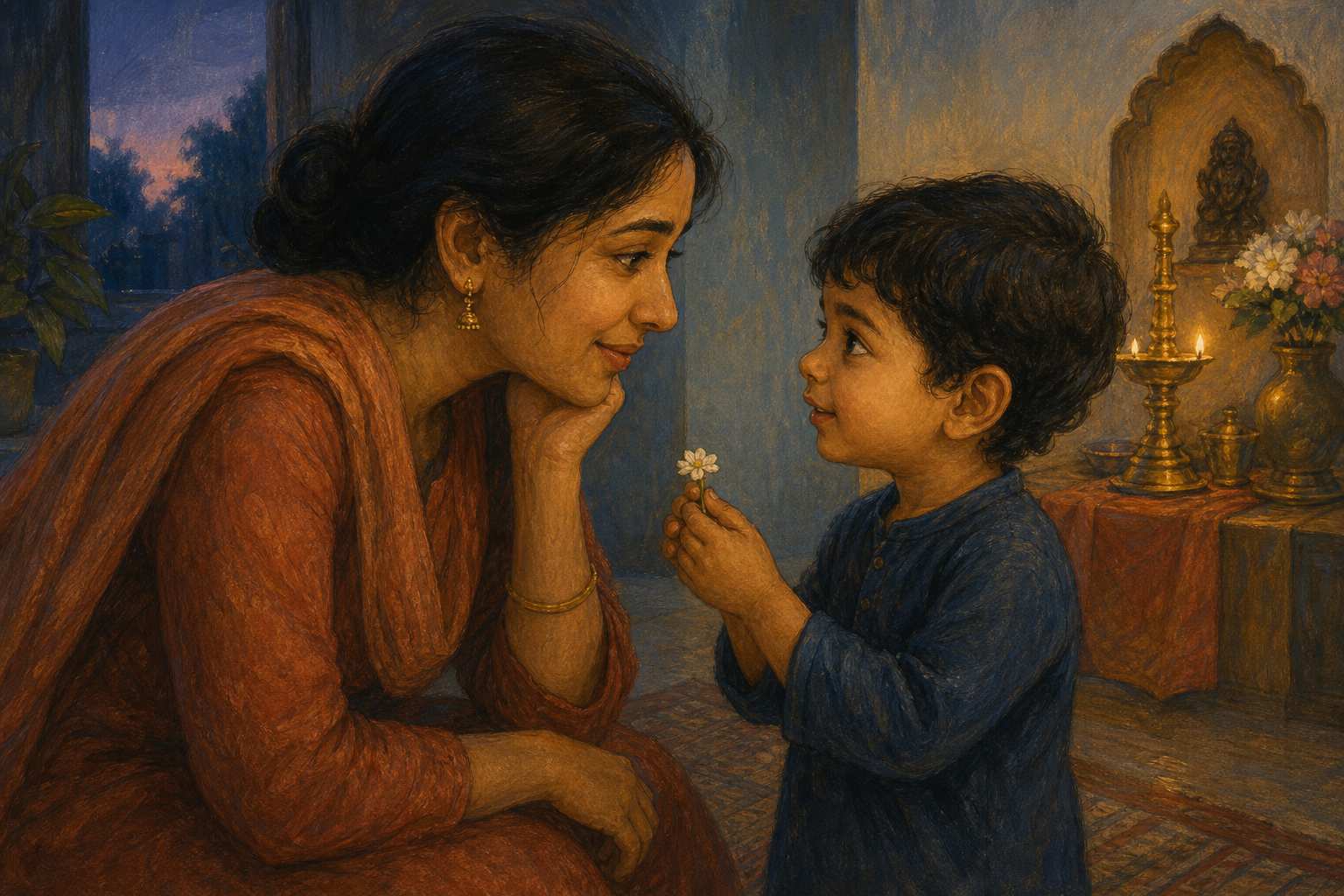
A child is not an empty container waiting to be filled with correct answers. Your child arrives with curiosity, imagination, preferences, resistance, and the capacity for wonder. Respecting that inner life does not mean giving the child authority over every family decision. It means treating questions, feelings, and attempts to participate as worthy of a real response.
Suppose your child interrupts a prayer because they want to ring the bell. You can treat the interruption as misbehaviour, or you can give the impulse a form: hold the bell carefully, wait beside us, and ring it when the chant ends. The boundary remains, but the child moves from being an obstacle to becoming a participant.
Use the same pattern in ordinary family life. Notice what the child is trying to do, invite participation that fits their capacity, and explain only what is needed for the next action. Long lectures usually answer questions the child was not asking. A short explanation followed by participation gives the teaching somewhere to live.
Listening also reveals what your child has actually understood. When a child asks why food is offered before it is eaten, begin by asking what they think is happening. Their answer may show reverence, confusion, playfulness, or concern about wasting food. You can then respond to the real question instead of delivering a prepared speech.
This is not child-centred spirituality in the sense that every preference must be obeyed. It is relationship-centred practice. The adult still provides rhythm, protection, cultural memory, and ethical limits. The difference is that guidance begins with connection rather than domination.
Build a daily rhythm small enough to survive busy days
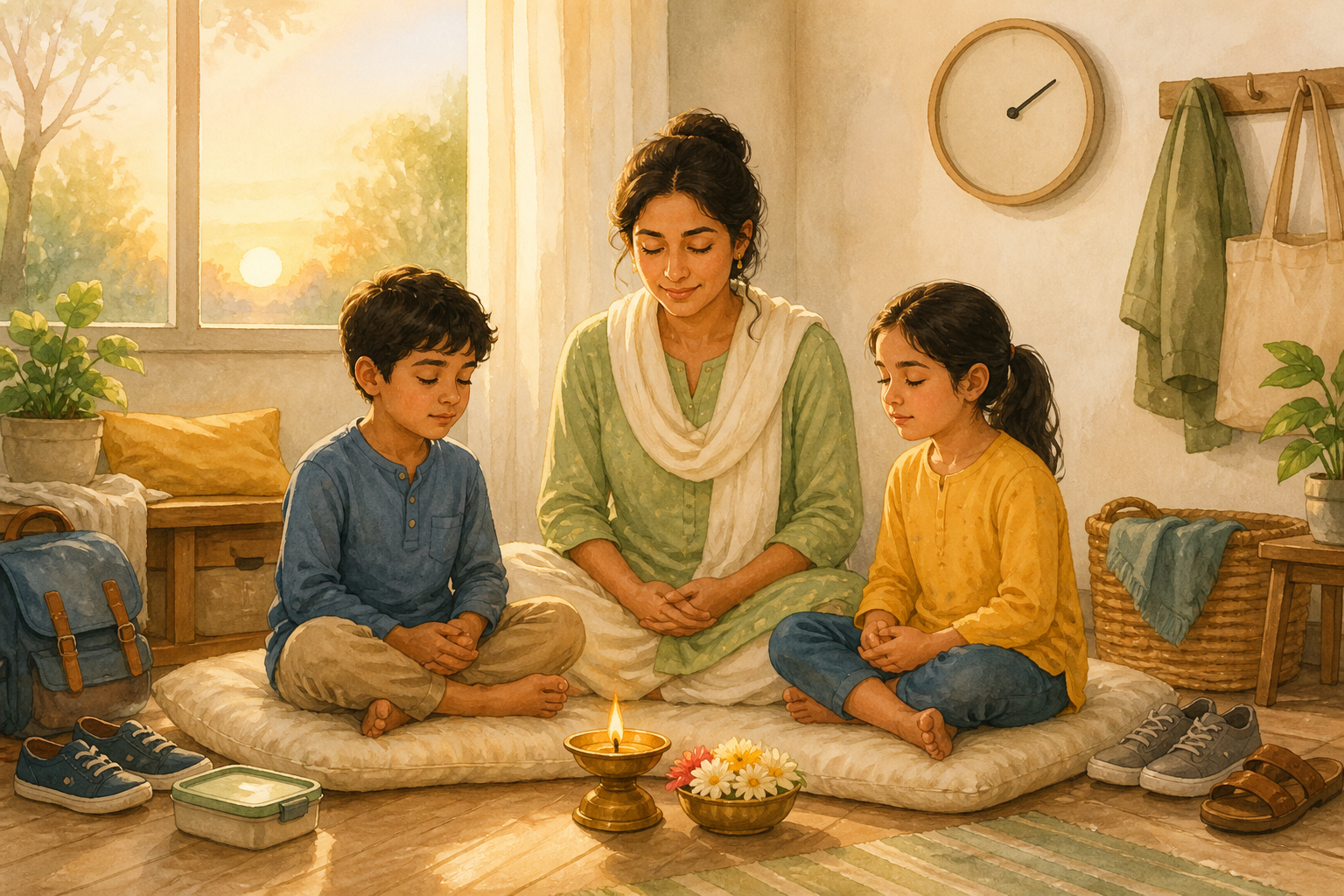
An elaborate family practice may work on a festival day and collapse during an ordinary week. A durable Dharmic home needs practices that still fit when everyone is tired. Play, a pause, and service are enough to create a recognisable rhythm.
Give your child five minutes of undivided play
Put away the phone and let your child lead for five minutes. Join the blocks, pretend game, drawing, clapping, or movement without turning it into a quiz. Describe what you notice, imitate an action, or accept the role the child gives you. Intervene when something is unsafe or harmful, but do not correct the harmless logic of the game.
This period tells the child that attention is not available only after good behaviour, achievement, or ritual compliance. It also gives you a chance to observe what currently occupies their imagination. That knowledge will make later stories and conversations more relevant.
A tiny greeting can carry the same spirit. A clap at the doorway, a familiar hand movement, or a playful call and response can become a family micro-ritual. Its value lies in recognition: you have returned, I see you, and we are together again.
Attach mindfulness to a moment that already happens
Before a meal, pause for a few breaths. You might notice the aroma, the colours on the plate, the hands that prepared the food, or the living world from which it came. Then offer a brief expression of gratitude or shanti. There is no need to demand closed eyes, perfect posture, or prolonged silence. The purpose is attention, not performance.
If the pause repeatedly becomes a conflict, make it lighter. Hum a gentle line, place hands together briefly, or let the child name something for which they feel grateful. A child who does not want to speak can listen. Invitation keeps the practice open; consistency keeps it recognisable.
Make seva visible in household life
Seva need not begin with a special project. Let your child set cups, water a plant, carry clean cloths, prepare part of an offering, arrange shoes, or help serve another family member. Work beside them instead of announcing the task and disappearing.
Name the effect rather than awarding a moral identity. The cups are ready, so everyone can sit together. The plant has water because you noticed what it needed. This connects service to care and consequence. It is more useful than telling the child they are good only when they help.
Do not turn seva into a disguised punishment. If service appears only after wrongdoing, the child may learn that caring for others is a penalty. Keep some shared service in ordinary family life, including on peaceful days, so it retains its proper meaning.
Turn Dharmic values into play, stories, and choices
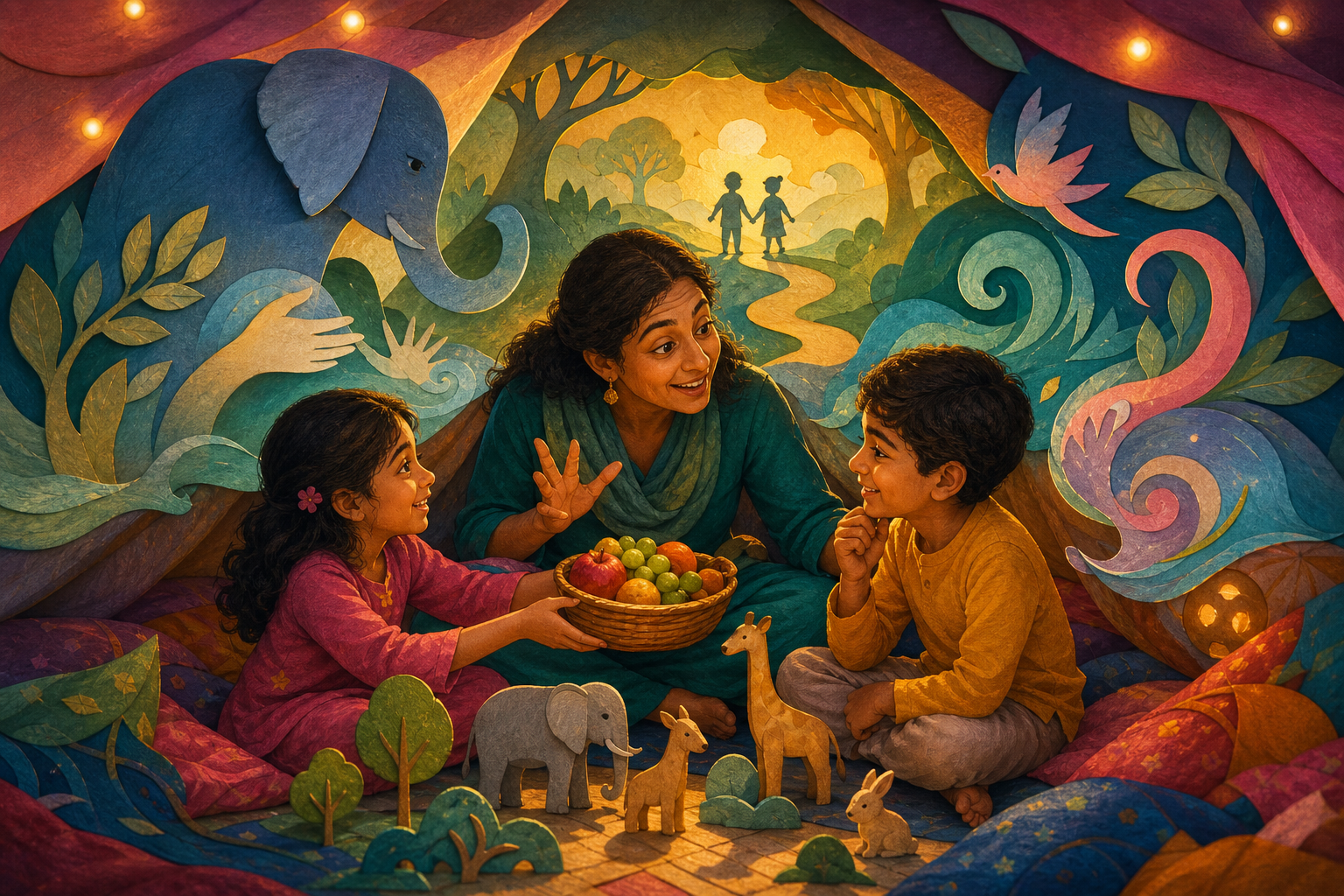
Words such as ahimsa, satya, aparigraha, seva, bhakti, and mindfulness become useful to a child when each word corresponds to something they can notice or do. Play gives these ideas movement. Stories give them motives and consequences. Family choices show that adults are also accountable to them.
Give each value a form the child can practise
Practise ahimsa through a gentle redo. When words become needlessly sharp, pause and try the same message again without the wound. Do this with your own speech as well as the child’s. Ahimsa then becomes a discipline shared by the family, not a rule imposed downward.
Practise satya by making truth safe enough to tell. Thank the child for admitting a mistake before dealing with its consequence. When you overreact, state plainly that your manner was wrong. Do not attach an excuse to the apology. The boundary may have been valid while the way you expressed it was not.
Practise aparigraha when possessions accumulate. Before bringing home something new, look together for something that is no longer being used and could benefit someone else. Do not secretly remove a treasured object in the name of non-attachment. Choosing, releasing, and giving are the practice.
Practise mindfulness with a sound game. Ring a bell or make a soft sound and listen until it disappears. Ask what could still be heard after the first sound faded. This invites attention without turning stillness into a contest.
Let bhakti include the body. A short bhajan can involve clapping, swaying, call and response, or helping prepare the place of worship. Lila reminds us that spiritual seriousness need not produce a permanently solemn home. Reverence and delight can occupy the same room.
Use stories to open moral imagination, not test memory
Choose a short episode from the Ramayana, a Jataka tale, a Jain parable, or a Sikh sakhi. Tell it in your own natural voice. Stop before announcing the moral and ask a question that allows reflection: What did the character want? Who might have been hurt? Where did someone show courage? What could they have done differently?
These questions are not a hidden examination. If the child notices a different aspect of the story, follow it. You can still clarify an ethical line, but curiosity should come before correction. A child may remember the tension, humour, fear, loyalty, or sacrifice in a narrative long before remembering an adult’s abstract explanation.
Keep your own family’s tradition rooted rather than blending every path into a vague spirituality. A Hindu household may return frequently to lila, bhakti, and family puja. A Buddhist household may centre mindful attention and compassion. A Jain household may make ahimsa especially visible in speech and daily choices. A Sikh household may organise family life around remembrance, humility, and seva. Children can respect neighbouring Dharmic traditions without being taught that all histories, practices, and doctrines are interchangeable.
Ritual can then complete what the story began. An adult may light a lamp while the child watches or assists in a way suited to their capacity. A brief bhajan, a quiet moment of shanti, or help arranging the prayer space makes the narrative part of family experience rather than information left on a page.
Hold boundaries without making shame the teacher

Playful parenting is not permissive parenting. Children need adults who can stop harm, protect routines, and remain steady when feelings are strong. The Dharmic question is not whether to set a boundary. It is whether the way you set it embodies the values you are trying to transmit.
Begin by stopping the harmful action. State the limit in plain language. Offer an acceptable way to express the underlying feeling, and reconnect after the immediate intensity has passed. For hitting, the message can be simple: I will not let you hit. Hands must remain gentle. You may tell me you are angry, stamp your feet, or move away.
Do not force a spiritual lecture into the peak of a conflict. A child who is overwhelmed is unlikely to absorb a discourse on ahimsa. Secure the boundary first. Return to meaning later, when both of you can listen. Ask what happened, identify who was affected, and decide what repair is possible.
Keep consequences connected to the action where possible. A deliberately created mess calls for help cleaning. An object used to hurt or threaten rests until it can be handled safely. Repair teaches responsibility more clearly than an unrelated deprivation delivered in anger.
Your own repair matters just as much. If you shout, mock, threaten, or speak unfairly, apologise without surrendering a necessary limit: my tone was unkind, and I am sorry; the rule still stands, and I will explain it calmly. That response places satya and ahimsa above adult pride.
A child’s refusal to sing, bow, answer, or sit perfectly should not automatically be treated as rejection of dharma. Look for the immediate cause. The practice may be too long, the child may not understand their role, or the encounter may have become a struggle for control. Preserve a small expectation, offer a concrete role, and let participation grow through familiarity. Coerced outward piety can conceal inward resentment; steady belonging gives reverence room to mature.
Key takeaways
- Let your child experience dharma through your tone, attention, choices, and repair before asking for verbal understanding.
- Begin with five minutes of undistracted play, a brief mindful pause, and a small shared act of seva.
- Treat the child as a participant with dignity, while keeping adult responsibility for boundaries and family rhythm.
- Give values a concrete form: redo harsh speech for ahimsa, admit mistakes for satya, release unused possessions for aparigraha, and care for others through seva.
- Use the Ramayana, Jataka tales, Jain parables, and Sikh sakhis to invite reflection rather than test memory.
- Keep your family’s own tradition rooted while teaching accurate respect for other Dharmic paths.
- Set firm limits without humiliation, and let honest adult apologies become part of the child’s spiritual education.
Tonight, choose the moment your family is most likely to repeat: play after returning home, a pause before food, or a shared household task. Give that moment your full presence. You do not need to redesign the household at once. A clap, a breath, a story, or a cup placed for another person can become the place where your child first recognises dharma as a way of living together.
References
