
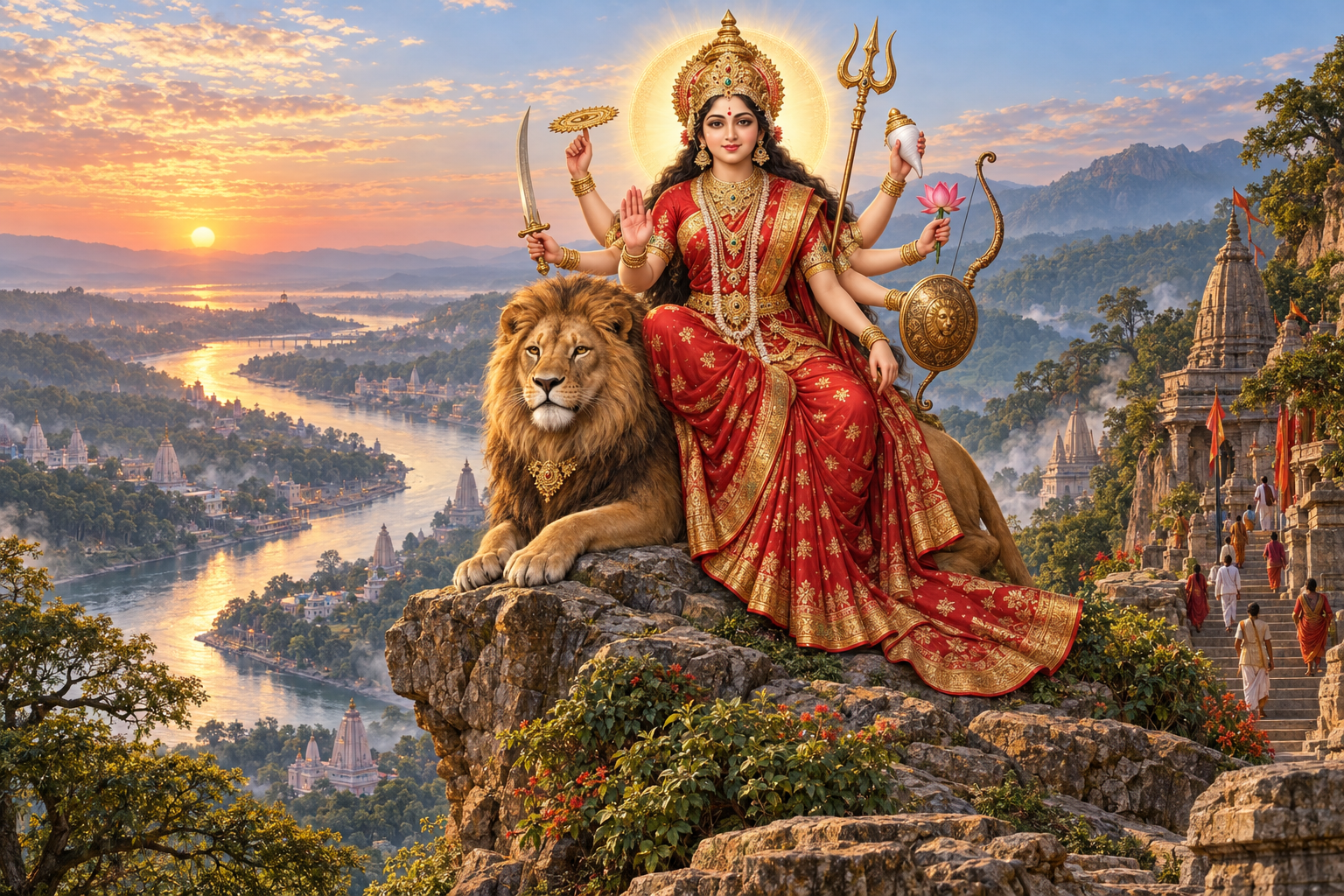
You may have encountered the name Vindhyavasini in a prayer, a pilgrimage plan, or a list of Devi’s forms and wondered whether she is Durga, a regional goddess, or a distinct deity. The most useful answer begins by refusing that false choice.
Maa Vindhyavasini is Durga known through a particular sacred presence and place. Once you understand that relationship, you can approach her without reducing her to either a geographical label or another name in a long catalogue.
Vindhyavasini is Durga encountered through place
Vindhyavasini is one of the names of Goddess Durga. Her name is connected with her residence at Vindhyachal. The name therefore does more than identify the Devi: it places her within a sacred landscape and tells the devotee where this particular presence of Durga is encountered.
This is a familiar pattern within Hindu worship. One Devi may be approached through many names and forms without becoming divided into unrelated beings. A name can express her dwelling place, an act, an attribute, a relationship with devotees, or a particular manifestation. The many names do not weaken the unity of the Goddess. They make that unity accessible in different circumstances.
Puranic traditions present Vindhyavasini as a manifestation or avatar of Durga. That description should guide your understanding without forcing every Hindu tradition to use identical theological language. One devotee may say “form,” another “avatar,” and another simply “Maa.” The important point is that worship of Vindhyavasini belongs within the worship of Durga rather than outside it.
If you already worship Durga, you do not need to treat Vindhyavasini as a competing deity or begin an entirely separate spiritual life. Approach her as the same Devi made intimate through the name Vindhyavasini. If you are learning about her for the first time, begin with that relationship before turning to elaborate stories, ritual lists, or claims about what every devotee must do.
Vindhyachal and Ganga are part of her identity
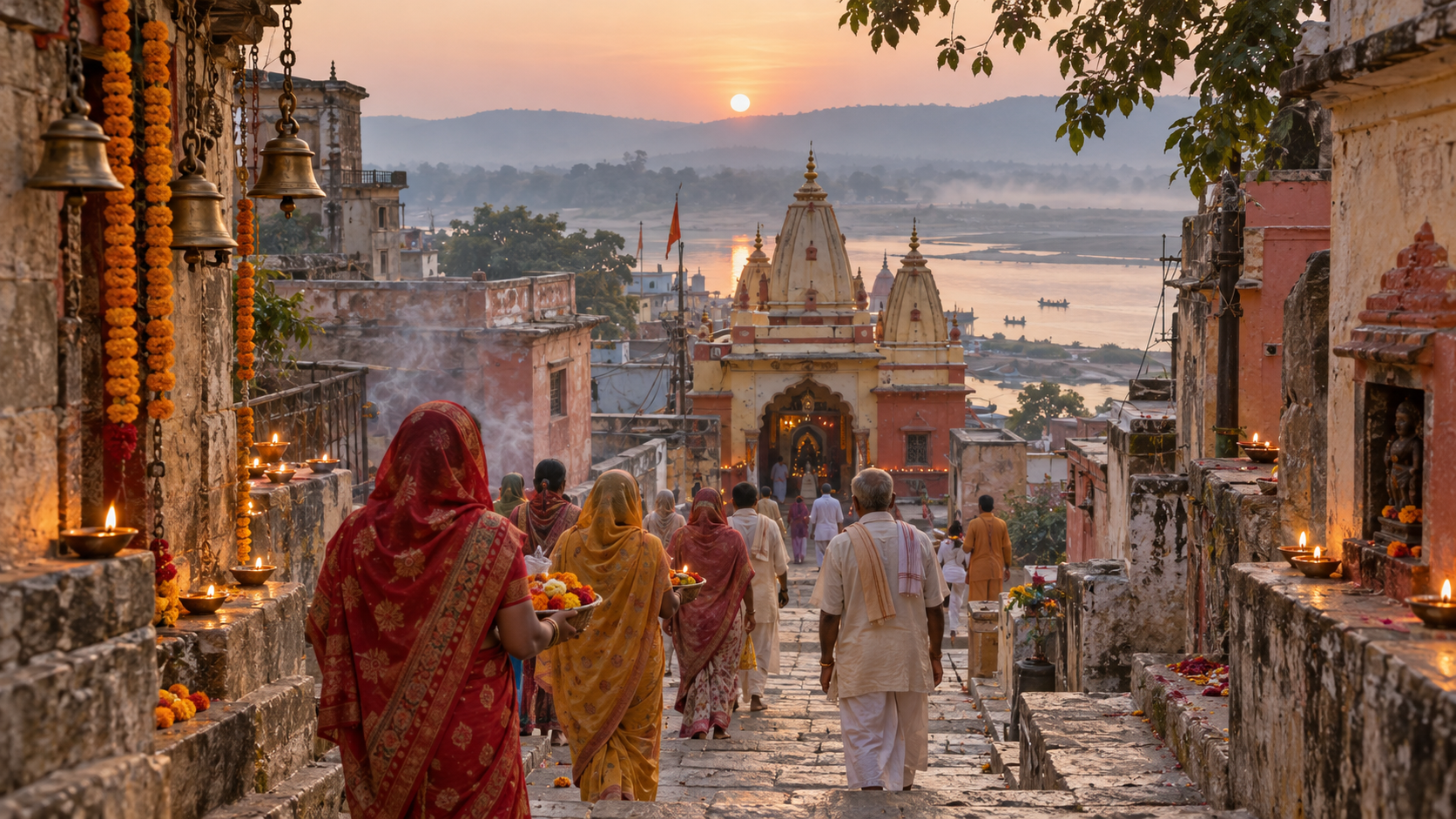
The temple of Maa Vindhyavasini stands at Vindhyachal, on the banks of the Ganga in Uttar Pradesh. This location is not incidental background. The name Vindhyavasini joins Devi and kshetra, the divine presence and the sacred place associated with her.
That connection changes the way a pilgrimage should be understood. You are not merely travelling to inspect a religious building. You are approaching a place in which geography, memory, worship, and the living presence of Devi meet. The temple is the focal point, but the surrounding sacred landscape helps explain why this form of Durga is remembered by this name.
If you plan to visit, prepare on two levels. First, handle the practical journey: check current temple hours, access arrangements, local transport, and any queue or photography rules close to your travel date. These details can change and should not be inferred from an undated devotional description. Second, prepare inwardly by learning the name you are going to invoke and deciding what prayer you wish to place before Maa.
At the temple, allow the local discipline of the sacred place to lead. Follow posted instructions, respect the worship already in progress, and avoid treating the darshan line as an obstacle between you and the experience. Darshan may be brief. Its value does not depend on how long you stand before the murti or how many photographs you obtain.
The Ganga-side setting also calls for ordinary responsibility. Do not leave packaging, offerings, plastic, or food waste in the temple precinct or near the river. Reverence for sacred geography becomes hollow if the physical place is treated carelessly.
How to begin worship without inventing requirements
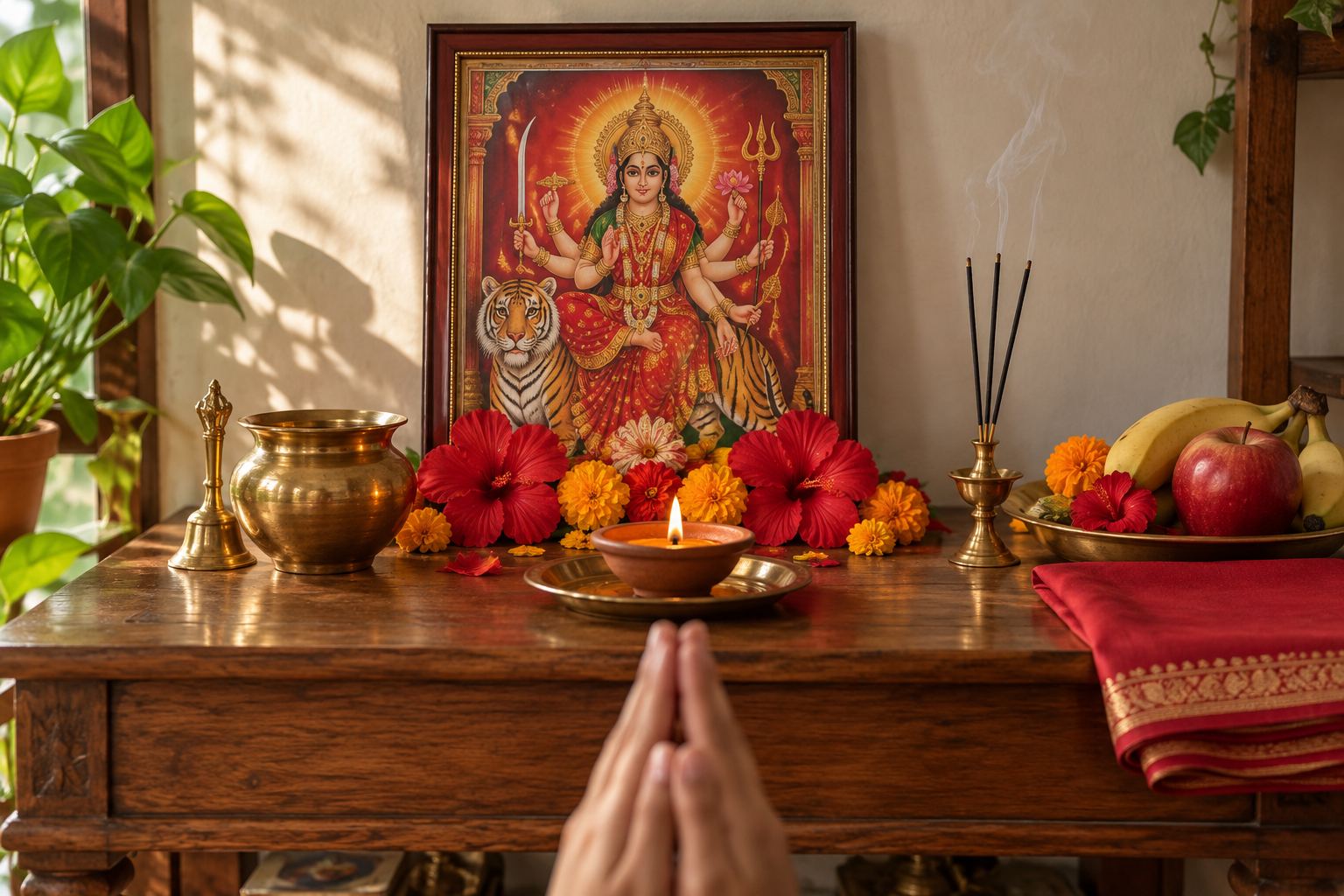
You do not need an elaborate ritual programme merely to begin remembering Maa Vindhyavasini. Nor should a generic online checklist be mistaken for a universal prescription. Family traditions, regional customs, and sampradayic disciplines can differ. If you have an established household practice or guidance from a guru or priest, let that framework come first.
For a simple personal practice, use the following sequence as a modest devotional structure rather than as a claim that only one method is valid:
- Prepare a clean place. Use the image or murti already appropriate to your household. You do not need to acquire several objects before you can pray.
- Address her clearly. Invoke her as “Maa Vindhyavasini” while holding in mind that you are approaching Durga through this place-rooted name.
- Make a customary offering if appropriate. A lamp, flower, water, or another simple offering may be used where it accords with your practice. Do not treat the number or expense of offerings as a measure of devotion.
- State your prayer plainly. Ask for what you genuinely need, acknowledge what requires courage or correction in your own conduct, and leave space for silent remembrance.
- Close with gratitude. Consistency matters more than creating a complicated observance that you cannot sustain.
If you want to add a mantra, vrata, or formal puja, obtain the wording and procedure from a tradition you trust. Do not assemble fragments from unrelated practices simply because they share the name Durga. A disciplined form of worship should deepen attention, not create anxiety about whether every accessory, count, or pronunciation is perfect.
You can also make the name meaningful outside formal puja. Before a difficult duty, pause and remember Maa Vindhyavasini. When you feel scattered, repeat her name with attention rather than mechanically. When you ask Devi for strength, identify the action that strength should enable: speaking truthfully, completing a neglected responsibility, protecting someone vulnerable, or restraining an impulse that leads you away from dharma. Devotion becomes practical when prayer and conduct point in the same direction.
Four mistakes that obscure rather than clarify
- Forcing a choice between Durga and Vindhyavasini. Begin with the relationship: Vindhyavasini is a name and manifestation of Durga associated with Vindhyachal. Local depth does not require theological separation.
- Treating every custom as compulsory. A practice followed by one family or region may be worthy without being universal. Distinguish a personal custom, a local temple rule, and a formal discipline before telling another devotee what must be done.
- Collecting legends without checking their purpose. Puranic narration communicates sacred meaning, while temple directions answer practical questions. Do not use a theological account as a substitute for current travel information, or reduce sacred narration to an itinerary.
- Turning pilgrimage into religious consumption. More purchases, photographs, and stops do not necessarily produce deeper darshan. Decide in advance what restraint, prayer, or act of responsibility will carry the pilgrimage into your life afterward.
A good test is simple: after learning about Vindhyavasini, can you explain her connection with Durga, identify Vindhyachal as central to her name, and approach worship without pretending that one local custom binds every Hindu? If so, you have the foundation. More detail can then be added without losing the centre.
Key questions about Maa Vindhyavasini
Is Vindhyavasini different from Durga?
She is worshipped as a name and manifestation of Durga. Hindu devotional language can honour a particular form fully without severing that form from the one Devi. You can therefore speak of Maa Vindhyavasini distinctly while recognising her identity with Durga.
Why is she called Vindhyavasini?
The name is connected with her residence at Vindhyachal. It preserves the relationship between the Goddess and the sacred place associated with her rather than functioning as an arbitrary title.
Where is the principal temple associated with her?
Her temple is at Vindhyachal on the banks of the Ganga in Uttar Pradesh. Anyone planning a visit should verify present-day opening hours, access rules, and transport information shortly before travelling.
Can you worship Vindhyavasini at home?
You can remember and pray to Maa Vindhyavasini at home within your established form of Devi worship. Keep a simple practice simple. If you undertake a specialised mantra, vrata, or ritual discipline, follow reliable guidance from your own tradition instead of assuming that every practice found under her name is interchangeable.
If her name has drawn your attention, begin with one concrete act: offer a quiet prayer, learn to say her name with understanding, or prepare for darshan at Vindhyachal with both reverence and practical care. Let that first act be small enough to complete and sincere enough to continue.
References

Leave a Reply
You must be logged in to post a comment.