
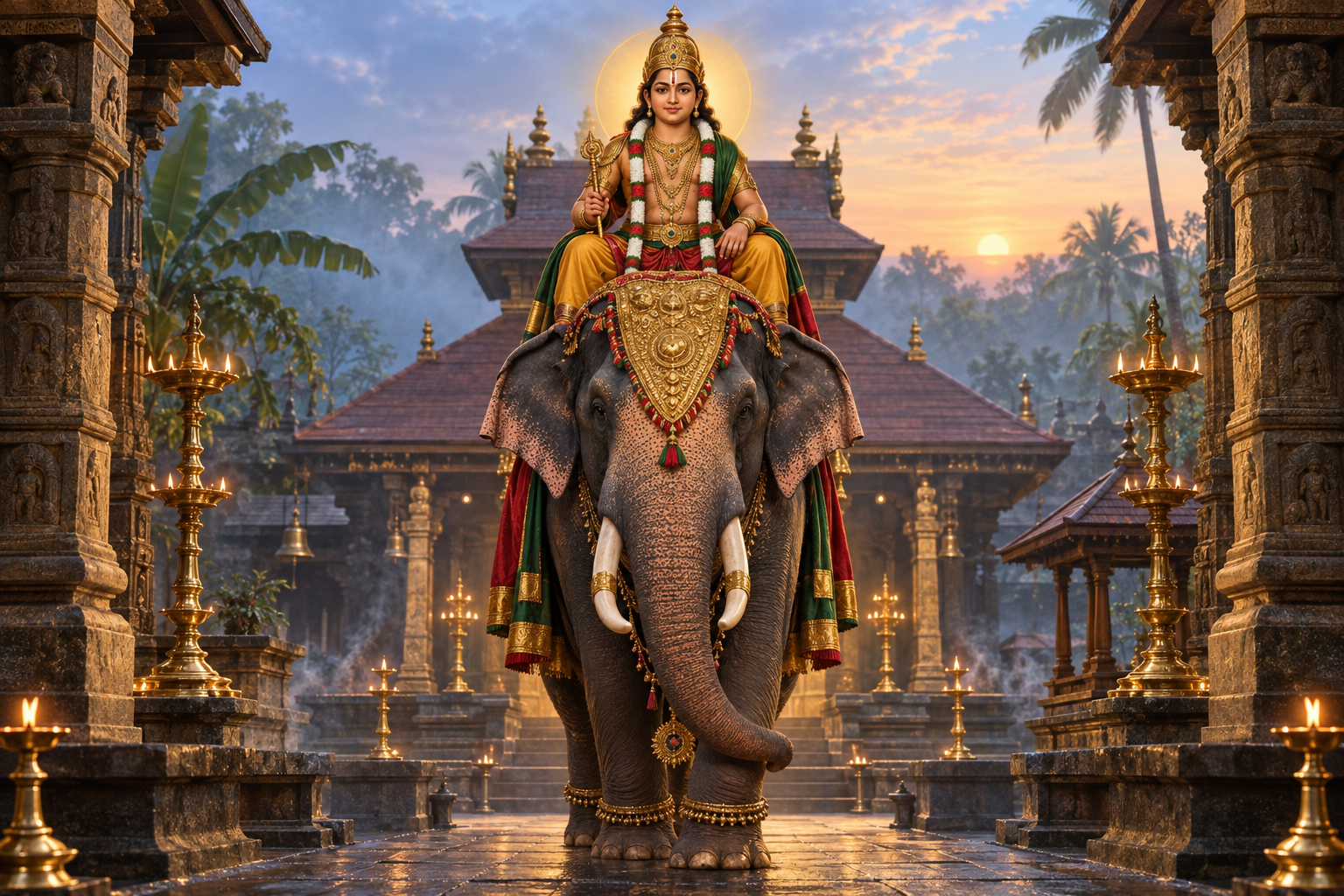
If you have encountered Ayyappa mounted on an elephant, you probably want to settle two questions: which form are you seeing, and does the elephant change how you should understand or worship the deity? Start with the visible form, then let the temple establish everything the image alone cannot tell you.
Gajaruda Sastha is a distinct iconographic manifestation within Ayyappa devotion. The elephant carries real symbolic weight, but it does not supply a universal mantra, offering, vow, or promised result. Keeping that boundary clear lets you approach the form with both insight and respect.
Read the name before adding extra meanings
The name gives you the safest point of entry. Gaja means elephant, while arudha means mounted or ascended. Gajaruda Sastha therefore identifies Sastha mounted upon an elephant. It is a lesser-known manifestation of Lord Ayyappa associated especially with South Indian temple and Agamic traditions.
This immediately corrects two common misreadings. First, the elephant is the mount; Gajaruda Sastha is not an elephant-headed deity. Second, the presence of an elephant somewhere in a sculpture or painting is not enough by itself to establish the identification. The defining relationship is that Sastha rides the elephant.
When you are trying to identify an unfamiliar image, check three things:
- Is the deity actually mounted upon an elephant, rather than merely accompanied by one?
- Does the shrine, inscription, festival notice, or temple representative use the name Gajaruda Sastha?
- Is the figure identified locally with Ayyappa or Sastha?
If one of these elements is missing, use a cautious caption such as “an elephant-mounted form of Sastha” until the temple confirms the precise name. Do not infer weapons, hand gestures, consorts, mantras, or a local legend merely from the title. Those details can vary, and the name alone does not settle them.
What the elephant contributes to this form
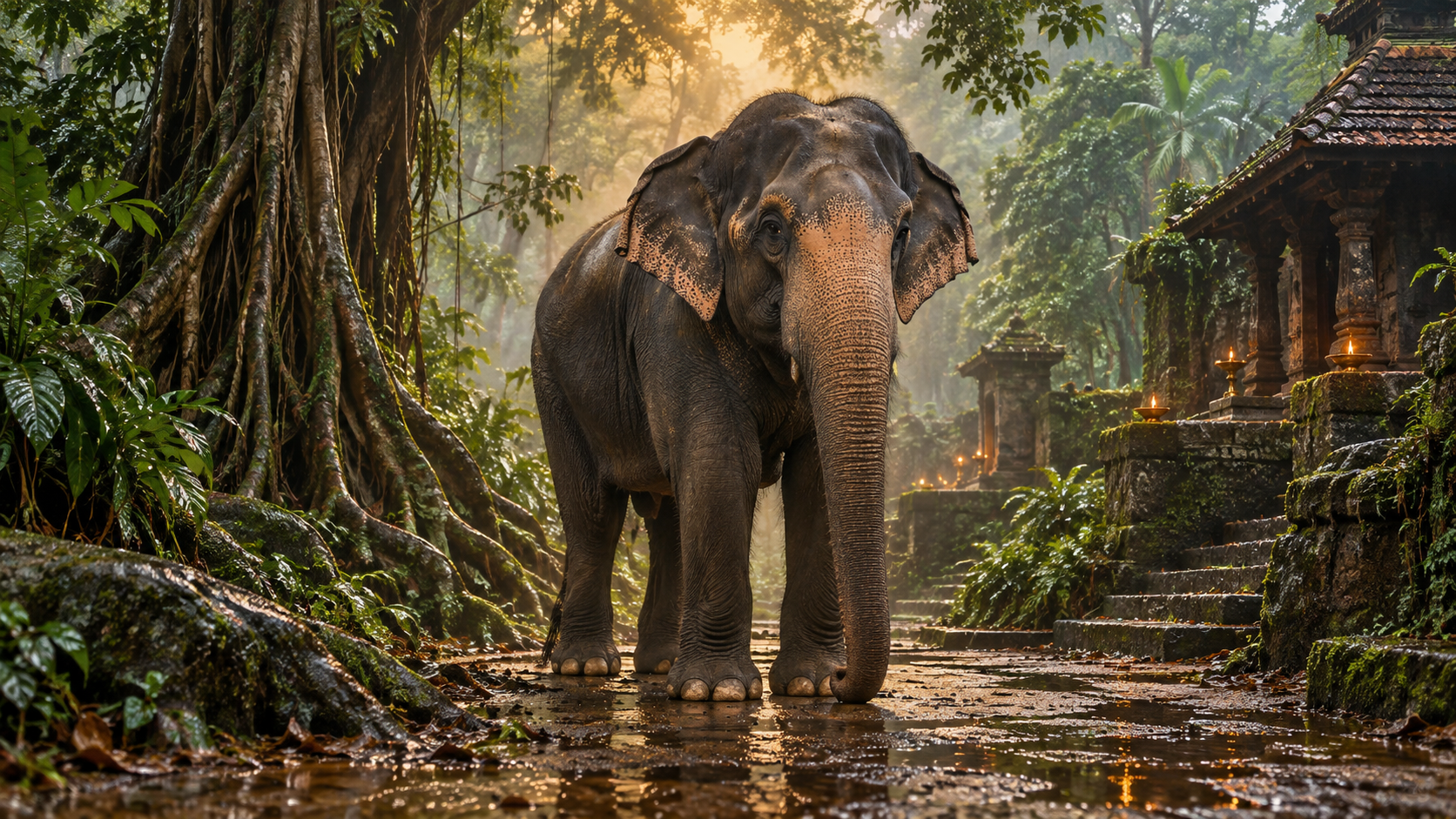
A vahana is not just transportation added to an otherwise unchanged picture. It helps express how divine power appears and acts. In Gajaruda Sastha, the elephant signifies sovereignty across earthly and spiritual domains. The image presents authority that is elevated, commanding, and capable of guarding an ordered realm.
The form is also understood as a fierce guardian connected with time and cosmic order. “Fierce” should not be confused with malicious or uncontrolled anger. In sacred iconography, fierceness can communicate protective intensity: the power to confront disorder rather than accommodate it.
Time adds another layer. It places sovereignty inside an order larger than personal preference. Time exposes delay, brings consequences, and prevents any condition from remaining fixed forever. Read devotionally, the form asks whether your strength serves dharma at the right moment or merely serves your own impulse.
That is a more disciplined interpretation than compiling a list of generic elephant qualities. It also prevents a symbolic association from becoming an unsupported promise. The iconography alone does not establish that this form will automatically end every delay, settle a dispute, remove a specific obstacle, or produce a particular material result. Treat such claims as local teachings only when a temple tradition explicitly teaches them.
Let the temple establish the ritual context
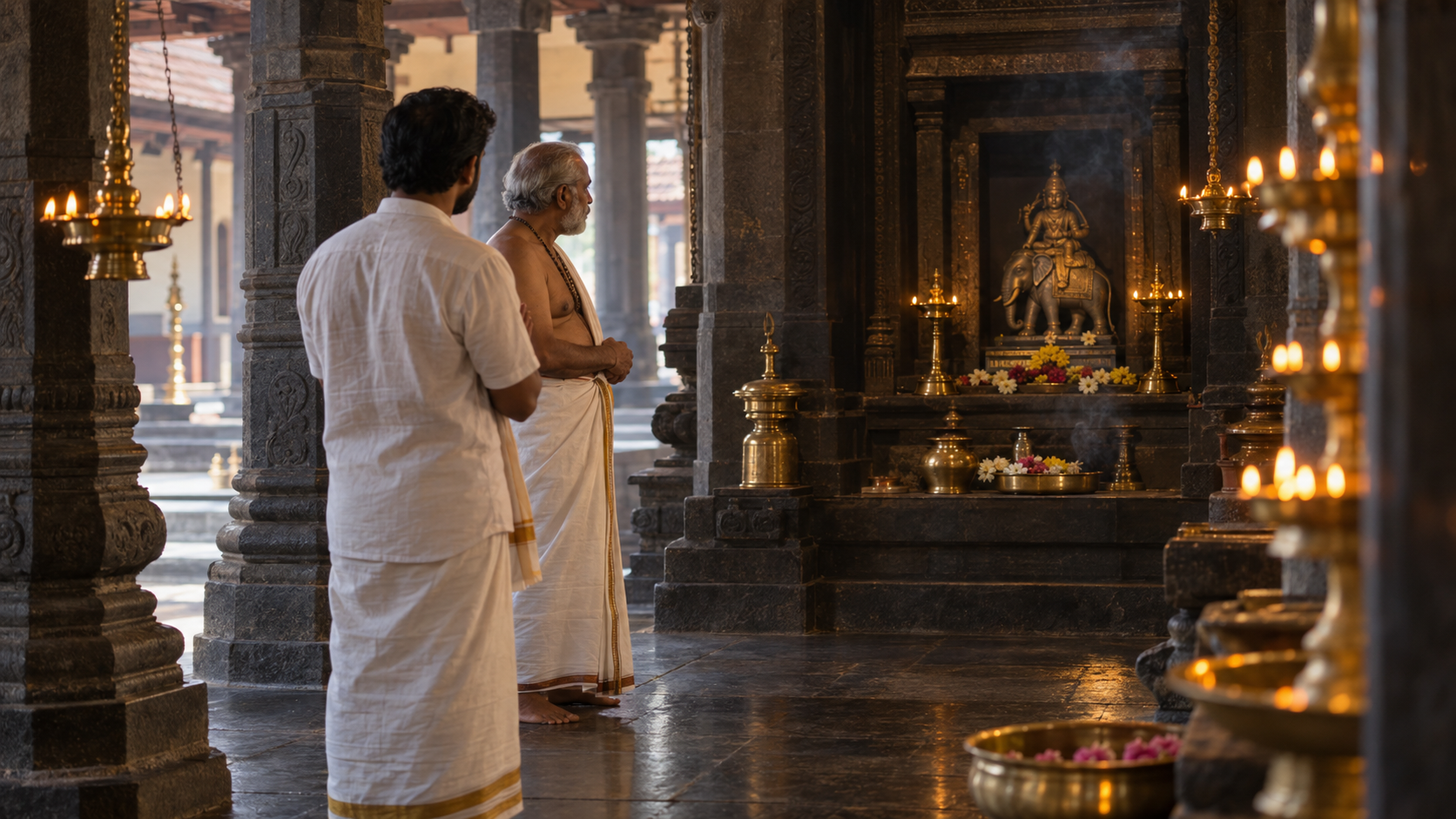
The form’s association with Agamic practice matters because temple iconography, consecration, and worship operate within a received ritual system. You cannot derive the complete method of worship from the visual symbol. Two shrines may recognize the same divine form while preserving different local observances.
Use this sequence when you visit a Gajaruda Sastha shrine:
- Confirm the temple’s exact name for the form. A signboard, official temple material, or the officiating priest is more reliable than a caption detached from its location.
- Observe before interpreting. Notice that Sastha is mounted on the elephant, then distinguish what is visibly present from what you have heard elsewhere.
- Ask narrow questions: Does this shrine prescribe a particular prayer? Are there designated offerings, timings, or observances? Is there a local account explaining the form?
- Follow the shrine’s order of worship. If no special instruction is given, a respectful namaskara is more appropriate than improvising an elaborate rite.
The same care applies at home. No universal mantra, vrata, day, or offering can be inferred from “Gajaruda” alone. If you want to begin formal worship specific to this manifestation, seek guidance from a temple or teacher rooted in the relevant tradition. This is not a barrier to devotion; it is how you avoid presenting a recent personal invention as inherited Agamic practice.
If you share an image online, preserve its context. Record the temple name and the identification supplied there. Caption only the attributes you can see or verify. An accurate, modest description serves the tradition better than an ornate explanation assembled from unrelated forms of Ayyappa.
Key takeaways
- Gajaruda Sastha is the elephant-mounted form of Ayyappa or Sastha.
- The mount expresses sovereign authority spanning worldly and spiritual domains.
- The fierce character points to protective power associated with time and cosmic order, not uncontrolled wrath.
- The image identifies the form but does not, by itself, establish a universal mantra, offering, vow, festival, or promised benefit.
- For worship, local temple and Agamic practice should take precedence over assumptions drawn from an isolated image.
Carry the symbolism into one concrete discipline
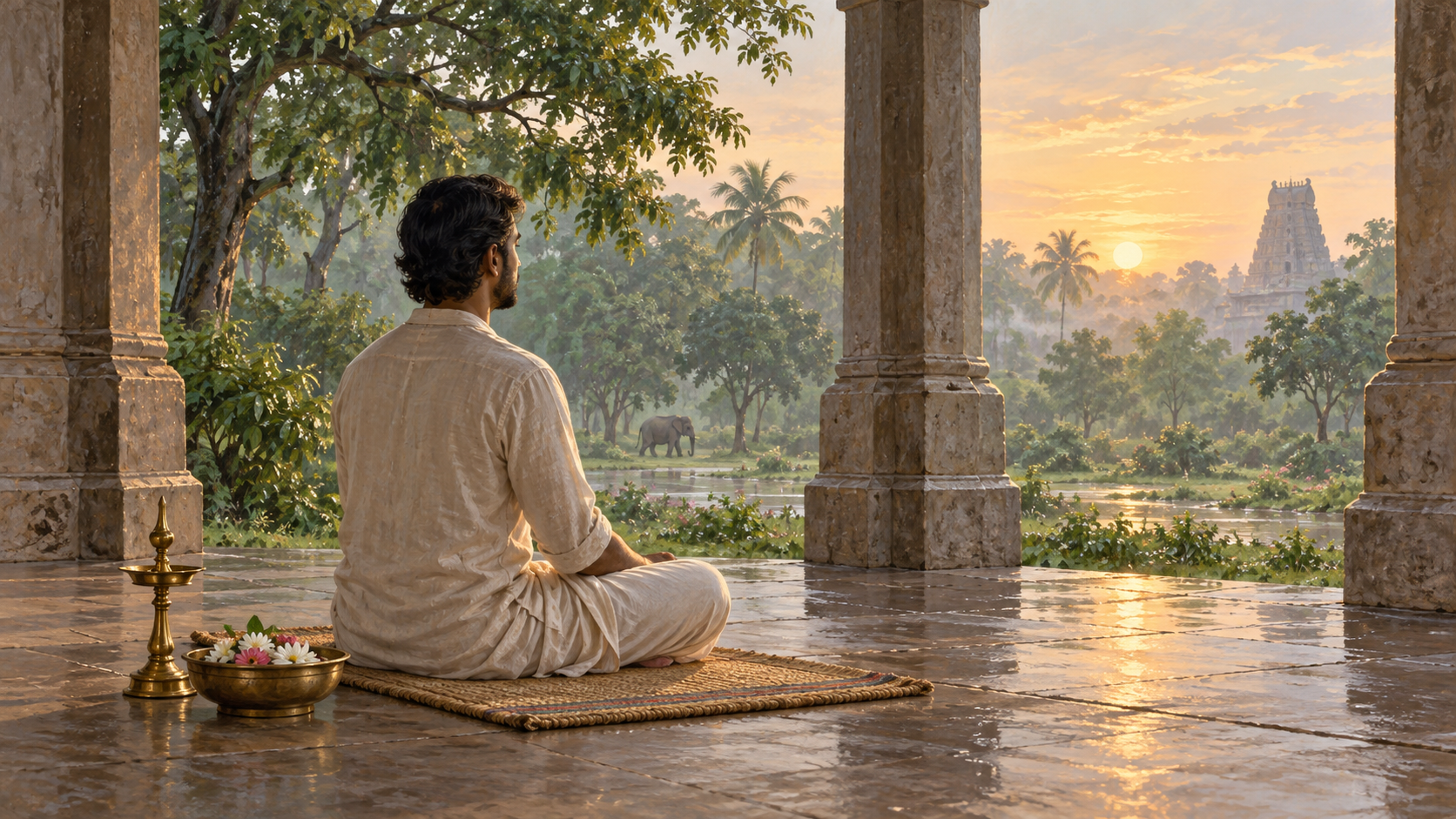
You can contemplate Gajaruda Sastha without pretending that a personal reflection is a prescribed temple ritual. Begin with one area of life in which delay, distraction, or self-interest has displaced a duty. Then ask what action would restore order rather than merely make you feel powerful.
- Name one responsibility you have allowed to drift.
- Identify whom that disorder affects besides you.
- Choose the smallest action that genuinely restores the proper sequence.
- Complete it without waiting for a more dramatic or convenient moment.
This is an ethical application of the iconography, not a substitute for puja. It turns the themes of time, guardianship, and order into conduct: strength governed by responsibility, exercised when it is needed.
The next time you encounter Gajaruda Sastha, begin with the elephant-mounted form, verify the shrine’s own identification, and ask what its tradition actually prescribes. Then let the image leave you with a practical question: what part of dharmic order is it your turn to protect?
References
- Hindu Blog — Gajaruda Sastha Form Of Ayyappa: The Elephant-Mounted Guardian of Time and Cosmic Order

Leave a Reply
You must be logged in to post a comment.