
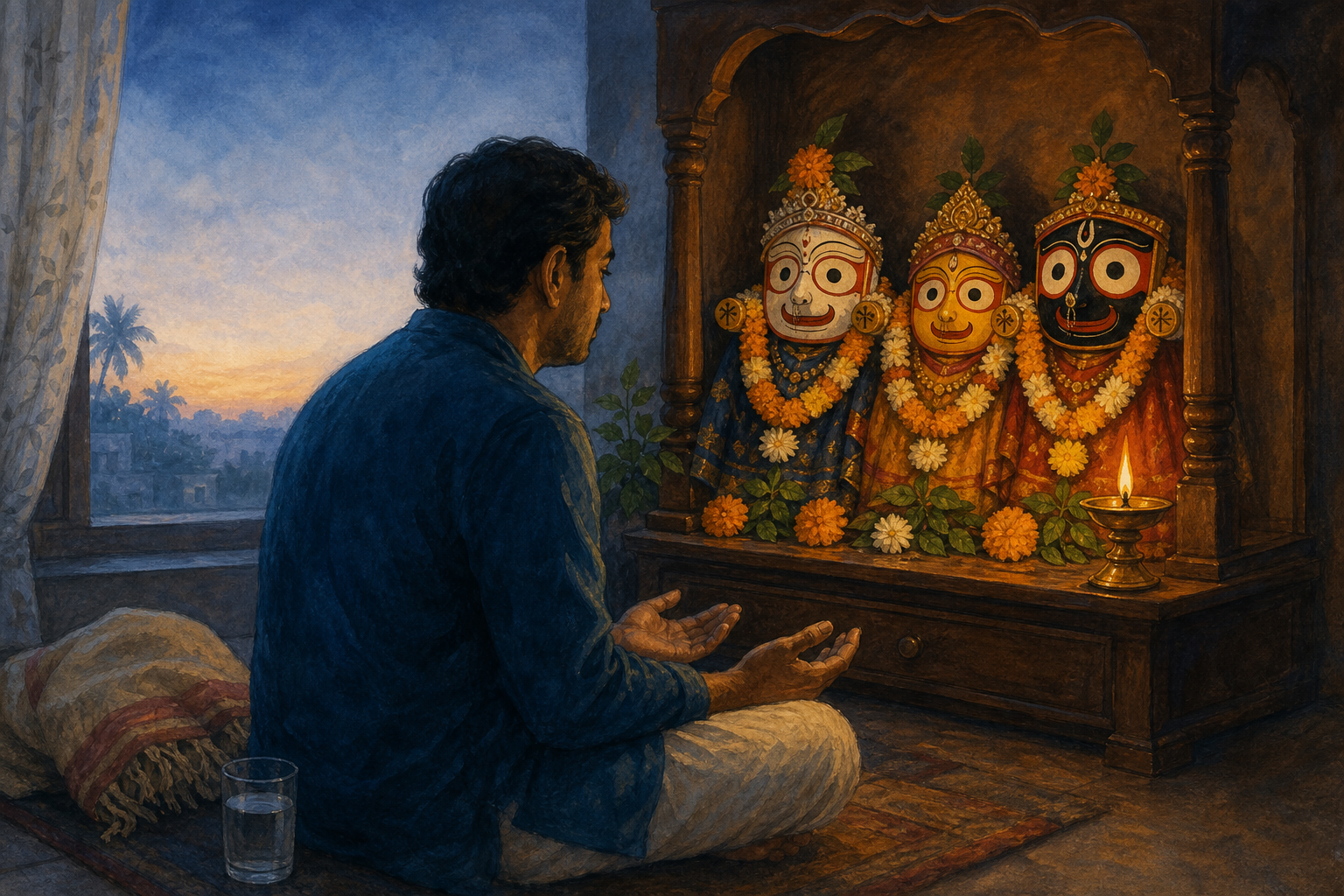
When someone you love is suffering, prayer can shrink to a single plea. Before Lord Jagannath, you do not have to manufacture certainty or search for impressive words. You need a way to remain present, keep doing what care requires, and place what you cannot control before the divine.
You can hold devotion and practical responsibility in the same pair of hands. Hope becomes dangerous only when it is mistaken for a diagnosis, a prediction, or permission to delay care. Kept in its proper place, hope can steady you for the next necessary act.
Pray honestly when polished words will not come
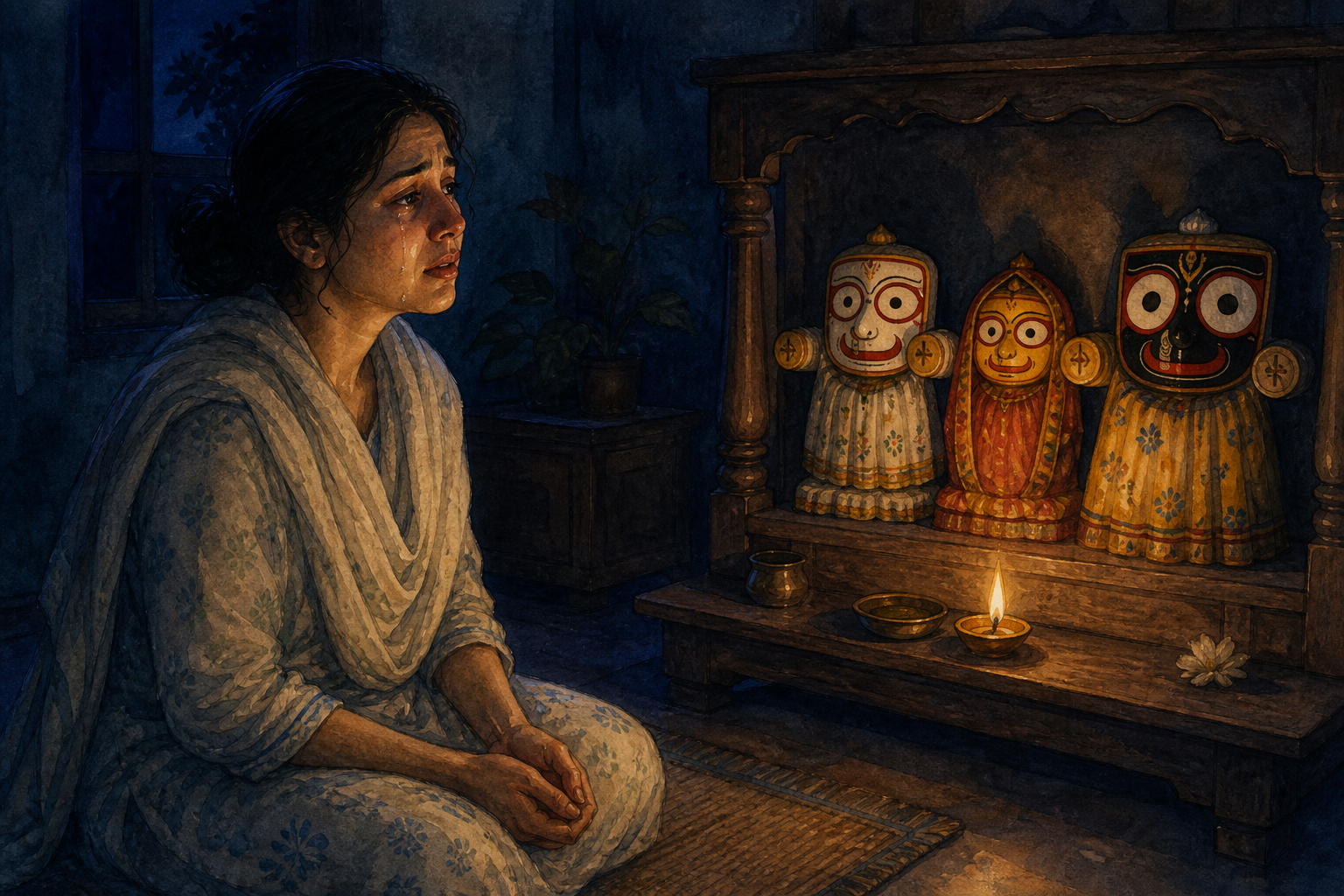
A crisis strips prayer down to its truth. Fear, grief, exhaustion, and even anger may all be present. You do not need to hide them from Lord Jagannath. Honest bhakti begins with the condition of your heart as it is, not as you think it ought to be.
If your mind is racing, make the prayer simple enough to remember. Move through five brief steps:
- Name the reality. Say plainly who is suffering and what is happening.
- Ask for what you long for. You may ask for healing, relief, protection, clarity, courage, or the strength to endure the next hour.
- Admit what you cannot control. This keeps prayer from becoming a demand that you must somehow enforce.
- Name your next duty. It may be calling a doctor, arranging transport, listening carefully, sitting beside the person, or asking someone for help.
- Become quiet for a moment. Do not hunt for a sign. Let the prayer settle, then return to the duty in front of you.
You might pray: Lord Jagannath, you know this suffering and my fear. Please bring relief, guide those who are caring for us, and give me the strength to do what is needed now. The value of such a prayer is not literary beauty. It is that nothing essential has been concealed: love, fear, hope, dependence, and responsibility all stand together.
This helps explain why the sight of a father pleading before Lord Jagannath while holding his ailing child moved so many people. Its force does not depend on proving a supernatural event. It shows parental love becoming prayer when ordinary language is no longer enough.
Let hope remain hope, not a promise about the outcome
Devotional hope says that suffering is not faced alone and that loving action still matters. It does not say that you know what will happen next. That distinction protects both faith and the person who is ill.
A visible movement, a calmer expression, or a moment of responsiveness can bring immense relief. But a recording of such a moment cannot establish recovery or reveal the person’s full clinical condition. Receive relief with gratitude, then let qualified medical professionals assess what the change means.
Three common mistakes are worth resisting:
- Do not turn prayer into a bargain. Devotion is not a transaction in which the right words compel a particular result.
- Do not blame the suffering person or family. An unwanted outcome does not prove that someone prayed badly, lacked faith, or was unworthy of grace.
- Do not turn another family’s vulnerability into miracle evidence. A brief clip may show genuine emotion and a hopeful moment without proving what happened medically before or afterward.
This is especially important when devotional moments circulate online. If you share one, describe only what can actually be seen. It is responsible to say that a family’s prayer moved you. It is not responsible to announce a cure that the footage cannot establish. Where consent or dignity is uncertain, reflection is better than redistribution.
Faith does not become smaller when it refuses exaggeration. It becomes more truthful. Lord Jagannath does not need a sensational claim in order for a parent’s love, a community’s compassion, or a moment of prayer to matter.
Keep prayer and medical responsibility together

When illness is involved, devotion must accompany care rather than replace it. Do not delay transport, examination, prescribed treatment, tests, or follow-up while waiting for a sign. If a child or adult becomes unresponsive, has difficulty breathing, or shows another severe or rapidly changing symptom, seek emergency help immediately.
Prayer can still do important work. It can help you slow down enough to hear instructions, ask a clear question, accept assistance, and stay beside someone who is frightened. These are not secondary acts. In a crisis, calm attention can be one form of seva.
If several relatives or friends are present, convert shared concern into a small care structure:
- Choose one person to speak with clinicians and write down their instructions.
- Ask another person to handle transport, medicine collection, food, or necessary phone calls.
- Let one trusted person update the wider family so the primary caregiver is not answering the same question repeatedly.
- Keep someone with the distressed parent or caregiver, even if that support consists mainly of quiet company.
- Record practical information accurately instead of relying on memory strained by fear.
If you are the person offering help, replace the broad question What can I do? with a concrete offer: I can bring a meal this evening, I can drive you to the appointment, or I can make the family calls while you stay here. A specific offer reduces the number of decisions an exhausted person has to make.
If you are the caregiver, accepting this help is not a failure of devotion. It may be the very means through which compassion reaches you. Bhakti directs the heart toward the divine; responsible care gives that devotion hands and feet.
Allow Jagannath bhakti to widen the circle of care
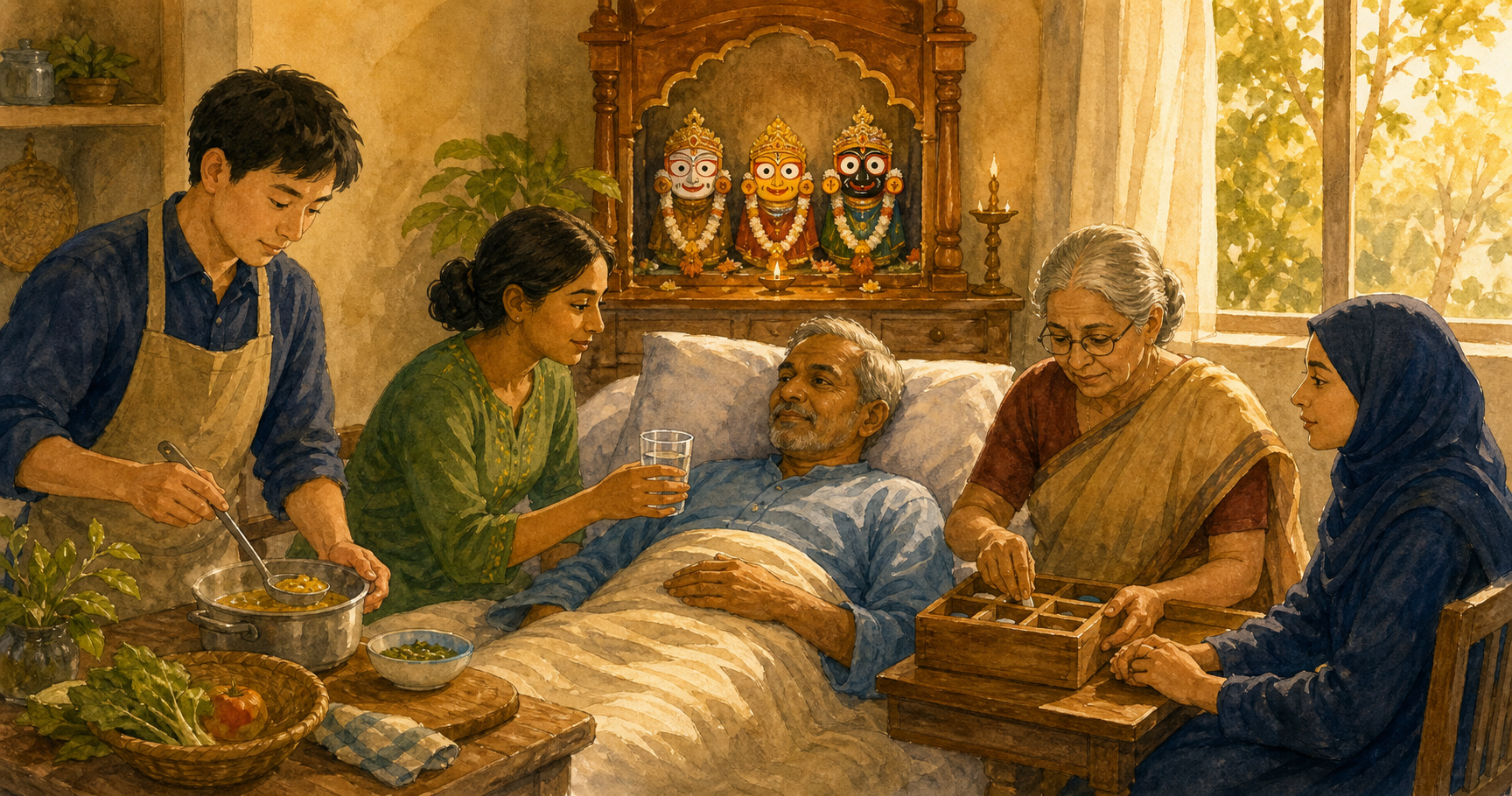
Lord Jagannath is revered in traditions closely associated with Puri Srimandir in Odisha, yet the meaning devotees find in Jagannath reaches beyond one sacred building. The name Patitapaban, the uplifter of all, carries a demanding implication: distress should weaken our instinct to exclude, not strengthen it.
That implication becomes practical when you ask a different question. Instead of first asking whether a suffering person belongs to your sect, community, language group, or social circle, ask what form of care is needed. A ride to treatment, a meal, patient listening, help with children, or quiet companionship does not require doctrinal agreement.
Across Hindu, Buddhist, Jain, and Sikh life, the emphases and vocabularies are not identical. Yet bhakti, karuna, daya, maitri, and seva provide a recognizably Dharmic grammar for responding to suffering:
- Bhakti turns fear toward the divine instead of letting fear rule the mind alone.
- Karuna asks you to see another person’s suffering without looking away.
- Daya refuses indifference when care is possible.
- Maitri stays beside the suffering person without making their crisis about the helper.
- Seva translates concern into useful work.
Use these values as a sequence. Begin with prayer. Notice who is carrying the heaviest burden. Ask what would reduce that burden today. Then perform the task without demanding recognition. In this way, a temple encounter does not end at the threshold. It changes how you behave when you return to the ward, the home, the street, or the family phone call.
This also gives a community a better response to a moving devotional image. The weakest response is to watch, feel briefly overwhelmed, and keep scrolling. A stronger response is to let the feeling identify a duty: contact a family in difficulty, volunteer for community care, accompany someone to an appointment, or simply listen without rushing to explain their pain.
Key takeaways
- Pray in plain words: name the suffering, ask for help, admit uncertainty, and identify the next duty.
- Treat hope as spiritual strength, not as a prediction or proof of recovery.
- Never delay urgent or prescribed medical care while waiting for a devotional sign.
- Receive a hopeful change with gratitude, but leave clinical interpretation to qualified professionals.
- Turn bhakti into seva through one specific act that reduces another person’s burden.
- When sharing devotional footage, protect dignity and do not claim more than the visible moment can establish.
If you stand before Lord Jagannath with a burden today, begin with one honest sentence. Then take the next responsible step available to you. Ask someone to take it with you if necessary. Let your hope remain humble, your care remain practical, and your devotion become shelter for someone besides yourself.
References
