
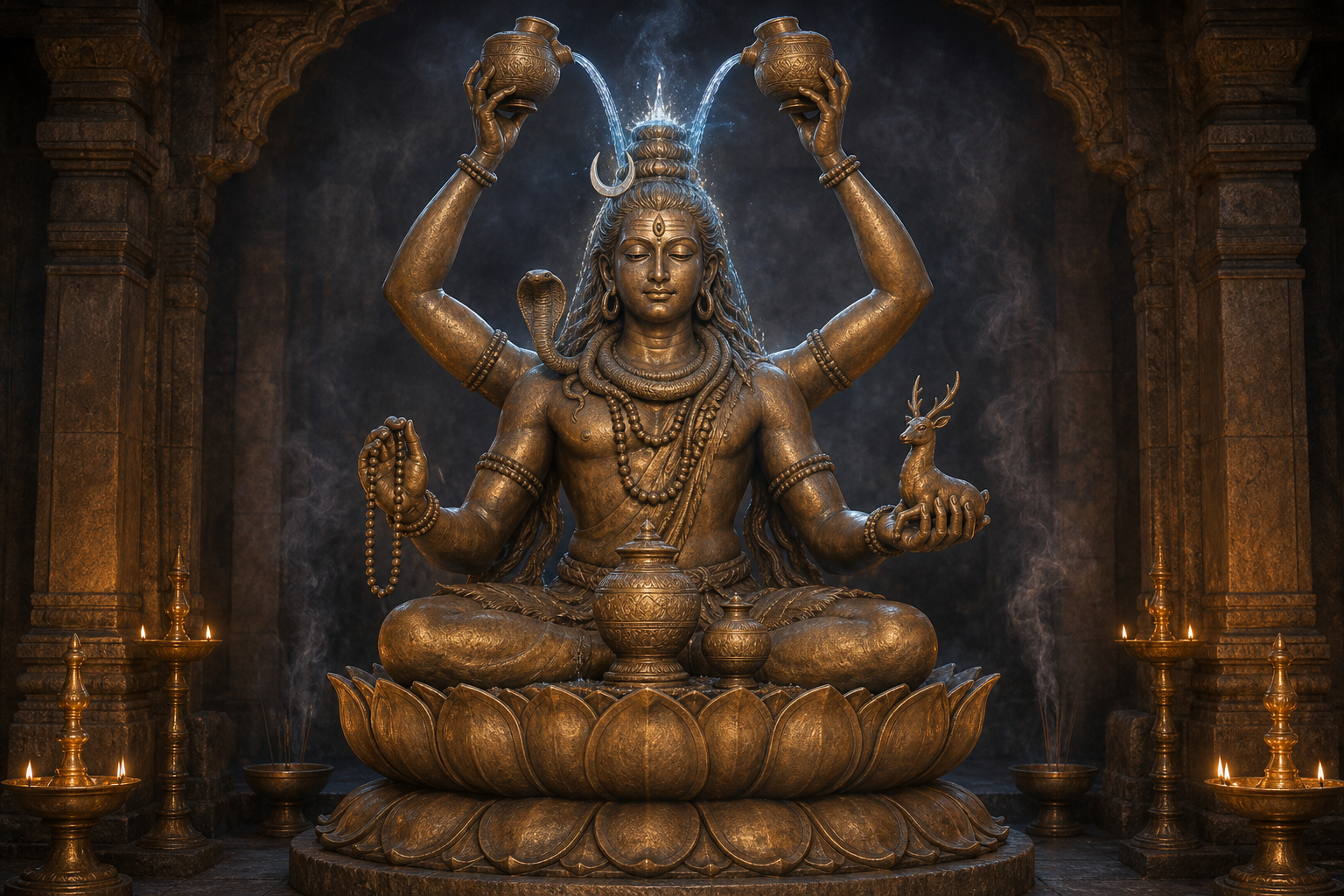
You have found a temple image, sculpture, or photograph labelled Amrita Mrityunjaya, and you want to know what makes it different from a general image of Shiva. Do not begin by matching one vessel, hand gesture, or ornament against pictures online. Begin with the complete name, then test that reading against the whole image and its temple context.
This approach will help you identify the form responsibly, describe what you can actually see, and understand why the words amrita and Mrityunjaya belong together. It also protects you from the most common mistake in religious iconography: turning a profound form into a one-symbol puzzle.
The name is the first key, not the final proof
Amrita Mrityunjaya is presented as a rare form of Shiva that joins the conquest of death with the bestowal of immortality. Each part of the name does distinct work. Mrityunjaya identifies Shiva as the conqueror of death. Amrita evokes nectar, deathlessness, and immortality. Read together, they express more than escape from an immediate danger: death is overcome, and the devotee is directed toward that which death cannot extinguish.
That distinction matters when you interpret the murti. If you reduce the form to Mrityunjaya alone, you retain victory over death but lose the positive symbolism of amrita. If you focus only on nectar, you risk treating immortality as a substance or reward detached from Shiva’s mastery over mortality. The compound name holds the two meanings in one vision.
It is therefore safer to describe this form as Shiva who both conquers death and bears or bestows amrita. Calling him merely a “god of longevity” narrows the meaning too far. Longevity still belongs to measurable time; deathlessness points beyond the simple extension of biological life.
This is also where devotional language needs care. A worshipper may approach Mrityunjaya during illness, danger, bereavement, or fear, but the icon should not be turned into a medical promise that a body will never die. Its theological meaning is larger: mortality is real, yet it does not possess the final word over existence.
Read the whole image before naming the nectar symbol
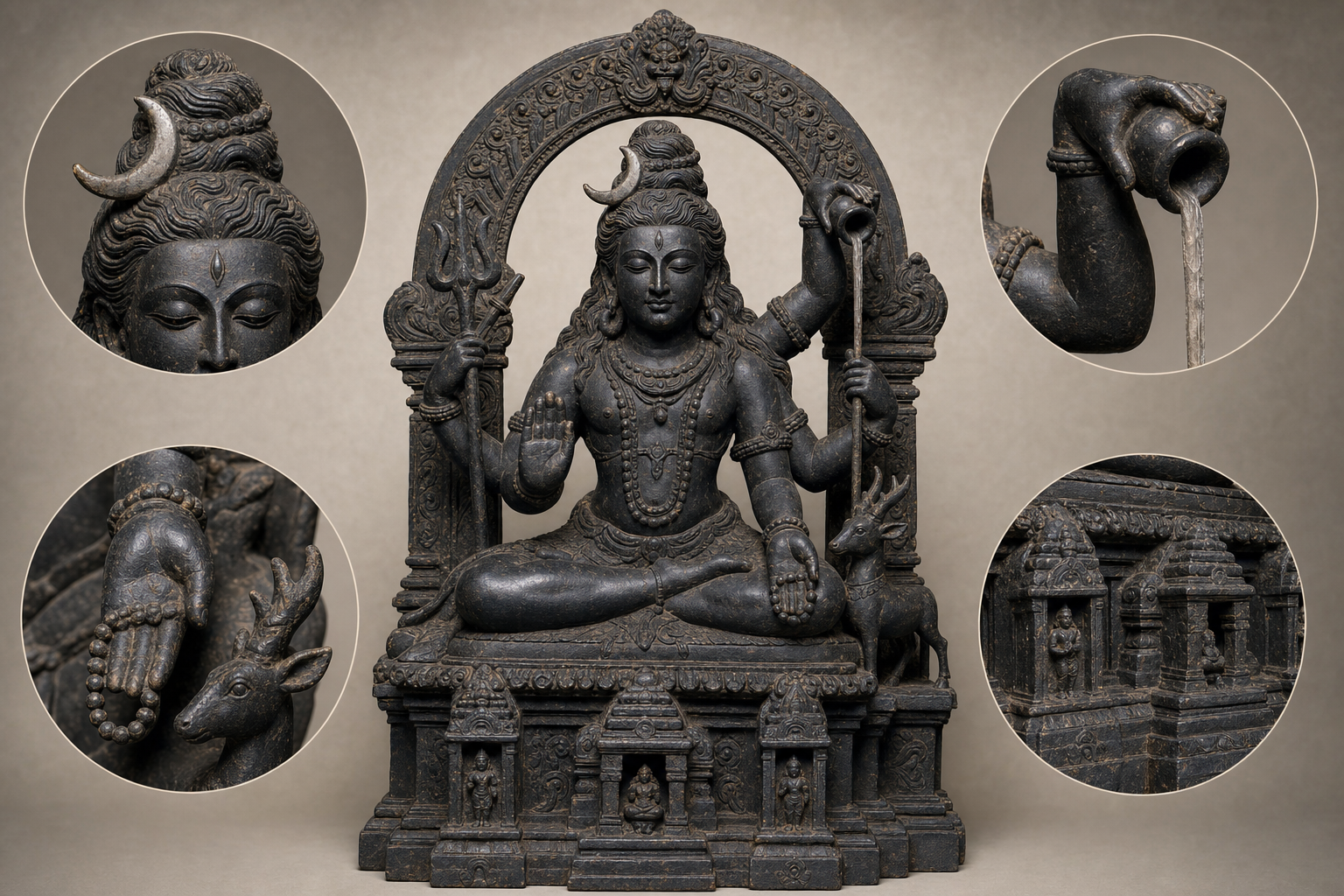
Iconography works cumulatively. A reliable identification comes from several features supporting one another: the name used by the temple, the posture of the murti, the number and placement of arms, hand gestures, held objects, attendant figures, pedestal, shrine position, inscription, and living ritual tradition. One appealing resemblance is not enough.
If a sculpture carries a vessel or another nectar-bearing object, record it carefully, but do not immediately declare that object to be amrita. Vessels appear in more than one sacred setting and can carry different meanings. The useful question is not simply, “Is there a pot?” It is, “What does this temple call the object, which hand holds it, and how does it relate to the identity of the complete form?”
- Formal features: Is Shiva standing or seated? How many faces and arms are visible? Is the figure calm, dynamic, ascetic, or regal in presentation?
- Gestures and attributes: Which hands make mudras, and which hold objects? Record the position of each feature rather than making a loose list.
- Relational features: Are there attendants, consorts, sages, guardians, animals, or subsidiary figures? Their placement may clarify the scene.
- Architectural context: Is the image the principal murti, a subsidiary shrine image, a wall sculpture, or a later devotional installation?
- Traditional identification: What exact Sanskrit or regional name appears on a label, inscription, temple publication, or ritual announcement?
The rarity of Amrita Mrityunjaya makes this discipline especially important. When there are fewer familiar examples available for comparison, resemblance-based identification becomes less dependable, not more. A rare form should increase your standard of evidence.
A practical method for identifying a suspected murti
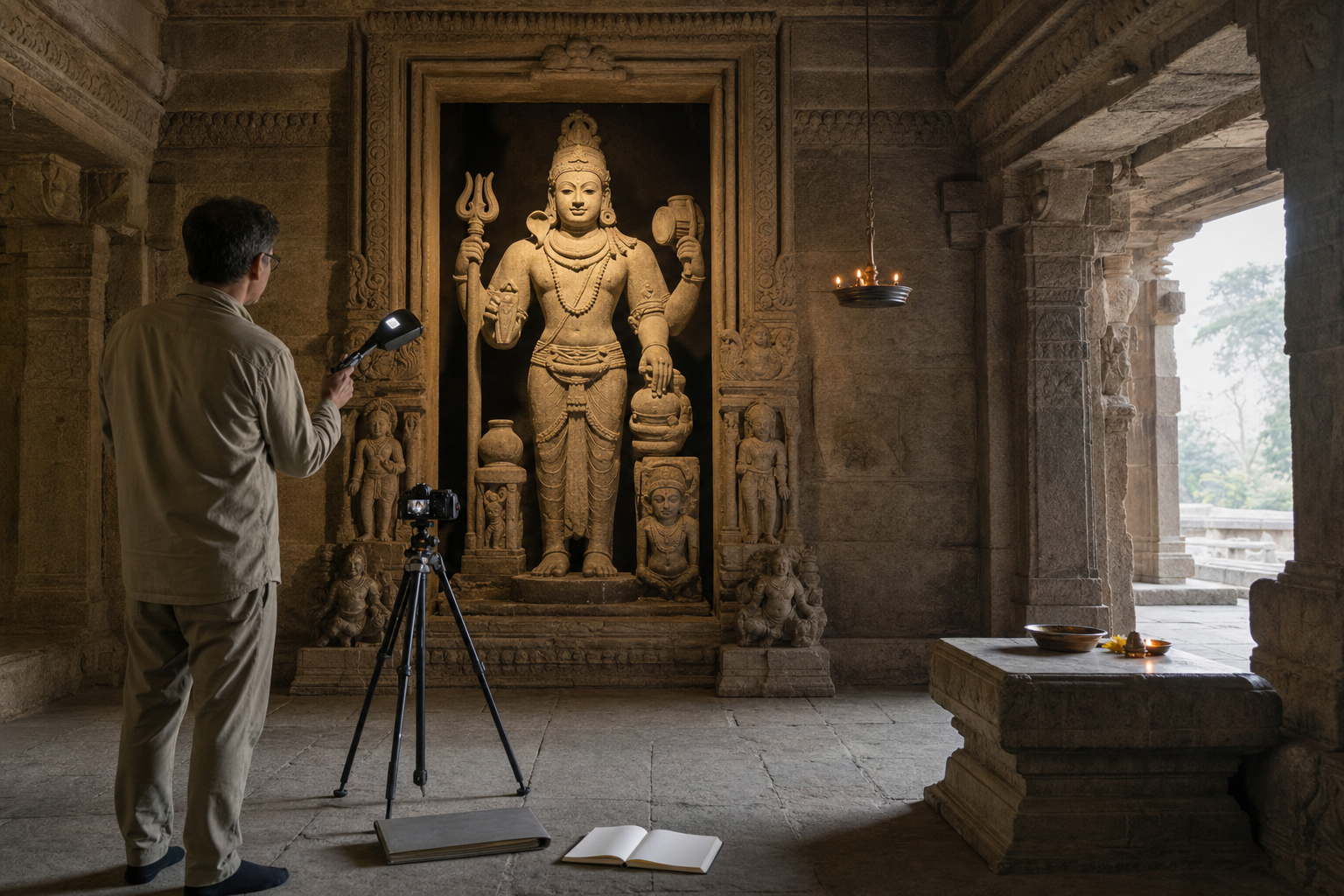
You do not need to be an art historian to make a useful record. You do need to separate observation from interpretation. Use the following sequence when you encounter a possible Amrita Mrityunjaya image.
- Observe the temple’s rules first. Ask whether photography and note-taking are permitted. A clearer record is never worth disregarding the sanctity of the shrine.
- Copy the name exactly. Preserve spelling, honorifics, regional pronunciation, and any accompanying Sanskrit or local-language text. Do not silently replace the temple’s name with a more familiar one.
- Record the complete composition. If photography is allowed, take one view showing the whole murti and shrine relationship before concentrating on individual hands or objects. If it is not allowed, make a simple position-by-position sketch.
- Describe before interpreting. Write “rounded vessel in the upper left hand” if that is what you see. Do not write “pot of immortality” until the temple tradition or a suitable iconographic authority supports that conclusion.
- Ask precise local questions. Ask the priest, sthapati, guide, or temple office: “What is the full name of this form?”, “Which attribute signifies amrita here?”, and “Does this identification come from an Agamic prescription, an inscription, or the temple’s sthala tradition?”
- Compare like with like. Give priority to material connected with the same temple or iconographic tradition. A modern decorative statue, an uncited social-media image, and a consecrated temple murti are not interchangeable evidence.
- State your confidence honestly. Use “identified by the temple as Amrita Mrityunjaya” when you have local confirmation. Use “possibly Amrita Mrityunjaya” when your conclusion rests only on visual resemblance.
A three-part note is particularly effective: “what I observed,” “what the temple calls it,” and “what I infer.” Keeping those columns mentally separate prevents a tentative interpretation from turning into a false fact as it gets repeated.
What the combined form asks you to notice
Once the identity is reasonably established, shift from classification to contemplation. The icon’s meaning moves in two directions. Mrityunjaya confronts the fear that death is absolute. Amrita supplies the positive completion: liberation is not merely the cancellation of an ending but an orientation toward the deathless.
This makes Amrita Mrityunjaya more than a reassuring image used when life feels fragile. The form places mortality and immortality in the same field of vision. You are not asked to pretend that decay, separation, and death do not occur. You are asked to examine whether the whole of being can be reduced to them.
The nectar symbolism should be read within that larger movement. If amrita becomes only a magical liquid, the icon’s philosophical reach collapses into a hunt for endless bodily survival. If it becomes only an abstract metaphor, the embodied power of the murti is lost. The image holds visible form and transcendent meaning together: something is borne, shown, or bestowed, while the death-conquering identity of Shiva determines what that gift means.
A concise description for a temple note, class, or caption could therefore read: “Amrita Mrityunjaya is Shiva envisioned as the conqueror of death and bearer of immortality; the form joins deliverance from mortality with the positive gift of the deathless.” This is more accurate than identifying the figure solely through a vessel or calling it a promise of physical immortality.
Common misreadings to avoid
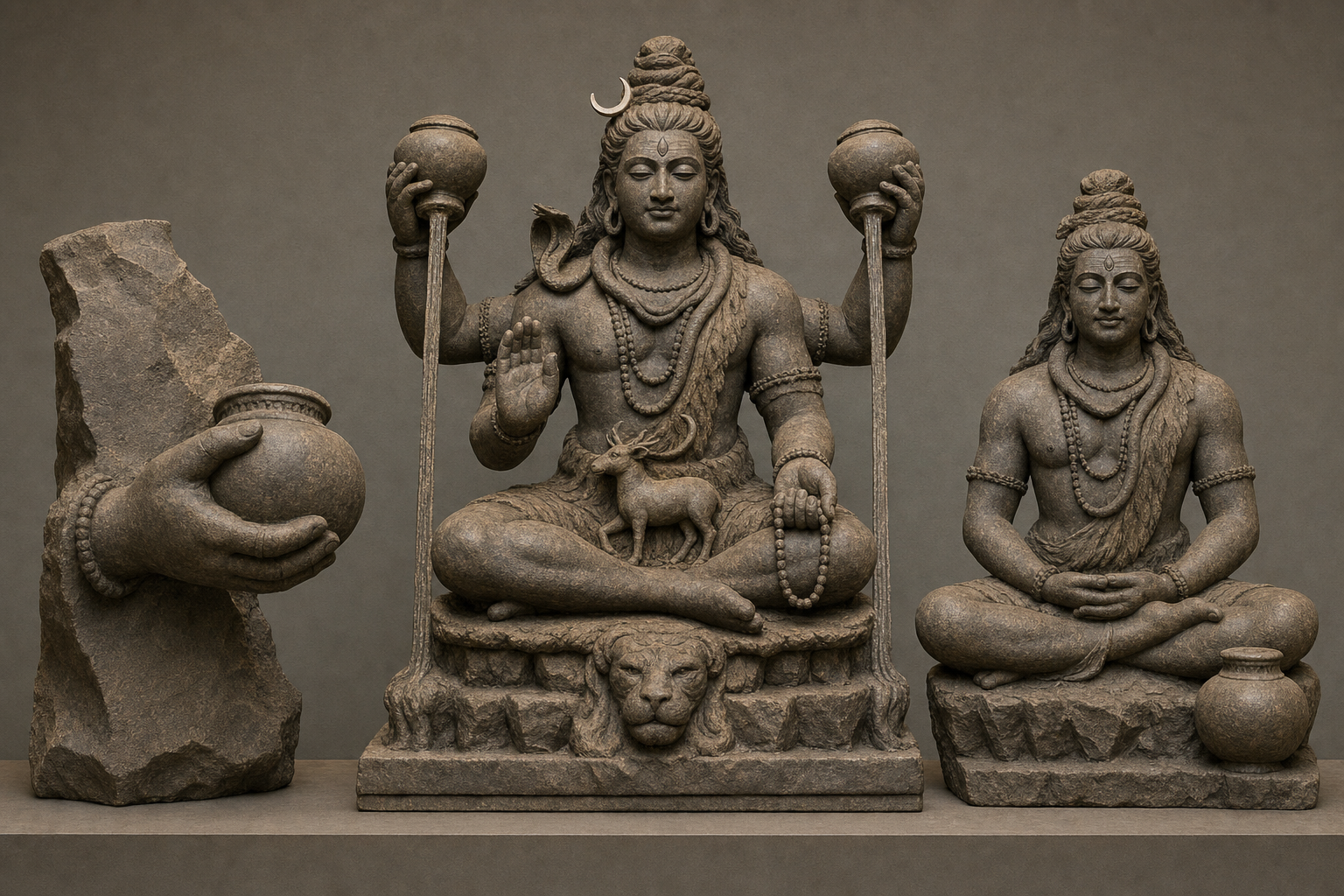
- “Every Mrityunjaya image is Amrita Mrityunjaya.” The added word amrita is meaningful. Verify that the temple or iconographic tradition actually uses the fuller name.
- “A vessel proves the identity.” An attribute contributes evidence, but its meaning depends on the complete composition and traditional identification.
- “Immortality means the body continues forever.” That reading confuses spiritual deathlessness with indefinite biological duration and turns iconography into an unsupportable physical claim.
- “Conquering death means denying death.” Victory presupposes something confronted. The form is powerful precisely because mortality is acknowledged rather than hidden.
- “A rare form must be secret or superior.” Rarity tells you that the depiction is uncommon. By itself, it does not establish rank, secrecy, antiquity, or greater spiritual power.
- “The symbol has one meaning everywhere.” Local temple usage, regional convention, Agamic framework, and ritual context can affect how an attribute is understood. Preserve that context instead of forcing every example into one generic caption.
Key takeaways
- Read Amrita Mrityunjaya as a compound identity: Shiva conquers death and bears or bestows immortality.
- Use the name as your interpretive key, but require the whole composition and temple tradition to confirm the identification.
- Record the position of each gesture and object before assigning it a theological meaning.
- Keep direct observation, local identification, and your own inference clearly separated.
- Do not reduce amrita to a promise of endless bodily life or Mrityunjaya to a denial of mortality.
- Let rarity raise your evidentiary standard; it should not encourage a more dramatic claim.
The next time you encounter this form, pause before searching for a visual match. Copy the temple’s name, map the complete image, and ask which feature the living tradition identifies with amrita. That small discipline will give you a sounder identification and a deeper darshana.
References
