
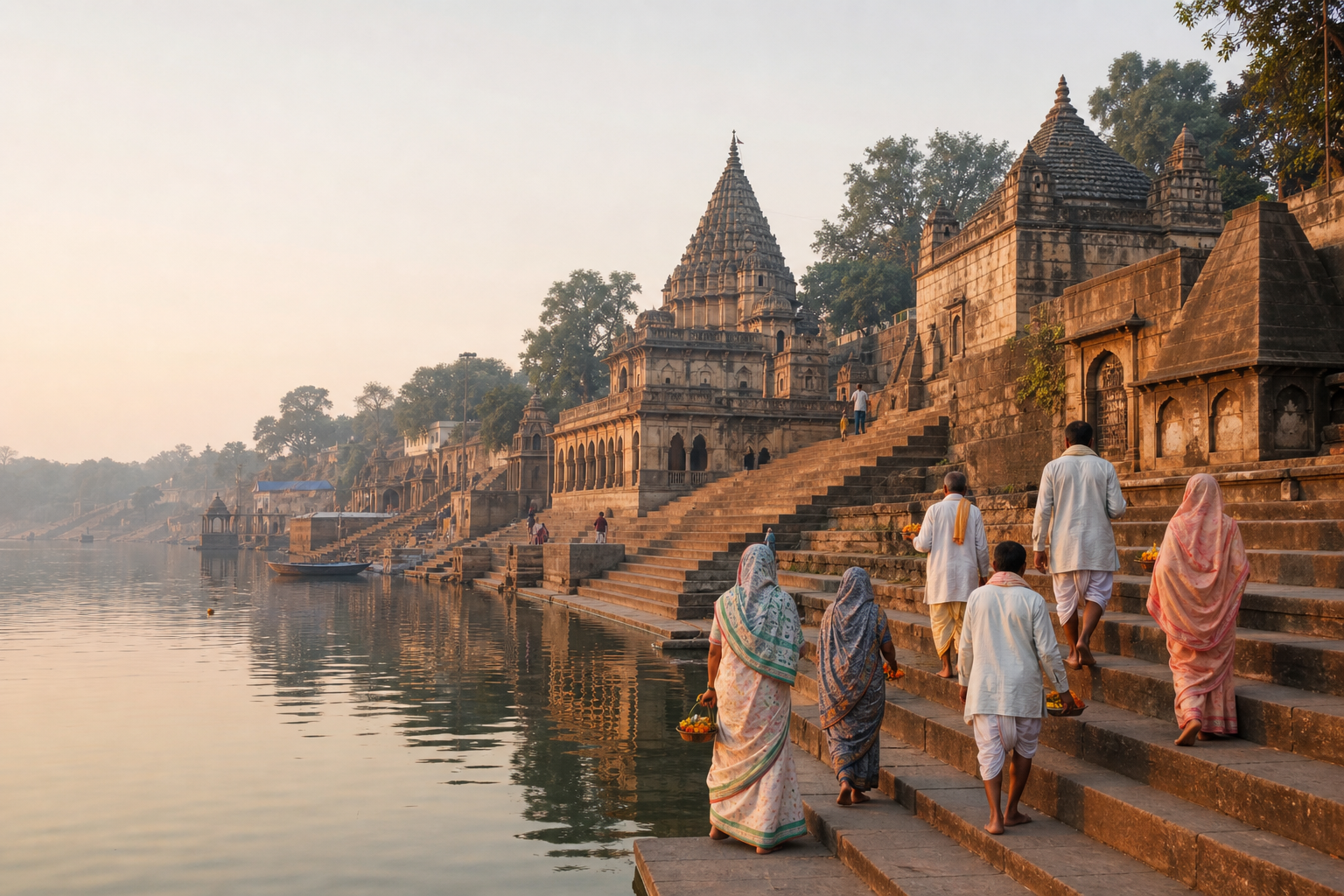
If you are going to Maheshwar and wondering whether Ahalyeshvara Mahadeva Mandir deserves more than a quick temple stop, give it one deliberate circuit: approach from the Narmada, pause at the sacred threshold, and then enter for darshana. That order reveals how the mandir joins pilgrimage, architecture, and historical memory.
Most visitors naturally look toward the garbha-griha, the inner sanctum. Fewer notice that two smooth black stones in its doorway carry thirty-seven lines of Devanagari. If you pass them without looking, you miss the feature that most directly connects the living shrine to the history of its construction.
Begin your pilgrimage at the Narmada ghats
The approach is part of the experience. Broad, finely cut steps rise from the Narmada ghats toward the mandir, allowing the river, stone ascent, and temple silhouette to appear as one sacred landscape.
If you are physically able to use the ghat route, begin below the temple rather than treating the steps as something to clear quickly. Before climbing, find a place where you can see both the stairway and the mandir above it. On the ascent, pause once and look back toward the river. This simple movement helps you notice that the temple was not conceived as an isolated building. Its setting beside the Narmada shapes how a pilgrim encounters it.
You do not need to turn this pause into an elaborate personal ritual. Its purpose is attention. The change from the river’s cadence to the rising stone prepares the mind to move from an open public landscape toward the concentrated space of the sanctum.
If climbing steps is difficult for you, verify an alternative approach locally before setting out. The traditional ghat approach described here requires a stair ascent, and it is better to plan around that constraint than to discover it after reaching the riverfront.
The doorway inscription is the mandir’s historical centre
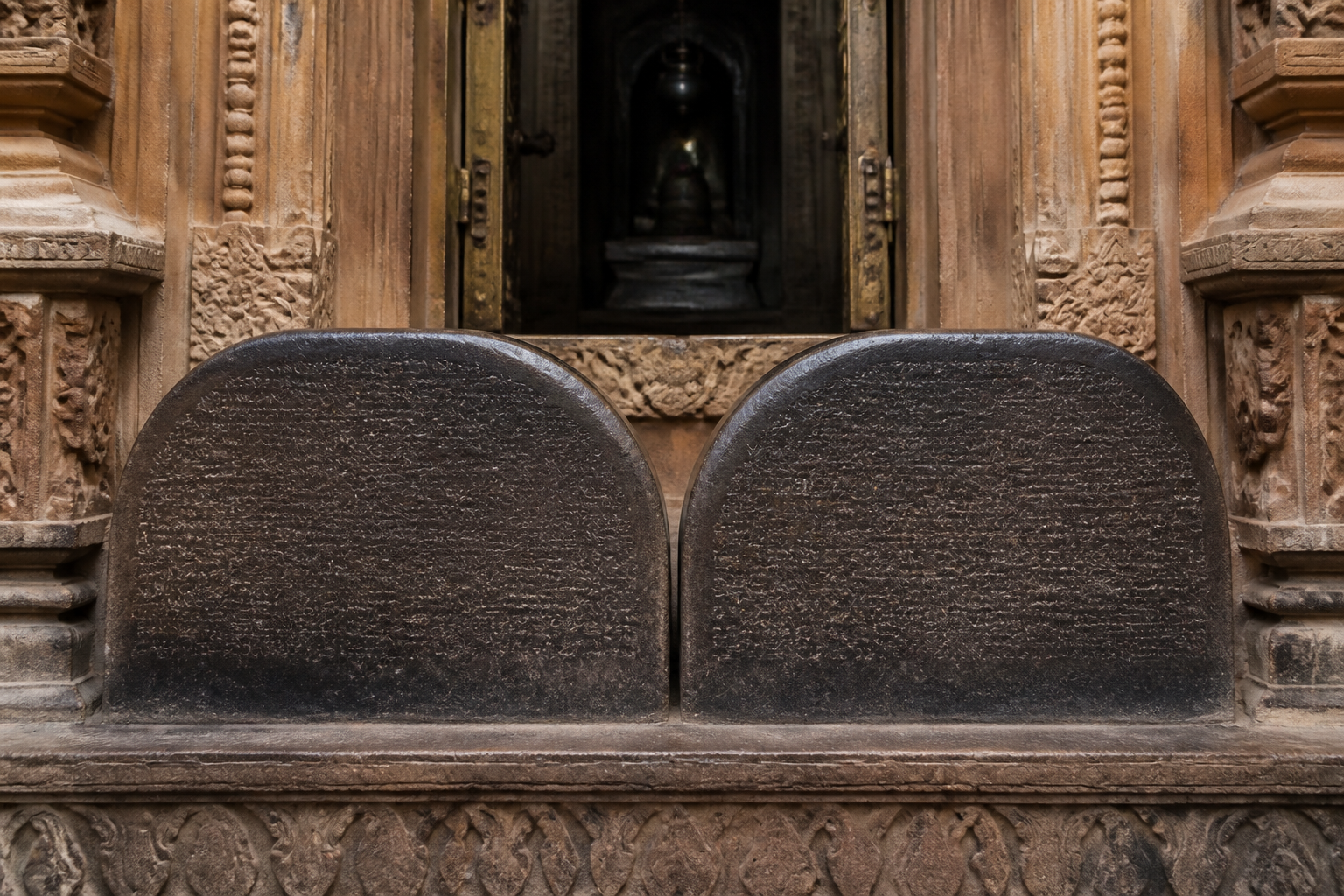
As you move toward the garbha-griha, slow down at the doorway without obstructing worshippers. Two black stone panels are embedded in the frame. Across them, thirty-seven carefully carved lines of Devanagari form a compact record of the mandir’s construction.
The placement matters. This history has not been removed to a museum case or reduced to a modern signboard. It remains within the architecture and beside the route taken for darshana. Every devotee crossing the threshold passes a written record of the human intention, labour, and patronage behind the sacred structure.
The inscription also sets a limit on what should be claimed casually. Its existence, material, location, script, line count, and connection with the mandir’s construction can be stated with confidence. A precise date, complete translation, or identification of every person named in it requires a verified transcription and competent epigraphic reading. Devanagari by itself is not a date, and visual resemblance is not a translation.
If you are documenting the temple for a class, heritage group, publication, or family archive, separate observation from interpretation. Record that there are two black panels in the doorway, that the text runs to thirty-seven lines, and that it concerns construction. Put proposed dates, names, and translations in a separate section until you can support them. That small discipline prevents an attractive guess from becoming an endlessly repeated historical claim.
Follow a sequence that respects both darshana and history
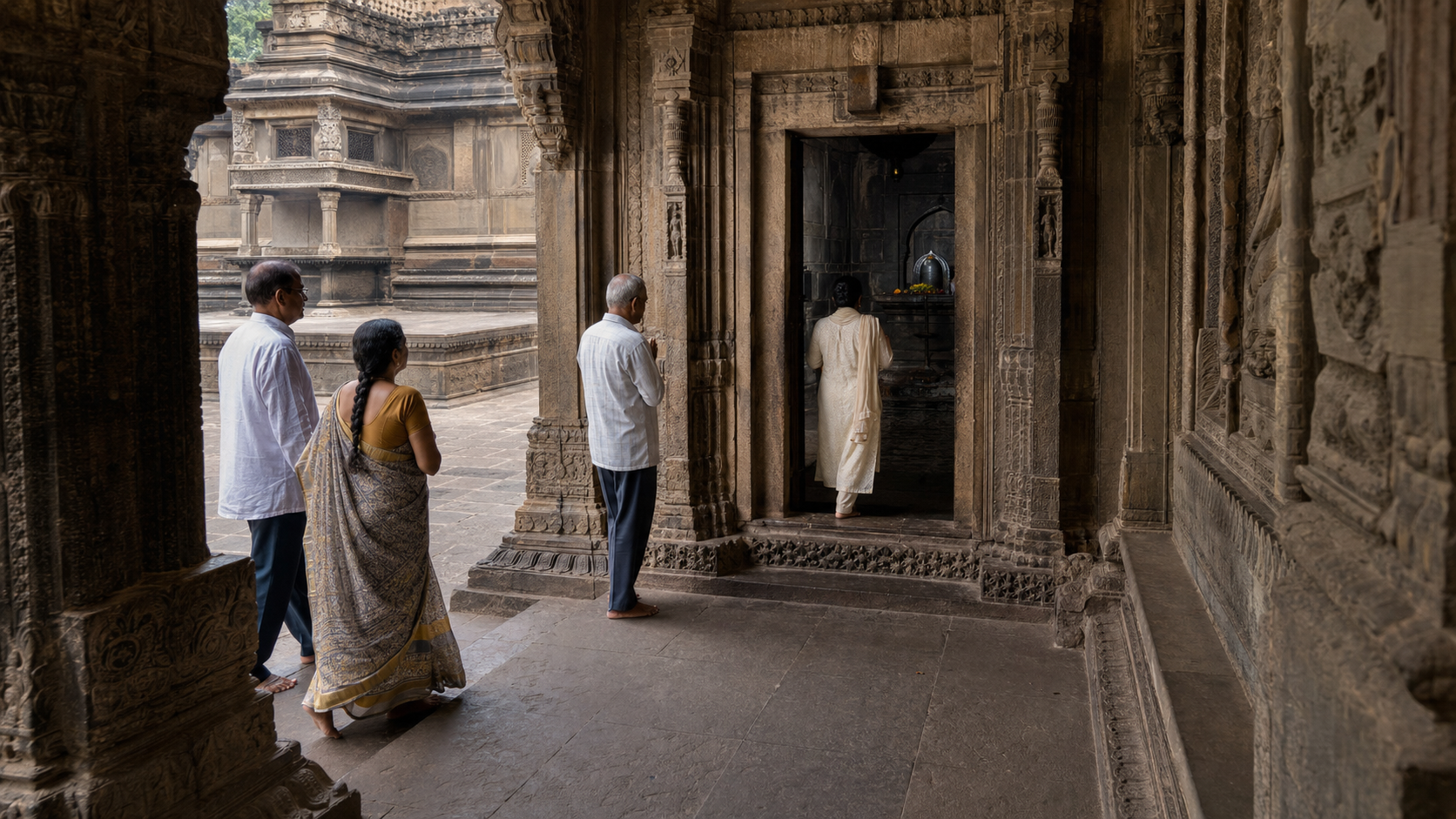
You can experience the mandir as a pilgrim and study it as a historical place without forcing one role to displace the other. Use this sequence:
- Begin at the Narmada ghats when the route is accessible to you. Take in the relationship between river, steps, and temple before climbing.
- Ascend without making photography your first task. Notice the changing view and the transition from the open ghat to the enclosed sacred precinct.
- At the doorway, move to the side so that you do not interrupt the flow of devotees. Locate both black inscription stones and observe how they are fitted into the frame.
- Look for the arrangement of the thirty-seven Devanagari lines, but do not improvise a reading from isolated characters or familiar-looking words.
- Proceed for darshana and follow the instructions of the temple’s priests or caretakers. Ahalyeshvara remains a place of worship, not an archaeological display arranged for private inspection.
- After darshana, return to the threshold if movement permits. Ask before taking photographs, and keep the entrance clear even when permission is granted.
- Write your notes soon after leaving. Record what you actually saw before adding historical explanations from elsewhere.
This order keeps the visit coherent. The Narmada establishes the sacred setting, the inscription supplies the historical anchor, and darshana remains the centre of the pilgrimage.
Protecting the inscription is part of temple conduct
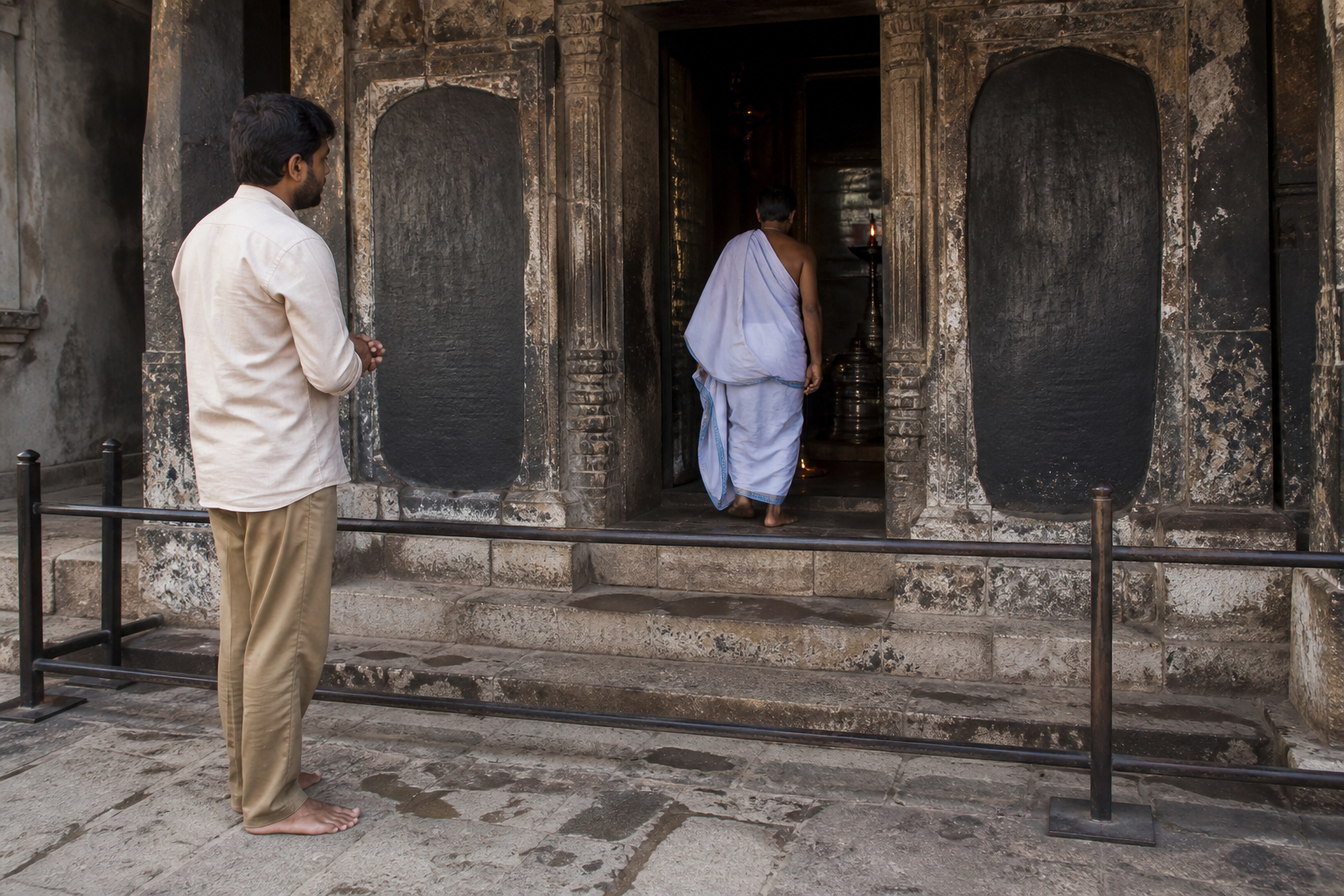
The doorway panels are powerful precisely because they remain close to ordinary ritual movement. That accessibility also makes them vulnerable. Repeated touching, rubbing, tracing, leaning, or contact with residue can gradually damage a carved surface even when no single act appears serious.
Keep your hands, luggage, and loose objects away from the inscription. Do not make a rubbing, outline the letters, apply chalk or powder to improve contrast, or attempt to clean the stone. If an offering or local ritual involves the doorway, follow the direction of the responsible temple authority rather than assuming that a practice used elsewhere belongs on these panels.
Photography rules can vary in living temples. Ask first, accept a refusal without argument, and avoid blocking the doorway while composing an image. If you notice flaking, staining, cracking, or another apparent problem, bring it to a caretaker’s attention. Do not test the surface or attempt a repair yourself.
This is where scholarship and bhakti meet in a practical way. Reverence for knowledge is not expressed only by reading old words; it is also expressed by preserving the material that carries them. That habit of disciplined care can be recognised across Dharmic traditions without erasing the distinct forms of Hindu, Buddhist, Jain, and Sikh practice.
Key takeaways for your Maheshwar visit
- Approach Ahalyeshvara Mahadeva Mandir from the Narmada ghats when the stair route is accessible to you; the river and ascent are integral to understanding the setting.
- Pause at the doorway to the garbha-griha and look for two black stone panels bearing thirty-seven lines of Devanagari.
- Treat the inscription as primary historical evidence about the mandir’s construction, not as background decoration.
- Do not assign a date, patron, or full meaning to the inscription without a verified transcription and translation.
- Keep worshippers’ movement clear, ask before photographing, and follow instructions given by priests or caretakers.
- Never touch, trace, rub, clean, or apply substances to the carved panels.
When you reach Maheshwar, put one extra pause into your itinerary. Stop before crossing the threshold, see the inscription carefully enough to describe it accurately, and treat it gently enough that the next pilgrim can encounter the same union of Narmada, darshana, and history.
References
