-
Shantipur Pilgrimage: Sri Advaita Acarya’s Sacred Home and the Call of Harinama

Shantipur, one hour from Sri Mayapur Dhama near Ranaghat, preserves the home and living legacy of Sri Advaita Acarya. Here, he vowed to invoke Lord Krishna’s advent in Kali-yuga as Sri Caitanya Mahaprabhu through Harinama and pure devotion. Pilgrims encounter the deity of Sri Madan Gopal and the saligrama-sila he worshipped, a direct link to…
-
Kanuma 2026: Date, Rituals, and Heartfelt Traditions of Sankranthi in Andhra Pradesh

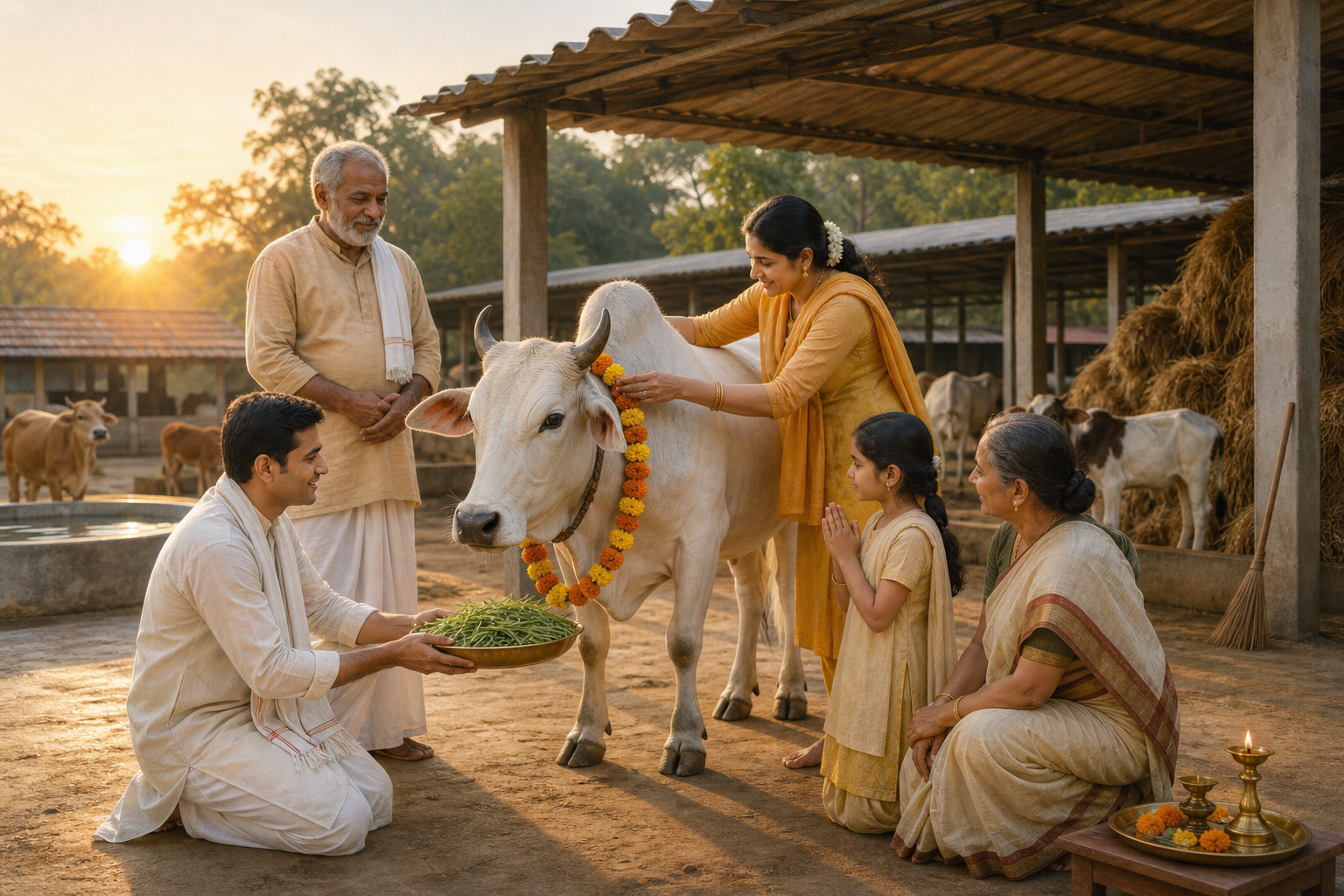
Kanuma 2026, the third day of the Sankranthi festivities in Andhra Pradesh and Telangana, falls on January 15. The day centers on Govardhana Puja (Go puja), where cows and bulls are worshipped in gratitude for their role in agrarian life. Families decorate cattle, prepare offerings from the new harvest, and visit temples, recalling Sri Krishna’s…
-
See the World Anew: Krishna’s Test of Duryodhana and Yudhishthira on Perception and Dharma

A classic teaching from the Mahabharata tradition, guided by Sri Krishna’s wisdom, shows how perception shapes reality. In the story, Duryodhana sees faults everywhere while Yudhisthira discerns redeeming qualities in all, revealing the inner lens each brings to the world. Read alongside the Bhagavad Gita’s discipline of equanimity (samatva), the lesson becomes a method for…
-
Srimad-Bhagavatam: The Living Book-Form of Sri Krsna Revealing Ten Transcendent Themes

Srimad-Bhagavatam is honored in Vaisnava tradition as the “book form” of Lord Sri Krsna, unfolding twelve cantos that mirror His bodily limbs and present ten transcendental topics. Lord Sri Caitanya Mahaprabhu praised it as pramanam amalam—“the spotless authority”—while Srila Rupa Gosvami highlighted hearing the Bhagavatam as a most potent limb of bhakti-yoga. Its narrative and…
-
Bhagavad Gita Leadership Lessons: Timeless Strategies for Ethical, Resilient Decision-Making
The Bhagavad Gita articulates a clear, practical framework for ethical leadership and resilient decision-making. Grounded in Dharma and Karma Yoga, it strengthens self-leadership, reduces anxiety through non-attachment, and aligns choices with long-term social good. The dialogue between Sri Krishna and Arjuna models calm, courageous action under uncertainty. Compassion, dialogue, and Lokasangraha reposition leadership as stewardship…
-
CC Madhya 10.62–73 Explained: Devotional Wisdom and Harmony at ISKCON Govardhan Eco Village

This academic yet accessible class at ISKCON Govardhan Eco Village examined Sri Caitanya-caritāmṛta, Madhya-līlā 10.62–73, drawing out enduring principles of humility, service, and attentive devotion. H.G. Navin Nirad Prabhu connected scriptural insights to daily routines, emphasizing nāma-saṅkīrtana, compassionate conduct, and steady sādhana. The session highlighted how Lord Chaitanya Mahaprabhu’s teachings translate into ethical action and…
-
Why Krishna Calls Yoga ‘Evenness of Mind’: Timeless Guidance for Inner Strength

Bhagavan Sri Krishna’s teaching in Bhagavad Gita 2.48 defines Yoga as evenness of mind, placing equanimity at the heart of ethical action. This balanced awareness steadies decision-making amid success and failure, transforming stress into resilience and clarity. Practically, brief breath awareness, mindful pause, and dharmic intention help train this steadiness in daily life. The approach…
-
Revealing Krishna’s Intimate Disguise: Masseuse Lila and the Prayer to Serve Sri Radha

This installment of the miniseries examines a tender lila where Sri Krishna appears as a masseuse, emphasizing humility and seva in the Bhakti Tradition. It unpacks how the prayer to serve Sri Radha’s lotus feet expresses refined devotional love grounded in action. The narrative connects core themes—service, compassion, and ethical care—to shared values across Hinduism,…
-
Unveiling the Supreme Goal: A Dharmic Journey Through Knowledge, Yoga, Service, and Unity

This reflection presents a Dharmic synthesis of the human spiritual journey, grounded in Vaishnava scripture and open to inter-traditional harmony. It explains how knowledge, sacrifice, yoga, austerity, and action converge on the realization of Sri Krsna, the Personality of Godhead. It integrates these insights with the broader spirit of Sanatana Dharma, affirming unity across Hindu,…
-
When Darkness Shields the Divine: Kali’s Jackal Guardianship of Infant Krishna by the Yamuna

This exploration examines a striking puranic motif in which Kali, manifesting as a jackal, guides and protects the infant Krishna along the Yamuna’s banks. It interprets the scene through the Harivamsa–Vishnu Purana tradition, highlighting how Shakti safeguards the unfolding of Sri Krishna’s destiny. Readers gain a clear, academic understanding of the symbolism—darkness shielding light—while appreciating…
-
Utpatti (Utpanna) Ekadashi Vrat Katha: Bhavishyottara Purana Origin, Significance, Benefits

Utpatti (Utpanna) Ekadashi is described in the Bhavishyottara Purana as the origin of the Ekadashi vrata, revealed when Ekadashi Devi emerged from Vishnu’s energy to vanquish the asura Mura. In response to Arjuna’s inquiry, Sri Krishna extols the vrata as a disciplined path to purification, steadiness, and grace. Observed on Margashirsha Krishna Paksha Ekadashi (regional…
-
Why Sri Krishna’s Yellow Pitambara Still Inspires: Sacred Symbolism, Dharma, and Unity

Sri Krishna’s yellow pitambara is more than attire; it is a layered symbol of sattva, wisdom, and compassionate action. Rooted in Vaishnava texts and art, the garment visually echoes the Bhagavad-Gita’s call to clarity and dharma. Its earth-toned associations connect spiritual insight with ecological stewardship and community care. Rituals and festivals amplify these meanings through…
-
Fifty Transcendent Qualities of Sri Krishna: Rupa Gosvami’s Timeless Portrait of Divinity

Srila Rupa Gosvami’s classic enumeration of Sri Krishna’s qualities offers a clear, contemplative framework for devotion and ethical living. Organized across themes—beauty, intellect, virtue, compassion, and sovereignty—it provides a practical syllabus for daily reflection. Readers gain a succinct yet comprehensive guide to cultivate truthfulness, compassion, self-control, and forgiveness. The portrait aligns naturally with the shared…
-
18 Parvas of Mahabharata: A Life-Changing Guide to Dharma, War, and Wisdom

This guide to the 18 Parvas of the Mahabharata dispels the misconception that the epic breeds disorder, showing instead how it clarifies dharma and strengthens ethical discernment. It outlines each Parva—from Adi to Svargarohana—highlighting key teachings such as Vidura-niti and the Bhagavad Gita. Readers across Hinduism, Buddhism, Jainism, and Sikhism will find shared values like…
-
Arjuna’s Battlefield Anxiety: A Timeless Guide to Dharma, Mental Resilience, and Action

The Bhagavad Gita’s opening presents Arjuna in acute distress—trembling, disoriented, and morally torn—offering a precise portrait of battlefield anxiety. Rather than pathologizing, the text frames his vishada as the starting point for ethical clarity and inner steadiness. Krishna’s counsel models a pragmatic sequence: reframing, values-based duty, equanimity, breath regulation, and focused attention. These principles map…
-
Journey to Goloka Vrindavan: Transformative Bhakti, Silent Ecstasy, and Dharmic Unity
This reflection explores Gopa Kumara’s journey in Goloka Vrindavan, where devotion matures into serene fulfillment. It explains how the brajvasis’ speechless ecstasy exemplifies the depth of bhakti and the transformative power of remembrance. Readers gain clear, actionable insights: refine longing, seek community with realized devotees, and accept gentle guidance on the path. The narrative highlights…
-
‘Get Up and Fight’: Krishna’s Counsel to Arjuna on Duty, Detachment, and Everyday Courage

Krishna’s directive to Arjuna—“get up and fight”—is a disciplined call to fulfill duty with compassion, detachment, and clarity. Framed within Dharma-Yuddha and Kshatra Dharma, it rejects aggression and centers ethical responsibility. Through Karma Yoga, one acts without attachment to results, supported by equanimity and reflective practice. The guidance adapts to everyday life: addressing injustice, sustaining…
-
Sat-sanga Reflections (08.11.2025): Remembering Vamsi, Gita Review, and the Joy of Prema-bhakti

This sat-sanga (08.11.2025) with HH Krishna Kshetra Swami concluded a systematic review of the Bhagavad Gita and turned to an illuminating exploration of prema-bhakti. Drawing on Srimad-Bhagavatam, the session explained how mature devotion may express itself as tears, laughter, singing, dancing, and reverent līlā, arising naturally from deep absorption. Remembering the vamsi (Sri Krishna’s flute)…
-
Abhimanyu’s Final Stand: Why His Death in the Mahabharata Became an Unyielding Victory
Abhimanyu’s stand on the thirteenth day of the Kurukshetra War illustrates how a life can be “killed but not defeated” when Dharma is upheld. This analysis explains why his death represents an ethical victory that transcends the battlefield. It clarifies the tactical context of the Chakravyuha and the violation of Dharma-Yuddha that led to his…