-
Kali Yuga and Immediate Karma: A Clear, Cross-Dharmic Guide to Action, Reaction, and Dharma

This essay explains why the belief that actions trigger swift, sometimes near-immediate consequences in Kali Yuga is both philosophically coherent and practically observable. It situates the claim within Hindu cosmology and classical karma theory (sanchita, prarabdha, kriyamana; drishta/adrishta-phala). It shows how social and technological conditions of Kali Yuga create faster feedback loops for both harm…
-
Beyond Perfection: Liberating Dharmic Wisdom on Impermanence, Dharma, and Divine Order

Perfection, as popularly pursued, continually recedes because all conditioned things are impermanent; dharmic traditions convert this problem into a path by aligning aspiration with dharma and the Divine Order. Drawing on the Bhagavad Gita, Upanishads, Yoga philosophy, and the broader insights of Buddhism, Jainism, and Sikhism, the essay reframes success as excellence grounded in clarity,…
-
Ego (Ahamkara), Conflict, and Liberation: A Dharmic Synthesis with Practical Tools for Peace

This article examines why ego (ahamkara) is repeatedly identified by Hinduism, Buddhism, Jainism, and Sikhism as a root driver of conflict, and how each tradition prescribes precise methods to transform it. It clarifies the mechanism from avidya to anger found in the Bhagavad Gita and Yoga philosophy, then correlates those insights with Buddhist anatta, Jain…
-
Eternal Paradox of Being: Nothing Is Lost, Yet Everything Changes in Hindu-Dharmic Thought

This essay decodes the paradox “Nothing can be wiped out; but nothing remains same” through the lens of Hindu philosophy and the wider dharmic traditions. It shows how the Upanishads, the Bhagavad Gita, Advaita, Samkhya, Nyaya-Vaisheshika, Buddhism, Jainism, and Sikhism converge on a coherent view: being persists while forms transform. Readers gain clear definitions (sat,…
-
Desire Beyond Need: Dharmic Strategies to Transform Craving into Clarity and Freedom

This article clarifies why, in Hindu thought, desire is not a need but a demand that reaches beyond need—and how that demand can be guided rather than suppressed. It maps desire across the puruṣārthas and pañca-kośa models, showing when desire serves dharma and when it becomes compulsion. It integrates insights from the Bhagavad Gita, Yoga…
-
Andhatāmisra Unveiled: Inside Hinduism’s Blinding Hell of Deceit, Karma, and Justice

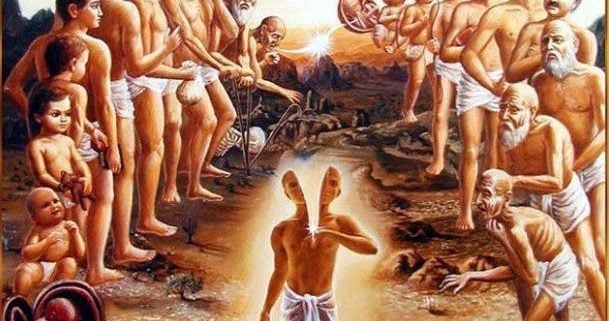
Andhatāmisra, the purāṇic “realm of blinding darkness,” illuminates Hinduism’s precise view of karmic retribution for deceit, cruelty, and willful ignorance. Drawing on sources such as the Garuḍa Purāṇa and the Bhāgavata Purāṇa, it explains how Naraka functions as a purgative, finite state aligned with Dharma and Adharma. The imagery of darkness serves as both cosmic…
-
From Adversity to Excellence: How Dharmic Wisdom Transforms Hardships into Strength

This article explains how adversity functions as a deliberate curriculum for strength and wisdom across Hinduism, Buddhism, Jainism, and Sikhism. It synthesizes dharmic teachings with contemporary research on resilience to present a unified, practical method. Readers gain a daily protocol that combines Karma Yoga, meditation, yogic breathing, ethics, and seva to build measurable resilience. Clear…
-
Unraveling Karma’s ‘Complicated Play’: Dharmic frameworks of action, causality, and grace

This long-form guide unpacks why “Gurudev says that it is a complicated play,” showing how Karma operates across intention, action, impressions, and outcomes. It compares Hindu, Buddhist, Jain, and Sikh frameworks, clarifying doership, responsibility, and grace without collapsing their differences. Readers gain a precise map of sañcita–prārabdha–kriyamāṇa, Buddhist intentionality (cetanā) and dependent origination, Jain karmic…
-
Shani Sade Sati for Makara Rashi: Mastering the Final 2.5 Years in Aquarius (Paada Shani)

Shani Sadesati for Makara Rashi culminates when Saturn enters Aquarius (Kumbha), initiating the final 2½-year Paada Shani phase. Because Aquarius is Saturn’s own sign and Moolatrikona, the transit is strong, procedural, and results-oriented. As the 2nd house from the Capricorn Moon, Aquarius concentrates Saturn’s discipline on finances, speech, family duty, and value systems. Outcomes vary…
-
Vrishabha Rashi Janma Shani Decoded: Shani Sade Sati Effects, Timing, and Powerful Remedies

Janma Shani—the middle 2½ years of Shani Sade Sati for Vrishabha Rashi—begins when Saturn transits Taurus, joining the natal Moon. This period often feels intense yet formative, maturing habits, relationships, and professional conduct through discipline and steady effort. Because Shukra (Venus) is a friend of Shani, Taurus Moon natives can convert restraint into elegant simplicity…
-
Parabhava 2026–2027 (Ugadi to Ugadi): Transform Obstacles into Opportunity with Vedic Insights

Parabhava Nama Samvatsaram (2026–2027) begins on Ugadi, March 19, 2026, and invites a disciplined, optimistic approach to karmic transformation, deep reflection, and overcoming obstacles. As the 40th year in the 60-year Hindu calendar cycle (Śaka 1948), it encourages clarity of intention, ethical restraint, and steady practice. Practical frameworks such as Aaya–Vyaya 2026–2027 support prudent budgeting,…
-
Are Animals and Plants Free from Karma? A Dharmic Deep Dive into Choice and Consciousness

Do animals and plants accrue karma like humans? This comprehensive, dharmic analysis explains why many Vedantic interpretations hold that animals and plants seldom generate fresh, morally binding karma, while humans—endowed with reflective awareness—carry heavier responsibility. It synthesizes perspectives from Hinduism, Buddhism, Jainism, and Sikhism, showing a shared insight: karmic weight scales with intention and choice.…
-
Shani Sade Sati for Kumbha Rashi: Master the Final 2.5 Years (Paada Shani), 2025–2027

Shani Sade Sati for Kumbha Rashi culminates in Paada Shani—the last 2½ years when Saturn moves through Meena Rashi (Pisces), typically from late March 2025 to mid-2027. In Vedic astrology, this final phase emphasizes the second house from the Moon, refining finances, family dynamics, speech, diet, and daily discipline. Saturn’s special aspects during this period…
-
Wealth, Karma, and Krishna: Evidence‑Based Dharmic Guidance to Earn, Spend, and Give with Peace

This long-form analysis explains how money reflects inner consciousness and how Krishna’s sanction, karma, and purushartha interact to shape financial outcomes. It integrates Hindu philosophy with Buddhist Right Livelihood, Jain aparigraha, and Sikh principles of kirat karo, vand chhako, and seva to offer a unified ethic. Drawing on Srila Prabhupada’s reminders about destiny and greed,…
-
12 Evidence‑Backed Advantages of Spirituality for Resilience, Clarity, and Inner Peace

Spirituality, practiced within the plural dharmic streams of Hinduism, Buddhism, Jainism, and Sikhism, offers reliable advantages during life’s hardest moments. Evidence from contemplative science shows that meditation, pranayama, and compassion training calm the nervous system, improve heart rate variability, and sharpen decision-making. Ethical frameworks like dharma, ahimsa, and seva provide clarity under moral pressure while…
-
Karma in Hinduism: A Definitive, Practical Guide to Action, Consequence, and Liberation

Karma in Hinduism is a precise ethical and philosophical system linking intention, action, and consequence within the larger pursuit of moksha. Drawing on the Bhagavad Gita, the Upanishads, and allied schools of Hindu philosophy, this long-form guide explains the threefold temporal model—sanchita, prarabdha, and agami—alongside the Gita’s categories of karma, akarma, and vikarma. It clarifies…
-
Suchimukham Unveiled: The Chilling Karmic Price of Hoarded Wealth in Hindu Dharma

Suchimukham, the needle-mouthed hell in Hinduism, powerfully encodes the karmic consequences of hoarding wealth and neglecting compassion. Drawing on the Vishnu Purana, Devi Bhagavata Purana, and Garuda Purana, this analysis situates Suchimukham within a reformative, not eternal, Puranic model of Naraka. It clarifies the difference between prudent stewardship and miserliness, showing how dharma guides artha…
-
Why Pleasure Escapes Us: Hindu Wisdom on Desire, Avidya, and the Path to Lasting Ananda

Why does pleasure fade so quickly, and why does desire return so reliably? This long-form analysis uses Hindu philosophy—Bhagavad Gita, Yoga Sutras, and Upanishads—to explain the psychology of craving via avidya, raga-dvesha, samskara, and the gunas. It clarifies the distinction between sukha (contact-based pleasure) and ananda (enduring joy) and situates kama within the purusharthas under…
-
Karma and Karmaphala in the Ramayana and Mahabharata: Dharma, Consequence, and Liberation

This essay reads the Ramayana and Mahabharata as precise ethical maps of karma (action) and karmaphala (consequence), showing how intention, duty, and context shape outcomes. It explains sañchita, prārabdha, and āgāmi karma, and situates them within dharma and the puruṣārthas. Through case studies—Daśaratha’s unintended harm, Rāvaṇa’s hubris, the dice hall’s complicity, Karna’s complexity, and Bhīṣma’s…