
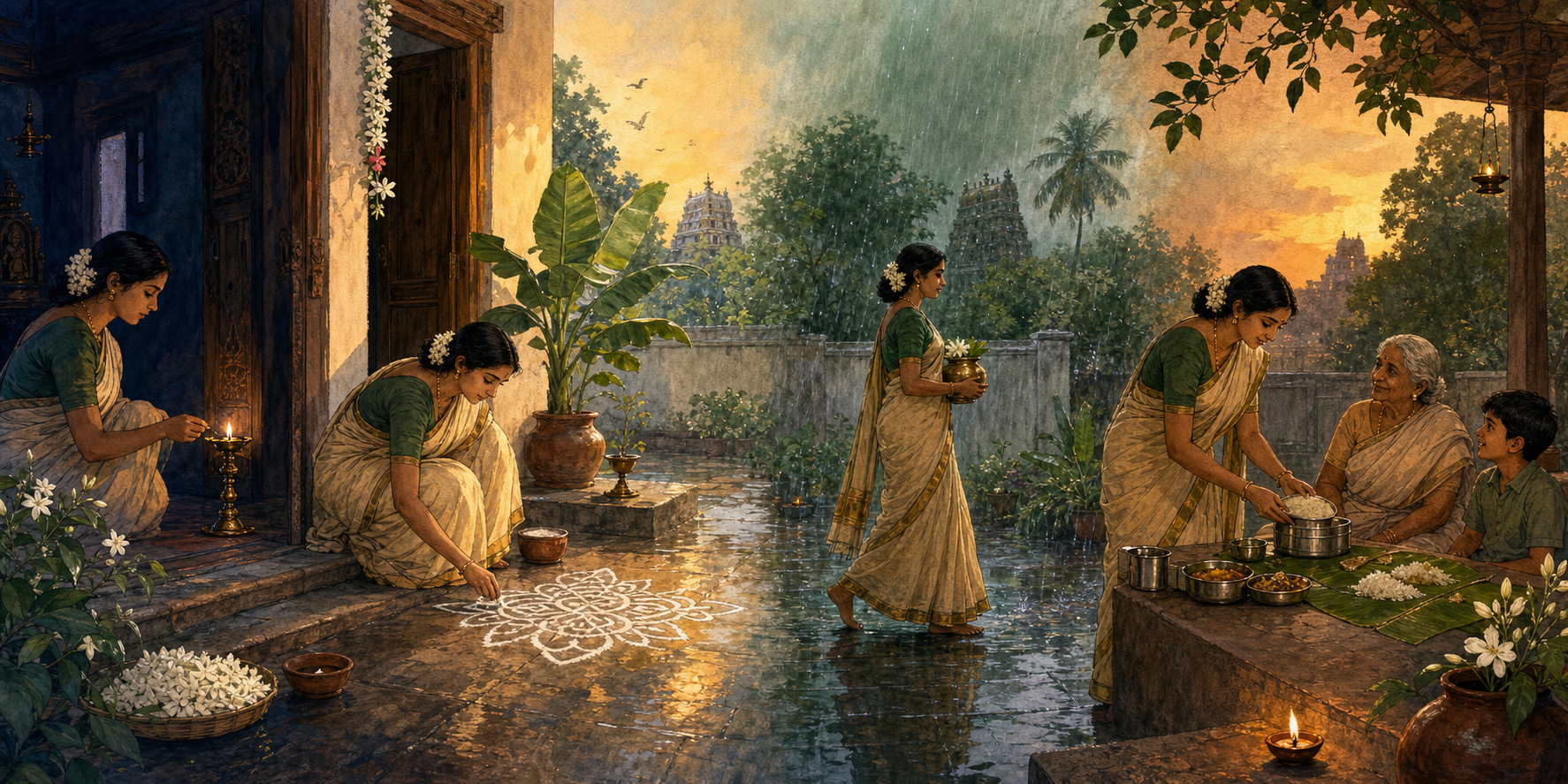
If your family remembers the names of sacred months but your week still runs entirely by work, school, and appointment calendars, the missing piece probably isn’t belief. A date on a calendar doesn’t yet tell your body what to do.
Tamil sacred time becomes tangible when a season changes one concrete habit: when you wake, what you sing, how you mark the threshold, what effort you carry, or how you feed another person. You don’t need to reproduce an entire temple festival at home. You need a practice small enough to repeat and specific enough to retain its meaning.
Tamil sacred time is a choreography, not a list of dates
The Tamil religious imagination has long treated place, season, body, and divinity as related. The Tolkappiyam associates Varunan with the seashore, Ventan with cultivated land, Korravai with arid country, Mayon with forests, and Ceyon with the mountains. Ceyon, the radiant mountain youth, develops in Tamil devotion as Murugan, the Beautiful One.
This landscape theology gives you a practical way to understand embodied devotion. The land isn’t decorative scenery around worship. Mountains suggest ascent and disciplined effort. Rivers carry renewal. Cultivated fields make gratitude and dependence visible. The threshold of a home becomes a place to draw a kolam because crossing from outside to inside is itself meaningful.
Embodied bhakti does not mean making devotion physically extreme. It means allowing a sacred teaching to govern time, voice, movement, material, and relationship. Before choosing a seasonal observance, ask five questions:
- Time: What will change in your day: waking, eating, resting, or gathering?
- Voice: Which hymn, mantra, or divine name belongs to this observance and your sampradaya?
- Movement: Will you sit in silence, draw a kolam, walk to a temple, dance, bow, or perform seva?
- Material: What will you handle with attention: a lamp, flowers, water, food, musical instruments, or the implements of service?
- Relationship: Who should receive gratitude, hospitality, instruction, protection, or reconciliation because you observed this day?
If an observance changes none of these, it can easily remain a social-media greeting rather than a lived vrata. Choose one answer from each category only if you can sustain it. One sincere bodily commitment is more useful than an ambitious programme abandoned after two days.
Margazhi: build a winter rule you can actually repeat
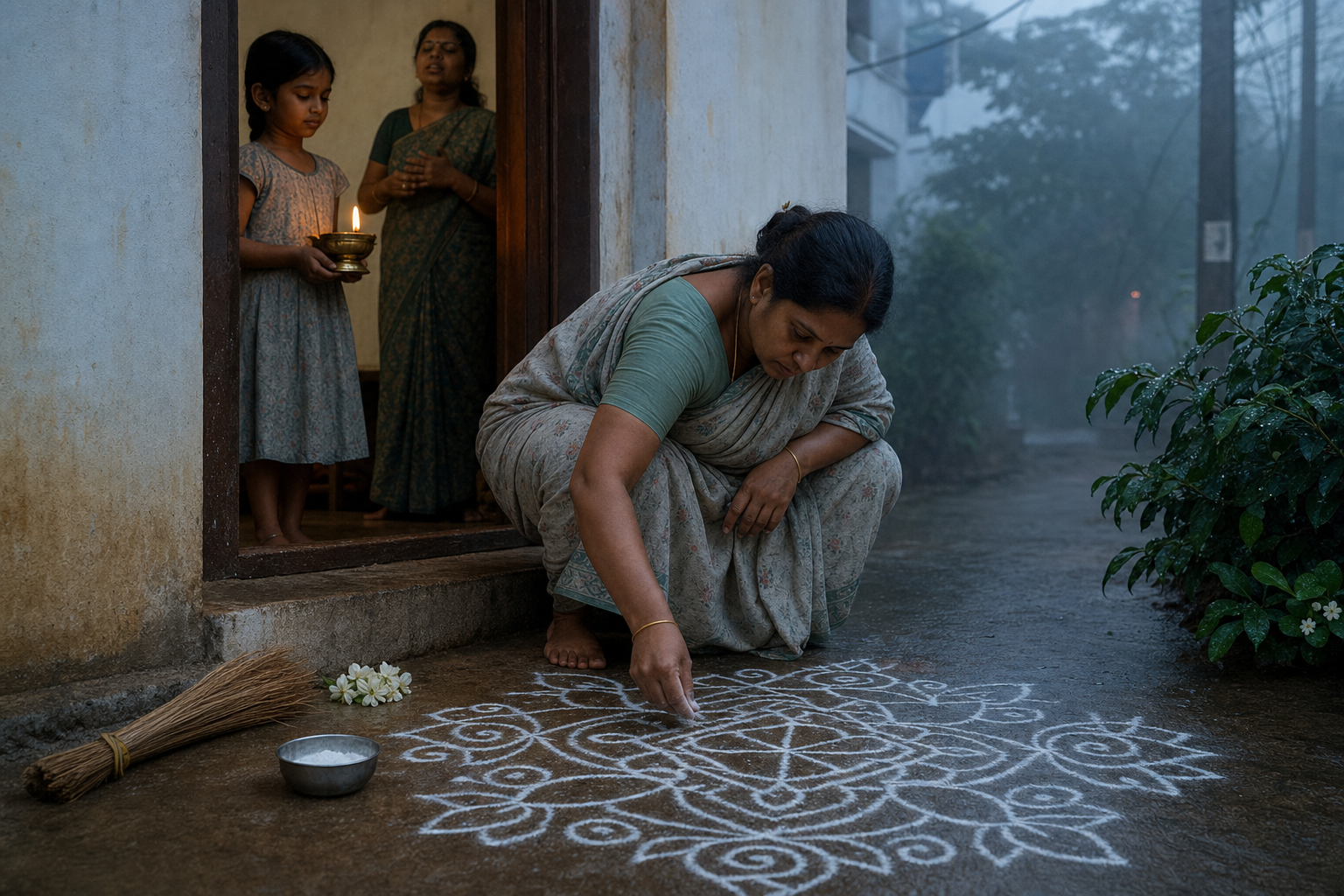
Margazhi falls roughly from mid-December to mid-January and overlaps with Dhanurmasa in many Vaishnava traditions. Its longer nights and quieter atmosphere lend themselves to inward practice after the publicly expressive festival months that lead through Deepavali. Bhagavad Gita 10.35 identifies Mārgaśīrṣa as the divine presence among months, giving the season a scriptural as well as regional resonance.
Margazhi is sometimes reduced either to the Chennai concert calendar or to a demand that everyone wake at an impossibly early hour. Both readings miss its discipline. Carnatic music and Bharatanatyam can become vehicles of bhakti, while early rising creates protected time for prayer. The point is concentrated attention, not exhaustion or cultural consumption.
Use the following sequence to design a Margazhi rule for your household:
- Begin with your lineage. Tamil Vaishnava practice gives a central place to Andal’s Tiruppavai and the Pavai Nombu. Shaiva households may orient the season toward Shiva and Arudra Darshanam. Don’t combine practices merely because they occur in the same month; first learn what your family, acharya, or temple treats as the anchor.
- Choose an honest time. Brahma-muhurta chanting and meditation may occur around 3–5 a.m., but that timing is one end of a spectrum that also includes a lamp at dusk. If waking that early leaves you unable to fulfil the day’s responsibilities, begin with fifteen protected minutes at the earliest sustainable time.
- Give the practice a visible place. Clean the shrine or threshold, draw a modest kolam if that belongs to your custom, and prepare the lamp, text, or instrument before going to bed. Removing morning decisions protects consistency.
- Keep one vocal and one silent element. Recite the same designated hymn, verse, or mantra, then sit quietly for a few minutes. Repetition lets meaning deepen; changing the programme every morning usually prevents that depth.
- Add one communal encounter each week. Attend a temple recitation, listen closely to a Carnatic performance, support a Bharatanatyam student, or gather family members to sing. The aim is to let individual sadhana and inherited culture reinforce one another.
The month also contains distinct theological pivots. Vaikuntha Ekadasi is marked in Vaishnava temples through special gateways symbolising entry into the divine realm, while Arudra Darshanam honours Shiva as Nataraja. At the season’s cusp, Pongal turns attention toward harvest, gratitude, and ecological dependence. These are not interchangeable attractions on a festival itinerary. Let the day proper to your tradition intensify the rule you have already been keeping.
A realistic weekday observance might consist of a lamp, one assigned hymn or prayer, and five minutes of silence. On a day off, add a kolam, a temple visit, or attentive participation in music and dance. That rhythm is modest, but it gives Margazhi a bodily shape that can survive employment, parenting, study, and diaspora life.
Murugan’s year trains different forms of courage
Murugan is often flattened into a “God of War,” but Tamil devotion presents a more demanding ideal: power directed by discernment. The Vel received from Parvati is not merely a weapon. Devotees understand it as the gnana vel, the spear of knowledge that pierces confusion. Even Murugan’s victory over Surapadman culminates in transformation rather than simple destruction: the former adversary becomes the peacock vehicle and rooster emblem. The enemy’s pride is converted into humility and alertness.
That pattern gives you a better way to approach Murugan’s festivals. Don’t ask only what happened in the sacred narrative. Ask what form of disciplined courage the season requires from you. The Gregorian spans below are for orientation; use the annual date followed by your family or temple.
| Festival and season | Sacred emphasis | Question for your practice |
|---|---|---|
| Skanda Sashti, Aippasi (Oct–Nov) | Murugan’s triumph and the restoration of order | Which recurring form of fear, pride, or confusion needs both a restraint and a reparative action? |
| Thaipusam, Thai (Jan–Feb) | The Vel, the full moon of Thai, and the discipline of bearing a burden | What bounded responsibility can you carry steadily without turning the effort into a performance? |
| Panguni Uttiram, Panguni (Mar–Apr) | Murugan’s marriages and the union of complementary paths | Where has discipline become dry, or spontaneity become unreliable? What would restore the missing half? |
| Vaikasi Visakam, Vaikasi (May–Jun) | Murugan’s manifest appearance | What devotional study or family practice is ready to begin rather than merely remain an intention? |
| Aadi Krithigai, Aadi (Jul–Aug) | Murugan’s upbringing and nurturance | Who formed your courage, and how will you return that care through gratitude or service? |
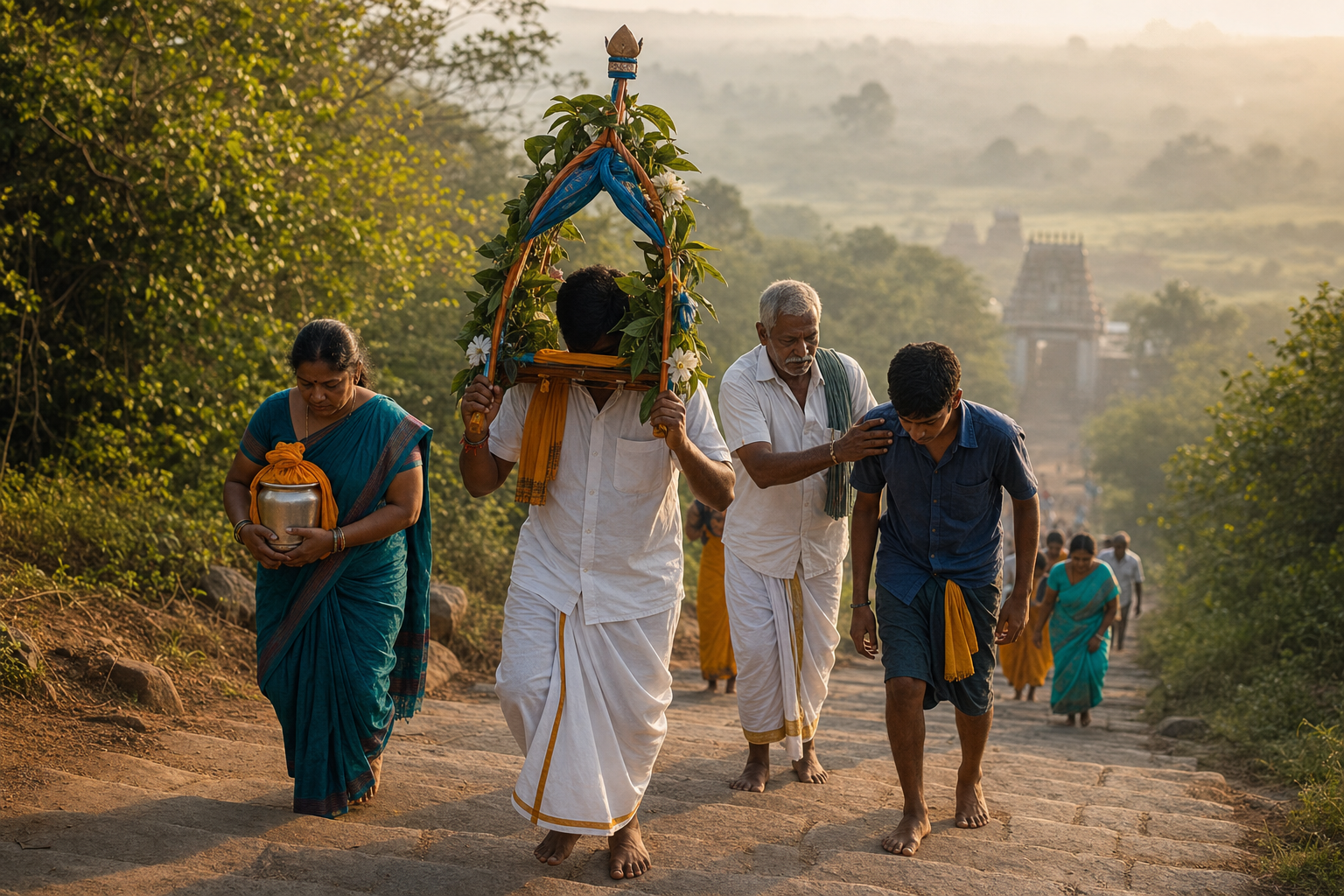
Thaipusam makes the distinction between embodied devotion and spectacle especially important. Its intertwined narratives connect the illuminating Vel with Indumban’s task of bearing twin hills on a balanced pole. A burden acquires devotional meaning through intention, discipline, and surrender; weight alone does not sanctify it. If a vow changes food, sleep, load-bearing, or physical exertion, don’t improvise it from images seen online. Learn its requirements from a responsible temple or lineage guide, and seek appropriate medical guidance when the practice could affect your health.
Murugan’s marriages offer another correction to one-sided practice. Devayani represents an ordered and metropolitan Vedic world, while Valli brings the fearless vitality of the Kurinji foothills and a love that precedes formal convention. Their complementary presence holds ritual discipline and spontaneous devotion together. If your practice has become mechanical, restore affection. If it consists only of emotion, give it a time, text, and commitment.
Pilgrimage can be approached with the same precision. Murugan’s six sacred abodes are Tirupparankunram, Thiruchendur, Palani, Swamimalai, Thiruttani, and Pazhamudircholai. They express initiation, victory, renunciation, instruction, reconciliation, and compassion. Before planning a journey, identify the facet you most need to encounter. That turns an itinerary into a pilgrimage and gives you a question to carry home after the temple visit ends.
Make the practice portable without making it generic
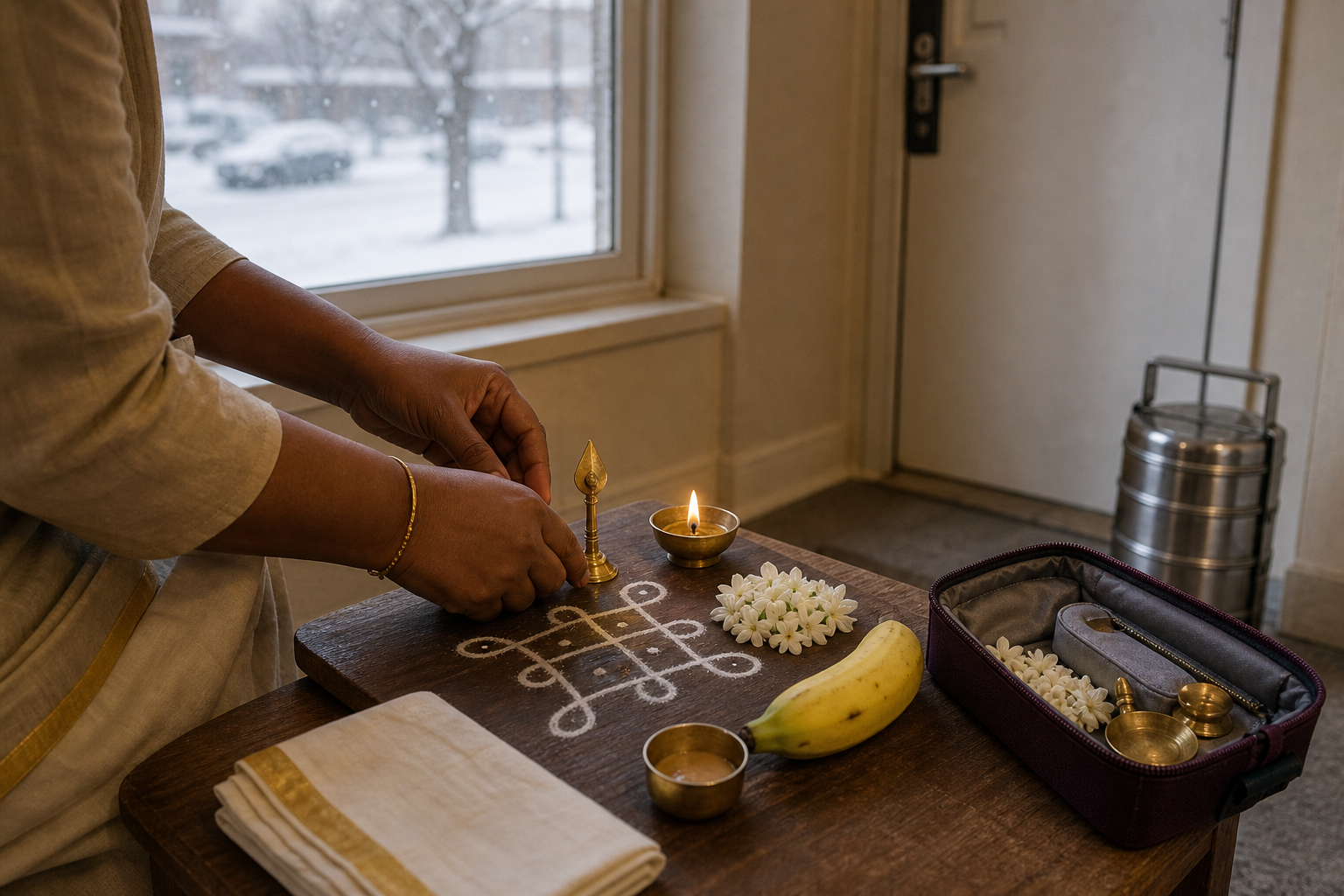
Diaspora life creates a practical tension. You may lack the temple schedule, extended family, ingredients, climate, or artistic ecosystem that once held a festival together. Simplification is often necessary. Vagueness is not.
Simplify the objects, not the identity of the observance
A neighbouring South Indian example makes the distinction clear. Vishu belongs to the Malayalam calendar, not the Tamil one. Yet a Vishu celebration in the Pyrenees retained its centre with a small brass lamp, incense, a Kerala mundu sari, and the produce that was available. Its portability offers a lesson for Tamil practice without erasing the difference between traditions: preserve the observance’s name, deity, narrative, and central act even when the material arrangement must shrink.
When you adapt, describe the adaptation honestly. A useful household distinction is:
- Lineage practice: the hymn, vrata, temple act, or theological meaning received through the tradition.
- Family custom: the food, music, route, decoration, or gathering pattern particular to your household.
- Local accommodation: the change made because of work hours, climate, travel, safety rules, ingredients, or available space.
Those labels prevent two common errors. You won’t mistake every family habit for a universal command, and you won’t present a convenient substitute as an ancient rite.
Use a thirty-minute home framework
The following is a planning framework, not a prescribed liturgy. Confirm the appropriate prayer, offering, and vrata rules with your own family or sampradaya.
- Minutes 0–5: prepare the boundary. Wash, clear the shrine or table, silence devices, and place the required objects deliberately.
- Minutes 5–10: establish presence. Light a lamp where open flame is permitted, make the customary offering, and name the deity or purpose of the day.
- Minutes 10–20: recite or sing. Use the text that actually belongs to the season, such as Tiruppavai in its Vaishnava Margazhi setting, rather than selecting a random devotional track.
- Minutes 20–25: become still. Let the recitation settle. Notice the desire, fear, resentment, or duty that the observance is asking you to see clearly.
- Minutes 25–30: convert insight into conduct. Decide on one act of seva, restraint, gratitude, study, or reconciliation and put it on the calendar.
If you are travelling, retain the same sequence in shorter form: prepare, invoke, recite, become still, and act. A hotel table, trail overlook, or borrowed kitchen can support sadhana when treated carefully. If a venue forbids flames, don’t light one; attention and cleanliness are not diminished by observing a safety rule.
Let music and dance alter your attention
The Chennai Music Season brings Carnatic music, Bharatanatyam, kolam, sabha culture, and devotional repertoire into an unusually dense public ecosystem. Its value is not confined to professional artists. A listener also practises attention.
Before a performance, learn which deity, sacred episode, or devotional mood anchors at least one item. During it, notice how word, melody, rhythm, gesture, and facial expression carry that meaning through the body. Afterwards, write down one image or phrase that changed your understanding, then bring it into the next prayer period. This keeps the experience from ending as applause and consumption.
Community organisers can apply the same principle abroad. A Margazhi festival in Sacramento in January 2025 included second-generation Indian American performers, showing how the artistic season can create a portal into identity as well as a stage. Give young performers more than a slot: provide the text’s meaning, identify the devotional context, include elders without making them the sole authorities on stage, and leave room for attentive listening.
Complete the rite through land, food, and relationship
Seasonal worship becomes distorted when the altar is immaculate but the surrounding relationships remain neglected. Pongal’s agrarian turn places gratitude within a chain of soil, water, animals, cultivation, cooking, and community. Murugan’s mountain identity similarly reminds you that ecology is theological, not merely aesthetic.
Put that recognition into conduct. Reduce avoidable waste from decorations and offerings. Learn where the festival food came from. Thank the person who cooked it. Share it without treating hospitality as an opportunity to display abundance. When outdoors, leave the place cleaner than you found it. These acts don’t replace puja; they prevent puja from becoming detached from the world it sacralises.
A shared meal can also open a serious conversation across cultures. A vegetarian Vishu meal in a small Spanish village created an occasion to discuss Hindu faith, yoga, meditation, and reverence for the Divine in others. If you host such a meal, explain one practice accurately and invite one honest question. Don’t claim that Hinduism, Buddhism, Jainism, and Sikhism are interchangeable. Shared commitments such as inner discipline, ahimsa, meditation, seva, and reverence for nature become more meaningful when each path’s distinct language is respected.
Key takeaways
- Start with the observance’s lineage, deity, text, and central meaning before deciding which parts can be adapted.
- During Margazhi, choose a repeatable daily rule: a sustainable time, one appropriate recitation, a short silence, and one weekly communal or artistic practice.
- Read Murugan’s festivals as disciplines of discernment: victory over ego, responsible burden-bearing, balanced devotion, new beginnings, and gratitude for nurturance.
- Don’t use physical severity as a measure of sincerity. Learn demanding vows through responsible community guidance and protect your health.
- When tradition travels, simplify the material setup while naming clearly what is lineage practice, family custom, and local accommodation.
- Complete worship through conduct: service, reconciliation, hospitality, ecological restraint, and careful transmission to the next generation.
Before the next Tamil sacred month begins, choose one date and write down the bodily action that will distinguish it from an ordinary day. Prepare the text and materials in advance, tell the people who will practise with you, and keep the commitment small enough to repeat. Sacred time becomes yours not when you remember every festival, but when one festival teaches you how to live differently.
References
- DharmaRenaissance Blog — Margazhi’s Quiet Power: Chennai Music Season, Bharatanatyam, and Vishu Across Continents
- DharmaRenaissance Blog — Beyond ‘God of War’: Murugan’s origins, Vel symbolism, and Thaipusam’s transformative devotion