
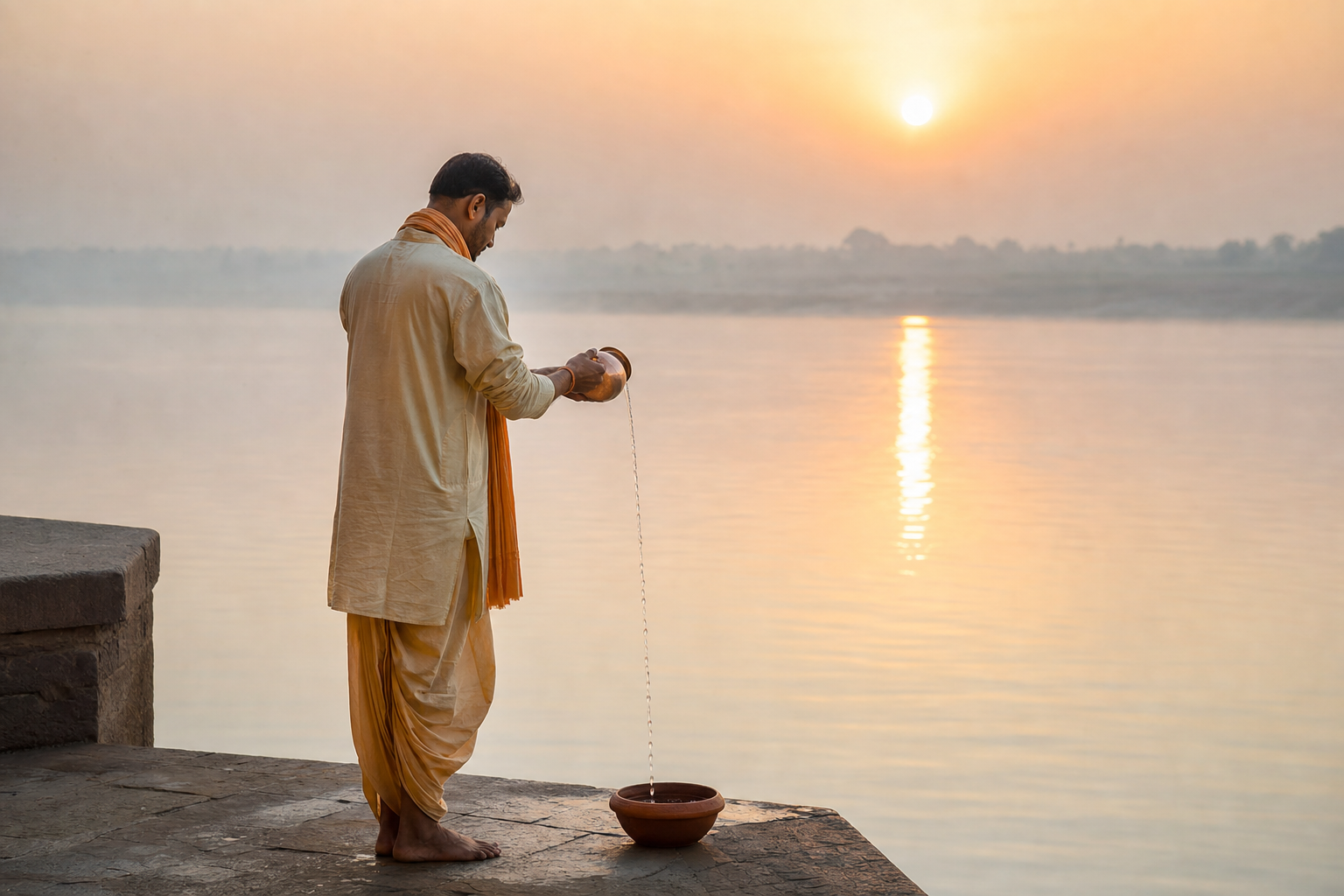
You may want to offer Surya Arghya at dawn but hesitate because every household seems to do it differently. One person insists on copper, another prescribes three offerings, and someone online turns the water into a miraculous optical device. The uncertainty can make a simple act of reverence feel needlessly difficult.
Begin with the irreducible form: face the dawn, hold fresh water in a clean vessel, make a sincere resolve, offer the water without staring at the Sun, and close with gratitude. That is enough for a personal daily practice. Family instructions and formal Sandhyāvandana should be preserved where you have received them, but ceremonial complexity is not the measure of devotion.
Key takeaways
- Offer Arghya near sunrise while facing east. If the Sun is hidden by clouds or buildings, the direction and intention still remain meaningful.
- A clean vessel and fresh water are sufficient. Copper is customary, not compulsory, and rice, sesame, or sandalwood should be added only when they belong to your tradition.
- For a simple practice, recite Om Sūryāya Namaḥ during one to three slow offerings. Follow your lineage rather than assembling unrelated mantras from the internet.
- Look toward the flowing water or the illuminated space around it, not directly at the solar disc. Water refracts light beautifully, but it is not an eye-protection filter.
- The defensible physiological benefits come from receiving a morning light cue and combining steady breath with focused attention. Surya Arghya should not be presented as a cure or a substitute for treatment.
- Use little water and return it to soil or a plant whenever practical. Reverence for a life-giving power should produce careful conduct, not waste.
What you are really offering when you pour water
Arghya is a respectful offering. Water traditionally serves as a medium of welcome and honor for a guest, teacher, or deity. When you offer it to Surya, you are not supplying something the Sun lacks. You are placing your attention, gratitude, and conduct before the most immediately visible source of light and life.
This is why Surya is approached as pratyakṣa devatā, divinity made directly perceptible. The physical Sun is present before your eyes, yet the act points beyond astronomy alone. Radiance becomes a way to contemplate intelligence, order, discernment, vitality, and the conditions that make embodied life possible.
Water adds the complementary principle. Surya expresses tejas, the power of illumination and transformation; water expresses receptivity, nourishment, cohesion, and care. Traditional interpretation also associates āp, water, with the tenderness conveyed by sneha. The resulting lesson is ethical rather than merely decorative: clarity must not become cruelty, and compassion must not become confused indulgence. You are asking to carry both light and gentleness into the day.
The textual arc behind this practice is broad. Rigveda 1.50 praises Sūrya, RV 3.62.10 addresses Savitṛ through the Gāyatrī, and Sandhyāvandana gives mantra and water offering a disciplined daily setting. The Aditya Hṛdayam of the Rāmāyaṇa tradition later presents solar contemplation as a source of courage, clarity, and resolve. These are related layers of tradition, not a single interchangeable script. A Vedic Sandhyāvandana sequence, a household Arghya, and devotional recitation may honor the same divine reality while retaining different forms.
Your saṅkalpa turns that inherited symbolism into a demand upon your own behavior. Avoid an impressive but vague wish. Choose one resolve you can examine at the end of the day: speak truthfully without humiliation, complete work you have delayed, restrain anger during one difficult exchange, or make one decision without sacrificing dharma for convenience. The offering becomes formative when the vow survives beyond the few minutes of worship.
A careful dawn ritual you can actually sustain
Prepare the place and materials
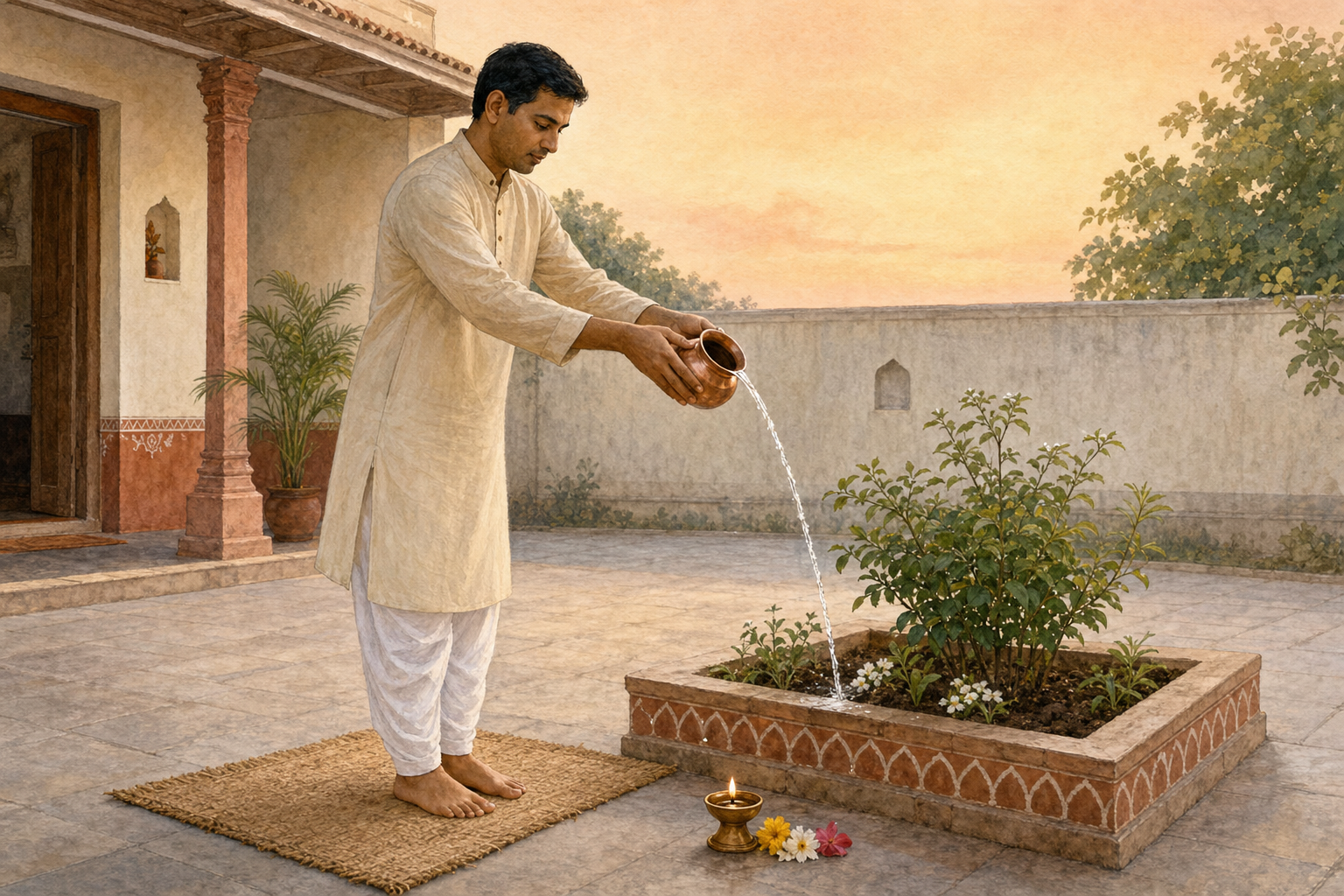
Choose a stable place where the water can reach clean soil, a plant, or a basin. Do not pour over a balcony edge, onto people below, or across a floor that will become slippery. A balcony, courtyard, terrace, open window, or quiet indoor place facing east can all serve when used responsibly.
- Vessel: A copper lota or kalaśa is customary. Any clean vessel is acceptable when copper is unavailable.
- Water: Use a small, manageable quantity of fresh, clear water. More water does not create more merit.
- Optional additions: Some households add unbroken rice, sesame, or a small amount of red sandalwood. Plain water is the sound default unless you have been taught otherwise.
- Receiving place: Use soil, a planter, or a clean bowl whose contents can later be returned to a plant. In shared housing, this preparation prevents both waste and conflict.
Perform the offering step by step
- Begin after basic morning cleanliness. Stand facing east near sunrise. Bare feet on a safe natural surface are customary, but protective footwear is sensible when the ground is cold, dirty, sharp, or unstable. If standing is difficult, sit upright and perform the same offering.
- Become still before you pour. Let your shoulders settle and take a few comfortable nasal breaths. Do not force breath retention. A relaxed, slightly lengthened exhalation is enough to interrupt the urge to rush.
- State your saṅkalpa. You may silently say: May my thought, speech, and action remain clear, compassionate, and aligned with dharma today. Add one concrete duty that needs your attention.
- Hold the vessel steadily. Bring it to about chest level and support it securely. In some family forms, the water passes through a ring made by the thumb and index finger; in others, it is poured directly from the vessel. Retain the method you inherited rather than declaring one regional form universally mandatory.
- Keep your gaze safe. Direct your attention to the water, the ground where it falls, or the surrounding dawn light. Do not stare at the solar disc, even through the stream. If a clinician has instructed you to avoid bright light, follow that instruction and perform the rite without direct visual exposure.
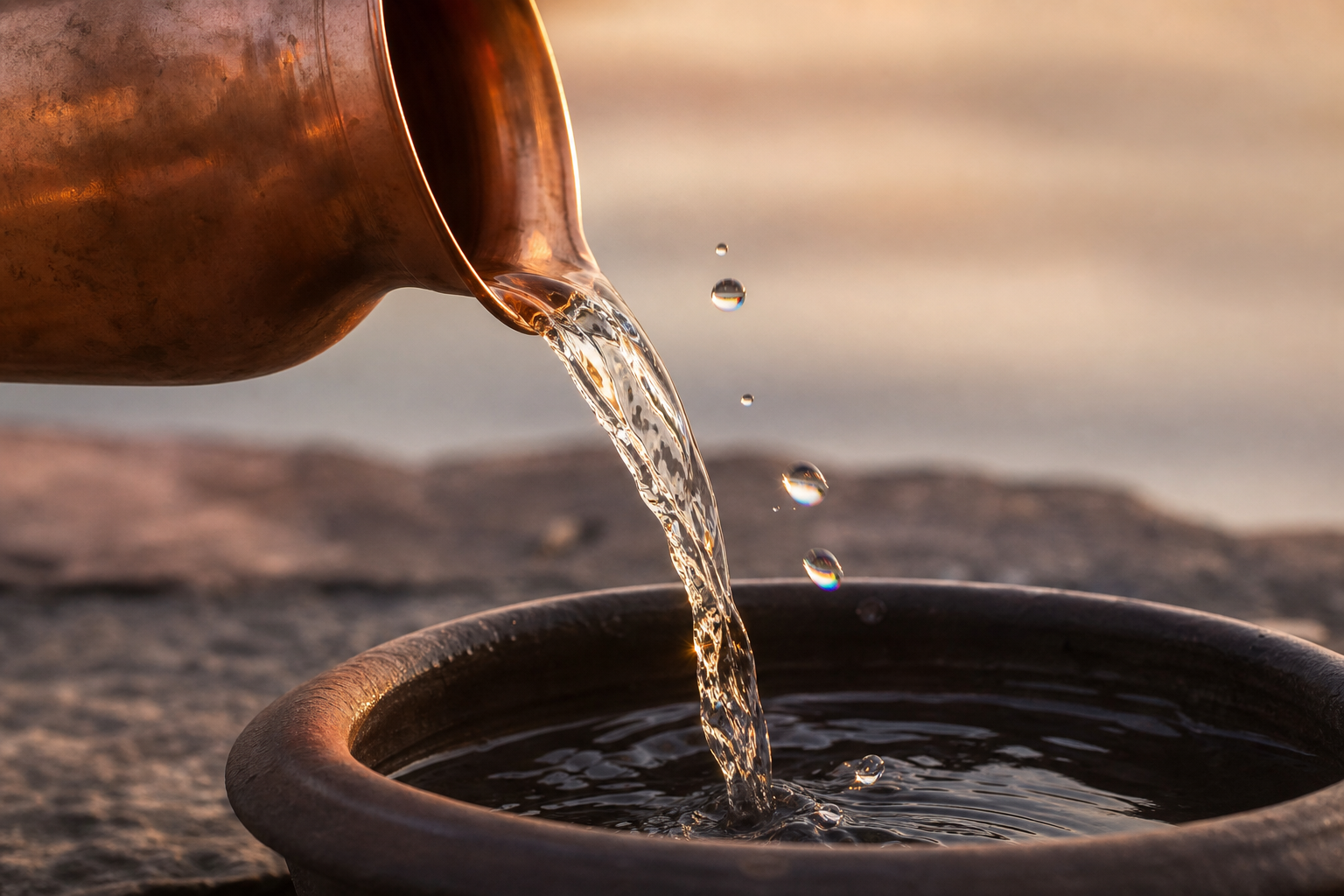
- Pour a thin, continuous stream. Recite Om Sūryāya Namaḥ as the water flows. One sincere offering is a complete beginning; one to three offerings are common in a simple household practice. Keep the hands steady and let the mantra determine the pace.
- Close without adding unnecessary drama. Join your palms in añjali. Some practitioners then touch the eyes and crown as a gesture of receiving clarity. Treat this as symbolic; there is no need to put offered water into your eyes.
- Complete the cycle responsibly. Give any suitable remaining water to soil or the roots of a plant. Wipe a wet surface immediately and clean the vessel for its next use.
Choose mantras by depth of practice, not by quantity
Om Sūryāya Namaḥ is the clearest option when you are beginning. If your household invokes the twelve Ādityas, retain their traditional order: Mitra, Ravi, Sūrya, Bhānu, Khaga, Puṣan, Hiraṇyagarbha, Marīci, Āditya, Savitṛ, Arka, and Bhāskara. Use the grammatical mantra forms taught in your lineage rather than improvising them from the bare names.
The Gāyatrī Mantra to Savitṛ may accompany the practice when it already belongs to your discipline. The bīja formula Om hrām hrīm hraūm saḥ sūryāya namaḥ is also used in some traditions, but a longer or more esoteric formula is not automatically superior. If you have learned Sandhyāvandana, follow its complete sequence, including its prescribed three Arghyas, prāṇāyāma, and Gāyatrī-japa. A short household method should not be represented as a replacement for that structured observance.
Sacred science without medical or optical mythology
The phrase sacred science becomes useful only when different kinds of claims remain distinct. Dharma can give an action theological meaning and disciplined form. Physiology can explain some effects of light, breathing, and attention. Clinical science must separately test claims about preventing or curing disease. Confusing these levels weakens both spiritual understanding and scientific honesty.
| Kind of claim | What can responsibly be said | What it means for your practice |
|---|---|---|
| Ritual and theological | Surya is revered as visible divine radiance, while water expresses honor, gratitude, receptivity, and reciprocity. | Perform the act with attention and let the saṅkalpa govern your conduct. |
| Physiological and psychological | Morning light helps time the circadian system, while slow breathing, mantra, and a stable focus may support calm attention. | Receive ordinary dawn light safely and perform the sequence without haste. |
| Medical | A claim that Arghya cures, prevents, or treats a condition requires evidence beyond ritual authority or personal testimony. | Keep appropriate medical care in place and reject guaranteed healing claims. |
Morning light provides a real timing cue
Specialized retinal cells called intrinsically photosensitive retinal ganglion cells respond to environmental light and help entrain the circadian clock. A regular early light cue can support the timing of sleep and wakefulness, daytime alertness, mood, hormones, and body-temperature rhythms. Surya Arghya places you in a repeatable relationship with that cue.
The mechanism does not require staring at the Sun. Ambient dawn light reaching the eyes is the relevant signal. Looking directly at the solar disc can injure the eyes, and sunrise does not make prolonged staring safe. The stream of water can provide a beautiful contemplative focus, but refraction is not protective filtration.
The sequence can function as a brief mindfulness discipline
Arghya coordinates posture, hands, breath, vision, language, and intention around one act. That coordination reduces the number of things competing for attention. A comfortable exhalation discourages hurried breathing; mantra gives the mind a stable object; the saṅkalpa directs attention toward the next ethical choice. Even when the rite is brief, it can mark a deliberate transition from sleep and reactivity into responsibility.
This justifies restrained language such as may support attentional steadiness or can serve as a contemplative practice. It does not justify saying that the water has absorbed curative rays, that different colors treat particular organs, or that the ritual can replace sleep, medication, therapy, or medical evaluation. A practice does not become less sacred when you refuse to attach an unsupported cure to it.
Copper is a custom, not the source of the rite’s power
Copper has antimicrobial properties and a long place in Indic domestic ritual. That does not make every copper vessel sterile, nor does it turn offered water into medicine. Keep the vessel clean and in sound condition. If copper is unavailable or impractical, use another clean vessel without anxiety. The decisive qualities are reverence, steadiness, and responsible handling of water.
Keep the practice living across lineages and modern settings
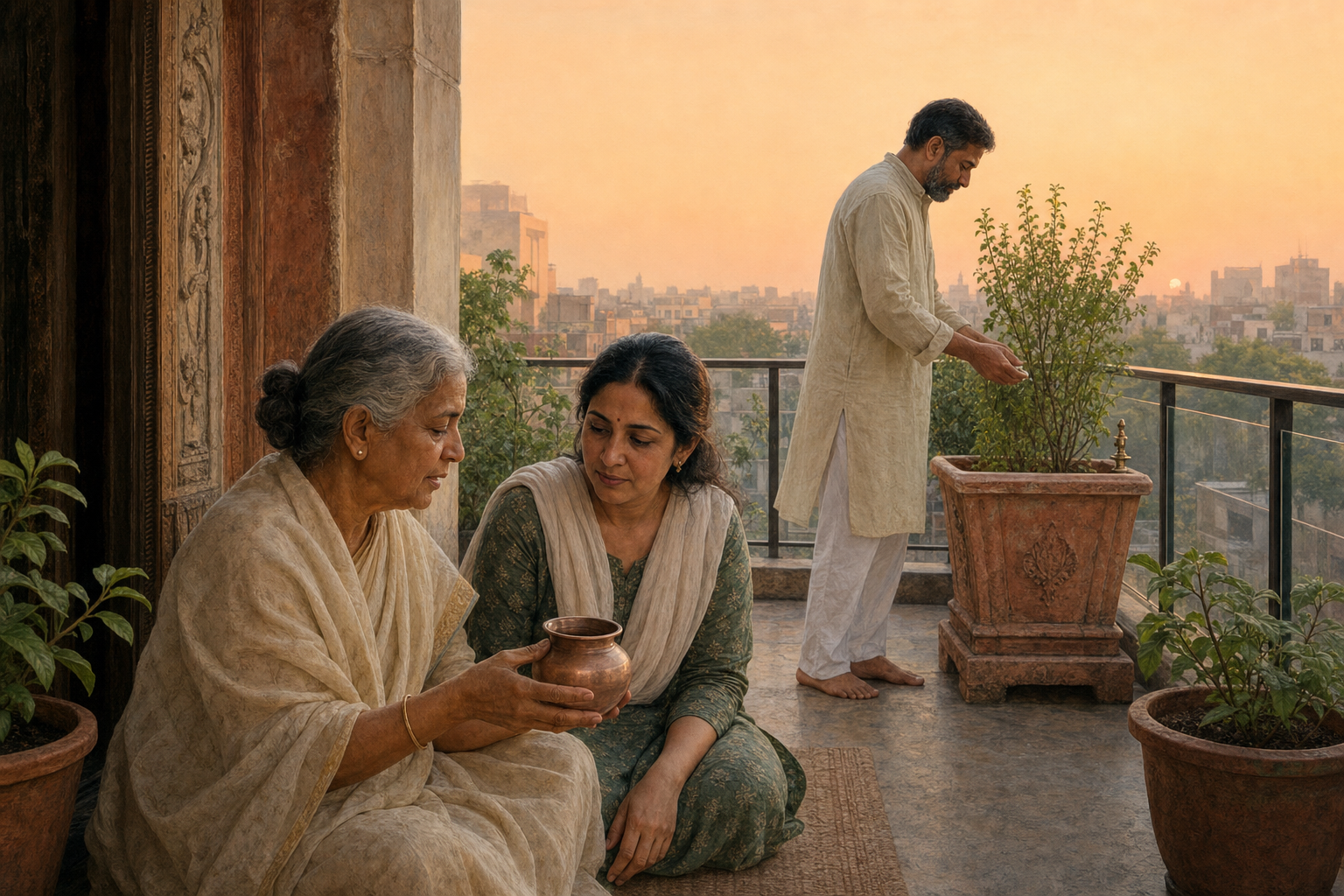
Variation is not automatically corruption. Chhath Puja in the eastern Indo-Gangetic region and Nepal brings communities together for both sunset and sunrise Arghya, with water or milk and a rich body of folk devotion. Southern household traditions often situate Arghya within Sandhyāvandana, while some western practices pair morning worship of Sūryanārāyaṇa with Surya Namaskāra. These forms share a center of gratitude without becoming interchangeable procedures.
The same care applies when considering other Dharmic traditions. Early Buddhist meditation, Jaina samayika at the junctions of the day, and Sikh remembrance during Amrit Vela are not versions of Hindu Surya Arghya. They do reveal a wider Dharmic intuition: dawn is a valuable threshold for collecting the mind, renewing moral purpose, and turning toward the welfare of living beings.
Adapt the circumstances without hollowing out the act
- Buildings block the horizon: Face east and offer toward the dawn light. The Sun does not need to be visible for the daily cycle to be honored.
- The sky is cloudy: Keep the same direction and timing. Cloud cover changes visibility, not the meaning of sunrise.
- You live above ground level: Pour into a stable planter or basin. Never send water over a railing.
- Mobility is limited: Sit comfortably, place the receiving bowl within easy reach, and use a light vessel that can be controlled without strain.
- You are travelling: A clean cup and a small quantity of water are sufficient for a simple personal observance.
- You miss sunrise: Do not create a safety risk by rushing to a roof, roadside, or moving vehicle. Offer a brief namaskāra where you are and return to your dawn discipline at the next safe opportunity. Follow lineage-specific guidance if a formal vow or Sandhyāvandana obligation is involved.
- A child joins you: Let the child make a small supervised offering, but keep attention on the vessel, wet ground, balcony safety, and safe viewing.
Ecological care is not an optional modern decoration. Water is the substance being honored, so use it sparingly and return it to the living earth when circumstances permit. Avoid additions that will damage a plant or create problems in shared plumbing. If milk belongs to a particular festival observance, that does not make it necessary for your daily offering.
Consistency will teach you more than accumulation. Begin tomorrow with a clean vessel, one honest saṅkalpa, one steady stream, and Om Sūryāya Namaḥ. Close in añjali, give the remaining water to a plant, and carry your stated resolve into the first difficult choice of the day. Let greater ritual detail come through lineage and learning, not anxiety.
References
