
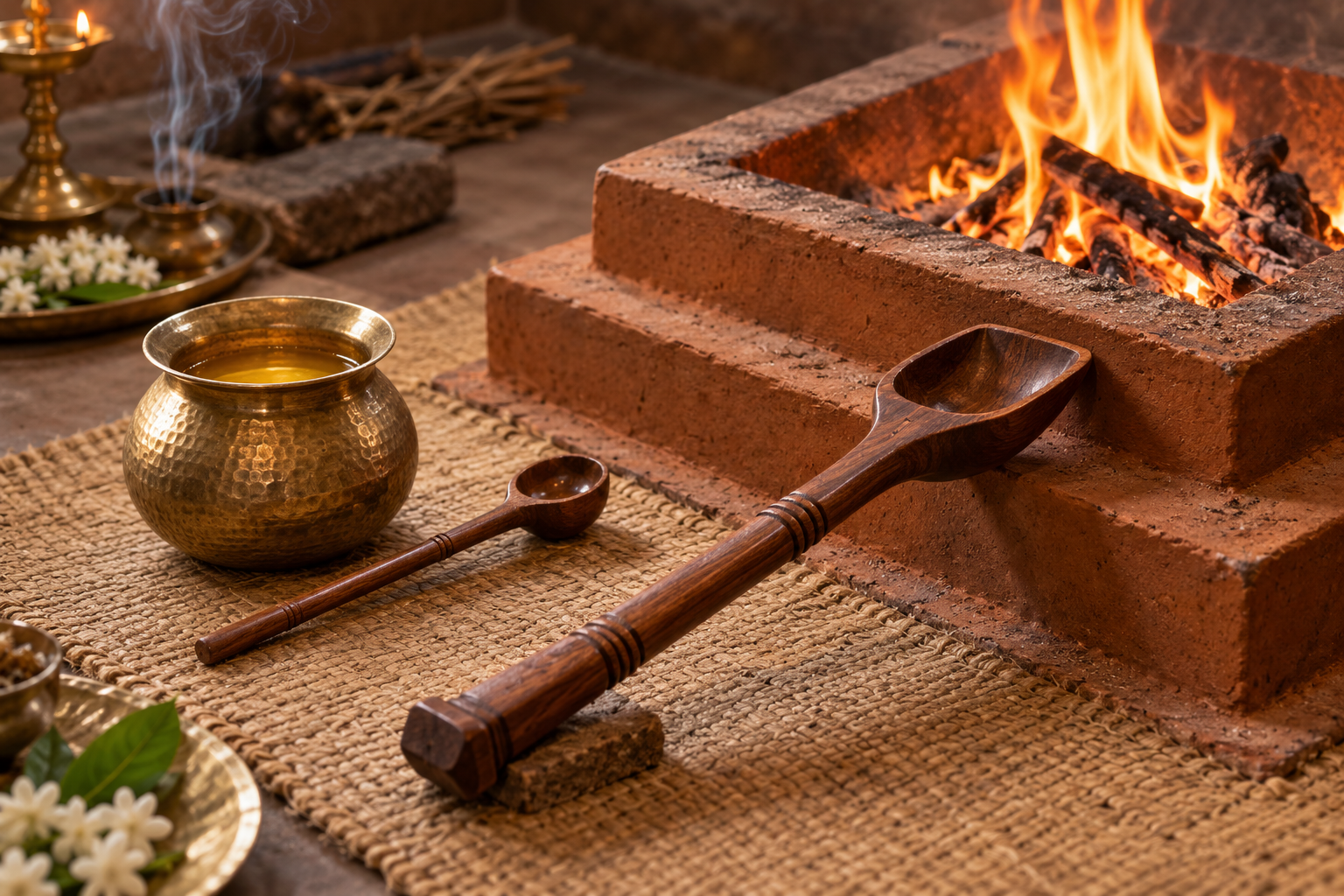
If you have watched a Vedic yajna closely, you may have seen the officiant use two long-handled ladles in quick succession. They can look like a matched pair, so it is easy to assume that their names are interchangeable. They are not.
The distinction becomes clear when you follow the offering rather than the shape of the utensils: the sruva draws and transfers ghee, while the sruk carries the prepared oblation to the sacred fire. These are separate ritual implements with precise functions, not duplicate spoons kept for convenience.
The shortest working distinction
In the basic sequence, the sruva is the drawing or transfer ladle. It takes a portion of ghee from its vessel and places that portion in the sruk. The sruk is the offering ladle: it receives the portion and conveys it into the yajna fire as the oblation.
| What to notice | Sruva | Sruk |
|---|---|---|
| Primary function | Draws and transfers ghee | Carries and offers the oblation |
| Direction of movement | From the ghee vessel toward the offering ladle | From the prepared offering toward the sacred fire |
| Relative appearance | Generally the smaller ladle | Generally the larger ladle |
| Best identification clue | Returns to the vessel holding the ghee | Approaches the fire for the offering |
A compact way to remember the pair is: sruva prepares the portion; sruk presents the portion. That formula is more reliable than trying to memorize their silhouettes.
Follow the ghee, not merely the ladle’s shape

Relative size helps when both implements belong to the same set, but appearance alone can mislead you. Craftsmanship and outward form can vary, while camera angles, distance and the officiant’s hand may conceal the difference. The action supplies the stronger evidence.
- Locate the vessel from which the ghee is being drawn.
- Watch for the smaller implement that enters or approaches that vessel. This is the sruva.
- Notice the transfer into the other ladle. The receiving implement is the sruk.
- Follow the sruk as it moves toward Agni and releases the oblation at the prescribed point in the rite.
You may not see every stage. The priest’s hands, other vessels or the edge of the altar can obscure the transfer. If that happens, look at the endpoints: the ladle associated with drawing from the ghee vessel is the sruva; the one that delivers the oblation to the fire is the sruk.
This is an identification map, not a complete manual for performing yajna. A particular rite follows its own inherited procedure, mantras and rules under the direction of qualified ritual authorities. If you are arranging a ceremony, confirm the required implements with the officiating acharya or ritvik rather than buying a pair solely because it is advertised as a havan set.
Why Vedic ritual keeps the two actions separate

The use of two implements shows that an oblation is not treated as an undifferentiated act of putting something into a flame. Drawing the substance, apportioning it, receiving it in the offering ladle and presenting it to Agni are distinct ritual movements. Each has its place within an ordered act.
That order is practically important. The sruva controls the transfer from the larger supply; the sruk carries the portion intended for offering. Confusing them erases the boundary between preparation and presentation, which is the very distinction their paired use makes visible.
There is also a sound spiritual reflection here, provided we do not mistake reflection for a technical ritual rule. Yajna joins intention to discipline. A worthy intention is not considered sufficient by itself; the offering is prepared, measured and conveyed through a prescribed form. The material act trains attention. Reverence appears not only in what is given, but also in how it is given.
This is why calling both objects simply “spoons” loses useful information. An ordinary utensil is usually named by its broad physical use. Sruk and sruva are better understood by their places in a sacred sequence. Their ritual identities come from what each one is appointed to do.
How to explain and name the pair accurately
If you are explaining a yajna to a child, visitor or student, begin with function. Say: “The sruva takes the ghee from its vessel and transfers it; the sruk carries the offering to the fire.” That single sentence is clearer than starting with decorative details or relative dimensions.
Avoid saying that one ladle is for ghee and the other is not. Ghee may pass through both. Their difference lies in the stage of the offering for which each is used. Also avoid treating the sruva as an ordinary kitchen spoon merely because it performs the transfer. Both belong to the consecrated equipment of yajna.
If you are cataloguing a photograph or museum object without seeing it in use, qualify the identification. “Sruva-like transfer ladle” is more honest than certainty based only on size. Context matters: its companion implements, the vessel beside it and any record of its ritual use can be more informative than ornamentation.
If you are commissioning or purchasing implements for an actual yajna, ask three concrete questions: Which rite will be performed? Which tradition’s procedure will the officiant follow? Has the officiant approved the material, form and dimensions? The generic label on a commercial set cannot answer those ritual questions.
Key takeaways
- Sruva is the drawing and transfer ladle: it takes ghee from its vessel and passes the portion onward.
- Sruk is the offering ladle: it receives the prepared portion and conveys the oblation to Agni.
- Function is the safest clue: watch where each implement begins and ends its movement.
- Size is secondary: the sruva is generally smaller and the sruk larger, but appearance should not replace ritual context.
- The pair expresses ordered offering: preparation and presentation are related, yet deliberately distinct actions.
At the next yajna you attend, choose one oblation and follow it from the ghee vessel to the fire. Once you see the transfer from sruva to sruk, the two names stop being abstract vocabulary and become parts of a living ritual grammar.
References

Leave a Reply
You must be logged in to post a comment.