

Preeti Vrata turns Chaturmasya into a sustained discipline of affectionate regard: devotion to Vishnu expressed through worship, food, speech, attention, and service. The DharmaRenaissance source presents the observance as a bridge between inward bhakti and practical care for other beings.
The resulting framework is useful for householders because it places individual restraints within a larger purpose. Fasting, simplicity, mantra, and study are not isolated accomplishments; they are meant to make loving conduct steadier over an entire sacred season.
The vow’s centre is preeti, not deprivation
The source places Preeti Vrata within Chaturmasya, beginning with Devshayani Ekadashi in the bright fortnight of Ashadha and concluding on Prabodhini Ekadashi in the bright fortnight of Kartika. It reports that this interval typically falls between July and November, although the applicable dates and parana window must be established through the local lunar Panchang.
Within the theology described by the source, Vishnu’s Yoga Nidra represents a sacred pause that invites greater inward stillness. Preeti means affectionate regard, so the vow directs devotion beyond private feeling and toward kindness, non-harm, truthful speech, and service. The post also connects this disposition with maitri and karuna in Patanjali’s Yoga Sutra I.33.
The cited post says the vrata is rooted in Puranic literature and regional paddhatis, mentioning the Matsya Purana and allied Smriti traditions. Because the supplied material does not identify particular chapters or verses, that provenance is best understood as the source’s report rather than an independently verified textual citation. The same caution applies to local variations: a family tradition, guru, or temple priest may prescribe a different form without displacing the vow’s love-centred purpose.
Key takeaways
- Preeti Vrata is presented as a season-long integration of bhakti, restraint, ahimsa, and seva.
- Devshayani and Prabodhini Ekadashi provide the principal calendar boundaries, while the local Panchang determines exact observance and parana times.
- Dietary rules support mental steadiness; they are not the complete meaning of the vrata.
- Daily mantra and worship establish continuity, while speech and service reveal whether the discipline is changing conduct.
- Health, safety, and sincere adaptation take priority over severe austerity.
A daily rhythm can carry the vow through four months

The source’s recommendations can be organised into three mutually reinforcing layers: a morning devotional anchor, mindful conduct during ordinary responsibilities, and an evening period of reflection. This structure avoids treating Chaturmasya as a sequence of occasional festival days while leaving the rest of life unchanged.
Morning: renew the sankalpa
The formal seasonal sankalpa is taken on Devshayani Ekadashi, according to the source, but a modest home puja can renew its intent each day. Its suggested pattern includes purification, lighting a ghee lamp, offering water, flowers, and Tulasi leaves to Vishnu, and completing a predetermined amount of mantra-japa. The post proposes Om Namo Narayanaya or Om Namo Bhagavate Vasudevaya, together with Vishnu Sahasranama or selected names of Vishnu, before arati and a contemplation for the well-being of all beings.
Daytime: make ordinary choices part of the vrata
Truthful, measured speech is especially important because it translates worship into relationships. The source also recommends a sattvic vegetarian diet, restrained consumption, reduced non-essential screen use, a brief midday mantra pause, and one deliberate act of kindness. For working practitioners, these disciplines can be applied through patient communication, fewer impulsive purchases, and protected time for japa rather than through withdrawal from professional or family duties.
Evening: review direction, not merely compliance
A short period of svadhyaya can draw on the Bhagavad Gita, Srimad-Bhagavatam, Ramayana, or other texts followed in the household. The source suggests tracking japa, dietary consistency, irritability, and weekly service. Such a journal functions best as a self-audit: its purpose is to notice whether discipline is producing clearer attention and gentler responses, not to turn spiritual practice into a competition of totals.
Food restraints and Ekadashi need a common purpose

The source reports a sequence of additional monthly food restraints found in many Vaishnava traditions. These customs are presented as common guidelines rather than a universal prescription:
| Chaturmasya month | Additional restraint reported by the source |
|---|---|
| Shravana | Avoid leafy greens |
| Bhadrapada | Refrain from curd |
| Ashwin | Reduce or avoid milk |
| Kartika | Abstain from urad dal |
Across the full period, the post recommends sattvic vegetarian food and reports that practitioners commonly avoid onion, garlic, alcohol, tobacco, excessive spice, and overconsumption. The unifying principle is clarity rather than deprivation: a restraint is meaningful when it reduces distraction and supports prayer, composure, and non-harm.
Ekadashi provides a recurring checkpoint within the longer vow. The source describes a range extending from nirjala fasting to fruit and water or simple anukalpa meals, followed by parana within the prescribed Dwadashi period. It also recommends pairing the fast with scripture, satsang, or kirtan so that upavasa is spiritually occupied rather than reduced to hunger management. The appropriate level of fasting depends on health and circumstance; the post explicitly gives professional medical guidance priority over austerity.
Seva tests whether devotion is becoming universal love
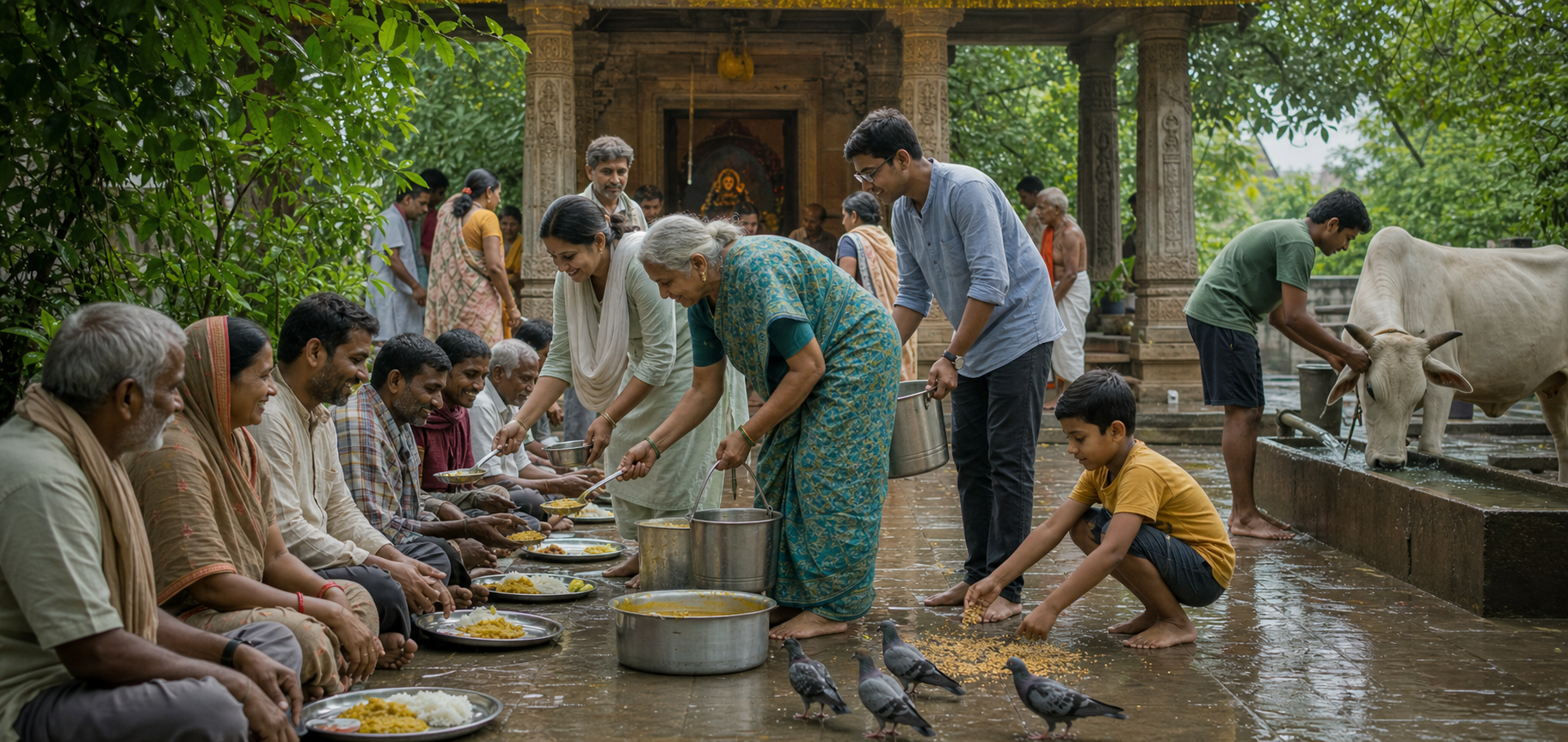
Preeti becomes visible when discipline benefits someone beyond the practitioner. The source gives annadana, contributions to community kitchens, tree planting, and gau-seva as examples. A sustainable observance might assign a regular place to one such commitment, rather than relying only on spontaneous generosity.
This outward dimension also offers a practical test. If dietary precision is accompanied by harsher speech or impatience, the supporting rule may be eclipsing the vow’s purpose. Conversely, a modest observance that reliably produces generosity, restraint, and consideration may express preeti more fully than difficult austerity pursued as an end in itself.
The source draws ethical parallels with Jain Paryushana and its emphasis on ahimsa and atonement, Buddhist metta-bhavana, and Sikh seva and langar. These comparisons should not be read as claims of ritual equivalence. They identify a shared moral register in which non-harm, goodwill, service, and human dignity give contemplative commitments a social form.
Families can make that principle tangible for children. The post proposes short Ramayana or Bhagavata readings, a nightly gratitude round, a coin jar for dana, and weekly temple visits. These practices give younger participants meaningful roles without imposing adult fasting standards and help associate bhakti with generosity rather than severity.
Adaptation preserves continuity when circumstances change
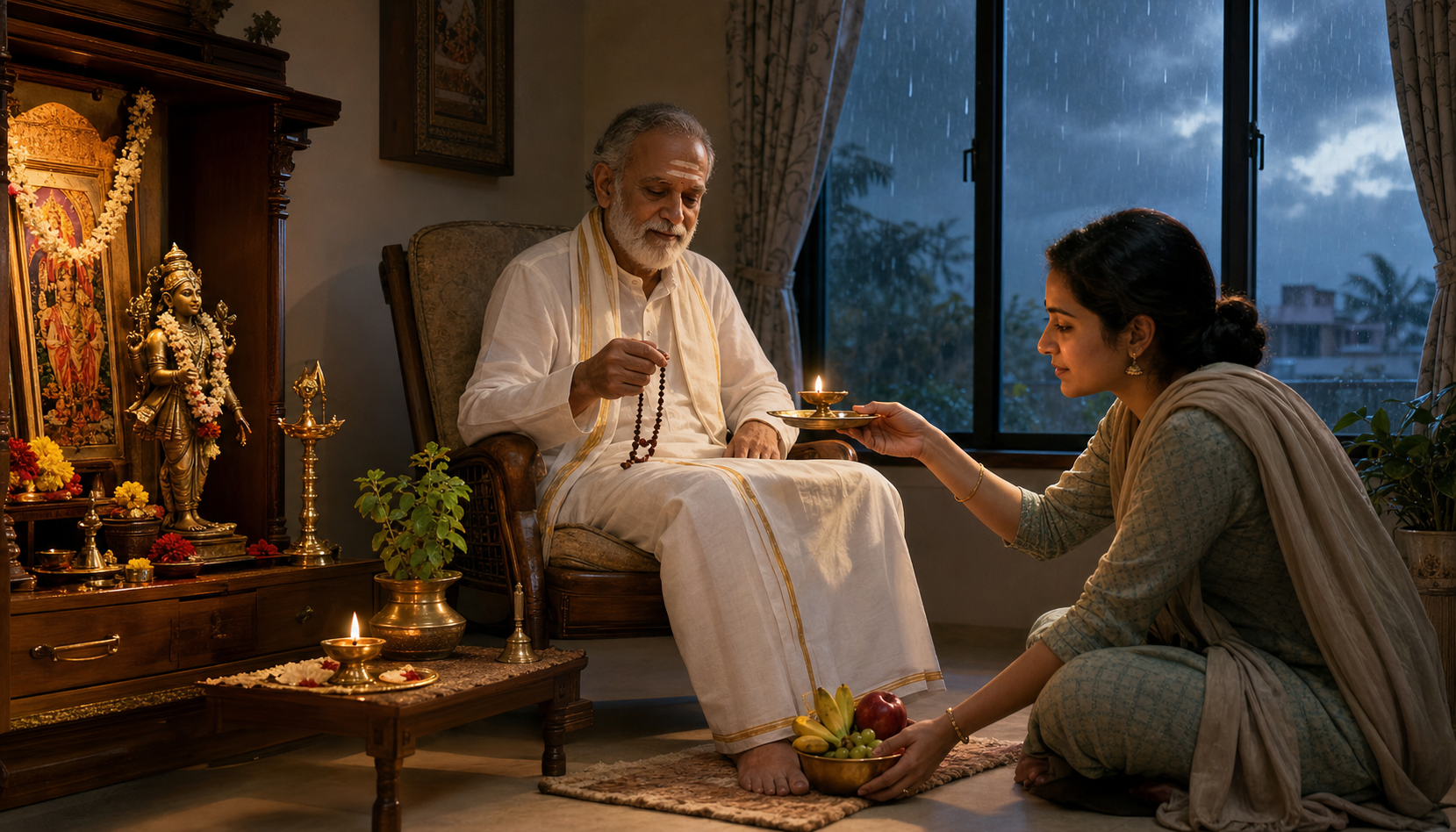
The source treats illness and travel as legitimate reasons to modify an observance. When a lapse is unintentional, it suggests additional japa, Tulasi puja, or feeding people in need as possible forms of prayaschitta. The relevant response can be selected with guidance from the household’s own tradition, keeping correction proportionate and constructive.
Completion on Prabodhini Ekadashi should receive the same care as the opening sankalpa. According to the post, parana follows within the locally prescribed period, marking both the conclusion of the vow and Vishnu’s traditional awakening. This closing moment can also serve as a transition: one or two disciplines that proved genuinely beneficial may continue after Chaturmasya instead of disappearing with the calendar boundary.
Approached in this way, Preeti Vrata can leave behind a repeatable household pattern in which devotion steadies attention and love becomes more dependable in conduct. Its enduring measure is not perfect restriction, but the capacity to carry clearer speech, lighter consumption, and consistent service into the months that follow.