
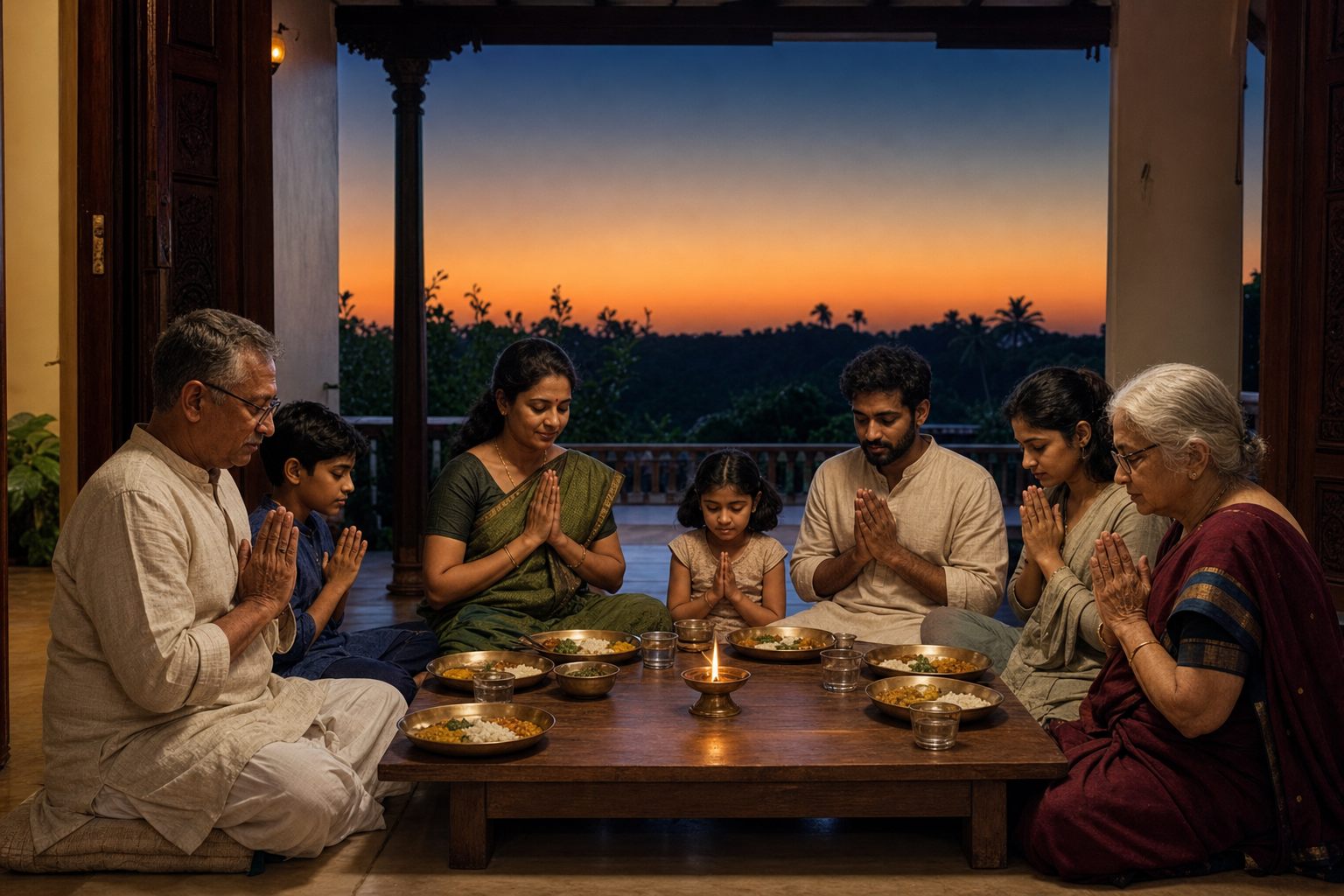
You may be ready to observe Pradosh Kaal Bhojan and still be unsure about the basics: Which sunset counts? How long is the eating window? Does an ordinary late dinner qualify? These questions matter because the discipline is defined by timing, restraint, and intention together.
Practised carefully, it gives your evening a clear centre. Worship and nourishment enter the same rhythm, food stops being a hurried interruption, and self-restraint becomes a concrete household practice rather than an abstract ideal.
The discipline is more than eating after dark
In its strict form, Pradosh Kaal Bhojan means taking one daily meal after sunset during the Pradosh interval. That interval comprises six ghatikas: 144 minutes, or 2 hours and 24 minutes, immediately following sunset.
This gives the observance three clear boundaries:
- It is a one-meal discipline, not merely a preference for a late dinner.
- Its clock begins at local sunset, not at a fixed hour used throughout the year.
- The meal is received as a deliberate act of devotion and restraint, not fitted accidentally into the correct time.
An ordinary dinner might happen to fall within Pradosh without becoming Pradosh Kaal Bhojan. Conversely, you may honour twilight with prayer and a mindful meal even when your circumstances prevent the strict one-meal form. Both can be meaningful, but naming the adapted form honestly keeps the observance from becoming so vague that timing and tapas no longer matter.
It also helps to distinguish Pradosh from Pradosham. Pradosh is the twilight interval itself. Pradosham commonly refers to worship associated with Shiva during this spiritually significant period. The meal and the worship can be joined, but they are not interchangeable. If your family follows a particular Pradosham sequence, arrange the meal around that worship according to your regional calendar, temple practice, or guidance from a knowledgeable elder.
Calculate the window from your own local sunset
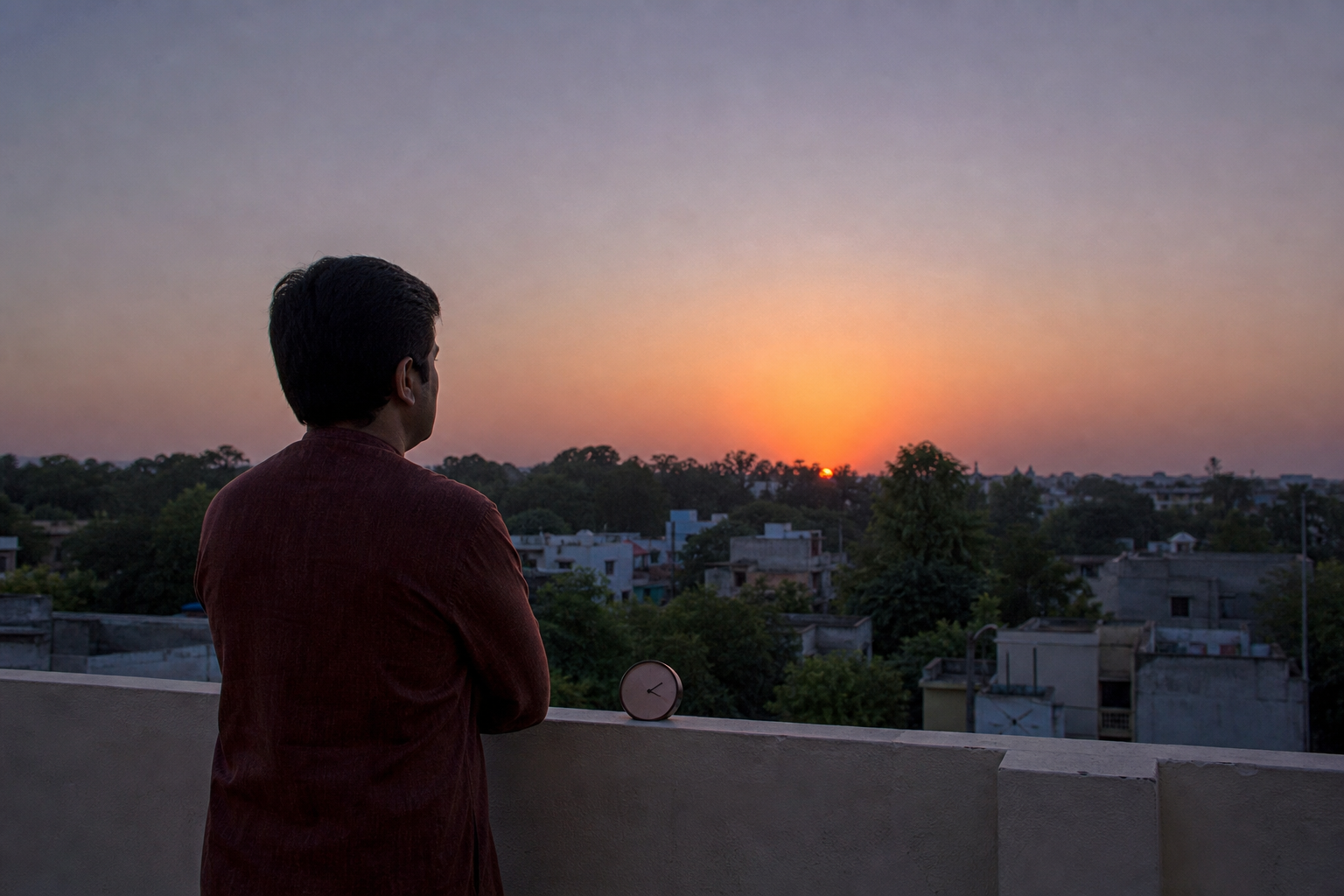
The useful rule is simple: your Pradosh meal window runs from local sunset until sunset plus 2 hours and 24 minutes. Because sunset changes with place, date, and season, a permanent clock time will eventually become inaccurate.
- Find the sunset time for your location and the date of the observance. Use the panchang followed by your household or another dependable local sunset calculation.
- Treat that sunset as the opening of Pradosh.
- Add 2 hours and 24 minutes to find the end of the six-ghatika interval.
- Plan worship, serving, and eating so the meal fits comfortably inside the interval. If you want to avoid uncertainty at the boundary, finish before the calculated end rather than beginning at the last moment.
- Check the time again for every observance instead of carrying forward last month’s calculation.
Use the sunset where you are physically present. A timetable copied from another city can move the window away from the natural transition the observance is meant to honour. When travelling, calculate from the destination rather than from your home clock.
If your temple or family panchang gives a more specific Pradosham schedule, follow that tradition consistently. The calculation above establishes the general six-ghatika window; it does not replace regional liturgical detail.
Turn the meal into a repeatable evening sadhana
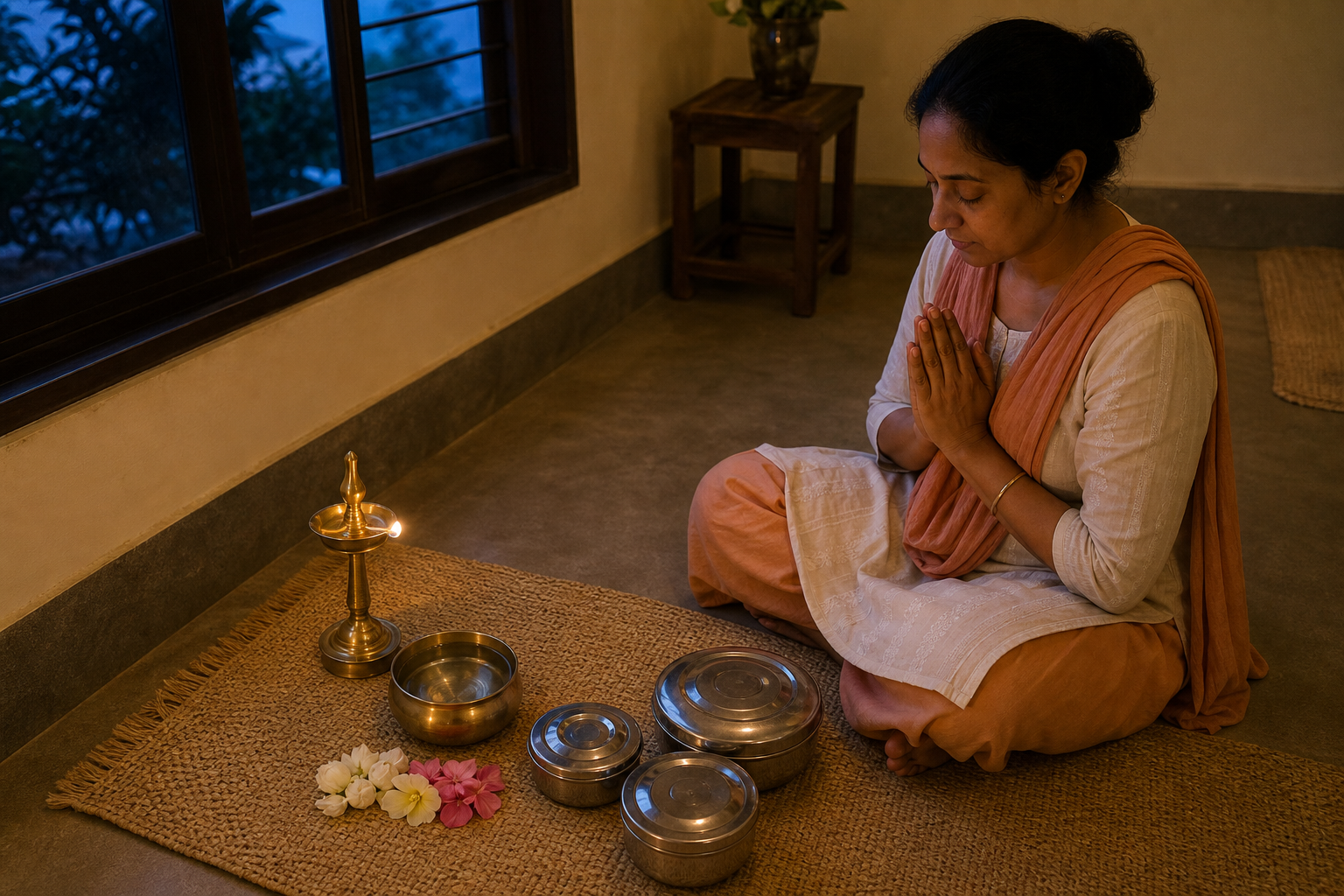
The greatest practical mistake is leaving every decision until hunger arrives. Decide the form, food, and timing earlier in the day. Then twilight can become a transition into stillness rather than a race between cooking, worship, and the closing time.
- Choose the form before you begin. Decide whether you are undertaking the strict one-daily-meal observance or an adapted twilight practice. Do not change the definition midway merely because the stricter choice becomes inconvenient.
- Prepare before sunset. Have the meal and eating space substantially ready so the Pradosh period is not consumed by avoidable household bustle.
- Mark the transition. Light a lamp at sunset and let that act signal the end of ordinary daytime activity.
- Pause before serving. Offer a brief prayer or keep a moment of silence. Bring to mind the land, living world, labour, and household care through which the food reached you.
- Keep the plate simple. A sattvic meal supports the atmosphere better than elaborate preparation undertaken for display. The point is not culinary austerity for its own sake, but freedom from excess and agitation.
- Protect your attention. Put away phones, television, and work. Eat slowly enough to notice taste, aroma, breath, and the impulse to hurry. If people eat together, keep conversation gentle rather than turning the table into another noisy part of the day.
- Close the observance clearly. Once the meal is complete, return to a quiet evening. In the strict form, do not let later grazing quietly become a second meal.
Putting away a phone is a modern adaptation, not an ancient injunction. It serves an older purpose: gathering the senses. In the same way, a lamp, a short prayer, and a simple plate are not decorative additions. They create a threshold between habitual consumption and conscious receiving.
This is where tapas and aparigraha become practical. Tapas appears in keeping the chosen boundary even when appetite argues for convenience. Aparigraha appears in refusing unnecessary excess. Gratitude prevents either discipline from hardening into mere self-denial.
Adapt faithfully without confusing distinct traditions
The resemblance between a single Pradosh meal and modern time-restricted eating does not establish a health benefit. The centre of this observance is spiritual discipline rather than a promised physical outcome. Do not treat it as a medical intervention or use it to replace nutritional or clinical advice.
If one meal a day conflicts with your medical needs or professional guidance, do not force the strict form. Keep the twilight lamp, prayer, gratitude, quiet atmosphere, and attentive eating while following the schedule that is safe for you. The disciplined choice in such a situation is honest adaptation, not concealing harm beneath the language of austerity.
Work, caregiving, and travel can also make the exact window impractical. When that happens, distinguish between preserving the ethos and completing the timed observance. You can mark local sunset, reduce digital noise, and receive your available meal reverently without claiming that every formal condition was met.
The broader dharmic family offers genuine resonances, but those resonances should not be used to erase differences:
- Jain ratri-bhojan tyaga restrains eating at night. Its form therefore differs from a Hindu discipline that places the meal after sunset. If you have undertaken the Jain restraint, honour that vow rather than merging two contrary timetables.
- Buddhist mindful eating and reflective Uposatha evenings share an emphasis on awareness and restraint, but that does not make them versions of the same Pradosh schedule.
- Sikh teachings on disciplined living, seva, and gratitude around shared food offer an ethical kinship, not a rule requiring this particular twilight window.
Shared values become more credible when distinctions remain visible. The point of dharmic kinship is not to make every practice identical; it is to recognise how different traditions train attention, gratitude, self-command, and reverence for life through their own forms.
Key takeaways for your next Pradosh meal
- The strict observance is one daily meal within the 144 minutes immediately after local sunset.
- Calculate the window for your current place and date; do not rely on a permanent dinner time.
- Prepare before sunset so lamp-lighting, prayer, and eating can proceed without hurry.
- Use simplicity, quiet conversation, and freedom from screens to protect attention.
- Keep Pradosh timing distinct from the particular Pradosham worship sequence followed by your temple or family.
- When the one-meal form is medically unsuitable or practically impossible, preserve the spiritual intention through an honestly named adaptation.
For your next observance, write down the local sunset and closing time where everyone involved can see them. Decide in advance whether you are following the strict or adapted form, and have the meal ready before twilight. Removing those small ambiguities leaves the Pradosh interval open for what it is meant to cultivate: collected attention, restraint, and gratitude.
References
