
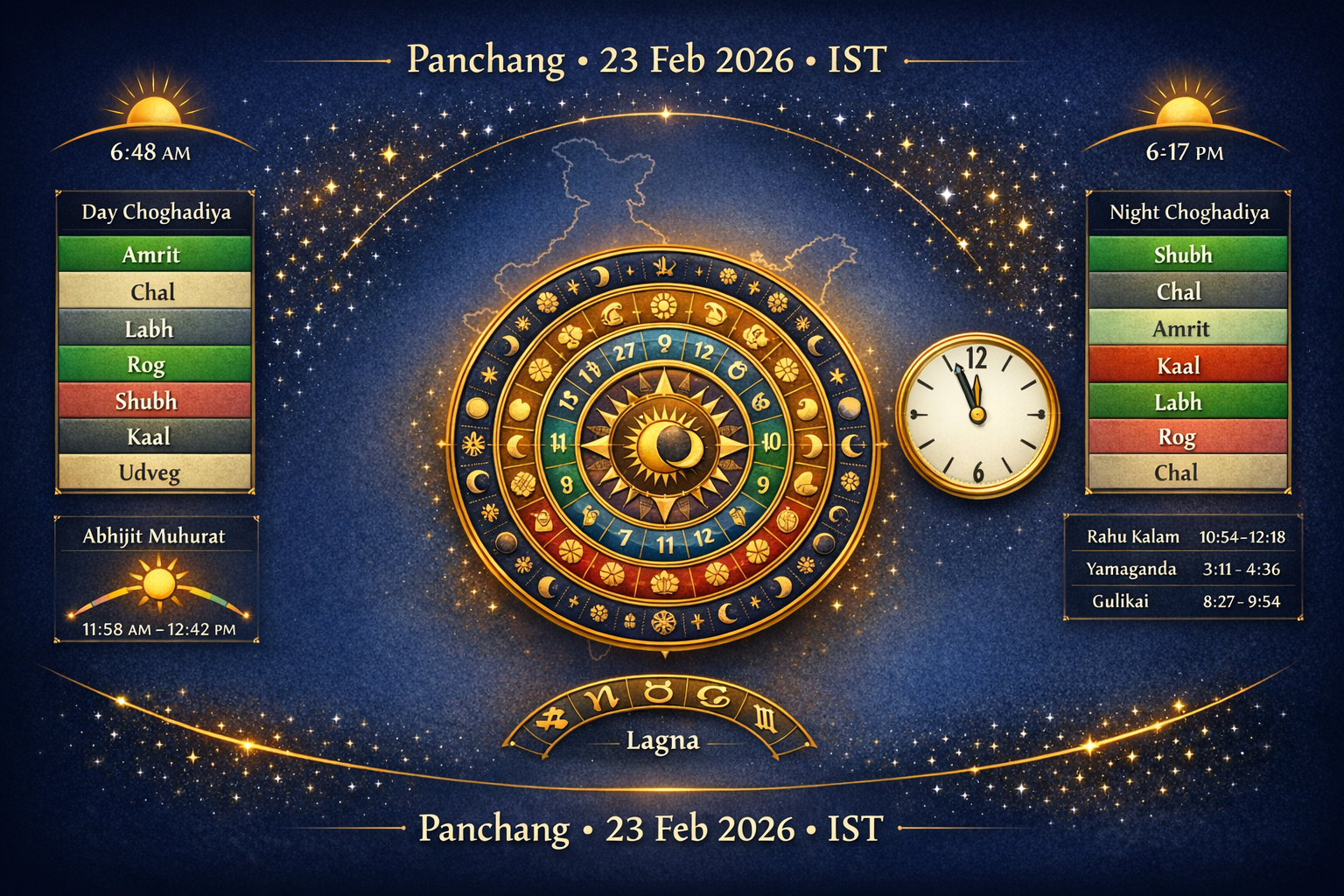
23 February 2026 (Monday) in Indian Standard Time (IST) falls within the late winter lunar cycle and is a day many households consult the Panchang to align decisions and observances with auspicious windows. A Panchang synthesizes the Sun–Moon relationship into actionable time markersTithi, Nakshatra, Yoga, and Karanaalongside practical muhurta tools such as Choghadiya, Rahu Kalam, Yamaganda, Gulikai, Abhijit Muhurta, Durmuhurtham, Tarabalam, Chandrabalam, and Lagna timings. Because these elements are astronomically sensitive and location-specific, exact timings vary from city to city; IST is commonly used as a national baseline, with local adjustments recommended for precision.
Rooted in the shared civilizational heritage of the Indian subcontinent, the Panchang supports spiritual life and cultural rhythms across Hinduism, Buddhism, Jainism, and Sikhism in ways that honor unity in diversity. Hindu rituals, Buddhist Uposatha reflections, Jain Poshadha vows, and community observances within many Sikh households often reference similar lunar markers to plan prayer, fasting, remembrance, and service. Used responsibly, the Panchang becomes a bridge between inner intention and outer action, encouraging compassion, self-discipline, and harmony.
Technically, the Panchang operates in the sidereal zodiac, applying an ayanamsa (most widely, Lahiri) to relate observable astronomy to the traditional jyotiṣa framework. For a given date and place, it requires precise sunrise and sunset, the geocentric longitudes of Sun and Moon, and standardized rules of transition at sunrise. The computational backbone is stable across traditions, while interpretive customs (e.g., regional month names and observance protocols) vary with paramparā and locale.
Tithi is the lunar phase, each spanning 12° of elongation between the Moon and Sun. There are 30 Tithis in a synodic month15 in Shukla Paksha (waxing) and 15 in Krishna Paksha (waning)with the current Tithi at sunrise governing the civil observance for that date. Tithi determines the energy profile for worship, vrata, and samskāras, and its transition during the day can open or close narrow muhurta windows relevant to travel, contracts, or sacred rites.
Nakshatra, the lunar mansion occupied by the Moon, divides the ecliptic into 27 segments of 13°20′ each. The sequenceAshwini, Bharani, Krittika, Rohini, Mrigashira, Ardra, Punarvasu, Pushya, Ashlesha, Magha, Purva Phalguni, Uttara Phalguni, Hasta, Chitra, Swati, Vishakha, Anuradha, Jyeshtha, Mula, Purva Ashadha, Uttara Ashadha, Shravana, Dhanishtha, Shatabhisha, Purva Bhadrapada, Uttara Bhadrapada, and Revatianchors daily qualities and interpersonal resonance. Nakshatra timing is central to naming ceremonies, mantra anushthana scheduling, and the nuanced assessment of Tarabalam and Chandrabalam.
Yoga is computed by summing the sidereal longitudes of Sun and Moon and dividing the result into 27 equal parts. These Yogassuch as Vishkambha, Preeti, Ayushman, Saubhagya, and othersadd a subtle layer to muhurta selection by indicating how readily effort transforms into outcome. While Tithi and Nakshatra often receive first attention in households, Yoga refines the qualitative tenor of the chosen time.
Karana is half a Tithi (6° of elongation) and cycles through seven repeating KaranasBava, Balava, Kaulava, Taitila, Garaja, Vanija, and Vishti (Bhadra)plus four fixed Karanas at specific junctionsShakuni, Chatushpada, Naga, and Kimstughna. Practical tasks prefer gentle, cooperative Karanas, whereas Vishti (Bhadra) is classically avoided for auspicious beginnings. The Karana at the moment of action is decisive in many crafts and rites.
Sunrise, sunset, and the twilight bands (Sandhyā-kāla) frame how the daily Panchang is read. In most almanacs, the Panchang day begins at local sunrise; Abhijit Muhurta straddles the solar midday; Choghadiya divides the diurnal and nocturnal arcs; and the inauspicious windows of Rahu Kalam, Yamaganda, Gulikai, and Durmuhurtham are distributed proportionally across the day and evening according to weekday rules.
Rahu Kalam, Yamaganda, and Gulikai are calculated by dividing the daylight interval (sunrise to sunset) into eight equal parts and assigning one part to each doṣa segment per weekday. On Mondays, the conventional order places Rahu Kalam in the second daylight segment, with Yamaganda and Gulikai occupying their respective segments later in the day, all scaled to the seasonally varying length of daylight. These intervals are generally avoided for first-time initiations of tasks such as signing agreements, starting journeys, or scheduling medical procedures, while ongoing activities may continue with prayerful intent and care.
Abhijit Muhurta centers on local solar noon and is traditionally considered auspicious, especially when no bespoke muhurta is available. It is derived by taking a narrow window around the midpoint of the daylight span, then adjusting slightly based on regional practice. Because it complements rather than replaces Tithi and Nakshatra considerations, many families consult both before finalizing time-sensitive decisions.
Durmuhurtham refers to brief intervals deemed unsuitable for fresh undertakings. Classical rules identify two short windows during the daylight period whose exact placement depends on the weekday and the seasonally scaled day length. These are not considered obstacles for worship, remembrance, or seva in the spirit of dharma, but are typically avoided for inaugurations and first signatures if flexibility exists.
Choghadiya divides day and night each into eight segments, labeling them as Amrit, Shubh, Labh, Chal, Udveg, Kaal, or Rog. The sequence and the first segment from sunrise depend on the weekday, after which the pattern repeats cyclically through the daytime and then resets for the night. For practical use on 23 February 2026 (Monday, IST), one determines local sunrise and sunset, partitions both arcs into eight equal spans, assigns the weekday-specific sequence, and then selects Amrit, Shubh, and Labh segments for auspicious initiatives, keeping Chal as neutral and setting aside Udveg, Kaal, and Rog for non-initiatory activities.
Tarabalam is a star-to-star strength derived by counting from one’s Janma Nakshatra to the day’s Nakshatra, grouping the count into ninefold cycles, and interpreting each taraJanma, Sampat, Vipata, Kshema, Pratyak, Sadhaka, Naidhana, Mitra, and Parama-mitraby classical canons. Many practitioners use Tarabalam as a personal filter layered atop generic good timings, particularly for travel, examinations, and interviews.
Chandrabalam evaluates whether the Moon on the day resides in a sign relationally supportive to one’s Janma Rashi. The tradition emphasizes emotional clarity, receptivity, and interpersonal warmth when Chandrabalam is favorable, which many families find invaluable for conversations, reconciliations, and teamwork. As with Tarabalam, its effect is personalized; combining it with Tithi and Nakshatra produces a more holistic picture.
Lagna (the rising sign) changes roughly every two hours and is indispensable when an exact muhurta is needed for griha-pravesha, vivaha, or starting an enterprise. After identifying broad good windows via Choghadiya and Abhijit, many advisors refine the choice to a Lagna that minimizes afflictions and places key houses under benefic influence. In IST-based planning for 23 February 2026, local Lagna spans at the target city should be mapped precisely, as even a 20-minute shift can meaningfully alter house lordships and aspects.
Moonrise and moonset matter for vratas dependent on sighting, while sunrise and sunset anchor sandhyā, Arghya, and cleanliness of the day’s boundaries. For cities far apart east–west within India, these times differ by tens of minutes; hence, IST Panchang tables are best read alongside the exact coordinates of the observer’s location for fidelity.
For 23 February 2026 (Monday), many almanac schools will place the civil date within Magha or Phalguna, depending on whether the region follows amanta or purnimanta month reckoning and on the underlying siddhānta employed. Such calendrical diversity is a strength of the Dharmic tapestry and does not hinder shared observance; rather, it reflects the adaptive, local genius by which communities have sustained festivals, fasts, and service for centuries.
Methodologically, assembling a reliable Panchang for this date in IST involves five disciplined steps: compute local sunrise and sunset using accurate coordinates and elevation; obtain high-precision sidereal longitudes of Sun and Moon (e.g., via Swiss Ephemeris or equivalent); determine Tithi, Nakshatra, Yoga, and Karana at sunrise and track their transitions through the day; generate Choghadiya, Rahu Kalam, Yamaganda, Gulikai, Abhijit Muhurta, and Durmuhurtham by proportionally segmenting day and night according to weekday rules; and finally layer Tarabalam, Chandrabalam, and Lagna spans tailored to the individual and location. Cross-checking against multiple almanac traditions improves confidence and highlights minor interpretive differences.
Data quality is crucial. Using IST without daylight saving, verifying time-zone offsets, and ensuring consistent ayanamsa across calculations reduce errors. For those generating tables programmatically, employing ephemerides aligned with JPL DE series, validating against authoritative Panchang sources, and documenting assumptions (e.g., sunrise definition at the apparent upper limb with standard refraction) safeguard reproducibility and trust.
Practically, Monday (Soma-vāra) is favorable for devotion to Shiva and for endeavors that nurture calm, health, and reflective study. When broad auspicious segments align with supportive Chandrabalam and a clean Lagna, families commonly schedule fee payments, study commitments, small purchases, or travel starts. If choices are constrained by work or caregiving, the tradition encourages proceeding with sincerity, prayer, and right conduct, affirming that intention and dharma-centered effort dignify every hour.
Across Hindu, Buddhist, Jain, and Sikh communities, the abiding value of a day like 23 February 2026 is not in a single canonical timetable, but in the shared aspiration to live thoughtfully. The Panchang equips that aspiration with temporal sensitivity, while the spirit of seva, ahiṃsā, satya, and inner cultivation ensures that auspiciousness ultimately rests in conduct. Reading the day through Tithi, Nakshatra, Yoga, Karana, and muhurta windows thus becomes a contemplative practiceone that unites households and traditions in common purpose.
Inspired by this post on Hindu Pad.
