
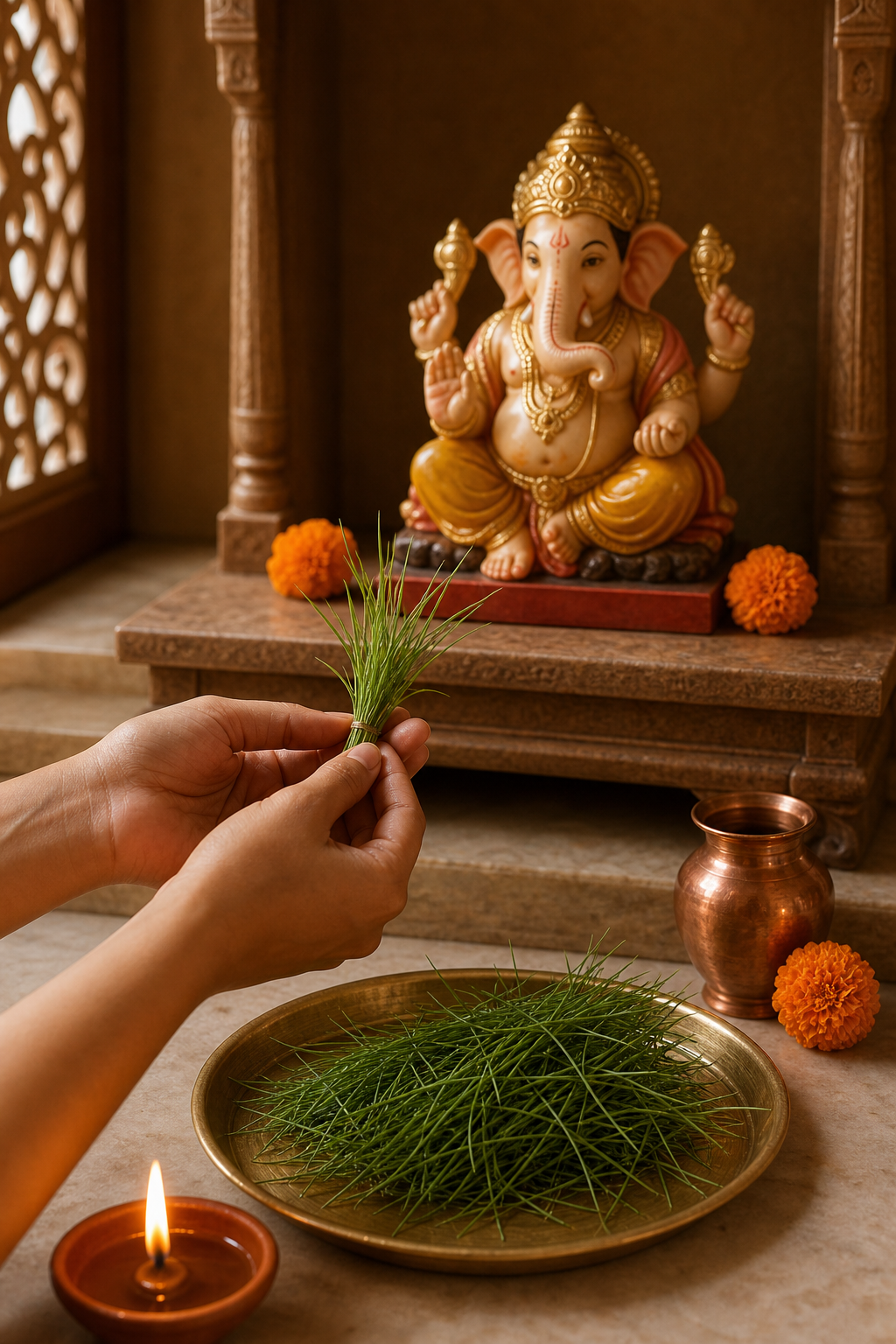
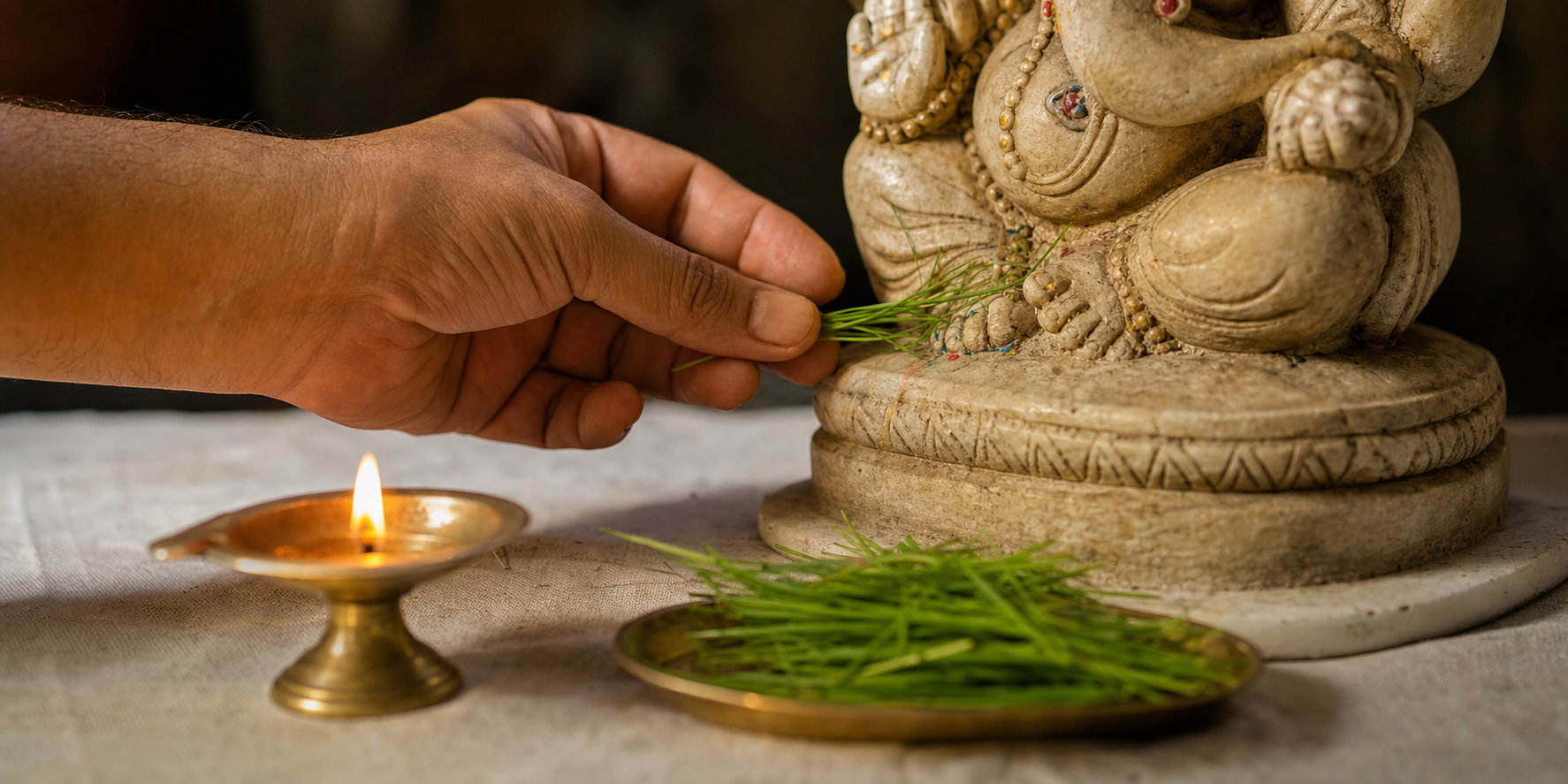
You have the Ganesha murti ready and a handful of grass in front of you. Then the practical questions begin: Is this really durva? Does 21 mean separate blades or three bundles? Must the roots remain attached? If your family custom differs from an instruction you found elsewhere, which one should govern the puja?
Use a clear order: identify the grass, prepare it without waste, settle the counting convention before worship, and make the offering with attention. The precision has a purpose. You are not merely placing vegetation before a murti; you are bringing the senses, vital energies, and mind into an act of disciplined devotion to Ganesha.
Begin with fresh durva in the form your tradition accepts
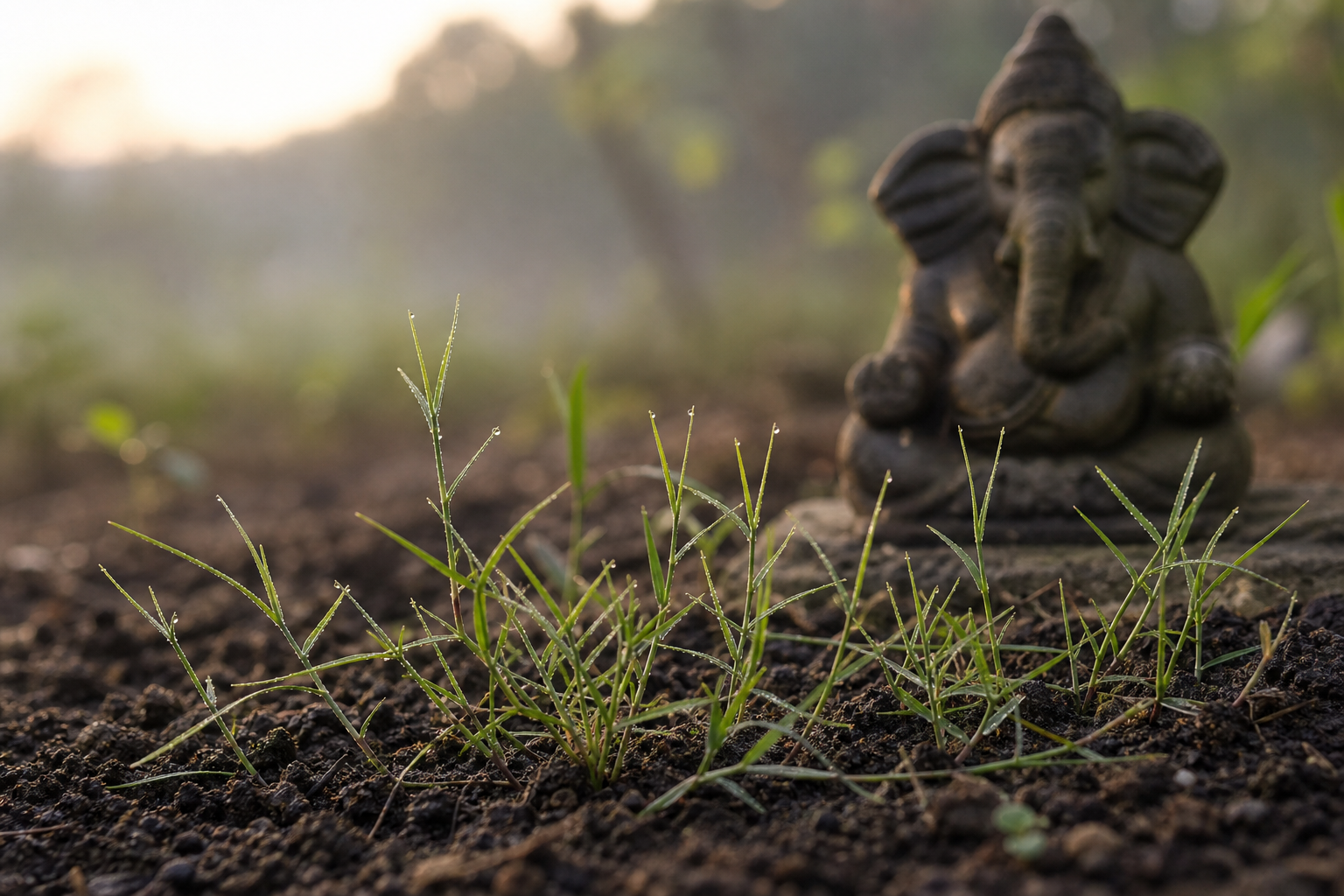
The grass associated with Ganesha is Cynodon dactylon, commonly called doob or Bermuda grass. It is known for surviving stress, spreading again after being cut, and taking root readily. Those qualities make it an apt emblem of regeneration: what bends or is cut down can return without surrendering its grounded nature.
For puja, look for the ritual qualities that can actually be judged at home:
- Choose fresh, tender, green growth rather than yellow, dry, or withered pieces.
- Prefer clean, unblemished blades with the characteristic branching or tri-forked form where available.
- Wash the durva gently with clean water and let excess water drain before counting it.
- Handle the shoots carefully enough that you do not spend the puja repeatedly replacing crushed or scattered pieces.
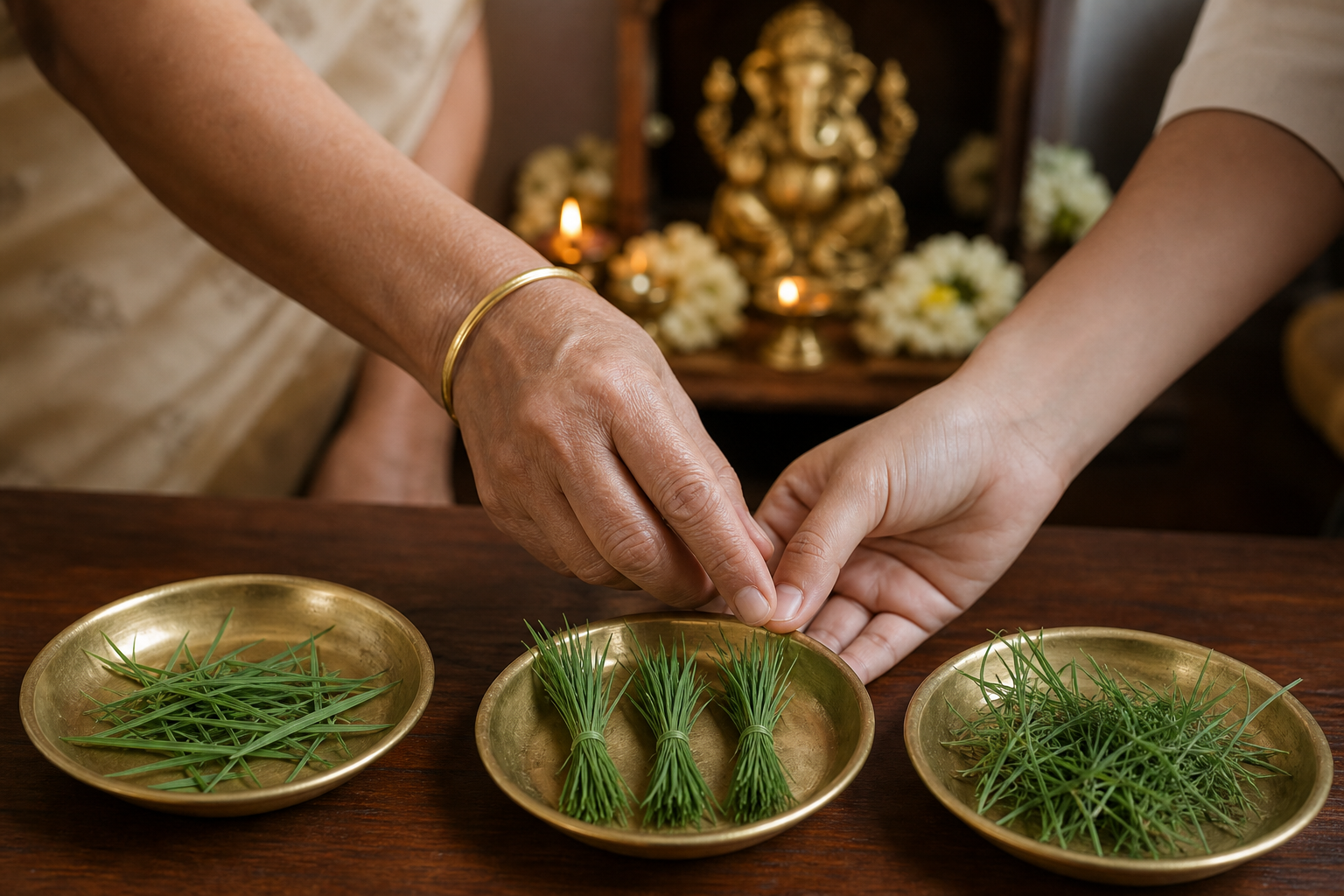
Words such as blade, shoot, sprig, and cluster are often used loosely in household instructions. That is why two sincere devotees can both say they offered 21 pieces while arranging the grass differently. Resolve the unit of counting before you begin. If your family has a settled convention, preserve it. If you are making the offering at a temple, ask how that temple counts durva rather than bringing an arrangement the pujari must undo.
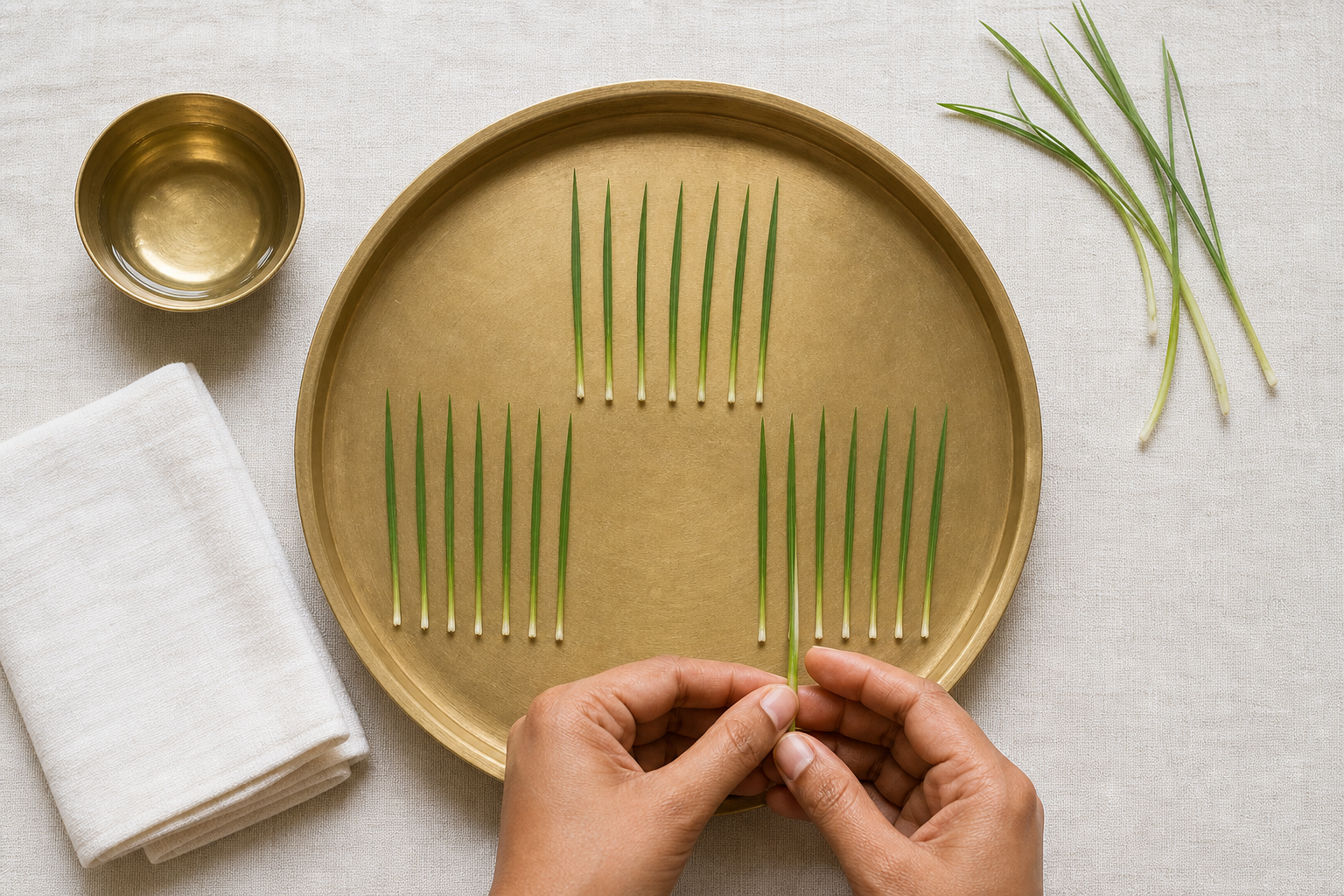
If you have no inherited instruction, 21 separate pieces arranged as three visible groups of seven is a practical choice. It keeps the total easy to verify while remaining within a widely followed form of the offering. Treat that as a usable household method, not as a declaration that every other parampara is mistaken.
Why Ganesha receives a grass associated with cooling
The best-known explanation begins with Analasura, a fire-born asura whose scorching power threatened the worlds. Ganesha contained and subdued him, but the act left an unbearable heat within Ganesha’s own form. When other attempts at relief failed, fresh durva was offered, and the heat subsided. Regional versions differ in their details, but the devotional memory remains consistent: durva cools the destructive heat that Ganesha has brought under control.
The sequence matters. Ganesha does not ignore the danger or merely decorate it. He first contains what threatens dharma and then restores equilibrium. You can carry that pattern into the puja. When anger, envy, agitation, or impulsiveness has become the immediate obstacle, the offering asks for more than the disappearance of an external difficulty. It asks for the inner heat feeding that difficulty to be governed.
Durva’s traditional Ayurvedic description reinforces the cooling image. It is characterized as sheeta, or cooling in potency, with astringent and slightly sweet qualities; traditional applications also associate it with stambhana, including the checking of bleeding. This vocabulary explains why the Analasura account and the plant’s ritual role fit together so naturally within the Dharmic imagination.
That correspondence is not permission to turn puja material into a home treatment. Do not drink, prepare, or apply durva medicinally simply because you offer it to Ganesha. Ritual symbolism and traditional classification do not establish what is safe or appropriate for an individual’s health condition; seek qualified professional guidance if the question is medical.
The grass also teaches through its humility. It is neither rare nor imposing, yet it persists and renews itself. Offering it at Ganesha’s feet turns resilience into a conscious sankalpa: may persistence be directed by wisdom rather than stubbornness, and may recovery from difficulty lead back to dharma rather than back to the same habit.
A simple way to prepare and offer all 21 blades
The following is an adaptable household sequence, not a replacement for an initiated practice, a family paddhati, or temple maryada. Where your parampara gives a different instruction, follow that instruction.
- Settle the counting method first. Decide whether you will offer 21 individual pieces or three bundles of seven. Do not change the unit halfway through merely to make the total come out correctly.
- Select and wash the durva. Remove yellowed or damaged portions, rinse the usable pieces with clean water, and place them on a clean plate.
- Count twice before the sankalpa. Make the first count while separating the pieces. Make the second while arranging them as 7, 7, and 7, or as one clearly ordered set of 21. This keeps uncertainty out of the actual offering.
- Prepare the rest of the puja simply. Place the murti, water, durva, and any customary upacharas in reach. Modaka, fruit, or another accepted naivedya may accompany the worship, but it does not replace the durva in this particular observance.
- State the sankalpa. Name the worship you are undertaking and the obstacle, beginning, or inner tendency you are placing under Ganesha’s guidance. Keep it honest and concise.
- Perform the customary preliminary upacharas. If your household follows a complete sequence, retain it. A simple household puja can remain simple; the care given to each act matters more than adding unfamiliar procedures.
- Offer the durva with mantra. A commonly used mantra is Om Gam Ganapataye Namah. Devotees whose practice includes the Ganapati Atharvashirsha may use that liturgy. Recite as you offer without inventing a mandatory number of repetitions that your tradition does not prescribe.
- Place the grass according to local custom. Durva may be touched to Ganesha’s trunk or head and then placed at the base of the murti or upon the crown. Let your household or temple practice decide among these accepted placements.
- Complete the puja without rushing away. Offer the customary naivedya if you have prepared it, conclude the worship as your tradition teaches, and allow a brief pause before returning to the task or difficulty named in the sankalpa.
If you lose the count while preparing, begin the count again before the puja rather than worrying through the mantra. This small correction preserves both accuracy and composure. Counting is supposed to collect attention, not consume it.
Let the number 21 change how you approach the obstacle
One traditional interpretation divides 21 into the ten faculties of perception and action, the ten principal and subsidiary vital energies, and the mind as the twenty-first. In Sanskrit terms, this brings together the five jnanendriyas, five karmendriyas, five pranas, five upa-pranas, and manas. The offering therefore represents the governance of senses, vital energies, and mind under Ganesha, not an arbitrary preference for an auspicious number.
You can turn that interpretation into a short discipline while arranging the durva:
- Pieces 1 through 10: notice what you are taking in through the faculties of perception and what you are doing through the faculties of action. Identify one input or action that is making the obstacle worse.
- Pieces 11 through 20: allow the breath to become steady without forcing it. Remember that agitation is not only an idea; it can take hold of the whole body and hurry the next action.
- Piece 21: bring the mind itself into the sankalpa. Name the response you intend to govern, such as anger, distraction, envy, avoidance, or needless haste.
This is a contemplative use of the symbolism, not a claim that every lineage assigns a particular organ or prana to an individually numbered blade. You do not need to recite a technical list during worship unless your teacher has given you that method. The essential movement is from scattered faculties toward one governed intention.
Three bundles of seven can also carry inherited associations with sacred sevens and triadic patterns. There is no need to force every numerical explanation into the same puja. Choose the interpretation your parampara teaches, or use the senses-pranas-mind framework consistently. A symbol becomes useful through disciplined attention, not through accumulating as many correspondences as possible.
If you are teaching a child, let the child wash suitable pieces, arrange three groups of seven, and verify the total. Then explain one meaning in plain language: we are asking Ganesha to help us use our body, breath, and mind wisely. That preserves precision without turning a living household practice into a test of memorized terminology.
Quick answers to common durva-offering questions
What should you do when fresh durva is unavailable?
Do not present an unrelated grass as durva merely to complete the visible form. You may make a manasika offering, visualizing fresh durva with focused devotion, or use akshata, unbroken sanctified rice, if that is accepted in your practice. You can accompany either choice with a resolve to offer fresh durva when it becomes available. This preserves the sankalpa without pretending that all materials are identical.
Must the durva have roots attached?
There is no single practice across all lineages. Some prescriptions favor mula-yukta durva with roots attached, while many householders offer tender tips. Follow a specific temple requirement when worshipping there. For home puja, cutting tender growth without uprooting the plant is a sound expression of ahimsa and ecological restraint unless your parampara explicitly teaches otherwise.
When can you make the offering?
Durva may be included in regular Ganesha worship and is especially associated with observances such as Ganesha Chaturthi and Sankashti Chaturthi. It is also fitting when invoking Ganesha at an auspicious beginning or while seeking steadiness in the face of an obstacle. The specific calendar, fasting rules, and fuller puja sequence should come from the tradition you actually follow.
Can darbha or kusa be used as though it were durva?
No. They are distinct sacred grasses with different ritual roles. Durva is Cynodon dactylon and is especially dear to Ganesha as a cooling, auspicious offering. Darbha or kusa is Desmostachya bipinnata, traditionally used in Vedic rites such as homa and in ritual arrangements concerned with purification and containment. The sacred status of both does not make them interchangeable.
Before your next Ganesha puja, make the decisive choices early: confirm the grass, settle your lineage’s counting method, and prepare all 21 pieces before the sankalpa. When you reach the final blade, pause long enough to name the one response you will govern after the worship. That is where a careful offering begins to become sadhana.
References
