

If you are trying to decide whether October 30, 2025 should be observed as Ashtami or Navami, the practical answer is Navami for most ordinary daytime activity. The date was a Thursday, and the commonly referenced transition from Shukla Paksha Ashtami to Navami occurred at 4:51 AM.
That time is a planning reference, not a universal muhurta. Tithi boundaries, sunrise conventions, Nakshatra, and daily auspicious or cautionary periods must be calculated for the place where your observance begins. Use the outline below to identify what can be planned immediately and what still needs a city-specific Panchang.
Which tithi prevailed on October 30, 2025?
Shukla Paksha Ashtami continued through the early hours of October 30 and ended at the commonly cited time of 4:51 AM. Shukla Paksha Navami then prevailed for the remainder of the day. This distinction matters because a tithi is a lunar division; it does not necessarily begin or end at midnight with the civil date.
For most people praying, studying, visiting a temple, or gathering with family after dawn, Navami is therefore the relevant frame. If you performed a pre-dawn practice, or if a vrata or ceremony depended on the tithi at a precisely prescribed moment, you should not rely on the date label alone.
- Ordinary daytime devotion: Treat the day as Shukla Paksha Navami, subject to local verification.
- Practice close to 4:51 AM: Check the transition calculated for your city before deciding which tithi applied.
- A vrata governed by sunrise: Confirm the local sunrise convention and the applicable ritual rule with a trusted temple or priest.
- A ceremony with a fixed start time: Verify the tithi together with the Nakshatra, Rashi, and muhurta rather than treating Navami alone as sufficient.
The useful correction is simple: October 30 was not wholly Ashtami, but neither should 4:51 AM be copied from one region into every calendar without checking the location.
How to find a reliable good time for your city

A favorable tithi and a shubh muhurta are related considerations, but they are not interchangeable. Navami prevailing through the day does not make every minute equally suitable for a formal beginning. Daily windows depend on the weekday, local sunrise, latitude, longitude, and the method followed by the Panchang.
This is why a national or generic calendar can identify the broad character of the date but still be inadequate for a wedding-related rite, initiation, major purchase, community ceremony, or another event whose exact commencement matters. Before fixing such an event, collect the following details from a reliable city-specific Panchang:
- Your exact city: Use the place where the rite or activity will begin, not a distant city that happens to share the same time zone.
- The local tithi end time: Confirm whether the listed 4:51 AM transition applies there.
- Local sunrise and the calendar’s convention: These may determine how an observance is assigned to the day.
- Rahu Kalam and Yamaganda: These are commonly treated as cautionary periods, but their exact clock times should come from the local calculation.
- Abhijit Muhurta: Check its local window if your tradition considers it appropriate for the intended activity.
- Nakshatra and Rashi: Verify both when the rite, family custom, or travel plan calls for them.
If two calendars disagree, first check whether they are set to different cities, time zones, or sunrise conventions. For a consequential samskara or community event, take the conflicting calculations to the priest or dharmic institution conducting it. That is more reliable than selecting whichever displayed time looks more convenient.
A simple Navami observance you can actually complete
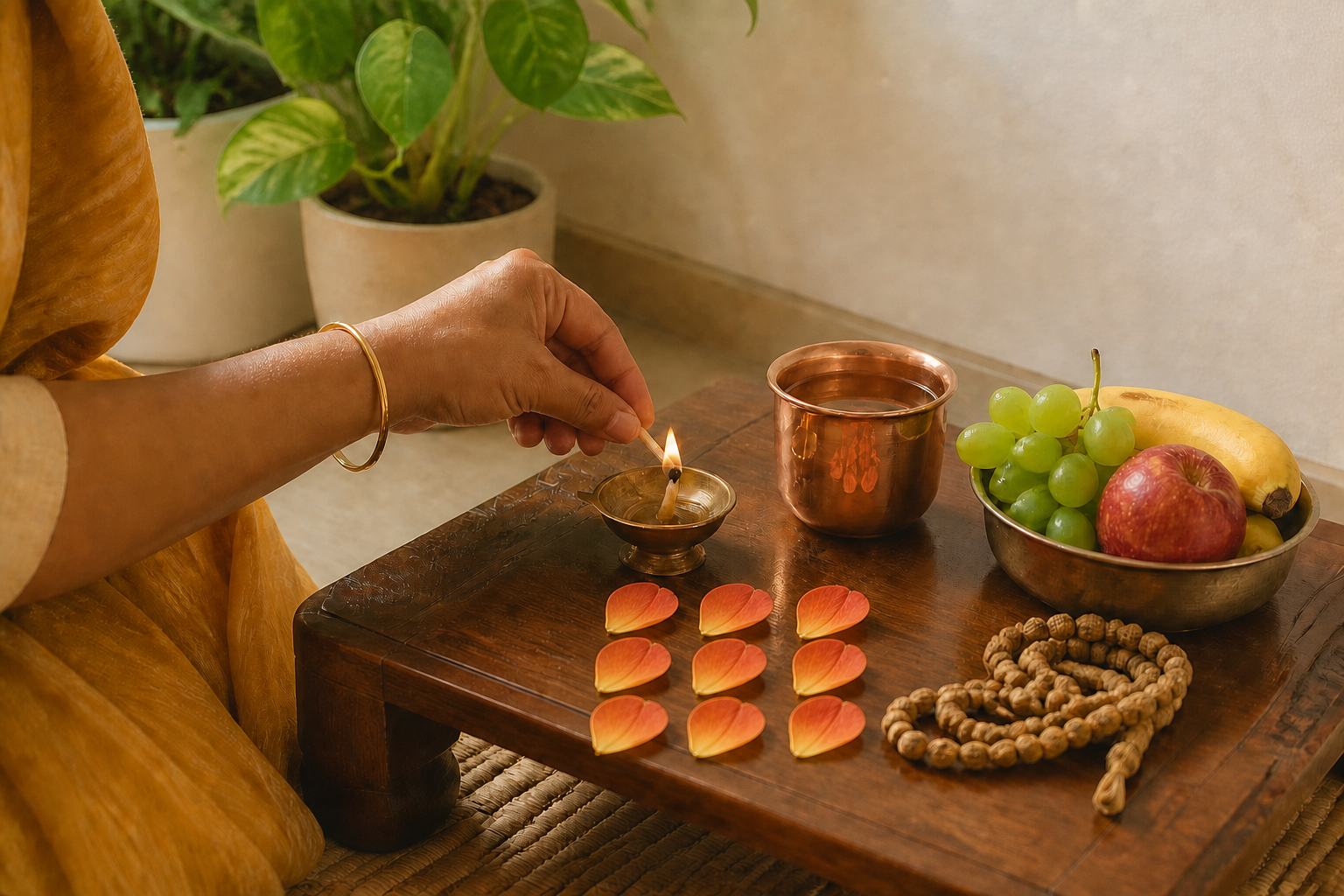
You do not need to turn the day into an elaborate ceremony to observe it meaningfully. Navami in the bright fortnight is commonly used for worship, disciplined study, reflection, charity, and renewed effort. Choose a sequence that fits your lineage and household rather than assembling unrelated practices.
- Prepare one clean place for worship. Remove distractions and set out only what you will actually use.
- Light a clean diya. Let this mark the beginning of the observance rather than leaving it as background decoration. Follow ordinary fire-safety precautions and do not leave it unattended.
- Recite your chosen stotra or mantra. Use a prayer you already understand or have received through your family or tradition. There is no need to invent a special recitation count for this date.
- Offer simple satvic naivedya. Keep the offering consistent with your household practice and share it respectfully as prasada where appropriate.
- Set aside focused time for svadhyaya. Continue a scripture or teaching you are already studying instead of opening several texts and finishing none.
- Write down one intention for the bright fortnight. Make it observable: a regular prayer, a study commitment, a repaired family routine, or a specific act of service.
- Complete one act of seva or dana. Give useful help, food, time, or support according to your capacity. The act should serve someone, not merely remain an intention in a journal.
If fasting is already part of your practice, the day can support a gentle vrata where appropriate. Fasting is not a universal requirement, and it should not override medical guidance or your physical capacity. Study, prayer, a satvic meal, and seva remain meaningful choices when fasting is unsuitable.
Match the observance to your household and tradition
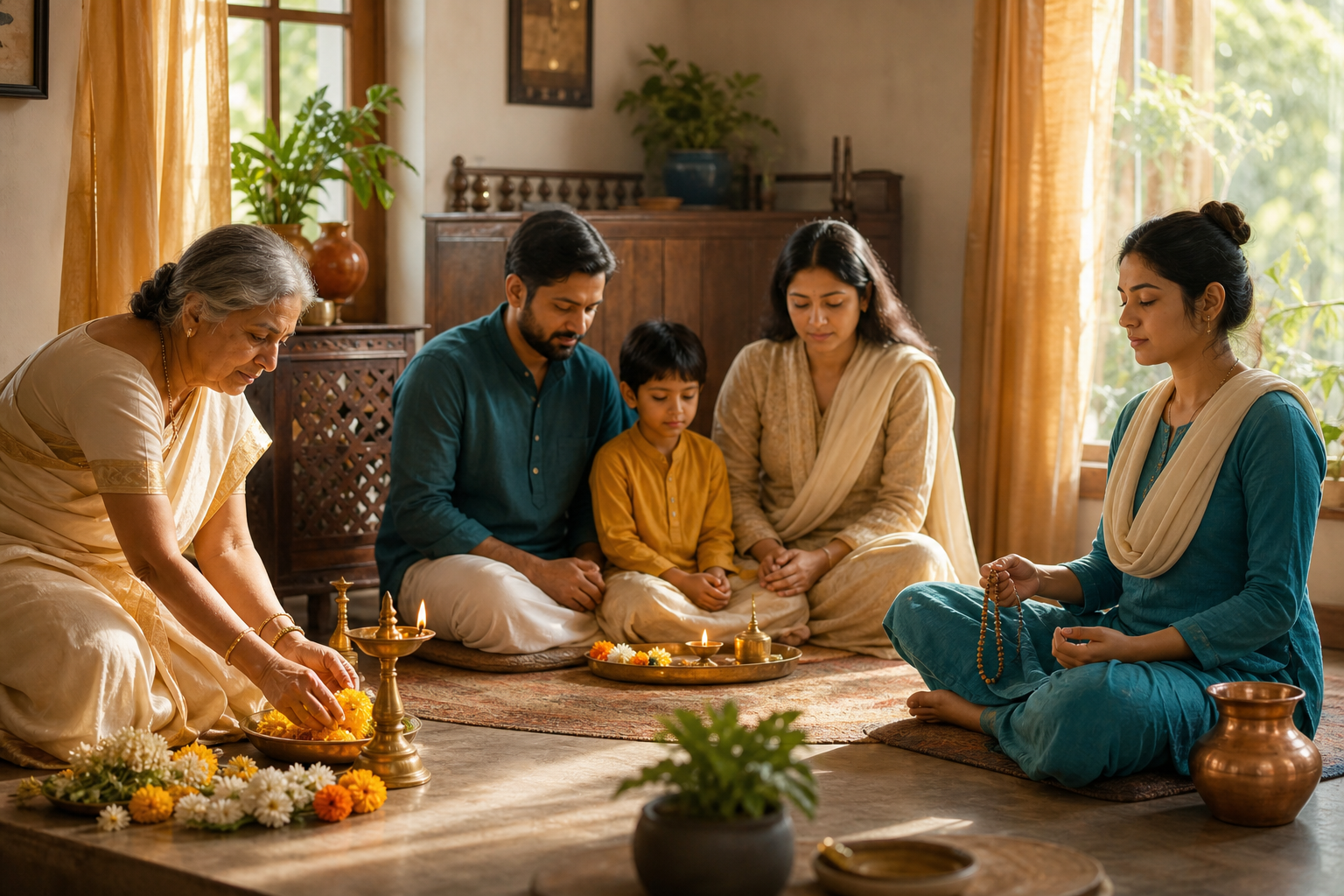
The most useful practice is one your household can carry from the calendar into conduct. A family observance might combine collective prayer, scripture reading, a mindful meal, and a shared act of charity. A person observing alone might emphasize mantra, svadhyaya, and written reflection. Someone with limited time can light the diya, complete one familiar recitation, and perform one concrete act of service.
Hindu, Buddhist, Jain, and Sikh traditions share important commitments to compassion, discipline, self-examination, and service, but they do not share one uniform liturgy. If your family belongs to a non-Hindu Dharmic lineage, keep the day’s ethical structure while using the prayer, meditation, scripture, or seva proper to that lineage. Respecting difference strengthens Dharmic kinship; flattening every path into the same ritual does not.
Navami is often associated with clarity and forward movement. Put that symbolism to work by choosing one unfinished duty that can be advanced without drama. Resume neglected study, restore a family prayer routine, settle a manageable obligation, or turn a charitable intention into an actual contribution. The tithi becomes useful when it changes what you do.
Key takeaways for October 30, 2025
- October 30, 2025 was Thursday.
- Shukla Paksha Ashtami lasted until the commonly referenced transition at 4:51 AM; Navami prevailed afterward.
- The 4:51 AM time should be verified for your city before it governs a pre-dawn or time-sensitive rite.
- Do not treat Navami as a substitute for a complete muhurta calculation. Check local Rahu Kalam, Yamaganda, Abhijit Muhurta, Nakshatra, and Rashi when the activity requires them.
- A practical observance can consist of a diya, a familiar stotra or mantra, satvic naivedya, svadhyaya, reflection, and one completed act of seva or dana.
- Use the forms of worship and discipline proper to your own sampradaya or Dharmic lineage.
When using this date, begin with the city-specific Panchang, mark 4:51 AM as provisional until verified, and choose one observance you can complete with attention. Precise timing gives the day its structure; sincere practice gives it substance.
References
