
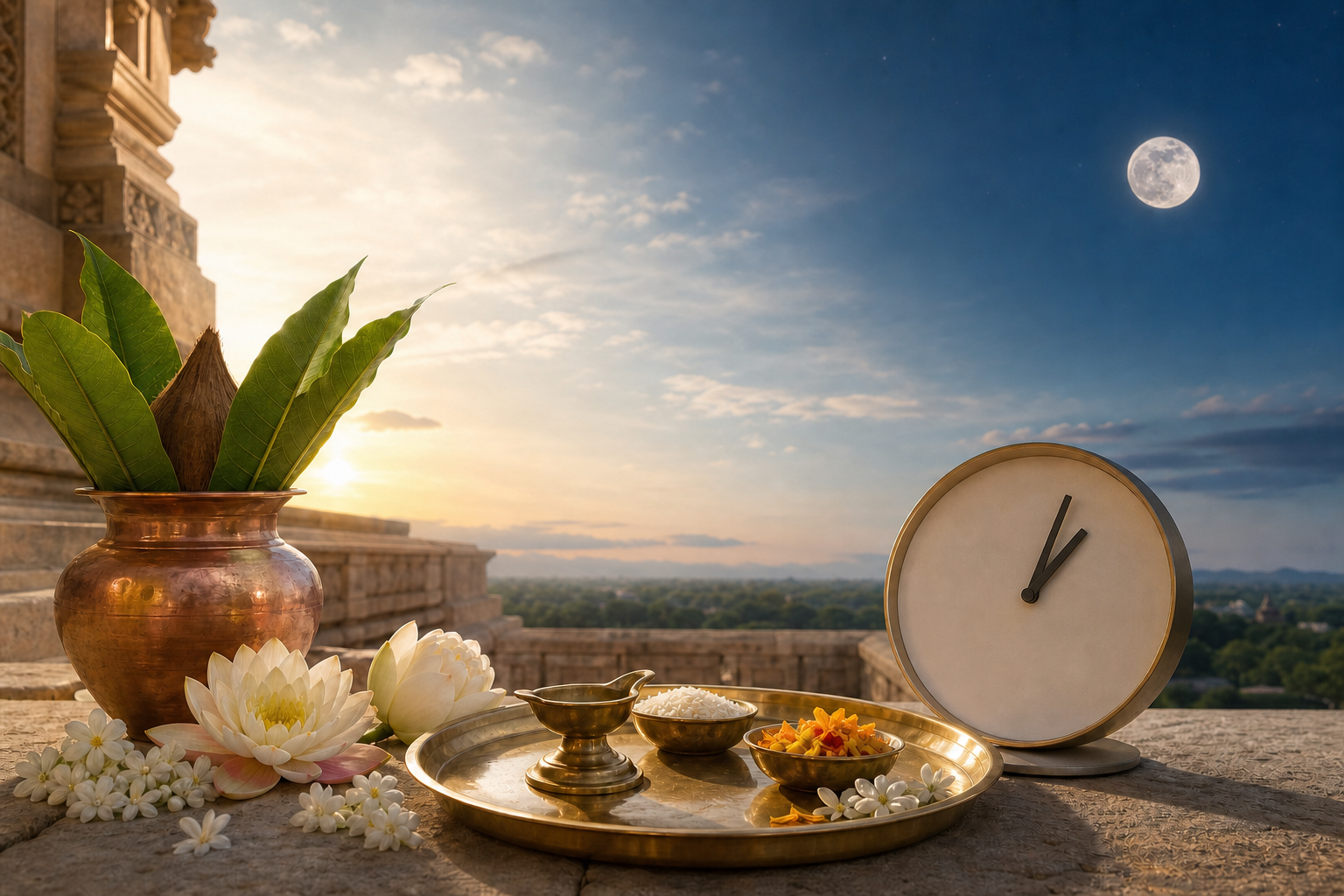
If you are arranging Purnima worship, a vrata, daan, or an important beginning on Sunday, May 31, the decisive boundary comes early in the afternoon: Purnima ends at 1:02 PM IST. Complete any act that specifically requires Purnima tithi before that time.
The tithi cutoff is common across India when expressed in IST, but sunrise, sunset, solar noon, moonrise, Rahu Kalam, Yamaganda, Gulika Kalam, Choghadiya, nakshatra, and Chandra rashi still require a city-specific Panchang. The plan below separates the fixed boundary from the timings you must calculate locally.
Key takeaways for May 31
- Purnima prevails on Sunday morning and ends at 1:02 PM IST on May 31, 2026.
- Krishna Paksha Pratipada begins at 1:02 PM IST and continues until 3:04 PM IST on Monday, June 1.
- Under the common sunrise rule, May 31 is the civil date for the Purnima vrata because Purnima is present at sunrise. Your sampradaya still determines the precise worship and Parana rules.
- Abhijit Muhurat is centered on local solar noon and is commonly treated as roughly 24 minutes on either side, although regional definitions can produce a total span of about 40 to 48 minutes.
- For Sunday, Yamaganda occupies the fifth part of daylight, Gulika Kalam the seventh, and Rahu Kalam the eighth. Their clock times change with local sunrise and sunset.
- Do not infer an exact nakshatra or Chandra rashi from the tithi alone. Confirm both, including any transition time, for your location.
What the 1:02 PM tithi change means in practice
| Period | IST timing | Planning consequence |
|---|---|---|
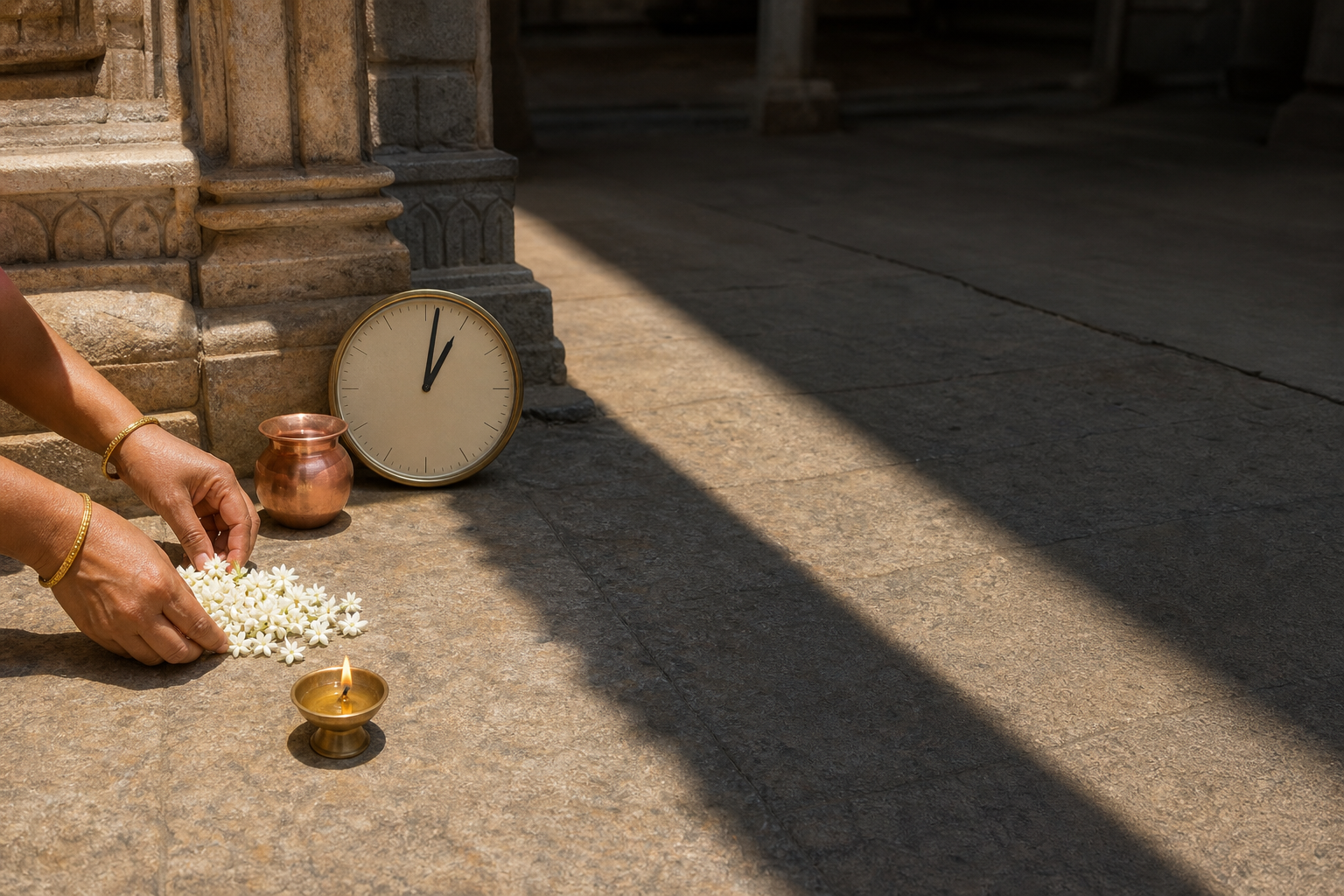
| Purnima | Until 1:02 PM, May 31 | Finish the defining Purnima-dependent act before the cutoff. |
| Krishna Paksha Pratipada | 1:02 PM, May 31 to 3:04 PM, June 1 | Use the later period for the opening practices of the waning fortnight. |
The change at 1:02 PM does not make the rest of Sunday spiritually unsuitable. It changes the tithi. If your sankalpa, puja, homa, or vrata completion must occur during Purnima, conduct its essential portion before 1:02 PM. Kirtan, study, feeding guests, community service, and other supporting activities may continue later when your tradition permits.
This distinction is especially important for Satyanarayana puja. A household following a tithi-centered rule should not assume that Sunday evening remains Purnima merely because the Gregorian date has not changed. Complete the Purnima-dependent portion before the cutoff. A family custom that explicitly prescribes evening worship or moonrise should follow that established parampara after checking the local moonrise and Parana instructions.
The usual sunrise rule places the Purnima vrata on May 31 because the tithi is present at sunrise. Parana is less universal. Some lineages break the fast after Purnima has ended; others connect it to moonrise or another prescribed interval. Therefore, 1:02 PM is a tithi boundary, not an automatic Parana command for every devotee. Likewise, 3:04 PM on June 1 is simply the end of Pratipada and should not be treated as a fasting instruction unless your tradition says so.
If you live outside India, converting 1:02 PM IST tells you when the astronomical tithi transition occurs in your local clock time, but it does not by itself decide the local vrata date. The date rule also depends on your local sunrise. Use a regional Panchang that applies the computational school followed by your community, and avoid mixing a tithi from one system with sunrise or nakshatra data from another.
Calculate the Sunday avoidance periods for your city
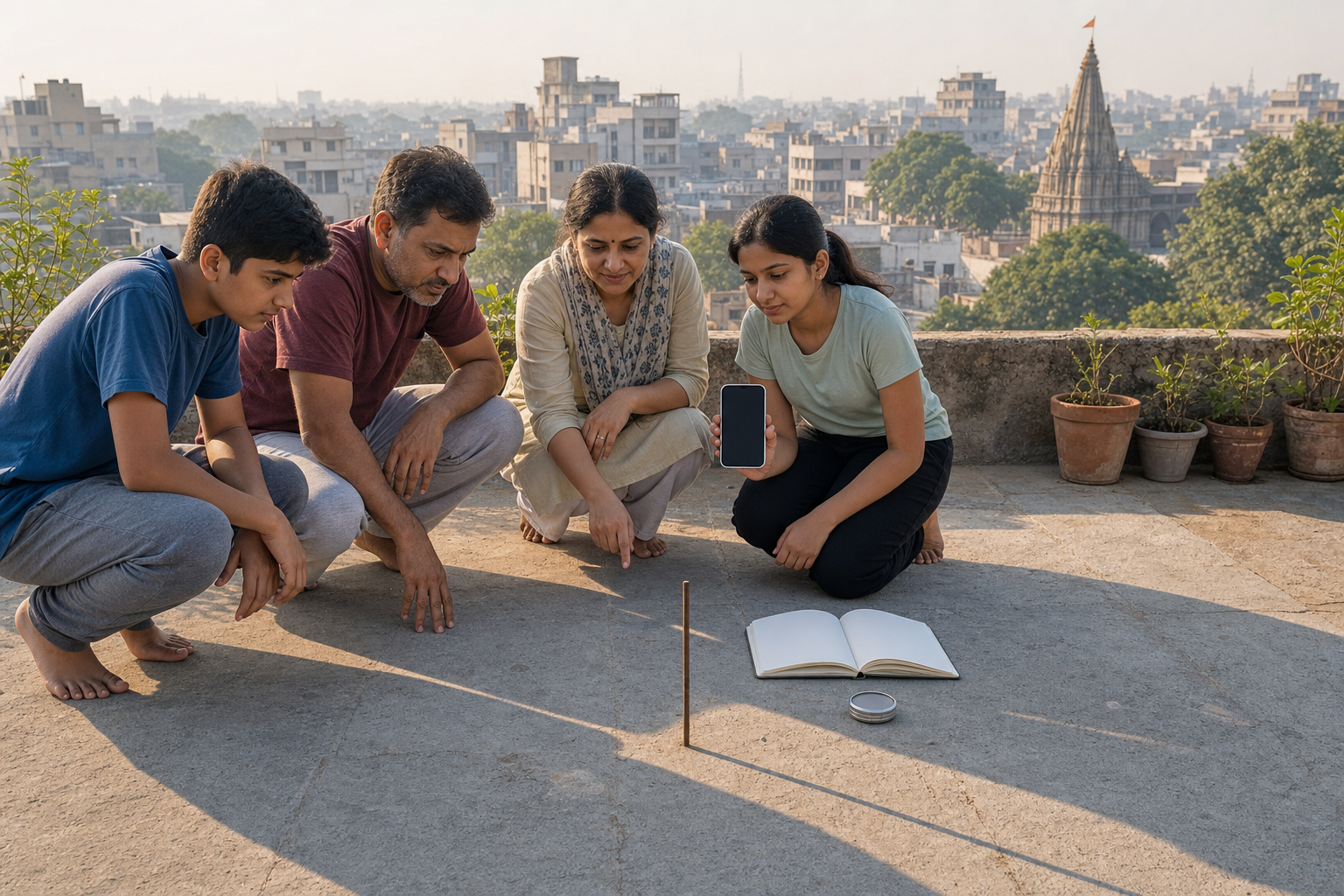
Fixed lists that assign the same Rahu Kalam to every city are only shortcuts. The traditional calculation divides the actual interval from sunrise to sunset into eight equal parts. On Sunday, the fifth, seventh, and eighth daylight parts are assigned to Yamaganda, Gulika Kalam, and Rahu Kalam respectively.
- Record the local sunrise and sunset for May 31 from one trusted Panchang.
- Convert both times to minutes and subtract sunrise from sunset. This gives the daylight duration, D.
- Divide D by eight. Call the result K, the length of one daylight part.
- Count forward from sunrise using the formulas below. Keep the same source and location for all three periods.
| Period to avoid for a major beginning | Sunday daylight part | Calculation from sunrise |
|---|---|---|
| Yamaganda | Fifth | Sunrise + 4K through sunrise + 5K |
| Gulika Kalam | Seventh | Sunrise + 6K through sunrise + 7K |
| Rahu Kalam | Eighth | Sunrise + 7K through sunset |
This method explains why Sunday Rahu Kalam falls in the final eighth of daylight rather than at one permanently fixed clock time. A change in location or seasonal daylight changes K and therefore changes every boundary.
For an auspicious beginning before the Purnima cutoff, first remove any interval that overlaps Yamaganda, Gulika Kalam, or Rahu Kalam. Then check Abhijit Muhurat and favorable Choghadiya. Abhijit is centered on local solar noon, not automatically at 12:00 PM on the civil clock. A commonly used approximation extends about 24 minutes to either side of solar noon, while some regional methods give a total duration closer to 40 minutes. Use the exact span printed by the same local Panchang you used for sunrise and sunset.
Choghadiya provides another layer. Day Choghadiya starts at sunrise, while Night Choghadiya starts at sunset. Amrit, Shubh, and Labh are the favorable designations normally sought for a beginning. Char, Rog, Kaal, and Udveg are treated as neutral or unfavorable to different degrees depending on custom. Do not invent clock times from the names: read the actual May 31 intervals for your city.
When several filters cannot be satisfied at once, use a clear order of priority. First obey the ritual’s tithi requirement. Next exclude the weekday avoidance periods recognized by your family. Then prefer Abhijit or a favorable Choghadiya if one remains. If the act is not optional or is already underway, ask whether your parampara applies these restrictions only to commencement; many muhurta decisions concern the moment an undertaking begins rather than every minute it continues.
Do not guess the nakshatra or Moon sign
A tithi endpoint is not enough to identify the day’s complete Panchang. Tithi, vara, nakshatra, yoga, karana, and Chandra rashi answer different questions. A reliable muhurta decision needs the relevant limbs for the place and moment of the proposed act.
The full Moon around this part of the sidereal cycle can occupy the Libra-Scorpio sector and may engage the Vishakha, Anuradha, or Jyeshtha regions. That broad possibility is not an exact May 31 determination. Do not print one of those names in a sankalpa, choose a ceremony around it, or assess compatibility until a location-specific calculation confirms it.
Ask your Panchang for four precise items: the nakshatra at local sunrise, its ending time if it changes during the day, the Moon’s sidereal rashi and any transition time, and the prevailing yoga and karana during your chosen muhurta. The sunrise nakshatra is often used for the day’s general sankalpa, but a ritual conducted after a transition may require the then-current nakshatra under some traditions. This is a matter for your ritual manual, family practice, or acharya rather than a guess based on the morning entry.
If your local calculation confirms Vishakha, its traditional emphasis can suit learning and outreach. Anuradha is commonly associated with devotion, cooperation, and shared effort. Jyeshtha calls for responsibility and restraint in speech. These are tendencies for interpretation, not substitutes for a complete muhurta or a personal horoscope when either is required.
Small differences between calendars can arise when they use different computational standards or location settings. Consistency matters more than switching applications until one displays the answer you prefer. Choose the Drik or Surya Siddhanta convention followed by your sampradaya, confirm that the city and time zone are correct, and use that system throughout the observance.
A workable Purnima observance for the day
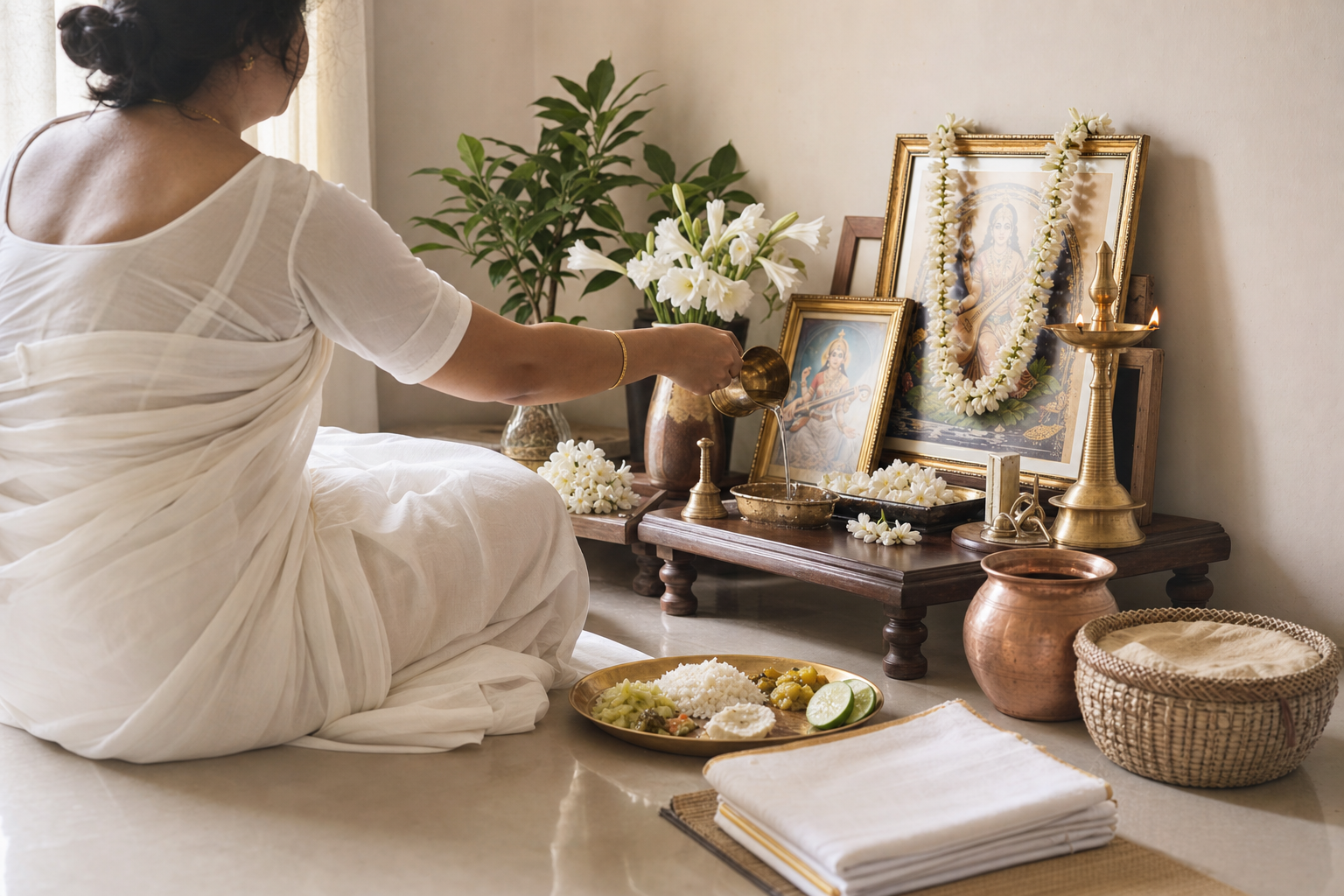
You do not need to crowd every possible practice into the hours before 1:02 PM. A coherent observance with one clear sankalpa is more manageable than a long checklist whose central puja misses the tithi boundary.
- Before Sunday, confirm the local sunrise, the exact nakshatra at sunrise, any nakshatra change, solar noon, moonrise, and your lineage’s Parana rule.
- At or near sunrise, undertake snana, light a deepa, and state the sankalpa appropriate to your family practice.
- Reserve the morning for the defining Purnima worship. Options include Satyanarayana puja, Vishnu Sahasranama, Lalita Sahasranama, japa, temple darshan, or quiet scriptural study. Finish the tithi-dependent portion before 1:02 PM IST.
- Add one concrete act of daan or seva. Annadana, vastra daan, support for a community kitchen, or direct help to someone in need gives the observance a social expression rather than leaving it only at the altar.
- After 1:02 PM, let Krishna Paksha Pratipada set a different tone. Use the afternoon for clearing an untidy space, reviewing an unhelpful habit, simplifying a routine, or committing to a sustainable fortnight of nitya japa or mindfulness.
The same full-moon day can be approached through the shared Dharmic values of restraint, generosity, contemplation, and service. Hindu households may center the morning on puja and mantra. Buddhist communities may choose meditation, dana, and collective reflection, subject to their calendar convention. Jain practice may emphasize prarthana, tapas, and darshan. Sikh communities that give the full moon a congregational place through the Vikram Samvat may focus on kirtan and seva. Each path should retain its own discipline rather than being reduced to a generic blended ritual.
Before May 31 arrives, put four entries in your calendar: local sunrise, the Purnima cutoff at 1:02 PM IST, your city’s calculated avoidance periods, and the Parana instruction of your parampara. Once those are fixed, you can spend the day in worship instead of repeatedly checking the clock.