
On Saturday, March 14, 2026, the Hindu calendar (Panchang) records an early-morning shift of lunar date (tithi). Krishna Paksha Dashami tithi holds until 05:49 AM IST on March 14, after which Krishna Paksha Ekadashi tithi prevails for the remainder of the civil day in most regions. As a Shanivara (Saturday), the day naturally blends Saturn’s emphasis on steadfast discipline with the devotional orientation associated with Ekadashi. This combination is widely experienced in households as a gentle nudge toward self-regulation, reflection, and service.
Technically, a tithi is defined by the angular separation between the Moon and the Sun (the difference in their geocentric longitudes), with each tithi spanning 12 degrees. Because the Moon’s speed varies slightly across its orbit, tithi durations are not uniform and can begin or conclude at any hour. The astronomical instant at which a tithi changes is global (when viewed in Universal Time), yet festival observances are anchored to local sunrise. This is why daily guidance often notes that a given tithi covers the greater part of a civil day “in most regions,” while advising local confirmation for precise muhurta (auspicious time) selection.
Across dharmic traditions, the eleventh lunar day of a fortnight is observed with special reverence. In many Hindu lineages, Ekadashi fasting is dedicated to Lord Vishnu, aligning personal restraint with sattvic clarity. In numerous Jain communities, Agiyaras (Ekadashi) is associated with dietary discipline and ahiṁsā-centered mindfulness. While Buddhist and Sikh families may not mark the day as a canonical fast, many embrace it informally as an opportunity for metta (loving-kindness) meditation, simran (remembrance), self-restraint, and seva (service). This shared emphasis on inner refinement, compassion, and truth nurtures unity among Hinduism, Buddhism, Jainism, and Sikhism.
Observing Ekadashi Vrat: Traditional practice encourages avoiding grains and legumes on Ekadashi, with many opting for fruits, milk, nuts, sabudana, and millets like sama (barnyard millet). Those following stricter Jain dietary principles may additionally avoid root vegetables. For mantra-japa, Om Namo Bhagavate Vāsudevāya and recitation of the Vishnu Sahasranāma are customary; contemplative readings from the Bhagavad-Gita or Upanishads are also common. Fasting methods vary from nirjala (waterless) to phalahara (fruits-only) to anukalpa (a light, sattvic meal). Devotees are encouraged to honor health conditions and consult family elders or spiritual guides when needed.
Paraṇa (breaking the fast) is performed on Dvādaśī, the twelfth lunar day, which for this sequence falls on Sunday, March 15, 2026 (local sunrise based). The core rule is to break the fast after sunrise and before the Dvādaśī tithi ends, avoiding the period known as Hari Vāsara (the first quarter of Dvādaśī) when paraṇa is traditionally not performed. Smārta and Vaiṣṇava traditions sometimes use slightly different paraṇa windows; local panchang guidance should be followed when choosing the exact time.
Saturday’s planetary rulership (Śani/ Saturn) emphasizes patience, structure, responsibility, and long-term commitments. Many families blend Ekadashi practices with Saturday sādhanā such as lighting a sesame-oil lamp, chanting the Hanuman Chalisa, supporting elders, or consciously attending to ethical duties (dharma) in financial and familial matters. This synergy often feels like a steadying influence: devotion sharpens intention, while Saturn’s discipline sustains it.
Auspicious times (muhurta) on a Saturday are selected by excluding inauspicious segments and, where possible, using constructive windows like Abhijit Muhurta. Abhijit Muhurta centers on local solar noon and typically spans about 48 minutes on either side, making it well-suited for prayer, study, and quiet beginnings. Because all muhurta depend on local sunrise and the day’s length, calculations should be tailored to the observer’s location.
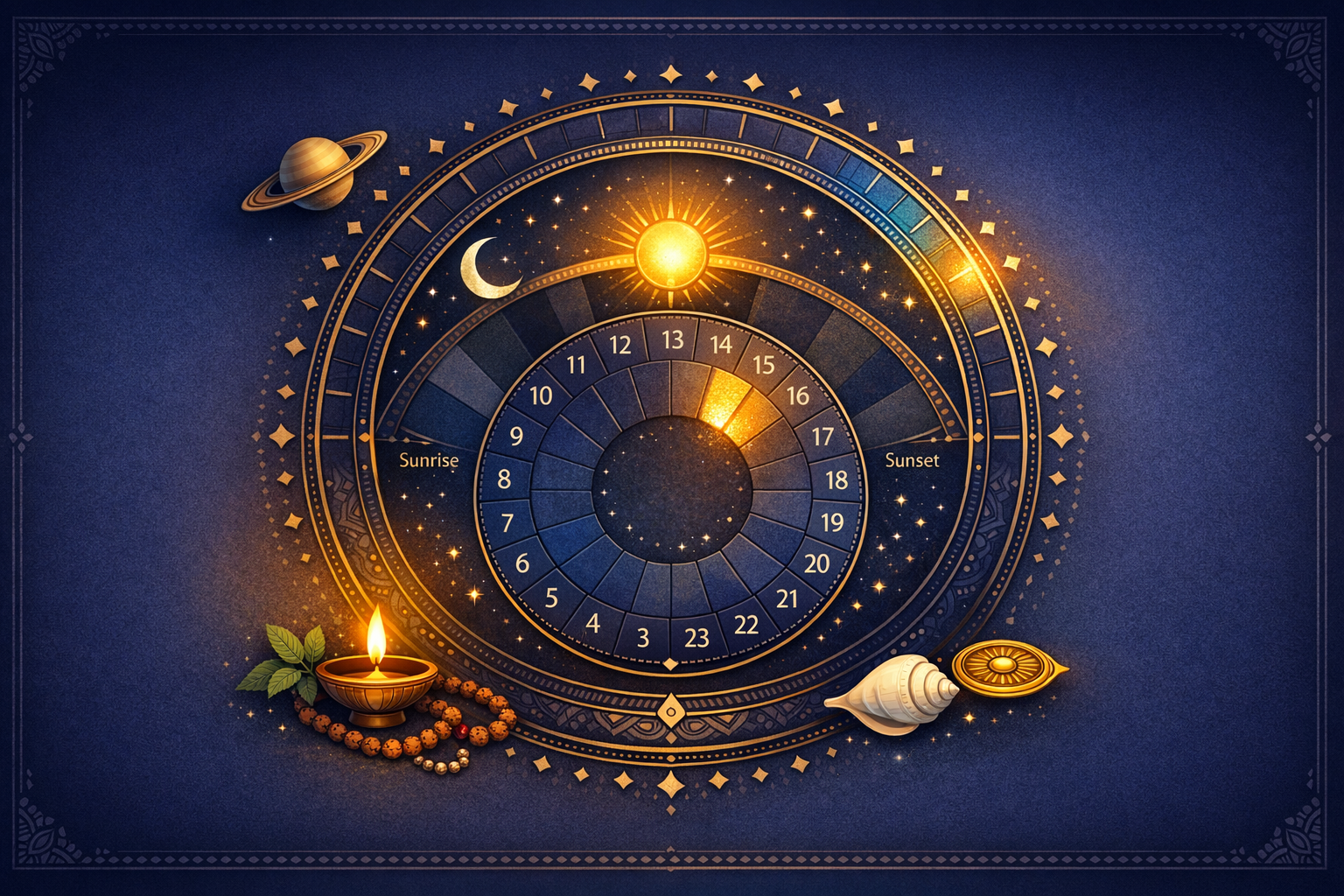
Rāhu Kālam, Yamaganda, and Gulika Kālam are computed by dividing the daytime (sunrise to sunset) into eight equal parts. Each weekday has a fixed mapping of which segment is to be avoided for specific activities. For Rāhu Kālam, the segment indices by weekday are: Sunday (8th), Monday (2nd), Tuesday (7th), Wednesday (5th), Thursday (6th), Friday (4th), Saturday (3rd). For Yamaganda, the indices are: Sunday (5th), Monday (3rd), Tuesday (2nd), Wednesday (1st), Thursday (7th), Friday (6th), Saturday (4th). For Gulika Kālam, the indices are: Sunday (1st), Monday (6th), Tuesday (5th), Wednesday (4th), Thursday (3rd), Friday (2nd), Saturday (7th). Beneficial undertakings are deferred outside these windows; regular worship and reflection, however, are welcome at all times.
Illustrative computation method (example only): Suppose a city experiences sunrise at 06:30 IST and sunset at 18:25 IST on March 14, 2026. The daytime spans 11 hours 55 minutes, which, when divided into eight equal parts, yields segments of roughly 1 hour 29 minutes 23 seconds each. On Saturdays, Rāhu Kālam falls in the 3rd segment (approximately 09:29–10:58 IST in this example), Yamaganda in the 4th segment (approximately 10:58–12:27 IST) or, by the index noted above, the 6th segment depending on regional convention, and Gulika Kālam in the 7th segment (approximately 15:26–16:56 IST). Because inputs vary by city and some traditions follow distinct index conventions, practitioners should recompute using the local sunrise–sunset and the specific mapping followed in their sampradāya. The example here is purely pedagogical to show the method.
Choghadiya offers another practical lens. The daytime sequence cycles through eight segments associated with planetary qualities. For Saturdays, many almanacs list the day sequence as: Udveg, Chal, Labh, Amrit, Kaal, Shubh, Rog, Udveg (and so on, repeating through the day). Labh, Amrit, and Shubh are generally considered favorable; Chal is moderate; Udveg, Kaal, and Rog are typically avoided for beginnings. Because each segment’s length depends on the day’s duration, the same calculation principle applies: divide sunrise-to-sunset into eight equal intervals and align activity choices accordingly.
Nakshatra and Chandra Rashi (Moon sign) for March 14, 2026 will depend on the Moon’s exact longitude at the observer’s location and may straddle two segments across the day. In the late Krishna Paksha of this season, the Moon often traverses the Makara–Kumbha (Capricorn–Aquarius) sector, which includes the nakshatras Śravaṇa and Dhaniṣṭhā. However, because nakshatra transitions can occur at any hour, local panchang data should be consulted to confirm the active star (nakshatra) and the Moon’s rashi at a chosen time and place.
Additional Panchang elements such as Yoga (one of the 27 daily yogas) and Karaṇa (one of the 11 karanas) are often referenced for fine-grained muhurta work (e.g., setting a start time within Abhijit or selecting a precise window for a vow or study session). These componentstithi, nakshatra, yoga, karaṇa, and weekdayform the five limbs (pañcāṅga) of the traditional almanac. For technical accuracy, each should be verified for the practitioner’s city, particularly when planning samskāras, travel, or time-sensitive rites.
Month-naming and the Ekadashi’s conventional title can vary by regional calendar. In North Indian purnimanta and amanta systems, this Ekadashi falls in the Krishna Paksha of the lunation overlapping March and is often referred to by a traditional name associated with that lunar month; in Tamil, Malayalam, Kannada, and Telugu calendars, the same lunar day maps onto Maasi/Meena-month reckoning depending on the system followed. Given these legitimate regional differences inside the broader Hindu calendar, relying on a local almanac (desa–kāla–pātra sensitive) is best practice.
Practical guidance for households seeking a unifying dharmic observance includes: maintaining a simple fast aligned with health and age; dedicating time to japa, dhyāna, and scriptural reading; engaging in seva and dāna with an attitude of kindness; and observing ecological and dietary ahiṁsā. Families frequently report that such shared rhythmsquiet mornings, light meals, evening prayerscultivate steadiness across diverse spiritual paths at home.
In summary, Saturday, March 14, 2026 carries the spiritual momentum of Krishna Paksha Ekadashi tithi following the 05:49 AM IST transition from Krishna Paksha Dashami tithi. With thoughtful use of muhurta (avoiding Rāhu Kālam/Yamaganda/Gulika Kālam, favoring Abhijit and positive Choghadiya), and with attention to local panchang specifics for nakshatra and rashi, the day supports introspection, study, and compassionate action. Approached in this spirit, Ekadashi becomes a shared dharmic spacehonoring Hindu, Buddhist, Jain, and Sikh values of discipline, remembrance, and servicenourishing unity in diversity.
Inspired by this post on Hindu Blog.
