
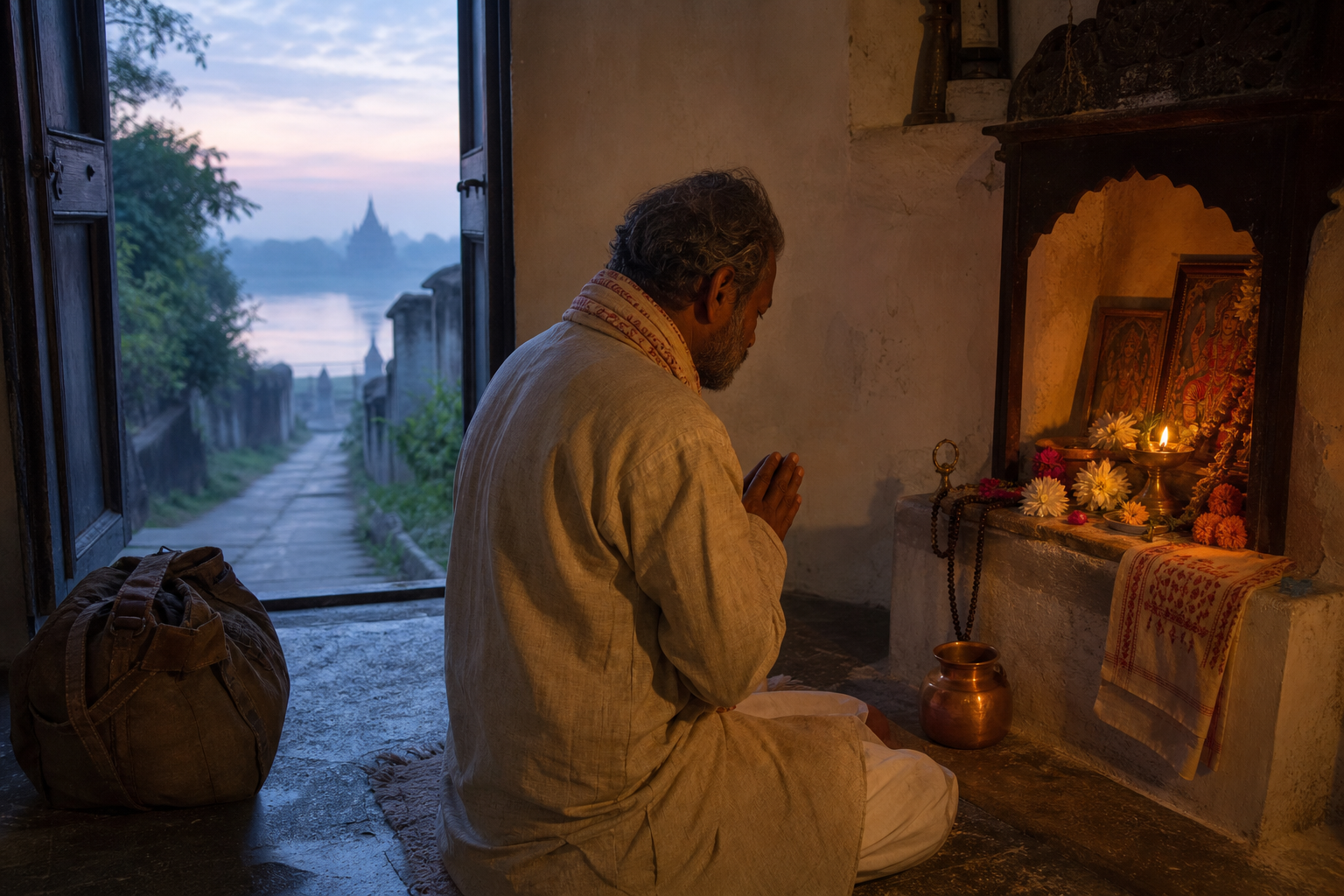
You may be preparing for Prayagraj, Gangasagar, Kurukshetra, a temple yatra, or a sacred observance at home. The difficult question is not where to go or which ritual to perform. It is how to return with more than photographs, fatigue, and a brief devotional high.
A fruitful pilgrimage concentrates the work of ordinary dharmic life. You hear more carefully, remember the Divine more deliberately, accept the discipline of a community, serve without demanding attention, and carry a definite change back into your conduct. Sacred time serves the same purpose: it gathers a scattered mind around what matters.
Begin with a sankalpa, not a sightseeing list

Travel arrangements can occupy the whole mind before a pilgrimage. Tickets, lodging, queues, bathing times, food, and transport all matter, but they do not tell you what the journey is for. Set your sankalpa before the itinerary takes over.
A useful sankalpa names an inward task in language you can test. What attachment are you trying to loosen? Which duty needs clarity? Where has impatience entered your speech? Which devotional practice has become mechanical? A vague wish to feel spiritual gives you nothing to carry home. A definite intention lets every inconvenience become part of the practice.
Within a Vaishnava devotional frame, ritual bathing remains meaningful, but attentive hearing, kirtana, remembrance, and association with saintly people carry the deeper transforming work. This distinction protects you from treating a tirtha like a spiritual transaction: arrive, bathe, make an offering, collect merit, and leave unchanged.
The same practical principle appears across Dharmic traditions without making those traditions identical. Hindu sādhu-saṅga, Buddhist sangha, Jain association with sādhus and sādhvīs, and Sikh sangat arise from different teachings and disciplines. Yet each reminds you that a sacred journey is shaped by the people from whom you learn and the conduct you practice among them. Shared ethical ground does not erase theological difference.
Prepare these elements before departure:
- Intention: Write a brief sankalpa that names the habit, duty, or virtue requiring attention.
- Root practice: Choose the practice that will anchor the journey, such as japa, scriptural hearing, kirtana, disciplined silence, reflection, or prayer.
- Human association: Find out where teaching, satsang, sangat, or community practice will occur. Do not leave this to whatever happens after arrival.
- Service: Decide how you will contribute through seva, charity, patient cooperation, or care for the site.
- Return commitment: Name a practice you can continue amid work, family obligations, and ordinary friction.
If your plan contains many places but no protected time for hearing, silence, or service, simplify it. Missing an attraction is usually less consequential than rushing through the encounter that could have clarified your life.
Use sacred time to narrow your attention

Sacred time is not a celestial shortcut. Its value lies in giving the mind a clear boundary within which practice becomes more deliberate. The calendar interrupts routine; you decide whether that interruption becomes remembrance or merely another event to consume.
Makar Sankranti marks the sun’s northward transition and is associated with clarity, purpose, prayer, bathing, mantra, and daan. At Prayagraj and Gangasagar, these practices take place within immense collective gatherings. The scale can strengthen a sense of belonging, but scale alone does not create attention. You still have to protect the inward purpose of the day.
Eclipses have likewise been treated in Dharmic practice as intervals for intensified japa, charity, study, silence, and remembrance. The useful question is not whether the sky will perform your inner work for you. It is what you will stop doing so that concentrated practice can actually occur.
Give a sacred interval a clear beginning, center, and close:
- At the beginning: Put away routine distractions, clean the practice space, settle the body, and restate your sankalpa. Bathe or wash according to your tradition and circumstances, but connect the outward act to the inward intention.
- At the center: Stay with a primary practice long enough for restlessness to become visible. Constantly switching among chanting, messages, videos, photographs, and commentary preserves distraction under a devotional appearance.
- At the close: Offer daan or seva, note what became clear, and choose the conduct through which the observance will continue. Charity should express expanded responsibility, not function as a fee paid to end the discipline.
Do not overload the interval with every practice you admire. A modest observance completed with attention is more instructive than an ambitious schedule that keeps you anxious about finishing. Sacred time should make you more present to dharma, not less present to duties that genuinely require you.
Read sacred geography as instruction

A tirtha is not interchangeable scenery. Its river, temple, coast, path, or battlefield carries a particular sacred memory. Learn that memory before arriving, because it tells you what the place is asking you to notice.
At Prayagraj, the Ganga and Yamuna meet at the Sangam alongside the revered invisible Saraswati. At Gangasagar, the Ganga reaches the Bay of Bengal. These settings make confluence, movement, gratitude, and surrender tangible. The practices surrounding them include early bathing, mantra, satsang, kirtana, study, charity, and volunteer stewardship. If you focus only on entering the water, you miss the disciplined life gathered around it.
Kurukshetra asks for a different kind of attention. Its sacred memory includes Krishna, worldly duty, the love of the Vrajavasis, separation, and reunion. Remembered in this devotional mood, Kurukshetra becomes a classroom for the tension between duty and transcendent love. You need not reduce that tension to a slogan. Let it expose where you use devotion to avoid duty, or where duty has become an excuse to neglect love and remembrance.
Use this sequence at any sacred site, adapting it to local custom and your sampradaya:
- Learn the central memory: Know which event, teaching, teacher, deity, Tirthankara, Guru, or community history gives the place its meaning.
- Enter deliberately: Pause before reaching for the phone. Notice your mental state, restate the sankalpa, and remember whose space you are entering.
- Perform the observance knowingly: If you bathe, circumambulate, bow, chant, sit in meditation, or make an offering, know what the act is meant to cultivate.
- Hear before interpreting: Attend a class, discourse, kirtana, recitation, or community teaching. Let the tradition explain the place before turning the experience into your own conclusion.
- Serve the living tirtha: Cooperate with volunteers, show patience in queues, avoid obstructing worship, keep waste under control, and treat local residents as participants in sacred life rather than as scenery.
- Record an implication: Before leaving, write what the place now asks you to do differently. A memory becomes formative when it acquires an ethical consequence.
Ecological care belongs inside the observance. Sacred rivers and coasts are also living ecosystems, and cleanliness, careful waste practices, and eco-conscious offerings express reverence for them. An offering that leaves avoidable harm behind contradicts the gratitude it is meant to embody.
Crowds also reveal whether your devotion has entered your conduct. A sacred bath followed by harsh speech in a queue is not a minor inconsistency; it identifies the exact place where practice has yet to mature. Patience, gentle speech, restraint, and consideration for elders, children, volunteers, and fellow pilgrims are not peripheral etiquette. They are part of the yatra.
Let holy company change the quality of the journey
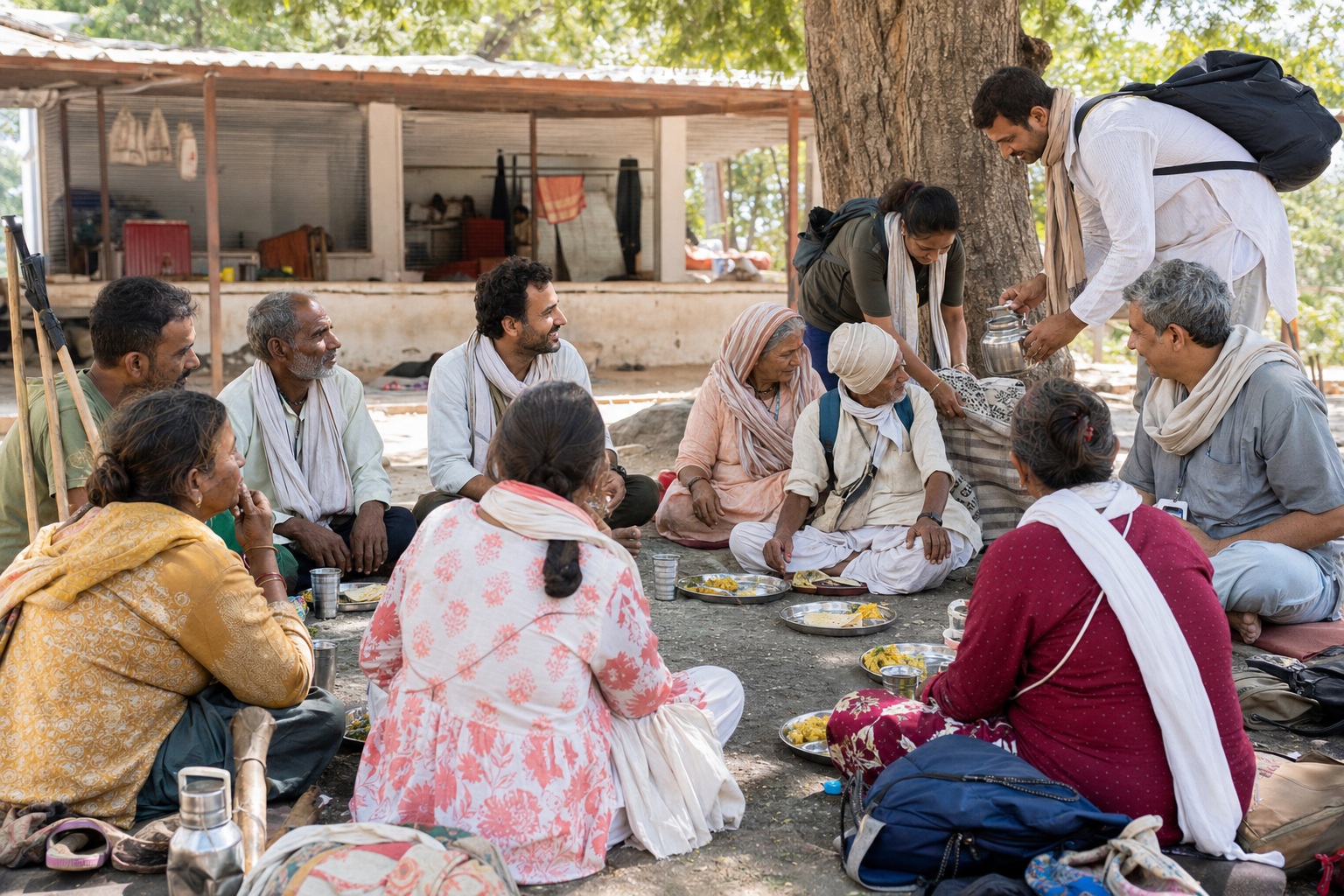
Being surrounded by religious people is not automatically sādhu-saṅga. A crowd can intensify distraction as easily as devotion. Ennobling association begins when you listen with enough humility to let wisdom correct your priorities.
The purifying mechanism is relational. Hearing and meaningful association can refine perception, strengthen gratitude, and support habits of integrity and self-restraint. The Buddhist sangha, Jain sādhu-sādhvī communities, Sikh sangat, and Hindu forms of satsang express this principle through their own disciplines. In each setting, community can provide the ethical scaffolding that private enthusiasm often lacks.
Approach association as a practitioner, not a collector of spiritual personalities:
- Consult the teaching schedule and protect enough time to hear a complete discourse rather than dropping in only for a photograph or blessing.
- Bring a question about practice: how to sustain japa, repair conduct, serve responsibly, understand a teaching, or carry the yatra home.
- Listen for an instruction you can actually follow. Accumulating impressive concepts can become another way to postpone transformation.
- Join ordinary service when appropriate. Working beside a community often reveals its values more clearly than observing it from a privileged distance.
- Notice the result of the encounter. Good association should leave you with clearer responsibility, deeper humility, and a more disciplined form of devotion, not a stronger need to display proximity or status.
Do not confuse charisma, access, or visibility with realization. Nor should you flatten every Dharmic teacher into a generic source of inspiration. Receive guidance within the commitments and standards of your own path, while showing respect to the disciplined lives of other traditions.
Association also works horizontally. A fellow pilgrim who helps you remain patient, keeps the shared space clean, reminds you of the teaching, or serves without recognition may do more for your yatra than a hurried encounter with a celebrated figure. Sanctity becomes participatory when people help one another practice truth, compassion, restraint, and service.
Make the return home part of the yatra
The journey home is not the end of pilgrimage. It is where the sankalpa meets the conditions that made it necessary. The first disagreement, neglected duty, rushed morning, or distracted prayer after your return will tell you more than the intensity of the peak experience.
Build a continuation that has a cue, a practice, an ethical expression, and community support:
- Cue: Attach the practice to a stable part of the day, such as waking, bathing, the beginning of work, a meal, or preparing for sleep.
- Practice: Continue a manageable form of japa, hearing, study, silence, prayer, kirtana, daan, or seva. The form should be recognizable even on an ordinary workday.
- Ethical expression: Translate devotion into observable conduct. If the sankalpa concerned gentler speech, the practice begins in the next disagreement. If the yatra awakened ecological reverence, reduce the waste you control rather than reserving concern for the riverbank.
- Community support: Maintain contact with satsang, sangha, sangat, or the trusted practitioner who helped clarify the teaching. Association stabilizes a resolve that mood alone cannot sustain.
- Review: Ask whether the commitment is changing choices. If it exists only in memory, make it smaller and more definite rather than waiting for another festival, eclipse, or journey.
A dramatic vow can feel appropriate at a powerful tirtha, but a vow that cannot survive family life and livelihood may become an exercise in guilt. Choose a discipline that stretches you without depending on conditions you do not possess. When you miss it, resume at the next established cue. Do not turn a lapse into permission to abandon the sankalpa.
You can also keep sacred geography alive through ethical memory. Let Kurukshetra question the relationship between duty and love. Let the Sangam remind you to bring divided parts of life into a coherent dharmic direction. Let Gangasagar deepen gratitude for the river and responsibility toward the natural world. The place continues to teach when memory changes behavior.
Key takeaways
- Begin with a definite sankalpa so that travel, ritual, inconvenience, and reflection serve the same inward task.
- Treat sacred time as a container for concentrated attention, not as a substitute for effort, duty, or ethical conduct.
- Keep ritual connected to hearing, remembrance, holy association, service, charity, and reflection.
- Learn the sacred memory of a tirtha before arriving, then let that memory identify a change required in your life.
- Judge the quality of association by whether it produces humility, clarity, self-restraint, compassion, and responsibility.
- Plan the return practice before leaving home; the real test begins when ordinary pressures resume.
Before your next sacred observance, write the sankalpa and the return commitment on the same page. Carry it with you, read it at the tirtha, and act on it when you come home. That simple continuity turns a holy occasion from an interruption of life into training for how life should be lived.
References
- Dandavats – Beyond Ritual: ISKCON Adelaide on Pilgrimage, Eclipses, and Kurukshetra’s Purifying Power
- Struggle for Hindu Existence – Makar Sankranti & Magh Mela 2026: Millions Unite at Prayagraj and Gangasagar in Peace and Devotion
