
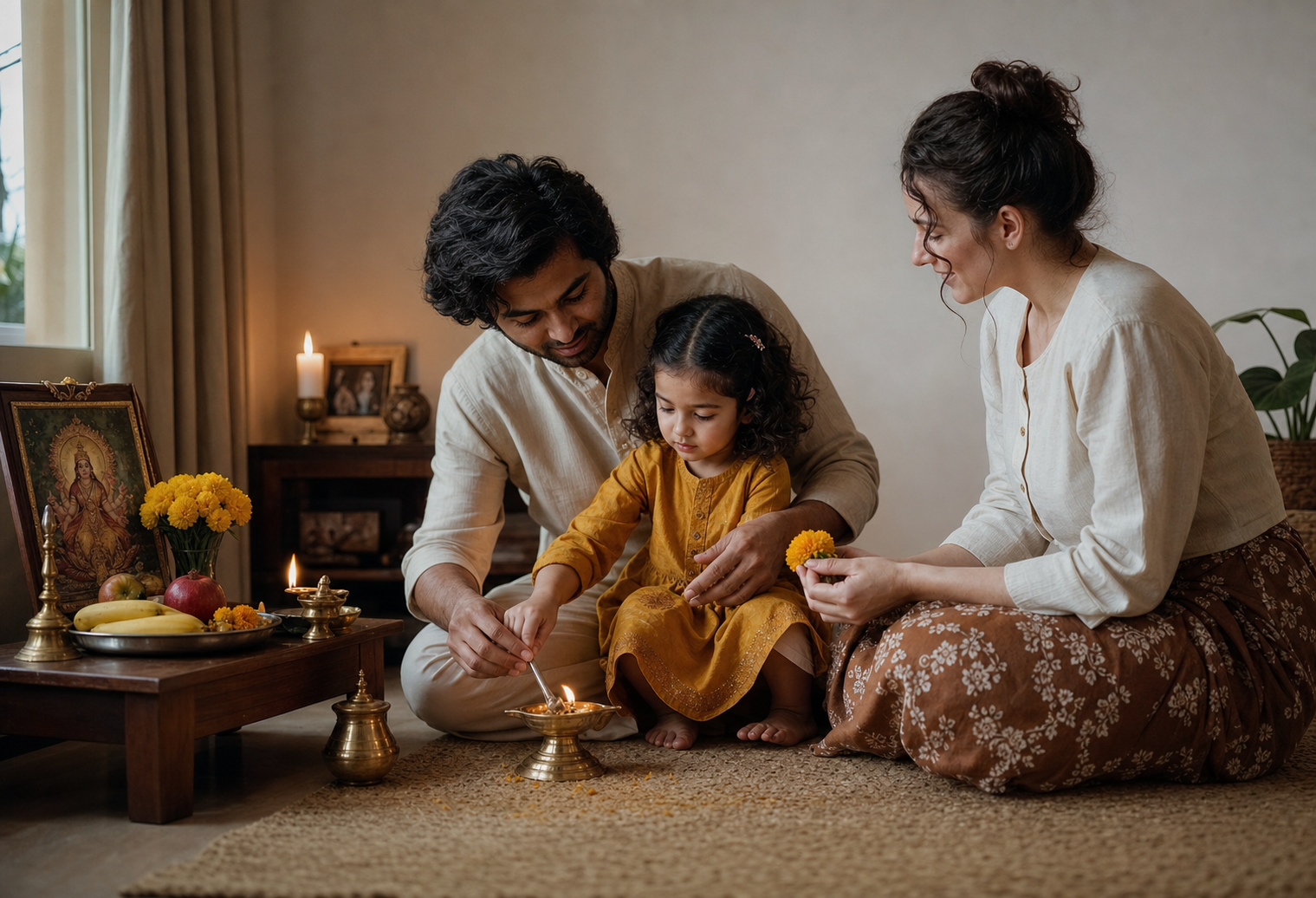
You and your partner may agree that your child should know both sides of the family. The difficulty begins when that promise meets ordinary life: Which prayers do you teach? Which festivals shape the family calendar? What do you say when a relative insists that a child must choose one identity?
Multifaith parenting becomes clearer when Hindu inheritance is made concrete. Nick Jonas and Priyanka Chopra describe a multicultural, multi-religious household in which their daughter is being raised with Hindu values expressed through respect, ritual practice and everyday understanding. Your family does not need to copy anyone else’s arrangement. It needs the same kind of clarity: Hindu dharma must be something your child can see, practise and explain.
First, agree on what you are actually handing down
The phrase raised with Hindu values can conceal several different intentions. One parent may mean celebrating major festivals. Another may mean learning prayers, understanding karma and dharma, visiting a temple, knowing family deities, hearing the epics, or eventually identifying as Hindu. If you do not separate those questions, each parent can believe there is agreement while imagining a different childhood.
Write a family agreement in plain language
Before choosing activities, complete these statements together. They are not a legal contract. They are a way to expose assumptions before your child is placed between them.
- Identity: Our child belongs to a family shaped by Hinduism and ______. At home, we will describe that identity as ______.
- Practice: The Hindu practices we will maintain consistently are ______. The practices from the other tradition will be ______.
- Respect: Neither parent or extended family will mock, frighten or pressure the child about the other side of the family.
- Agency: As our child matures, questions and disagreement will be allowed, while age-appropriate participation in family life will still be expected.
Fill the blanks with practices you can actually sustain. A long aspirational list usually becomes an occasional festival performance. A short commitment that survives busy weeks becomes part of the child’s identity.
Do not use we will let the child decide later as a substitute for making decisions now. A future choice is not informed if the child never receives the language, stories and practices of the Hindu inheritance. You can leave room for mature agency while still giving your child roots.
Give Hindu values child-sized meanings
Words such as dharma and karma should not remain decorative vocabulary. Connect each word to a question your child can use during an ordinary day. These prompts are teaching tools, not complete philosophical definitions.
| Hindu value | Question for the child | What practice can look like |
|---|---|---|
| Dharma | What is my responsibility in this situation? | Keeping a promise, doing a household duty, or protecting someone who is being treated unfairly. |
| Karma | What did my action set in motion? | Naming a consequence honestly, correcting the harm and choosing a better action next time. |
| Ahimsa | How can I reduce harm in what I say and do? | Stopping cruel speech, treating living beings with care, and repairing a relationship after causing hurt. |
| Seva | What can I contribute without demanding praise? | Helping at home, supporting a community activity, or serving someone who needs assistance. |
| Gratitude and reverence | What have I received, and how should I honor it? | Offering thanks before food, caring for sacred objects, respecting elders, or treating nature with attention. |
Use the words your family, sampradaya and community actually use. A broad values framework should support a living Hindu tradition, not replace it with generic niceness.
Build a rhythm your child can recognize
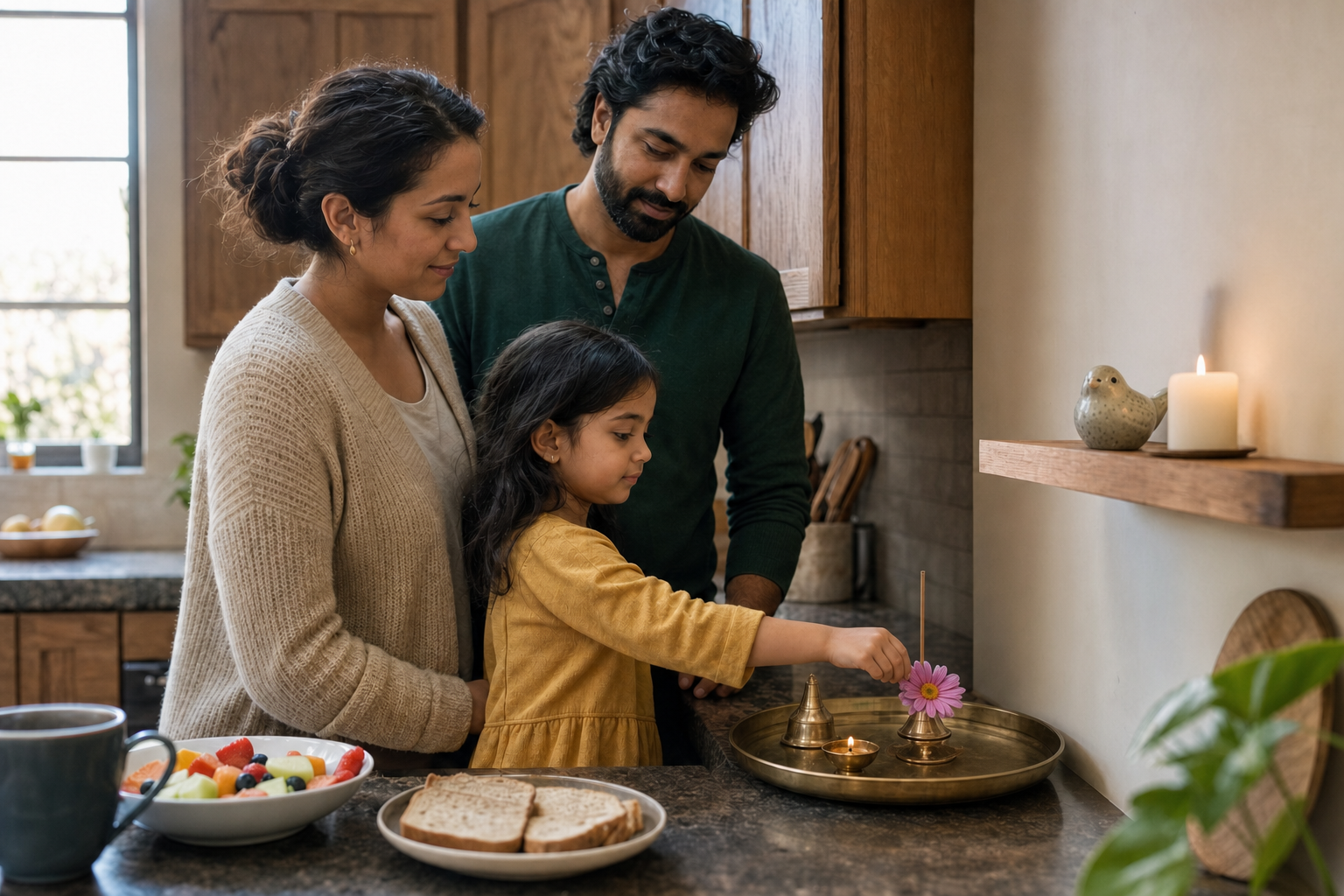
Children usually experience belonging through repetition before they can explain theology. If Hindu life appears only during a large festival or a visit from grandparents, it may feel like a special performance rather than the normal grammar of home.
- Keep a brief home practice. Use a prayer, mantra, namaskar, moment at the home shrine, or expression of gratitude that fits your family tradition. Explain its meaning in one clear sentence.
- Return regularly to a story. Read or retell an age-appropriate episode from an epic or another narrative honored in your family. Ask what each person owed to others, what choice was made, and what followed from it.
- Make seva participatory. Do not let the child watch while adults perform all the service. Give the child a real task suited to their maturity, then discuss whom the work helped.
- Choose festivals you can inhabit fully. Begin with the observances that matter in your own family or regional tradition. Teach the name, the central meaning, the household practice and the child’s responsibility in the preparation.
- Create a community connection. A temple, family circle, language setting, bhajan group, cultural art or music practice can give the child relationships and vocabulary that one parent cannot carry alone.
Pair action with meaning. A lamp lit without explanation can become decoration; an explanation without practice can become a lecture. A simple sentence closes the gap: We offer this light to remember clarity and reverence. Use an explanation that is faithful to your own tradition rather than presenting one interpretation as universal to every Hindu family.
Young children need imitation, short stories and repeated phrases. School-age children can trace choices and consequences. Adolescents should be invited into philosophical questions, community responsibilities and honest disagreement. The value remains stable, but the way you teach it must mature with the child.
You also do not need to turn Sanskrit fluency into an entry requirement. Teach a small amount accurately, include the meaning, and let familiarity grow. A mantra recited with some understanding is more useful than a large collection memorized only for display. When you are unsure about pronunciation or context, ask a trusted family member, teacher or community practitioner instead of improvising.
Teach both faiths honestly without thinning either one
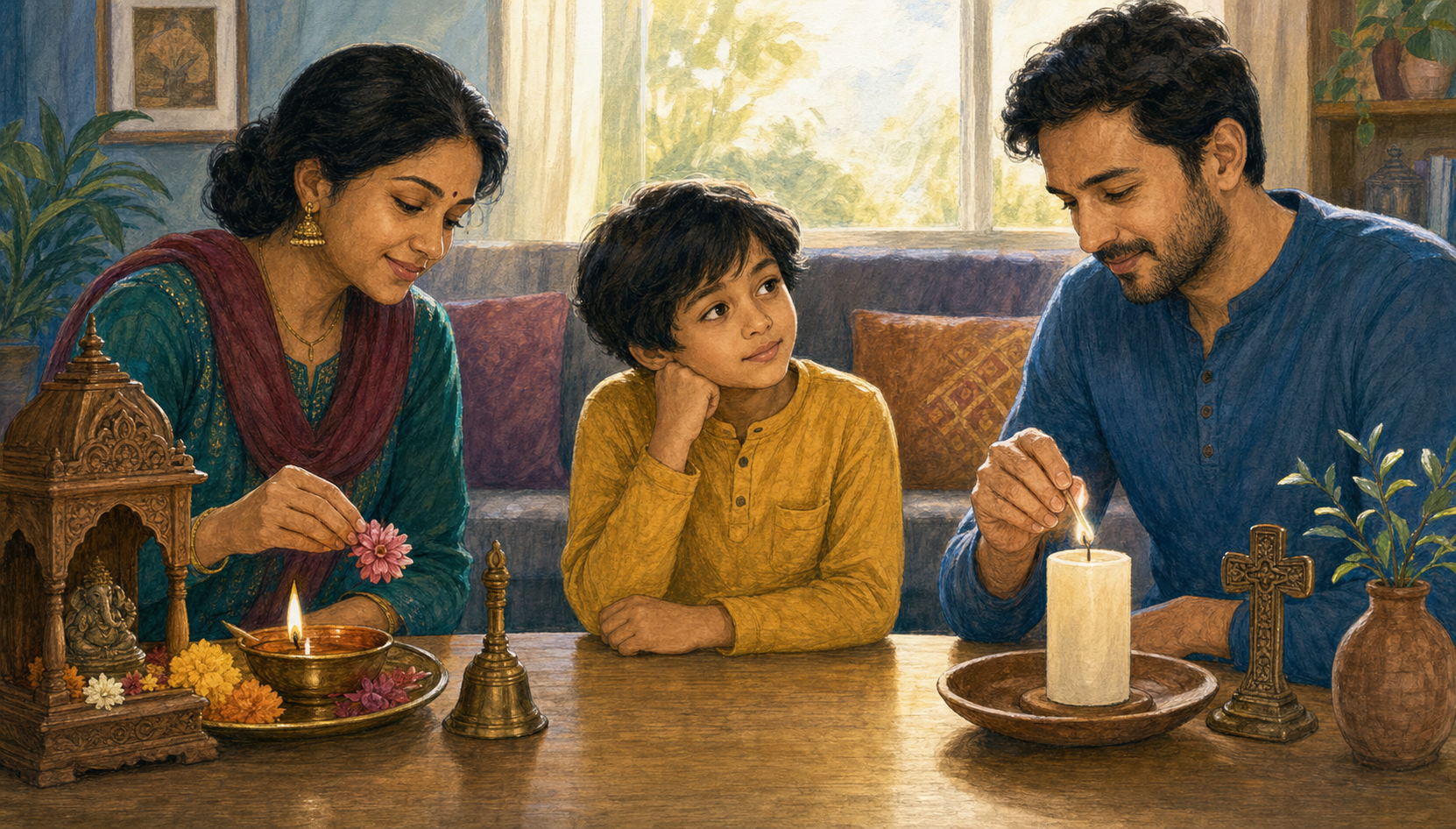
Compassion, duty, seva and mindful conduct can provide shared ethical ground across Dharmic traditions and within a multifaith family. Shared ethics are a meeting place, however, not proof that all traditions teach the same thing.
All religions are basically the same may sound peaceful, but it gives a child poor religious literacy. Traditions can overlap in conduct while differing about the divine, liberation, revelation, worship and religious authority. You do not need to rank those differences at the family table. You do need to name them truthfully.
- Name the origin of a practice. Say this is our Hindu prayer or this observance comes from your other parent’s tradition. Do not present everything as a nameless family custom.
- Acknowledge real overlap. If both traditions encourage service or gratitude, show the child how each expresses that value.
- Do not manufacture agreement. When beliefs differ, say that the parents understand this religious question differently.
- Let each parent represent their own tradition. One parent should not explain the other’s faith through criticism, caricature or second-hand assumptions.
- Separate participation from belief. A child can attend a family ceremony respectfully without being forced to claim a conviction they do not yet understand.
Watch for an imbalance in which Hinduism supplies colorful festivals, clothes and food while the other faith supplies all the serious moral and theological language. Correct it deliberately. Teach the Hindu names for ideas. Explain why a ritual is performed. Introduce the epics as sources of ethical reflection, not merely adventure stories. Let your child encounter Hinduism as a way of thinking and living, not just an ancestry aesthetic.
Equal respect does not require exact symmetry in time, ritual or belief. Families inherit different levels of observance, knowledge and community support. Fairness means that neither tradition is hidden, mocked or used to frighten the child. It also means that Hindu pluralism is not treated as permission to erase the Hindu side.
When a difficult difference arises, use language the child can carry: Your parents understand this question differently. You are allowed to ask about both views. Right now, we are learning what this practice means to this side of your family. That answer is truthful without turning the child into a judge.
Give your child words for identity and boundaries
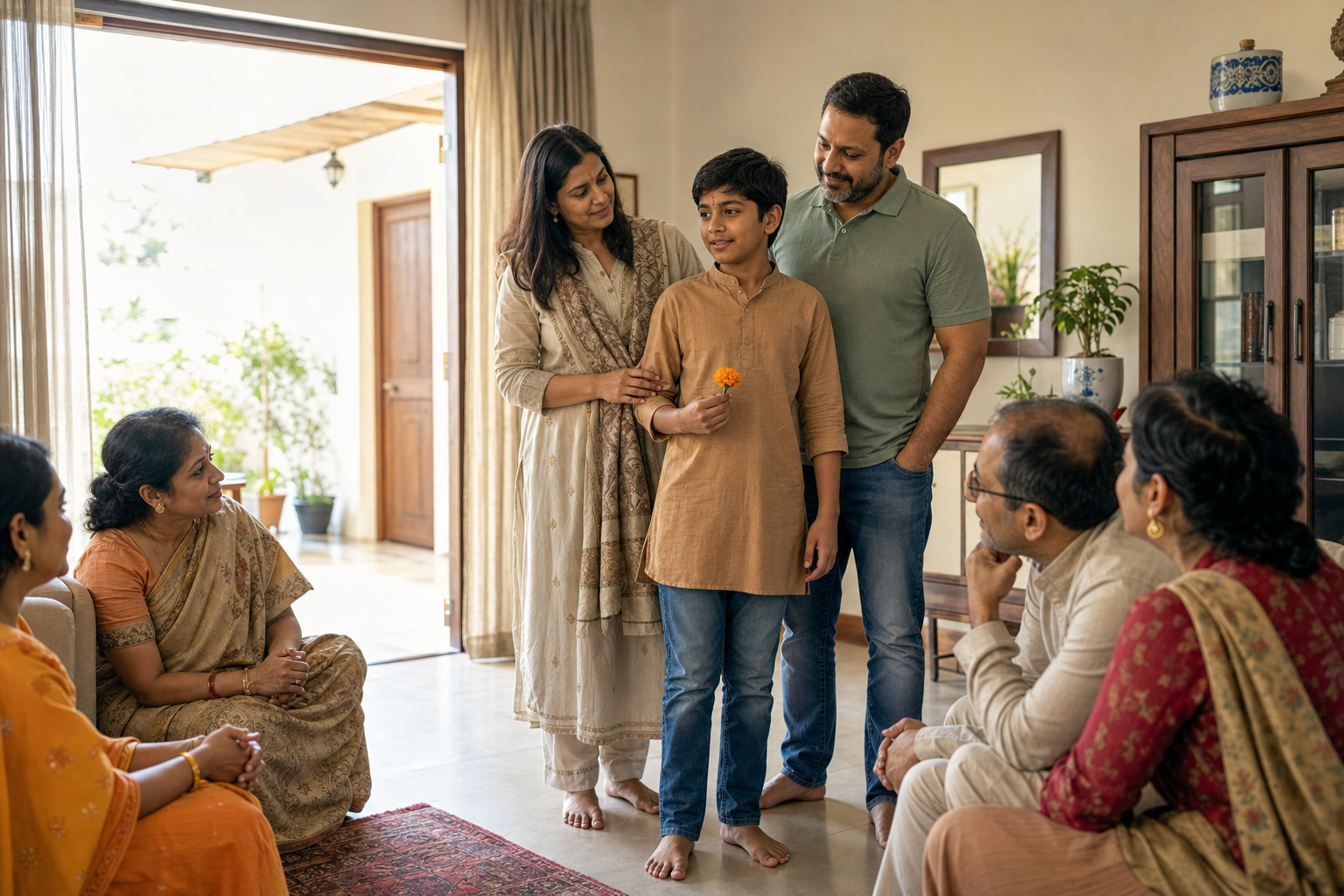
A child often feels confusion not because two traditions are present, but because adults avoid giving the child usable language. Prepare a short answer before school forms, classmates or relatives force the question.
- For a young child: Our family follows Hindu ways and ______ ways. Both are part of our home.
- For a school-age child: I come from a Hindu and ______ family. I am learning the beliefs and practices of both.
- For an adolescent: Let the young person describe their current convictions in their own words while distinguishing personal belief from family background.
Your preferred label may be Hindu, both traditions, interfaith, culturally Hindu, or a more specific sampradaya identity. Choose it consciously, explain it without embarrassment, and expect the child’s wording to become more precise with maturity. A sincere question about identity is not automatically rejection.
Set boundaries before relatives test them
Extended family can offer language, stories and belonging that parents cannot reproduce alone. They can also turn religious concern into a loyalty contest. State the household boundaries before a visit or ceremony, not during an argument in front of the child.
- No adult may tell the child that loving one parent requires rejecting the other parent’s tradition.
- No adult may use fear, shame or secrecy to obtain a religious declaration from the child.
- No initiation, vow or comparable commitment should be arranged without the parents’ prior agreement and the child’s age-appropriate understanding.
- Questions are welcome; interrogation and ridicule are not.
- If a boundary is broken, the parents end the exchange and address the adult privately.
After a tense encounter, tell the child directly: Adults sometimes disagree about religion. You did not cause the disagreement, and you do not have to resolve it. That sentence removes a burden children may otherwise carry silently.
Keep the child out of the adult negotiation
Do not ask the child which parent is right during a disagreement. Do not send religious messages through the child. Do not count attendance at one ceremony against attendance at another. Those habits turn faith into marital bookkeeping and make religious participation feel like betrayal.
Parents should settle calendars, dietary expectations, ceremonies and community commitments privately. Then present the decision as a shared household plan. If an agreement changes, explain the change without blaming the other parent.
Make room for the child’s own relationship with Hindu community as well. A trusted grandparent, temple community, teacher, storyteller, musician or cultural practitioner can add depth, provided that person respects the multifaith structure of the home. Community support should strengthen the child’s inheritance, not recruit the child into an adult dispute.
Key takeaways for a multifaith Hindu home
- Define identity, practice, respect and agency with your partner before conflict makes the decisions for you.
- Teach dharma, karma, ahimsa, seva and reverence through choices your child encounters in daily life.
- Combine ritual with a short explanation so that practice carries meaning.
- Give Hinduism philosophical and ethical depth, not only festival visibility.
- Respect the other faith without pretending that distinct teachings are identical.
- Protect the child from loyalty tests, secret commitments and pressure from either side of the family.
- Let questions mature with the child while keeping family practices steady enough to become a genuine inheritance.
This week, write the family agreement, choose one home practice, select one story to revisit, plan one act of seva and settle one boundary with relatives. Then keep those commitments visible in ordinary life. A child learns that Hindu values belong to them when those values are no longer reserved for special occasions.
References
