
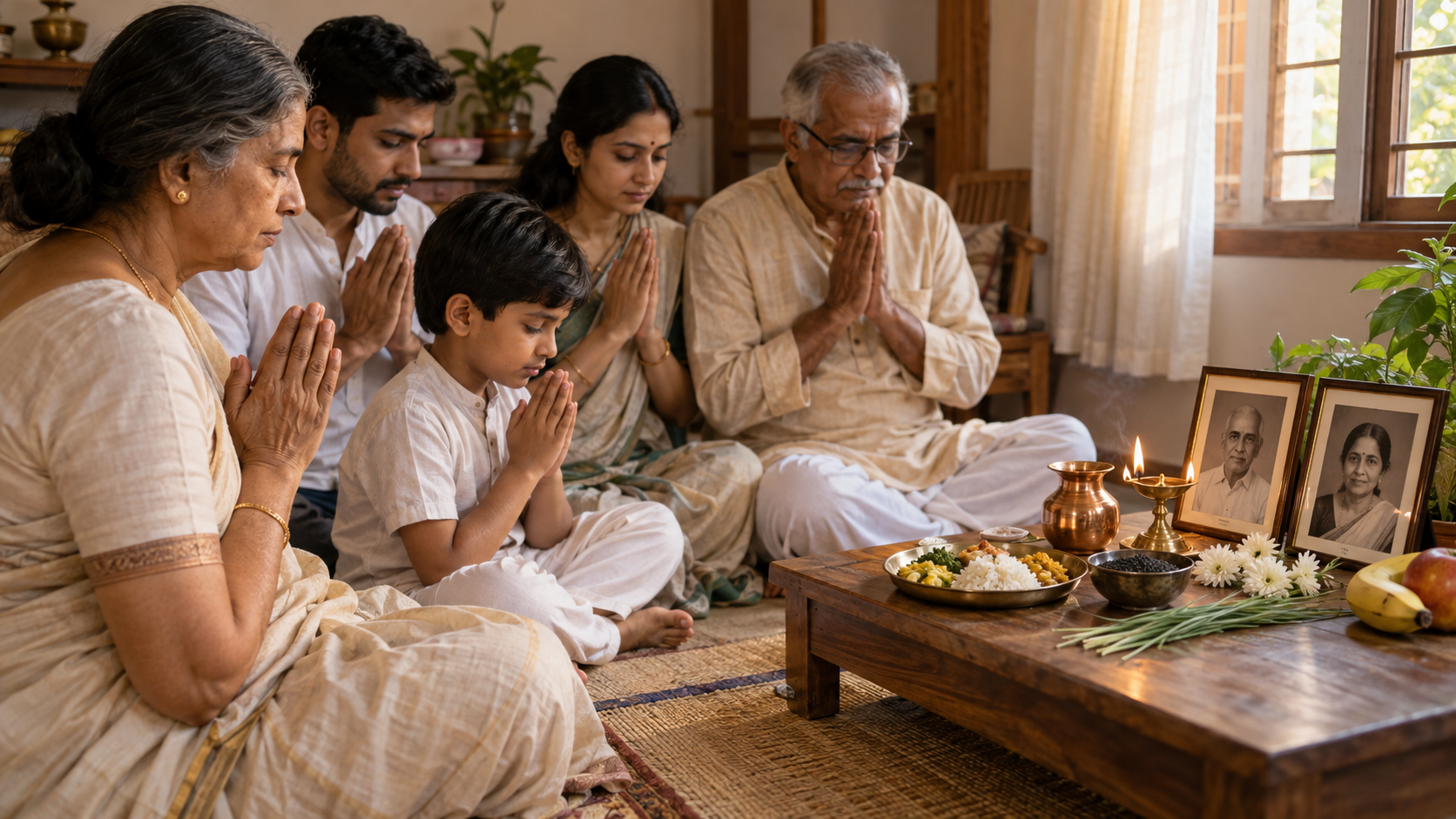
You want to honour a parent, grandparent or earlier ancestor during Pitru Paksha, but you may not know the death tithi, the mantras or the procedure your family once followed. The respectful answer is not to copy the longest ritual you can find. Recover the part of your own tradition that you can verify, perform it carefully and be honest about what you do not know.
If a complete shraddha can be arranged according to your sampradaya, arrange it with a qualified priest. If that is not possible, you can still make the fortnight meaningful through remembrance, a modest offering, dana and service. Simplicity is not carelessness when it is joined to attention and reverence.
Begin with your family tradition, not a generic checklist
Pitru Paksha is a lunar fortnight set aside for the pitris, the departed ancestors. Its practical heart is expressed through acts of remembrance, offering and service. It asks you to acknowledge the people through whom your body, family, language, memory and samskaras reached you.
That common purpose does not produce one identical ritual in every Hindu home. The foods prepared, the mantras recited, the person serving as karta, the use of sesame or kusha grass, the sequence of offerings and the people who are fed can vary by lineage and region. A custom inherited in one family should not be advertised as a universal command for every family.
Separate the observance into three layers:
- The enduring purpose: remember the ancestors with gratitude, fulfil the duty your circumstances permit and give without display.
- Your household custom: the ancestral tithi, accepted foods, family prayers, customary recipients of food and the order followed at home.
- The formal vidhi: prescribed mantras, tarpana, pinda offerings, ritual orientation, the role of the karta and other details that should be learned from a competent teacher or priest.
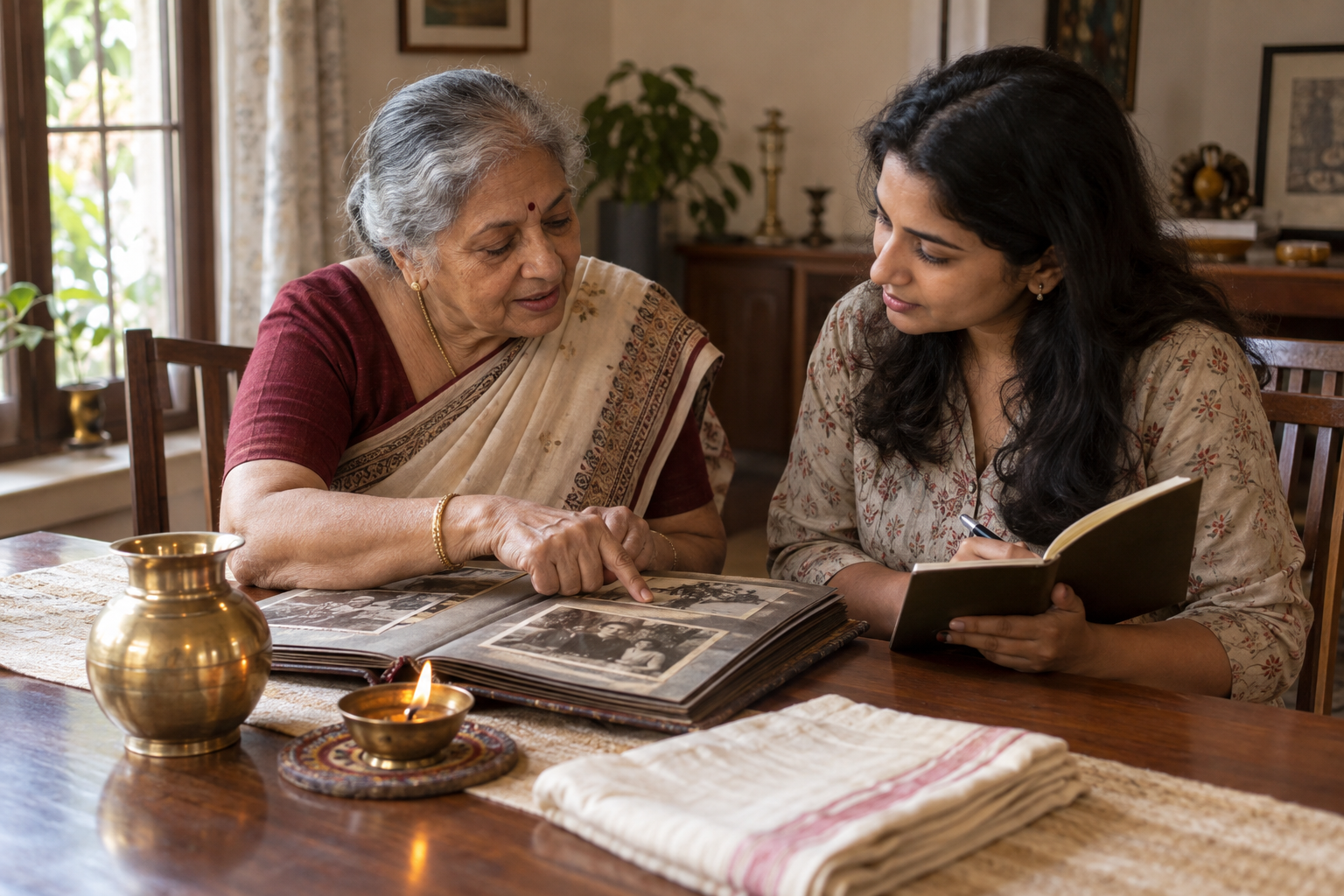
If you know the first layer but not the other two, do not pretend to possess a complete vidhi. Begin with sincere remembrance and service, then ask an elder or priest to help recover the missing family practice. One conversation with the oldest available relative may be more valuable than dozens of unrelated ritual videos.
Choose the ancestral tithi before choosing the ritual
The relevant day is normally identified by tithi, a lunar date. It is not automatically the same Gregorian date or weekday on which the person died. Repeating the civil date each year can therefore place the observance on the wrong lunar day.
Work through the date in this order:
- Ask the family first. An elder may already know the tithi, the regional calendar used and whether the family conducts an individual shraddha or a collective observance.
- Write down what is certain. Record the ancestor’s name, relationship, place and date of death, known tithi and gotra if the family knows it. Do not invent a gotra or ritual detail to fill a blank.
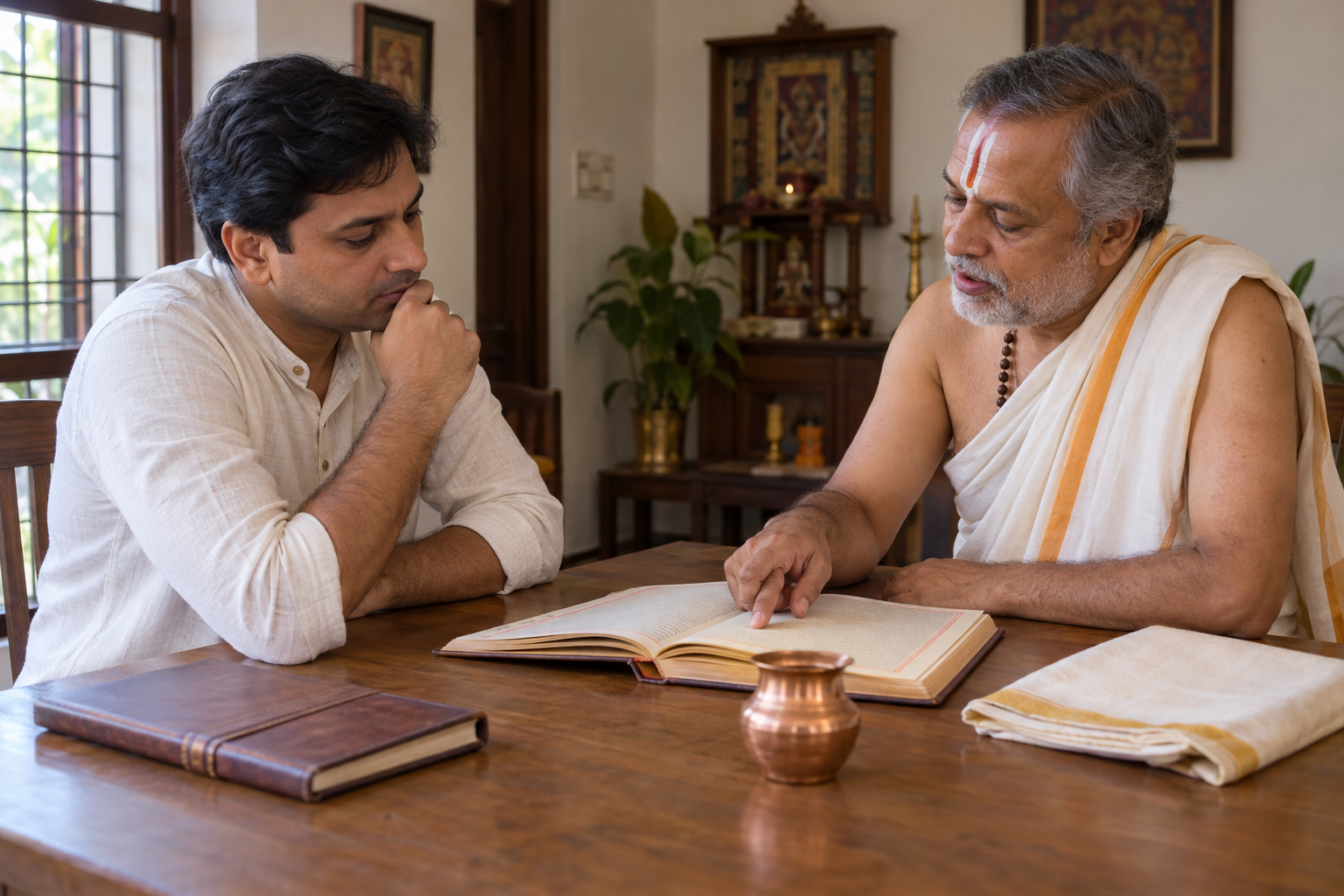
- Consult someone who follows your tradition. Give a family priest or temple priest the recorded information and ask which day applies in the current year.
- Use a panchang for your location. Tithi boundaries depend on place and time. If you live outside Bharat, an India-based calendar may not give the correct local observance window.
- Use the collective day when appropriate. When the individual tithi is genuinely unknown, many households remember ancestors together on Sarva Pitru Amavasya, the concluding amavasya of the fortnight. Confirm that practice with your family tradition rather than assuming it replaces every lineage-specific rule.
Regional calendars can use different month labels even when families are observing the same ancestral fortnight. Do not let a difference in terminology become a dispute. Match the tithi, location and sampradaya before comparing calendar names.
If a death was recent, the family may also have duties connected with antyeshti, the mourning period, monthly rites or the first annual shraddha. Those are not interchangeable with a generic Pitru Paksha routine. Ask the priest who handled, or is qualified to handle, the family’s post-death rites.
A simple home observance when full shraddha is not possible
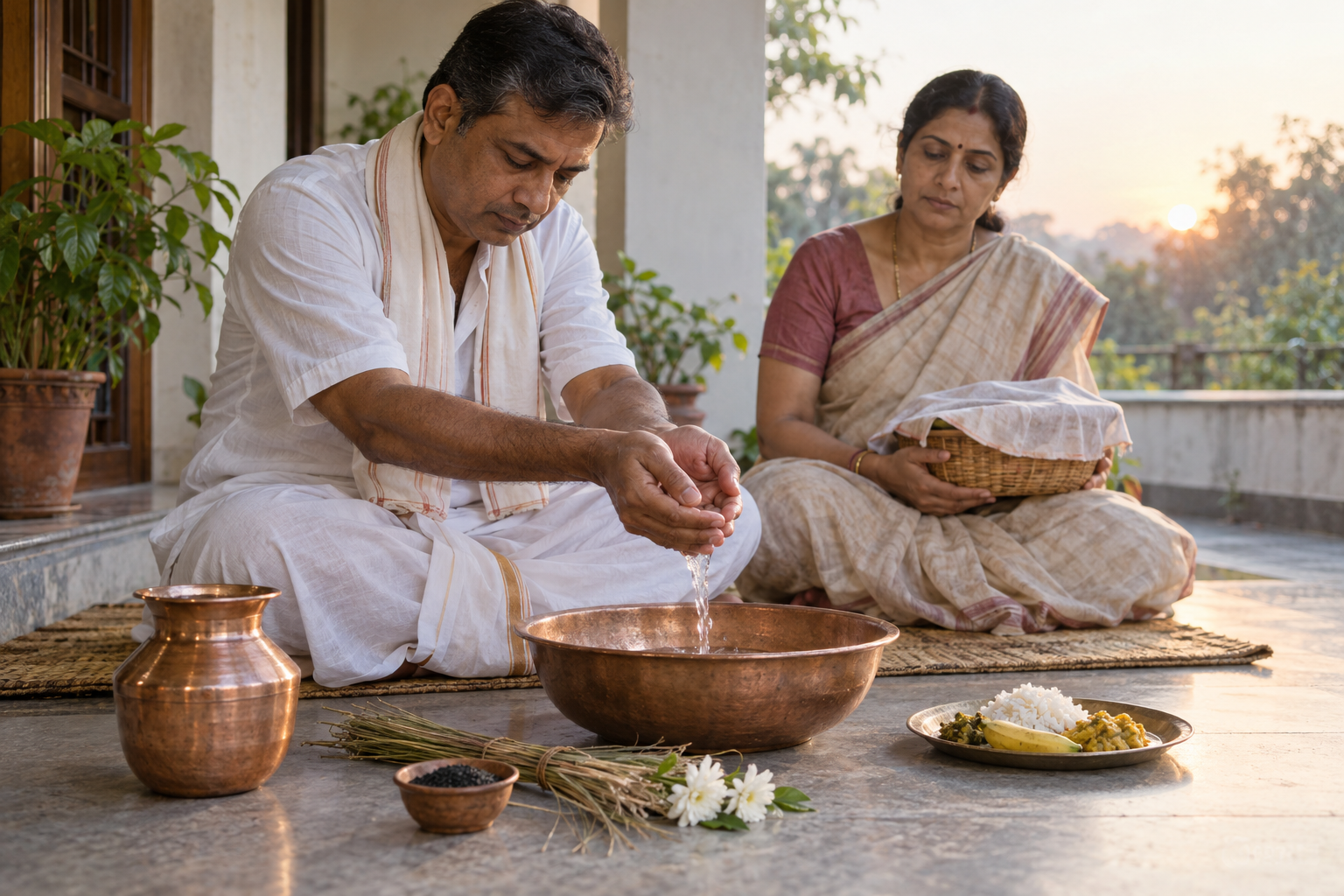
A formal shraddha has a defined vidhi. The following is a modest home framework for someone who cannot presently arrange the complete rite; it does not claim to reproduce every formal element. Preserve any reliable family instructions you already have, and omit specialised actions you have not been taught.
- Reserve an unhurried period. Put aside ordinary entertainment and unnecessary interruptions. Bathe, wear clean clothes and prepare a clean place before beginning.
- Prepare food within your means. Choose a fresh, simple sattvic meal consistent with your household custom. Do not add unfamiliar ingredients merely because another family uses them, and do not prepare so much that food will be wasted.
- Name those you are remembering. Recall each ancestor by name and relationship when known. If names have been lost, include the known and unknown forebears of the family without manufacturing details.
- State your intention plainly. In a language you understand, express gratitude, acknowledge any shortcomings and dedicate the observance to the welfare and peace of the departed. A memorised Sanskrit formula may be used when it has been taught correctly, but incomprehensible imitation is not a substitute for attention.
- Make only the offerings you understand. A simple portion of food and clean water can be set aside respectfully. If your family performs tarpana or prepares pindas, follow its taught method. Do not call an improvised gesture formal tarpana or pinda-dana when you do not know the required vidhi.
- Turn remembrance into giving. Depending on family custom, this may include Brahmana bhojana, feeding a guest or person in need, offering suitable food to cows, crows or other creatures, or making a useful donation. Choose an act you can complete respectfully, without debt, waste or public display.
- Close deliberately. Offer a final prayer, ask forgiveness for errors, dispose of or distribute offerings in the manner your household accepts and clean the space. Afterwards, write down what was done and who supplied the instructions so the next generation does not have to reconstruct everything again.
If a priest will lead the rite, ask for a preparation list in advance. Confirm the tithi, expected time, names and gotras to be recited, food requirements, materials, the role of each family member and how unused items should be handled. That short check prevents last-minute substitution and keeps attention on the rite rather than logistics.
Keep reverence from turning into fear, expense or display
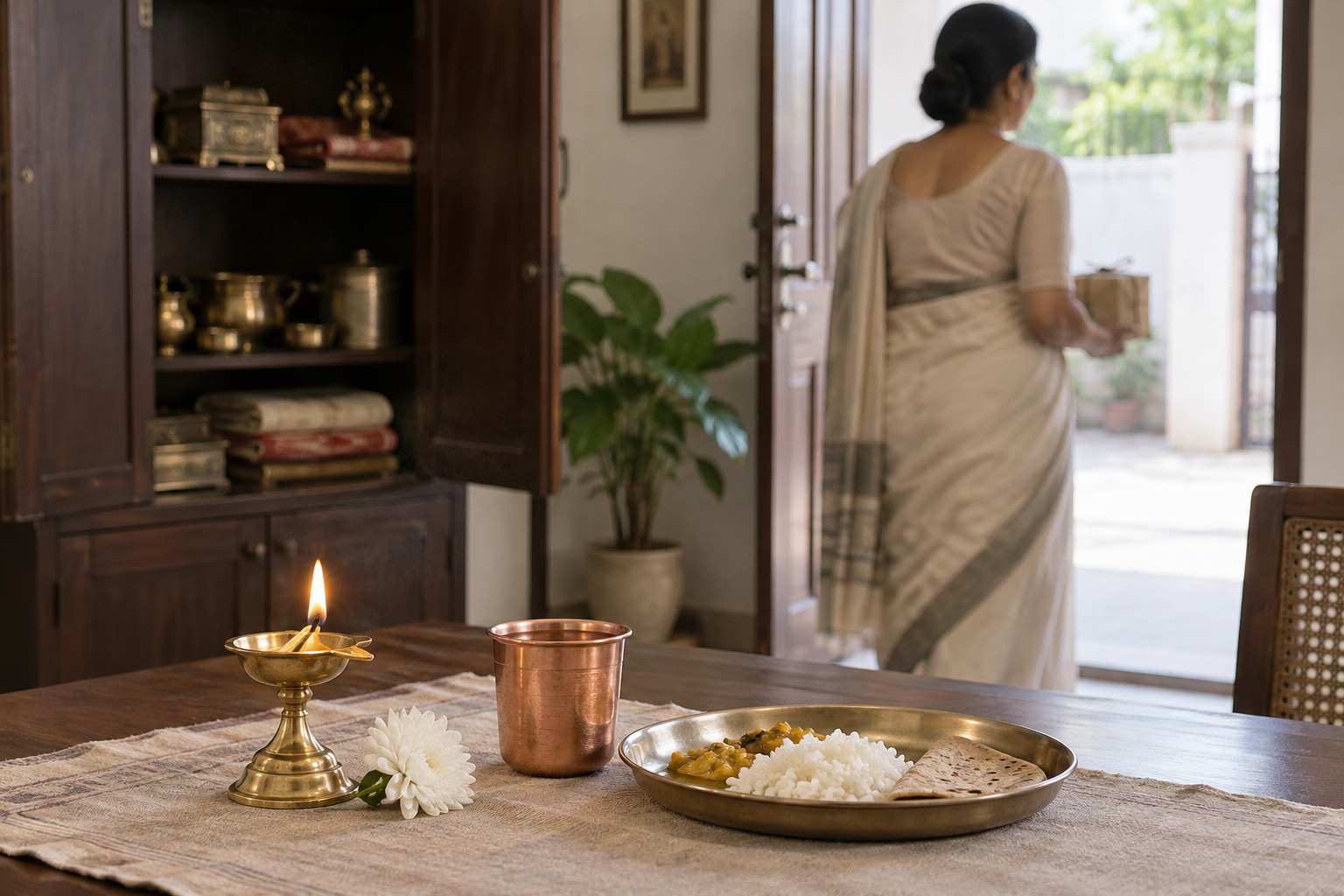
Pitru Paksha calls for seriousness, but seriousness is not the same as anxiety. An observance weakens when every ordinary event becomes an omen or when family members are pressured to spend beyond their capacity.
- Do not judge the rite by an animal’s timing. If your custom includes feeding crows or cows, make the food suitable and offer it without forcing the encounter. Whether a particular animal arrives at a particular moment is not a reliable measure of your sincerity.
- Do not borrow for spectacle. A modest meal and proportionate dana are preferable to a feast that creates debt, resentment or waste. Decide the budget before buying ritual materials.
- Do not mix unrelated procedures. Combining fragments from several lineages can produce a performance that belongs to none of them. Follow the closest reliable family instruction and ask about gaps.
- Do not turn restraint into a universal prohibition. Many families defer weddings, house-warmings or other celebrations during the fortnight, but the exact discipline varies. Follow your household rule instead of policing neighbours whose lineage differs.
- Do not neglect living elders while honouring departed ones. Call an elderly relative, listen to family history, record names and relationships, help with a practical need or resolve a needless quarrel. Care given to the living protects the very memory the ancestral rite is meant to preserve.
- Do not make the ceremony social-media content by default. Photograph a family record only when appropriate. The value of shraddha does not depend on public proof that it occurred.
Grief may also return during the observance, especially when a death is recent or a relationship was difficult. You do not have to manufacture idealised memories. Speak truthfully, pray without hostility and let the rite hold gratitude, regret and unresolved feeling without turning any of them into a public performance.
Pitru Paksha questions that need a practical answer
Can you observe Pitru Paksha while living outside Bharat?
Yes, but calculate the tithi for the place where you are observing. Keep the family sequence and ingredients where they are practical and lawful, and ask what may be adapted when a customary item is unavailable. If a priest is guiding the family remotely, confirm which physical actions you will perform at home and which parts the priest will perform elsewhere.
Can women or several relatives participate?
Hindu lineages do not apply one universal rule to the formal role of karta. Some households assign it through inherited kinship rules; others make provisions when the customary person is absent or unable to act. Ask a priest familiar with your sampradaya, and distinguish the formal officiating role from the wider family’s remembrance, prayer, dana and service. Do not let a categorical claim from social media overrule the people who actually know your family practice.
Should daily puja stop during the ancestral fortnight?
Do not abandon an established nitya puja merely because Pitru Paksha is solemn. Worship of Bhagavan and duty toward the ancestors are related parts of dharmic life, not automatic substitutes for one another. If your sampradaya prescribes an adjustment, follow that specific instruction rather than a blanket internet rule.
Before the fortnight begins, make one call to a knowledgeable elder or priest. Write one page containing the tithi, ancestor names, known gotra, accepted foods, ritual sequence and the origin of each instruction. Then choose an observance within your capacity, put the phone away and perform it with full attention. That page may become as valuable to your family as the ceremony itself.
References

Leave a Reply
You must be logged in to post a comment.