
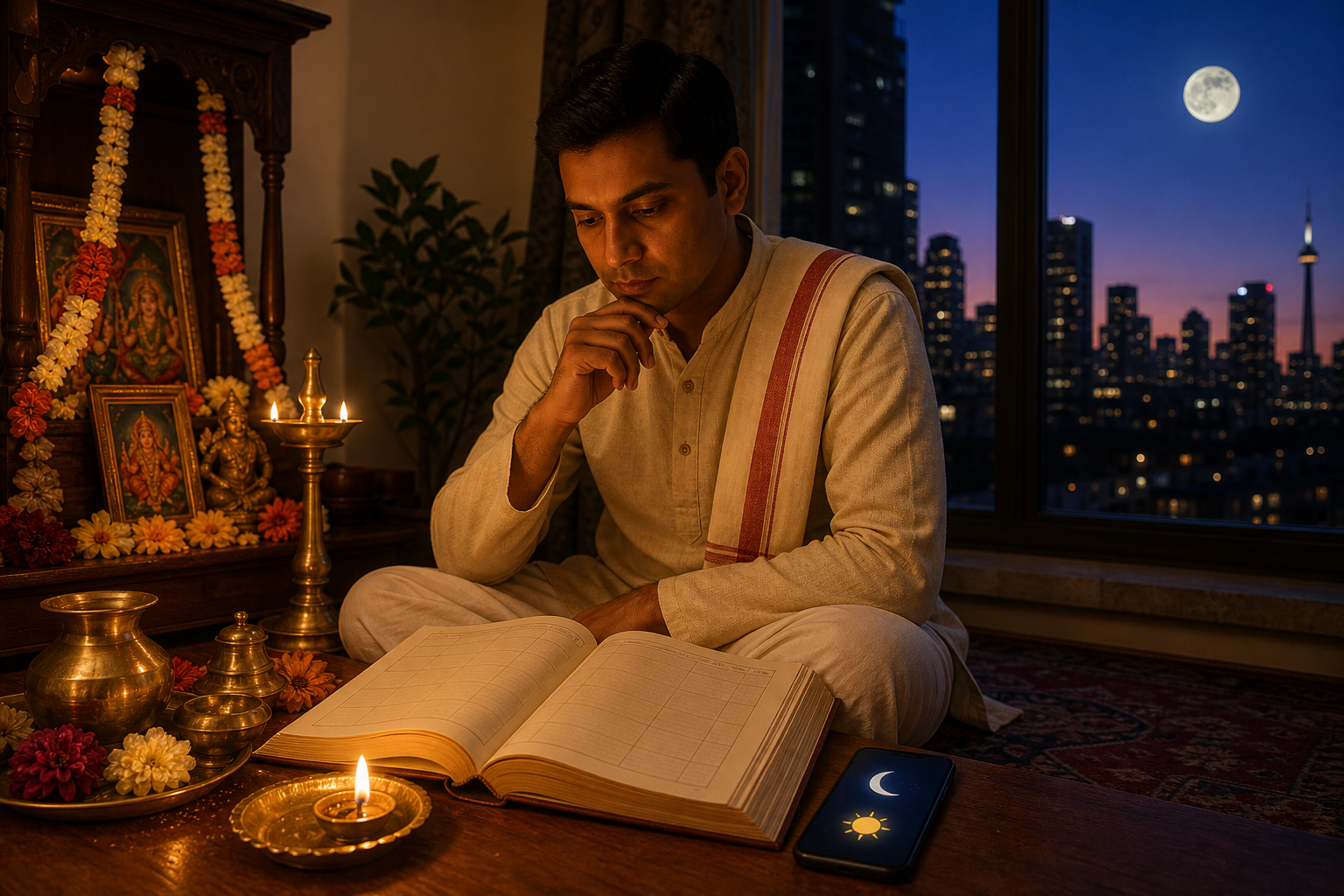
You have made time for a vrata or puja, but two calendars place it on different civil dates. A family message gives one day, the temple announces another, and an India-based calendar may not match the city where you live. The real question is not which date looks more familiar. It is which tithi and ritual window apply where you will perform the observance.
You can usually resolve the confusion by checking five things: the observance, its governing tithi, your location, the required time of day, and the tradition whose rules you follow. That method also tells you which parts of the practice must occur within the sacred window and which preparations can be moved around it.
The date on your phone is only one layer

A civil date runs from one midnight to the next. A Hindu sacred date may instead be anchored to a tithi, the lunar day used by the Panchang. A tithi can begin or end during the morning, afternoon, or night, so it does not necessarily fit inside a single civil date.
That difference has an immediate practical consequence. Seeing the name of an observance beside Friday does not mean every hour of Friday carries the relevant tithi. You still need its beginning and ending times. You may also need the kala, or part of the day, prescribed for the main ritual.
Friday, December 26, 2025, offers a clear illustration: Shukla Paksha Sashti continued until 10:00 AM in most regions, after which Shukla Paksha Saptami began. Someone intending to complete a Sashti practice would therefore place its core acts before the transition. A Saptami-oriented act would belong after it. Treating the entire civil date as Sashti would erase the very change the Panchang is showing.
Location adds another layer. Local sunrise and sunset, time zone, regional calculations, and the almanac tradition can affect the displayed date or ritual period. An announcement prepared for a temple in Bharat is useful context, but it is not automatically the correct personal timing for a devotee in Toronto, London, Singapore, or another city.
Ask a more precise question than “What day is the festival?” Ask: “In my city, when does the relevant tithi prevail, and during which part of that tithi should the main observance be performed?” That wording turns a date disagreement into a calculation you can check.
Use this five-step check before fixing your observance
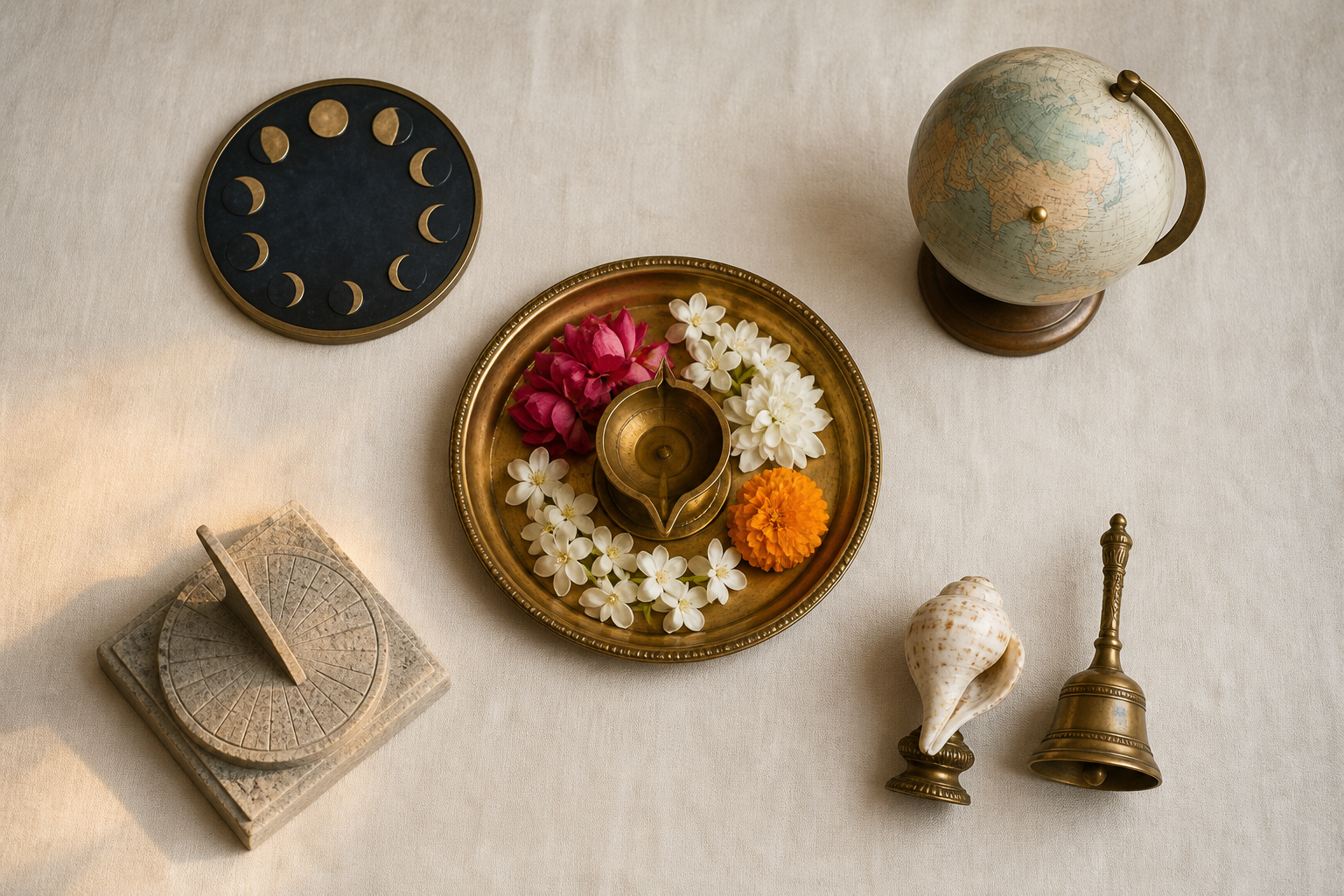
- Name the observance and its anchor. Write down the vrata or festival, the deity or sacred focus, and the relevant tithi. “Puja on Saturday” is not enough information. “Pradosh worship during Trayodashi twilight” gives you something a local Panchang can resolve.
- Set the location before reading the time. Use the city where you will actually make the sankalpa and perform the core worship. Do not silently apply an India-based time to an overseas location. If you are joining a livestream from another time zone, keep the temple’s collective schedule separate from your local vrata calculation.
- Identify the governing kala. Some practices are tied to a particular portion of the day. Pradosh, for example, is centered on twilight around sunset. Do not assume that the presence of the correct tithi at some point during the day makes every hour equally suitable.
- Look for the actual overlap. Record the tithi beginning and ending times, then compare them with the required ritual period. If the tithi changes at 10:00 AM and your practice belongs to the outgoing tithi, the essential worship must be completed before that point. Shopping, cooking, travel, and decoration can happen outside the core window.
- Choose one interpretive authority and stay consistent. Use a reliable regional Panchang, a temple almanac, or the convention maintained by your family or sampradaya. Combining the date from one calendar, the tithi ending time from another, and the ritual rule from a third can create a schedule that none of them actually supports.
Once you have checked those points, translate the result into an ordinary schedule. Record the civil date, time zone, tithi interval, core puja window, fasting plan, and the Panchang or tradition used. This small note prevents the same uncertainty from returning when relatives ask why your observance appears on a different date.
See how the method changes the practice
The calendar calculation is not separate from devotion. It tells you where to place the act that gives the observance its shape. Three common patterns show why one rule cannot be applied to every sacred date.
A tithi that changes during the day
When Sashti changes to Saptami at a stated hour, divide the day deliberately. Complete the Sashti sankalpa, japa, or other essential act before the transition if that is the tithi you are observing. Begin a Saptami-specific practice only after the change. Do not let an elaborate meal or a delayed temple journey push the core act beyond the relevant tithi.
The ending time deserves more attention than the large date printed at the top of a calendar. It is often the detail that determines whether your planned morning or evening practice still falls within the intended lunar day. Confirm it for your own city rather than treating a “most regions” time as universal.
Pradosh Vrat and the twilight requirement
Pradosh occurs on Trayodashi in both Shukla Paksha and Krishna Paksha, but its main worship is not simply “any time on the thirteenth tithi.” The defining period is Pradosha Kaala, the twilight interval around local sunset. Because sunset varies by place, you need a city-specific evening window even after identifying the correct civil date.
Plan the observance backward from that window. Before twilight, prepare a clean worship space and arrange the offerings your tradition uses. During the prescribed period, make the sankalpa, light the deepa, perform Shivalinga worship, and give the quietest portion of the window to mantra japa or prayer. Traditional practices can include abhishekam with water, milk, or panchamrita, an offering of Bilva leaves, and repetition of Om Namah Shivaya.
The fast and the puja are related, but they are not interchangeable. A demanding day-long fast does not compensate for overlooking the evening worship that defines Pradosh. Decide in advance whether you will observe nirjala, take fruit, or have a simple sattvic meal after puja, according to your tradition and what is safe for your health. Do not undertake a form of fasting that conflicts with medical needs, medication, or professional advice; ask your priest or elder about an appropriate non-fasting or modified vrata.
A Monday or Saturday Pradosh carries additional traditional emphasis as Soma Pradosh or Shani Pradosh. That association does not remove the need to verify Trayodashi and the local twilight interval. The weekday adds meaning; it does not replace the timing rule.
Shakambari Purnima and an observance expressed through food
Shakambari Purnima shows a different relationship between sacred time and practice. For 2026, the observance fell on January 3 and marked the conclusion of Shakambari Navratri. The Purnima establishes the sacred occasion, while offerings of seasonal vegetables, leafy greens, herbs, grains, and sattvic food express its focus on nourishment and the abundance of the earth.
Here the useful preparation begins before the ritual day. Buy only the seasonal produce you can offer, cook, share, or preserve without waste. Decide whether your household will prepare a simple Shakambari thali, donate fresh produce, support a community kitchen, or distribute prasada. Place the Devi puja within the locally confirmed Purnima observance, but arrange the shopping and donation logistics when they are realistically possible.
This distinction protects both parts of the vrata. You preserve the sacred timing of the worship without turning every act of service into a race against the clock. Annadana, mindful consumption, and ecological care then become extensions of the puja rather than decorative themes attached to it.
Settle disagreements without flattening tradition
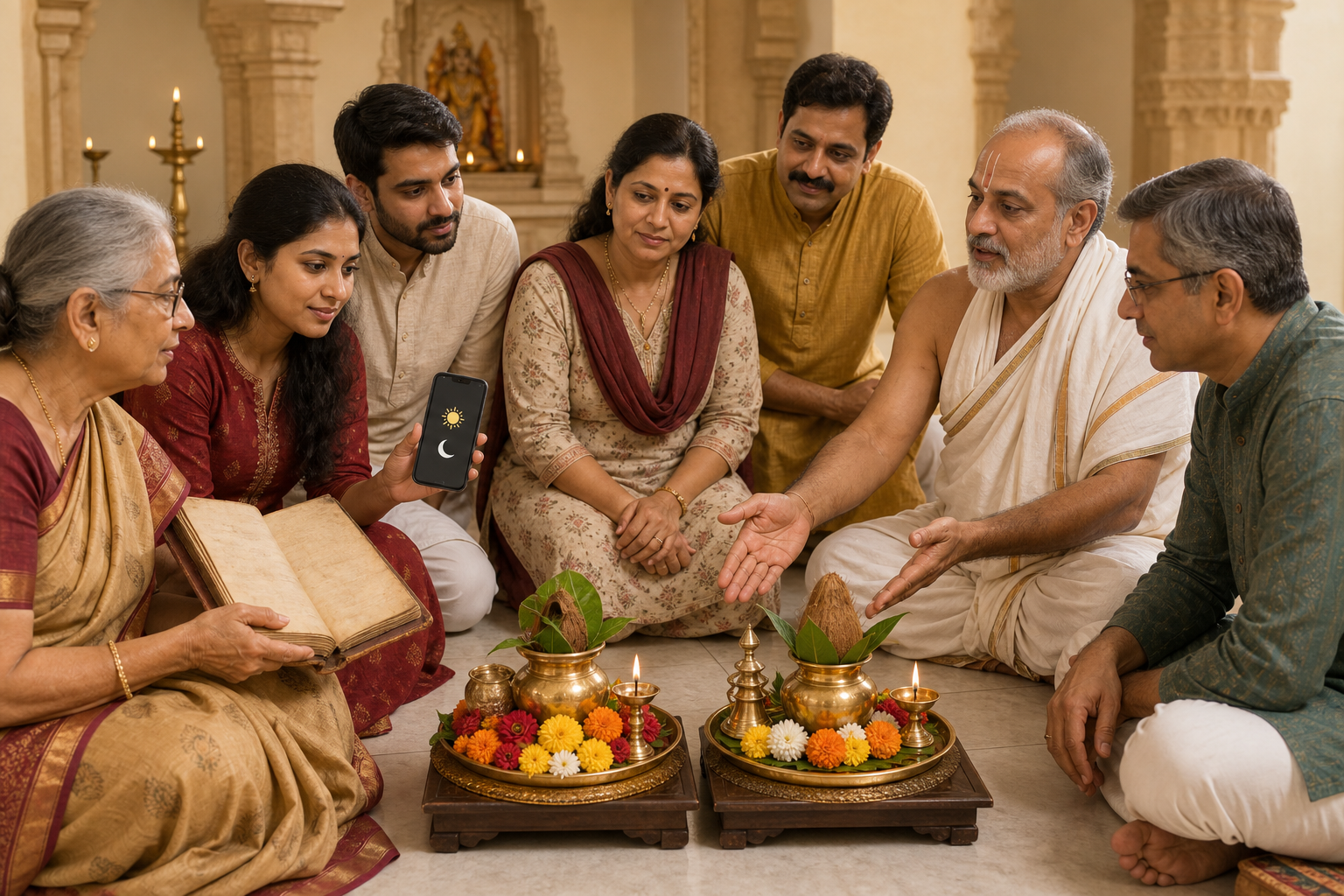
Calendar disagreements are not always calculation errors. Families and regional traditions can use different conventions for deciding which civil date receives an observance when a tithi spans, enters, or leaves a required period. You do not have to declare one family careless merely because another follows a different almanac.
- If two calendars show the same tithi interval but different festival labels: identify the ritual rule used by your family or temple. The label alone cannot settle the question.
- If an India-based date conflicts with your local Panchang: use your city for the personal sankalpa and ask the temple how it handles overseas devotees. You may still join a collective celebration without pretending that its clock is your local clock.
- If your family date and temple date differ: find out whether the difference concerns the core vrata or only the public gathering. A temple may schedule communal worship when devotees can attend, while the household vrata retains a more exact local window.
- If work or caregiving blocks the preferred period: move preparation and optional activities, not the tithi itself. Protect the shortest essential practice within the available sacred window. If that is impossible, ask a knowledgeable priest or elder what simplified or alternative observance your tradition permits.
- If the calculation still remains unclear: give the person advising you your city, time zone, observance name, and the tithi ending time shown on your calendar. “Which date is right?” supplies too little information for a precise answer.
It also helps to distinguish fidelity from elaboration. The timing, sankalpa, deity, and core worship carry more weight than the number of dishes, the scale of decoration, or the length of a public programme. Unless your tradition requires otherwise, a focused home puja in the correct window is more coherent than an elaborate arrangement that leaves no time for the act the vrata is meant to center.
Let children and other family members take part in tasks suited to them: cleaning the puja place, arranging produce, lighting a lamp with supervision, preparing prasada, or helping with food distribution. Participation should clarify the meaning of the day. It should not turn the household into a contest over ritual perfection.
Key takeaways for your next sacred date
- A Hindu sacred date may be governed by a lunar tithi and ritual kala, not by the full midnight-to-midnight civil day.
- Set your city and time zone before trusting a displayed tithi, sunset, or puja time.
- Check when the tithi begins and ends, then find where it overlaps the period prescribed for the core ritual.
- Use one reliable local Panchang, temple almanac, or inherited tradition consistently instead of assembling a hybrid schedule from unrelated calendars.
- Separate essential worship from flexible preparation. Cooking, shopping, decoration, and service can often be arranged around the sacred window.
- Choose a fasting form that respects both your tradition and your health. Physical severity is not a substitute for attention, prayer, or ethical conduct.
Before your next vrata, make a one-line plan containing the observance, city and time zone, tithi interval, core puja window, fasting choice, and the authority you followed. Share that line with your household. You will spend less time debating calendar labels and more time preparing for the practice itself.
References
- DharmaRenaissance Blog — December 26, 2025 Panchang: Auspicious Timings, Shukla Paksha Sashti to Saptami, Key Insights
- DharmaRenaissance Blog — Shakambari Purnima 2026: Date, Sacred Significance, and Eco-Devotional Practices
- DharmaRenaissance Blog — Pradosh Vrat 2026: Dates, Significance, and Evening Puja Guide for Pradosham Devotees
