

You may be trying to settle a deceptively difficult question: does bhakti require vegetarianism, or is vegetarian food only one cultural expression of devotion? The answer matters when you are choosing what to offer in puja, observing a vrata, entering a temple community, or raising a family whose members do not all eat alike.
Bhakti did not make an ingredient list sacred by itself. It joined vegetarian food to ahimsa, sattva, offering, self-restraint and service. That distinction gives you a practical way to honour the ideal without reducing dharma to a test of social respectability.
The decisive shift was from permitted food to prepared consciousness

The earliest Vedic horizon cannot simply be described through the dietary standards of later devotional communities. Food followed ecological conditions, seasonal realities and sacrificial requirements. Animal offerings and meat appeared in ritual settings, where they belonged to a sacral economy rather than serving as a general declaration that violence was morally desirable.
This history defeats two simplistic stories. Hindu civilization was not uniformly vegetarian from its first textual layer, but neither was its later preference for non-violent food an arbitrary departure from dharma. A living tradition can deepen its moral practice as its understanding of sacrifice, consciousness and responsibility develops.
That deepening occurred through several related currents. Upanishadic reflection drew attention toward the relationship between consumption and refinement of mind. Jainism gave ahimsa an exacting discipline, while Buddhism made karuna, or compassion, central to the treatment of living beings. These were not interchangeable doctrines, yet they helped establish a shared civilizational intuition that food affects the inner life.
The Bhagavad Gita’s classification of food as sattvic, rajasic and tamasic supplied a durable vocabulary for applying that intuition. Fresh, light and nourishing food came to be valued because it supports clarity and steadiness. The important question was no longer only, Can this be eaten? It also became, What quality of mind will this way of eating help me cultivate?
Bhakti gave these philosophical ideas a repeatable social form. Temple cuisine, household cooking, prasad and devotional vows brought restraint and compassion into ordinary routines. The kitchen could now serve the altar, and the meal could carry the intention of worship beyond the formal moment of puja.
Sacred food rests on four connected disciplines
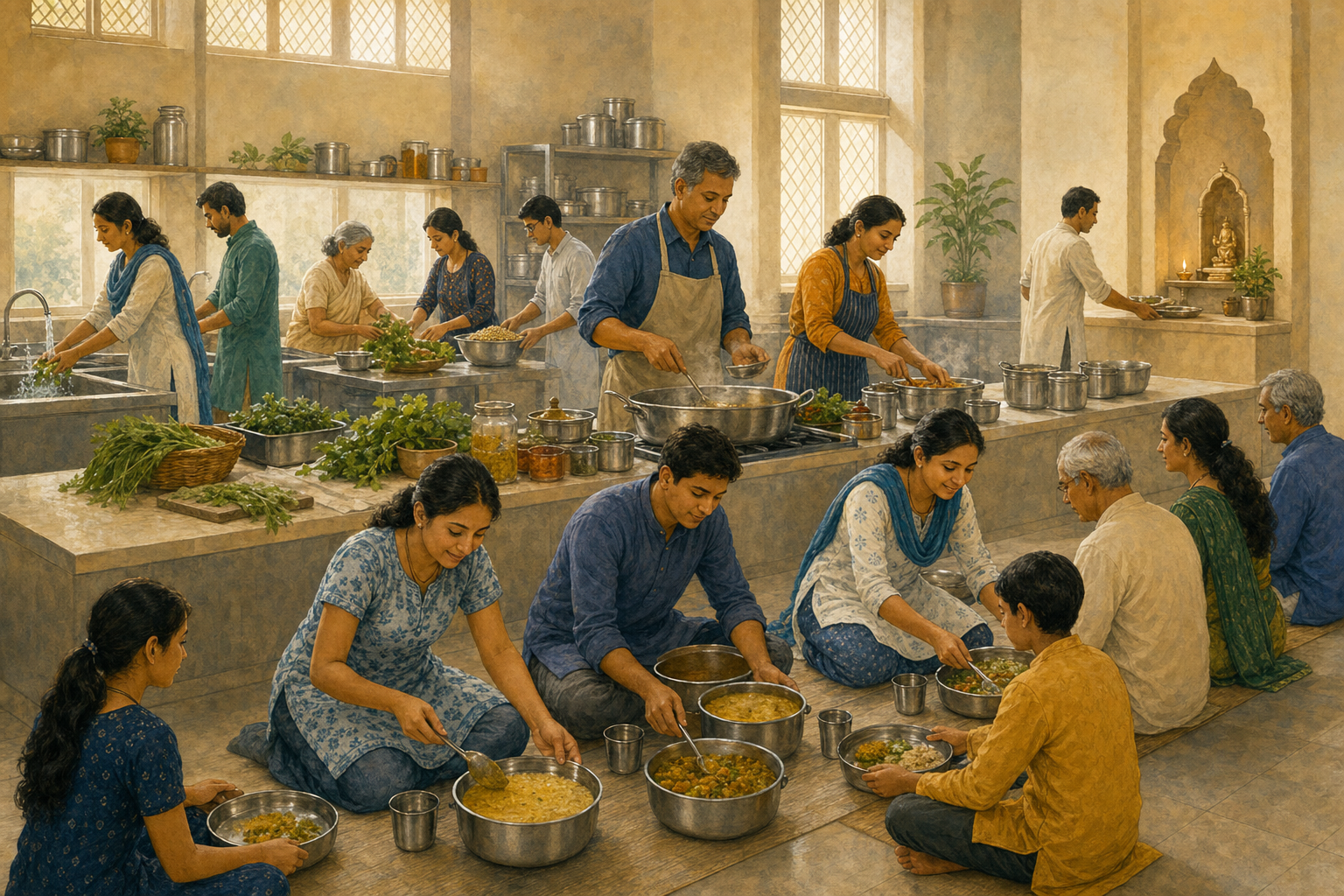
Sacralization happens through a relationship among choice, preparation, offering and reception. If you want vegetarianism to function as bhakti rather than as a personal food preference, keep all four dimensions in view.
- Ahimsa governs the choice. You select food with the intention of reducing avoidable harm. The aim is not to pretend that embodied life causes no harm at all, but to refuse indifference where a less violent choice is available.
- Sattva governs the desired effect. Food should support clarity, steadiness and readiness for worship. Vegetarian status alone does not guarantee these qualities; freshness, simplicity and the manner of consumption remain relevant.
- Offering changes the relationship. A meal prepared for the deity is not approached merely as private gratification. Once offered and received as prasad, it is understood through gratitude and grace. The change is relational, not chemical.
- Seva completes the practice. Cooking, serving and sharing prevent dietary discipline from becoming self-absorption. Shared devotional meals made food a means of inclusion, not just individual purity.
Each element corrects a possible distortion. Ahimsa without humility can become accusation. Sattva without devotion can shrink into lifestyle optimization. Offering without compassion can become empty formalism. Service keeps the practice turned outward.
This also explains why a vegetarian meal is not automatically a sacred meal. It may satisfy a dietary rule while being cooked carelessly, consumed greedily or used to advertise moral superiority. Conversely, a simple offering prepared with restraint and shared without distinction embodies much more of the Bhakti transformation. The menu matters, but the condition of the heart gives the menu its devotional meaning.
A sacred ideal is not a universal food census
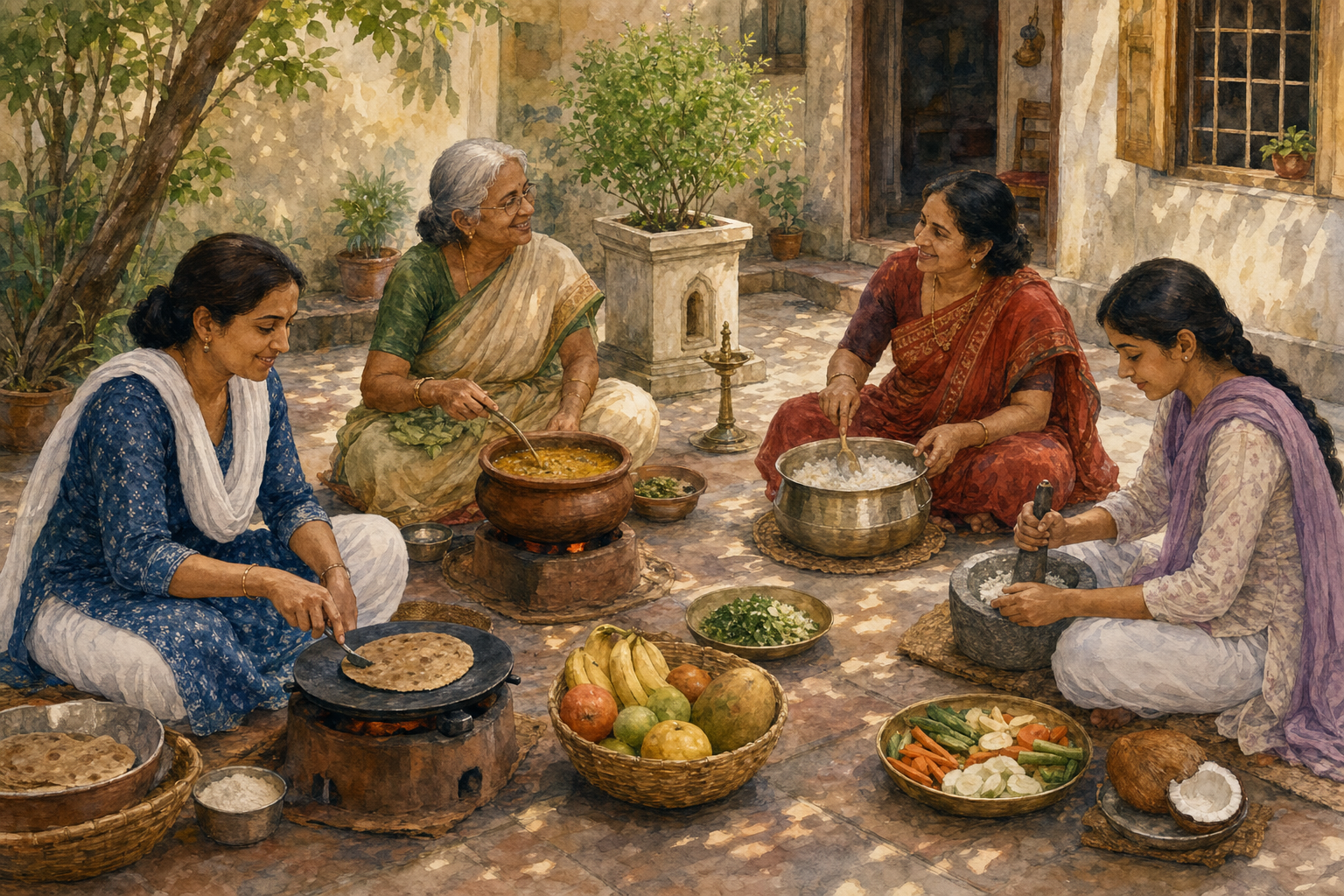
Bhakti traditions do not support one flat claim about every Hindu community. Many Vaishnava, Shaiva and Shakta lineages adopted vegetarian offerings, but dietary customs continued to vary with region, ecology, occupation and local tradition. The word many matters. It identifies a powerful devotional pattern without rewriting diversity as non-existence.
You therefore need to distinguish two kinds of judgement:
- Within a particular practice, the discipline of the temple, deity, vrata or lineage should be taken seriously. Do not demand that a sacred institution alter its offering standard merely because your household follows another custom.
- When describing the wider dharmic world, do not present one community’s standard as proof that every authentic Hindu in every place has always eaten identically.
This distinction preserves both fidelity and honesty. Pluralism does not make every choice spiritually equal within every lineage. A real tradition may set demanding boundaries. Yet a boundary governing an offering is not a licence to rank the human worth of everyone outside that discipline.
Sikh langar shows why this matters socially. Langar commonly uses simple vegetarian food so that people with different dietary commitments can sit at one table. The common meal does not prove that every participant maintains the same private diet. It creates an accessible shared floor on which status and sectarian difference need not decide who may eat together.
Bhakti saints likewise carried devotional teaching in regional languages and crossed inherited social divisions. That history gives purity a demanding test: does the practice make you more compassionate and available to serve, or does it make you eager to humiliate another person? A kitchen may cultivate purity of attention, but it cannot certify the purity of a human being.
How to make vegetarianism part of your bhakti
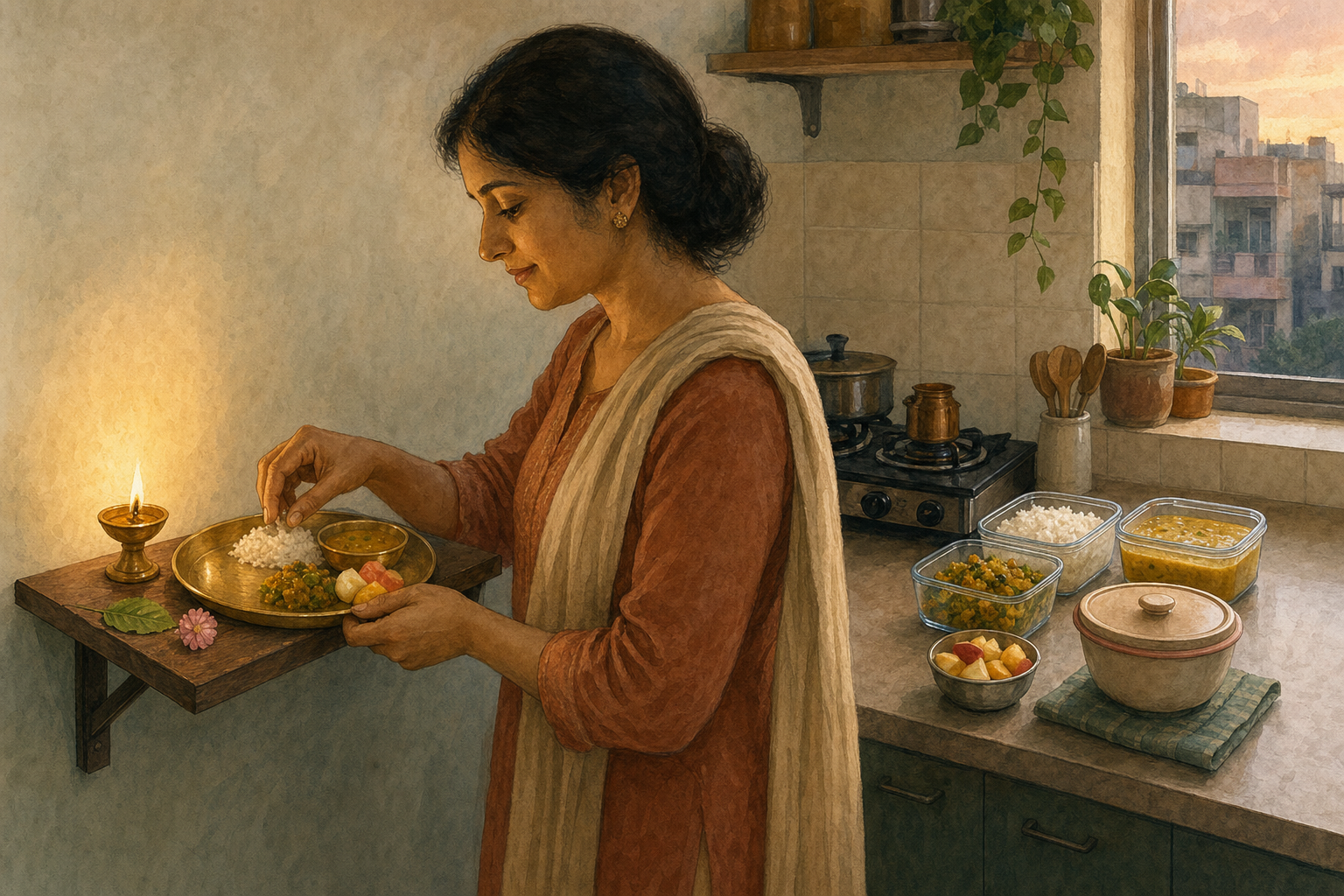
If you want to move from agreement with the ideal to an actual discipline, begin with the devotional act closest to you. A quiet, stable practice is more useful than a sweeping declaration that your household cannot yet sustain.
- Name the intention. Decide whether your immediate emphasis is ahimsa, cultivation of sattva, preparation of an offering, or fidelity to a vrata. The elements reinforce one another, but naming the intention stops the change from becoming an exercise in public identity.
- Learn the standard of your own lineage. Find out which foods are accepted for the deity, how your community treats particular observances, and what its temple or household custom requires. Do this before importing a rule encountered in a different sect or region.
- Begin with the meal connected to worship. Prepare one fresh, light and nourishing vegetarian meal for puja rather than starting with an argument about every meal eaten by every family member. This establishes a positive centre from which the practice can grow.
- Offer before you consume. Cook with the understanding that the meal is not yet simply yours, present it in the manner taught by your tradition, and receive it as prasad. This small sequence trains gratitude and restraint at the moment appetite is strongest.
- Use vrata as a rhythm of renewal. Observances such as Ekadashi can make restraint periodic and memorable instead of merely theoretical. Follow the form appropriate to your tradition and circumstances. A vrata should not require you to ignore a medical need; where fasting would be unsafe, seek a health-compatible form of observance within your lineage.
- Share food in an inclusive form. When a devotional gathering includes people with differing backgrounds, a simple vegetarian meal can provide a common table. Treat hospitality as part of the sadhana, not as an activity added after the supposedly spiritual work is finished.
- Examine the fruit of the discipline. After a vrata or shared devotional meal, ask whether the practice made you steadier, humbler and more considerate. If it mainly increased contempt for other people, correct the method rather than congratulating yourself for keeping the menu.
If complete household vegetarianism is not presently possible, do not disguise the gap or abandon the ideal. You can begin with food offered in daily worship, meals served at devotional gatherings, or the disciplined observance of vrata days. Bhakti’s historical strength lay precisely in making a high principle repeatable through ordinary acts.
Parents and elders should also explain the purpose before enforcing the boundary. A child who hears only that certain food is impure may learn anxiety or superiority. A child who sees food chosen to spare life, steady the mind, honour the deity and welcome a guest can understand why the discipline deserves care.
Key takeaways
- Vegetarianism became especially sacred in Bhakti through its union with ahimsa, sattva, offering, prasad and seva, not through ingredients alone.
- The early Vedic record and the later devotional ideal belong to a developing civilizational history; neither should be erased to protect a simplistic narrative.
- A lineage may legitimately maintain a strict offering discipline without turning that discipline into a universal measure of human worth.
- Regional and sectarian diversity does not cancel vegetarianism as a serious dharmic aspiration. It requires you to state the ideal accurately and practise it without coercion.
- The clearest place to begin is the next meal connected to worship: prepare it carefully, offer it, receive it gratefully and share it where possible.
At your next offering, choose one simple vegetarian meal and let every stage carry the vow: selection with less harm, preparation with attention, reception with gratitude and service without condescension. Then judge the practice by the transformation Bhakti asks of you: a heart becoming steadier, humbler and more compassionate.
References
