
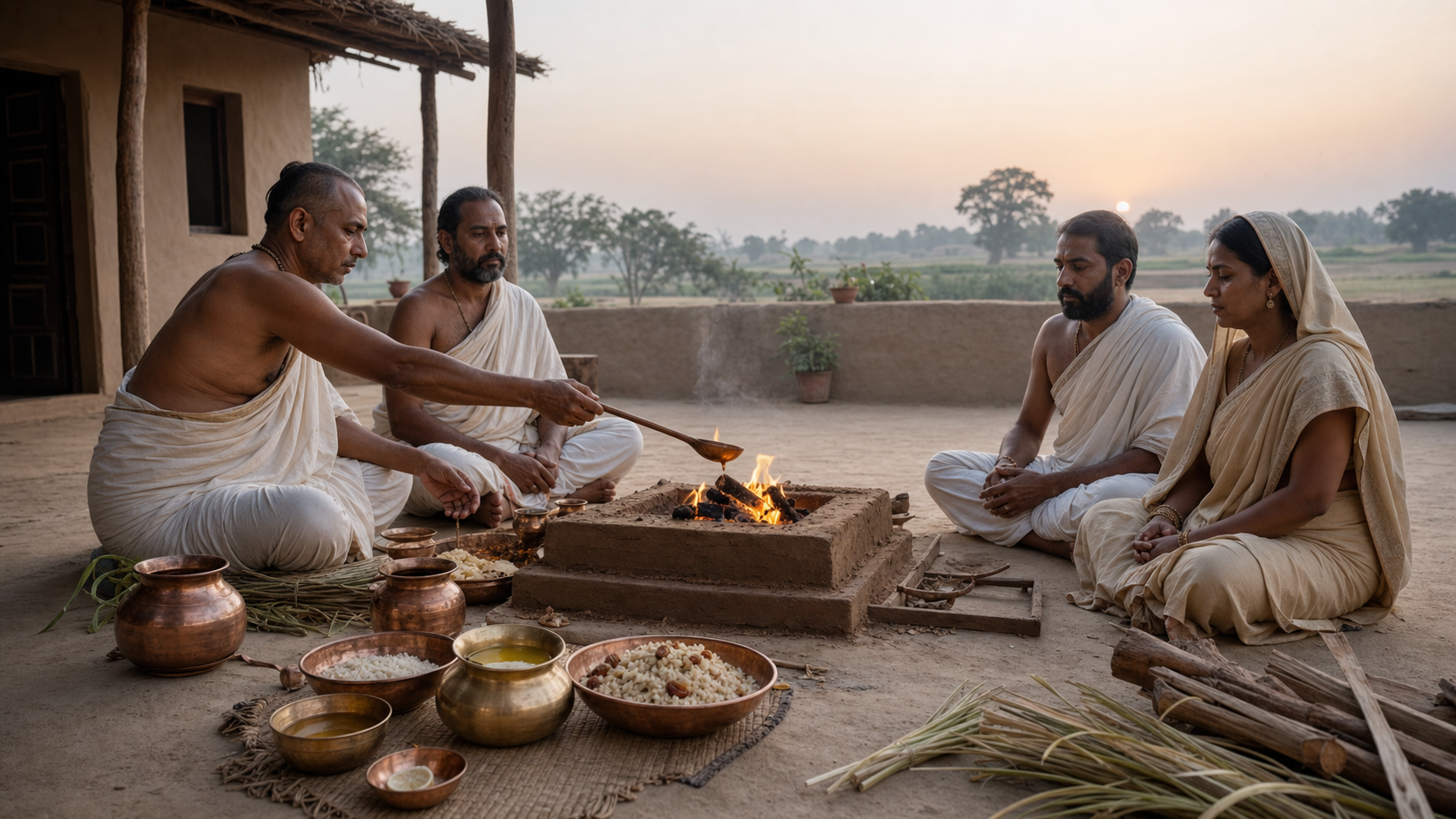
You may be trying to decide whether a fire ceremony you witnessed was a Haviryajna, whether Agnihotra belongs to that category, or whether the word simply means placing ghee in a flame. The uncertainty is reasonable. Yajna is now used so broadly that a precise Vedic classification can disappear inside the general image of a sacred fire.
You can read the practice more accurately by asking four questions: What is offered? When is it offered? What ritual order governs the act? What obligation does the offering express? Those questions reveal why Haviryajna is more than a ceremony and why its ethical meaning cannot be separated from its discipline.
First identify what kind of yajna you mean
Start by resisting the habit of using yajna, homa and every fire offering as interchangeable labels. Haviryajna names a class of Vedic sacrifices within the Shrauta tradition. Its central feature is havis: an oblation commonly made from grains, ghee and other plant-derived substances and offered through sacred fire.
This distinction prevents a common misreading of the word sacrifice. In ordinary English, the word may suggest killing. In Haviryajna, the defining action is the disciplined relinquishment of havis. Historical Vedic ritual traditions contain diverse variants, so it would be careless to declare that every sacrifice in every period was exclusively plant-based. It is equally careless to make slaughter the defining image of Haviryajna when grain, ghee and related offerings stand at its center.
The wider Vedic scheme places Haviryajna between two related classes. The classification is useful because it identifies the ritual horizon rather than merely the presence of a flame.
| Class | Distinguishing feature | Primary horizon |
|---|---|---|
| Pākayajna | Simpler domestic or community offerings | Household piety and social cohesion |
| Haviryajna | Havis is the focal oblation | Daily, lunar, seasonal and agrarian obligations |
| Soma Yajna | Soma pressings within a more extensive liturgy | Elaborate Shrauta sacrificial performance |
This is a graduated ritual architecture, not a league table of spiritual worth. Domestic devotion is not made insignificant by the complexity of a Soma rite, and complexity alone does not prove depth of intention. The classification tells you what kind of undertaking is present, which ritual grammar applies and how far its obligations extend.
When you encounter an unfamiliar ceremony, therefore, do not identify it from the fire alone. Ask whether it is a domestic offering, a havis-centered Shrauta observance or a Soma sequence. If its lineage and structure are unknown, fire offering is a more honest description than confidently calling it Haviryajna.
The calendar is part of the offering
Haviryajna regulates attention through time. Its daily, lunar, seasonal and agricultural rhythms are not decorative dates placed around an otherwise interchangeable ceremony. The appointed threshold helps define the rite itself.
- Agnihotra places the offering at sunrise and sunset, joining spiritual discipline to the two daily transitions of light.
- Darśa-Pūrṇamāsa marks the new moon and full moon, giving the lunar cycle an explicit ritual response.
- Cāturmāsya comprises seasonal observances, acknowledging that human life changes with the larger movement of the natural year.
- Āgrayaṇa is a first-fruits observance. It places gratitude and restraint at the threshold between receiving a harvest and consuming it.
These daily, lunar, seasonal and first-fruits rites train different kinds of attention. Agnihotra asks for reliability at recurring daily boundaries. Darśa-Pūrṇamāsa locates human activity within a cycle that no household controls. Cāturmāsya requires adjustment to seasonal change. Āgrayaṇa interrupts the impulse to treat agricultural yield as an ownerless commodity available for immediate private enjoyment.
This is why timing cannot be reduced to convenient scheduling. Within a formal ritual order, an act specified for sunrise is not made equivalent merely by moving it to a comfortable hour. Intention matters, but intention does not abolish form. Vedic discipline joins the two.
If you are studying a Haviryajna, make a four-column note before interpreting its symbolism: rite, offering, appointed time and participants. Mark missing information as unknown. That simple method prevents a familiar error in popular explanations, where an attractive meaning is supplied while the actual structure of the rite remains vague.
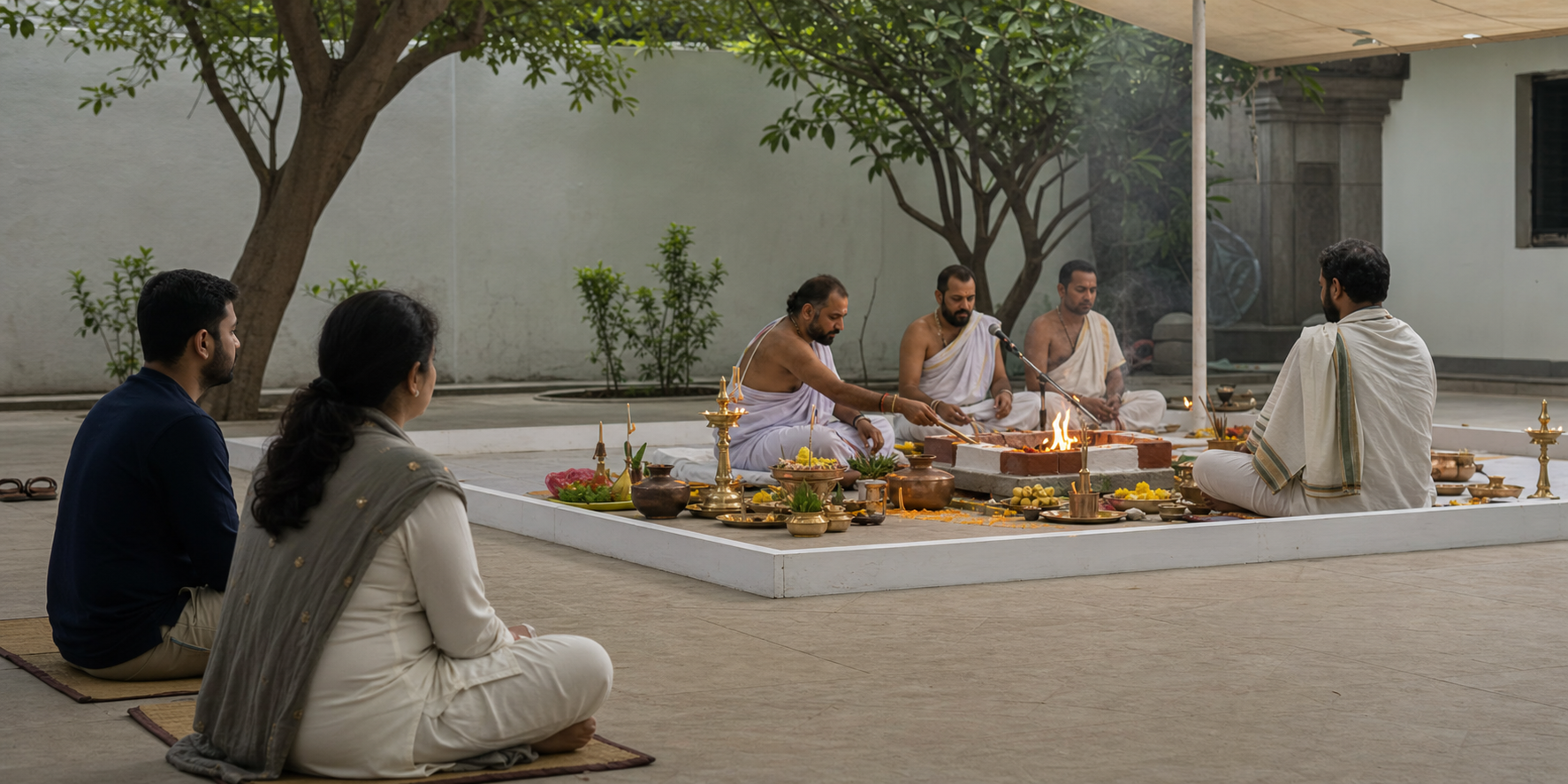
If you intend to perform rather than study or attend, an outline is not an instruction manual. Formal fire rites involve real fire as well as transmitted rules of preparation, recitation, timing and sequence. Work with someone qualified in the relevant living tradition instead of reconstructing a multi-fire Shrauta act from a short description.
Precision turns ordinary materials into a disciplined act
From outside, the visible action may look simple: a substance enters a flame. The ritual infrastructure is more demanding. Material, fire, mantra, time, priestly responsibility and sequence have to meet. Remove enough of those relationships and you may still have sincere worship, but you no longer have grounds for identifying it as a particular classical Haviryajna.
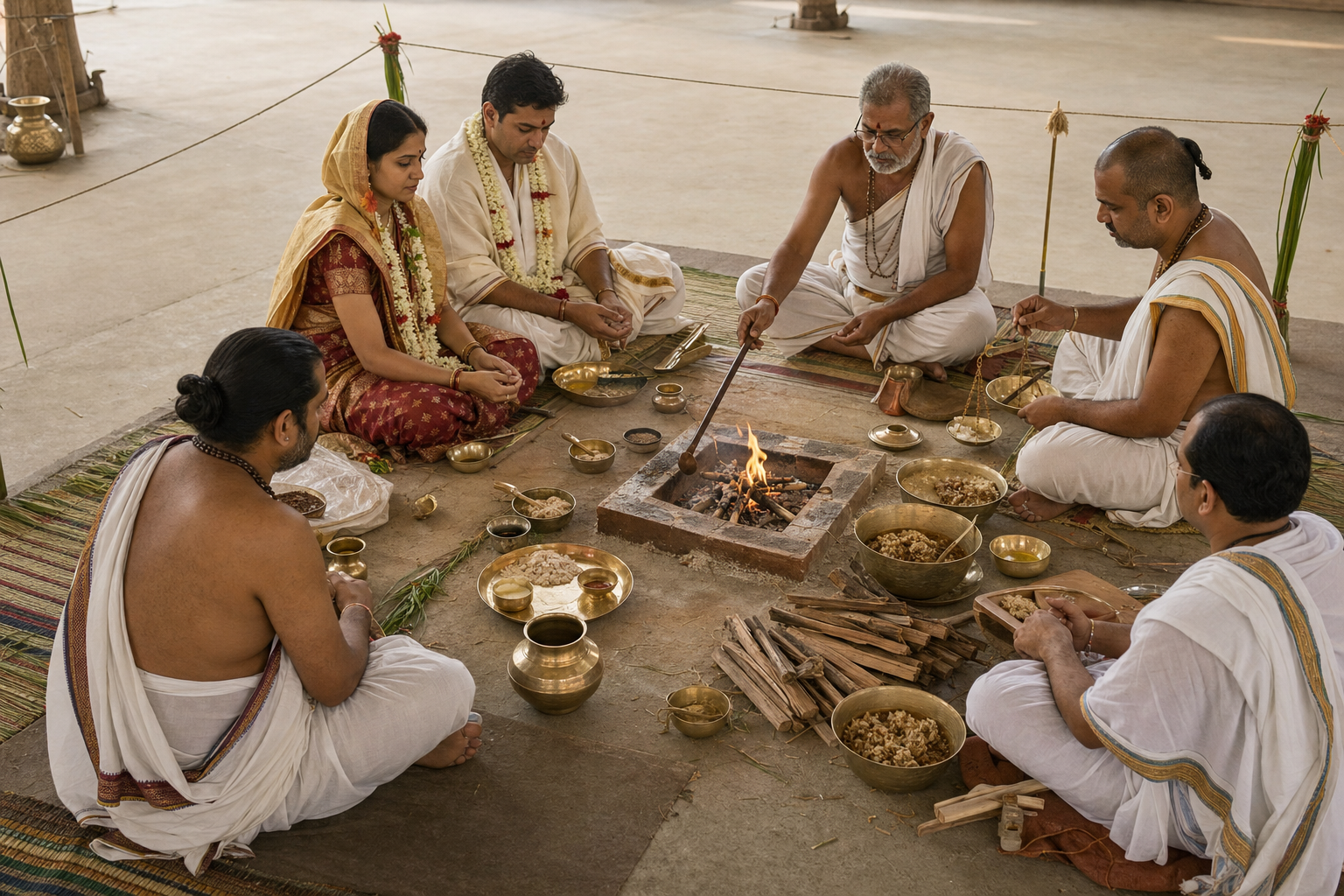
The Shrauta setting commonly distinguishes three sacred fires: Gārhapatya, Āhavanīya and Dakṣiṇa. They are not three poetic names for an undifferentiated flame. They occupy distinct ritual positions and functions. Their presence shows that sacred space itself is ordered; the rite does not happen in a neutral container.
Responsibility is also distributed. The broader priestly vocabulary includes the Adhvaryu, Hotṛ, Udgātṛ and Brahman. The Adhvaryu is associated with measured performance and Yajurvedic formulae; the Hotṛ with Rigvedic recitation; the Udgātṛ with sung liturgy in the wider Shrauta system; and the Brahman with oversight of ritual coherence. Exact personnel and duties depend on the particular sacrifice, so the list of principal offices should not be turned into a claim that every Haviryajna has an identical team.
You can use the following checks when observing or reading about a rite:
- Substance: What is actually being offered? Is the havis identified, or is the explanation content with saying only that there is an offering?
- Time: Is the act daily, lunar, seasonal or tied to first fruits? Is the stated time essential to the rite?
- Fire: Which sacred fire receives the offering, and how does it relate to the other fires?
- Word: Which mantras or Vedic liturgical materials govern the action?
- Office: Who is responsible for recitation, measured action and oversight?
- Sequence: Is the offering part of an ordered series, or is only its most visible moment being shown?
Precision here is not empty pedantry. It trains the sacrificer to act without making private preference the measure of everything. The offering is limited by what is appropriate, when it is appropriate and how it is to be given. Restraint enters before the material reaches the fire.
The substances can then carry meaning without becoming a free-floating code. Ghee can signify solar brilliance, grain the bounty of the earth, and fire the power of transformation. The word can matters. A symbol receives its force from the rite’s relationships; it is not a fixed dictionary entry that can be detached from context and applied anywhere.
Start with the literal economy beneath the symbolism. Grain depends on soil, water, season and labor. Ghee comes from a network of care and sustenance. Offering either means relinquishing something that could have been privately retained. Fire makes that relinquishment irreversible. Symbolic transformation therefore rests on a material act of giving up control.
Carry the ethic forward without erasing the form
What can travel into daily life
Most readers will not undertake a formal Shrauta sacrifice. That does not make Haviryajna irrelevant, but relevance requires honesty. You can adopt a discipline inspired by its ethical logic without relabeling every candle meditation or informal homa as a classical rite.
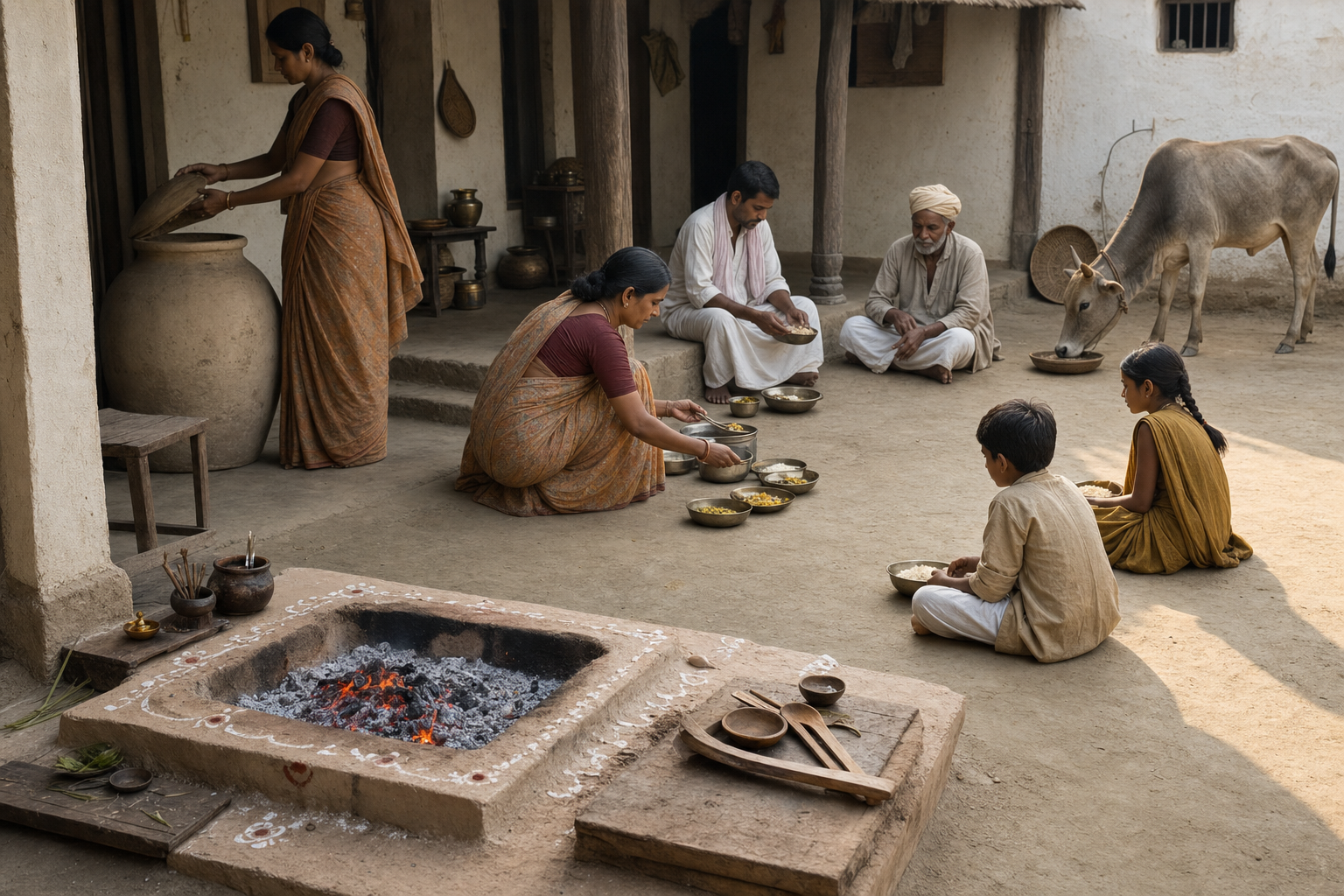
- Put gratitude before consumption. When a harvest, meal or other benefit reaches you, identify the land, water and labor that made it possible before treating it as private possession. A first share directed toward hospitality, community nourishment or service makes gratitude material rather than sentimental.
- Let time impose a boundary. Use an actual daily, lunar or seasonal threshold for reflection instead of postponing it until convenient. The point is not to imitate Agnihotra without its form, but to learn why a repeated obligation becomes stronger when preference cannot continually reschedule it.
- Join reverence to restraint. Track what you waste, what you take out of season and what you could share. An ecological interpretation becomes credible through changed consumption and redistribution, not through ceremonial language alone.
These are ethical translations, not replacement rituals. If the traditional fires, mantras, timing, offices and transmitted procedure are absent, say that your practice is inspired by yajna rather than claiming the name of a formal Haviryajna. Respect sometimes begins with a narrower label.
Where Dharmic unity needs careful language
Haviryajna can open a meaningful conversation across the Dharmic family because its ethical concerns resonate with dāna, ahiṁsā and sevā: generosity, non-harm and service. Many mainstream and regional understandings emphasize non-violent, plant-based offerings. Buddhist restraint, Jain attention to non-harm and Sikh traditions of communal service can therefore meet Vedic offering around shared moral questions.
Resonance is not sameness. Buddhism, Jainism, Sikhism and the many Hindu traditions do not become one ritual system because they value generosity or discipline. A productive comparison asks how each tradition limits possessiveness, reduces harm and directs resources toward others. An unproductive comparison erases their different scriptures, institutions, practices and theological commitments in order to announce a superficial unity.
The same care is necessary with ecological claims. A fire rite does not automatically become environmental policy, and combustion by itself is not evidence of ecological benefit. Haviryajna’s contemporary force lies in the ethic it can cultivate: awareness of natural cycles, gratitude for material sources, limits on consumption, and responsibility to return rather than merely take. If those habits never appear outside the ceremony, ecological language has become decoration.
Read ṛta, cosmic order, in this practical light. Alignment is not a private feeling of harmony. It asks whether action acknowledges relationships that precede the individual: season, land, inherited discipline, shared labor and the needs of a community. The sacrificial grammar makes those relationships difficult to ignore.
Key takeaways
- Haviryajna is a defined class of havis-centered Vedic sacrifices, not a synonym for every ceremony involving fire.
- Pākayajnas, Haviryajnas and Soma Yajnas describe different ritual horizons; their distinction concerns form and scope, not a simple ranking of spiritual value.
- Agnihotra, Darśa-Pūrṇamāsa, Cāturmāsya and Āgrayaṇa show how daily, lunar, seasonal and agrarian time can become part of religious obligation.
- Havis commonly includes grain, ghee and other plant-based offerings, although the diversity of historical ritual practice should not be concealed by an absolute claim about every Vedic sacrifice.
- The sacred fires, priestly responsibilities, Vedic recitation, timing and sequence are constitutive parts of the rite, not optional scenery around a personal intention.
- Generosity, non-harm, service and ecological restraint can carry the ethic into contemporary life, but an inspired personal practice should not be misnamed as a formal Haviryajna.
Your next step should match your purpose. For study, choose one named rite and map its offering, time, fires, words and participants. When attending, ask which tradition is being followed and what the ceremony is actually called. For performance, learn from a practitioner capable of preserving the sequence and explaining the obligations behind it.
Begin with one precise question rather than with Vedic sacrifice in general. Choose Agnihotra if you want to understand daily discipline, Darśa-Pūrṇamāsa for lunar order, or Āgrayaṇa for the relationship between harvest and gratitude. Precision is not a barrier to meaning here. It is how the meaning becomes visible.

References
