
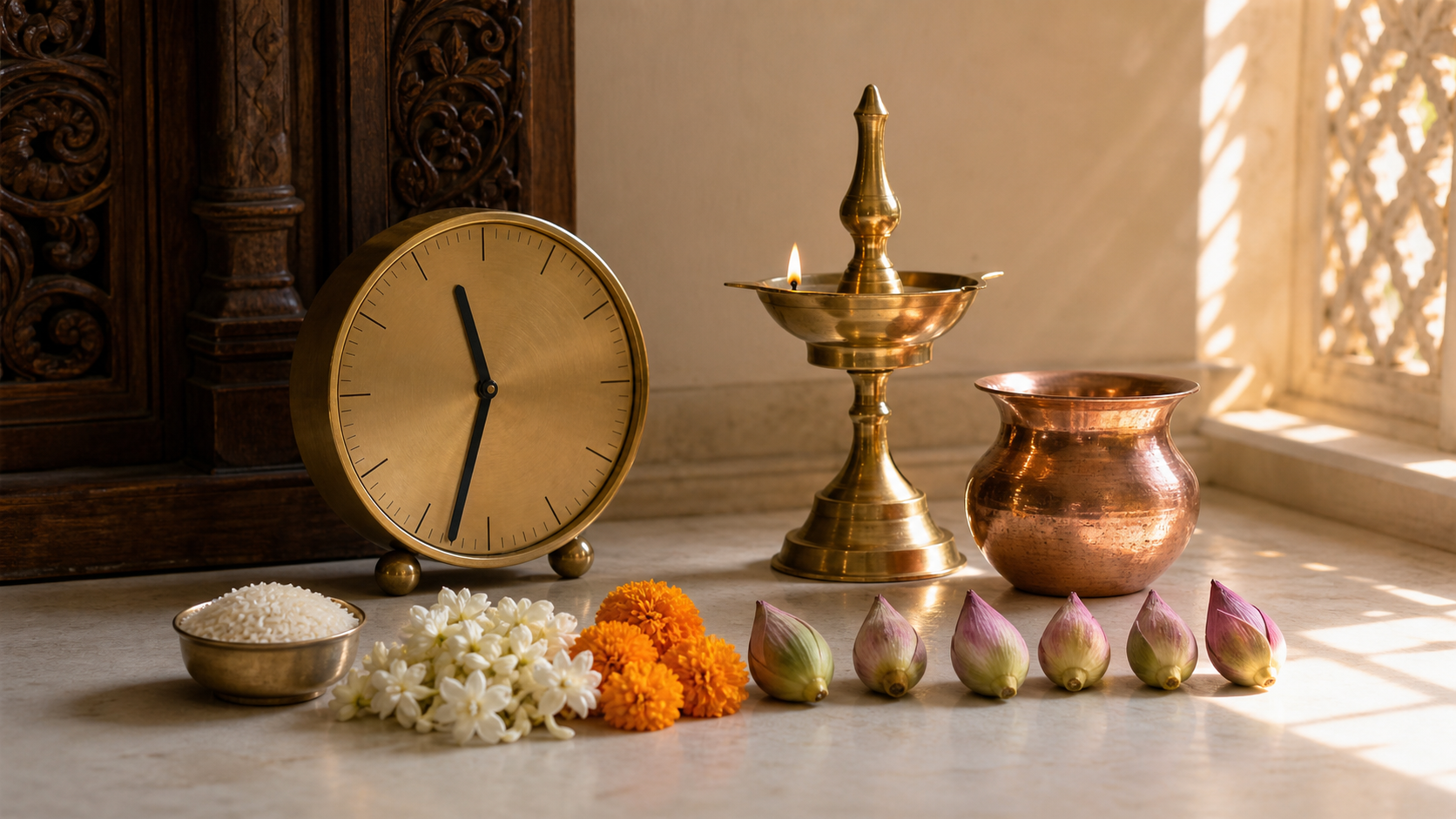
If you have set aside Sunday, February 22, for a new course of study, a family sankalpa, or monthly Sashti worship, do not treat the whole date as one undivided Panchang day. In the standard Indian reckoning, the day has a clear hinge: Shukla Paksha Panchami continues until 11:34 AM IST, and Shukla Paksha Sashti begins at 11:34 AM.
Use that transition as your starting point, then adjust your plans for local sunrise, Nakshatra, Rashi, and personal lunar strength. The result is a practical schedule that respects the Panchang without pretending that one India-wide clock time is a complete personal muhurta.
Key takeaways for February 22
- Sunday begins under Shukla Paksha Panchami in the standard Indian reading.
- Panchami ends at 11:34 AM IST; Sashti governs the remainder of the day.
- The morning is broadly suited to learning, planning, steady beginnings, and gentle routines, subject to the other Panchang factors.
- After 11:34 AM IST, the emphasis shifts toward Sashti vrata, Skanda worship, disciplined effort, and firm commitments.
- If you live outside India, convert the transition to your local time and check which tithi is present at your own sunrise.
The day’s Panchami-to-Sashti timeline
| Period in the standard Indian reckoning | Prevailing tithi | Practical emphasis |
|---|---|---|
| From the morning until 11:34 AM IST | Shukla Paksha Panchami | Study, project planning, measured beginnings, and gentle wellness routines |
| From 11:34 AM IST onward | Shukla Paksha Sashti | Skanda devotion, vrata observance, disciplined routines, and resolute action |
The tithi changes before noon because a lunar day is not tied to midnight. It is determined by the changing angular distance between the Moon and Sun. Each tithi occupies a 12-degree interval: Panchami covers a Moon-Sun separation from 48 degrees to less than 60 degrees, while Sashti covers 60 degrees to less than 72 degrees. Once the separation reaches the next boundary, the tithi changes, whatever the civil clock may show.
This also explains why two statements that look different can both be correct. February 22 is a Panchami date under the commonly used sunrise rule, yet Sashti prevails for most of the period after 11:34 AM IST. The weekday remains Sunday throughout; only the lunar-day component changes.
Many Hindu calendars assign a vrata or festival date through udaya tithi, the tithi present at local sunrise. A later transition does not retroactively change the sunrise tithi. When a particular vrata has a more specialized rule, however, follow the prescription of your sampradaya or regional Panchang rather than assuming that the general sunrise rule settles every observance.
How to plan the morning and afternoon
Panchami is generally counted among the supportive tithis for auspicious activity. Its traditional character favors steady growth, learning, and beginnings that need patient development. If your task is educational or preparatory, the period before 11:34 AM IST is the more natural part of this date to use.
- For study: begin a course module, establish a reading discipline, organize notes, or make the first serious commitment to a field of learning.
- For a project: define the scope, create the outline, choose the next milestone, or start work that benefits from orderly growth rather than immediate confrontation.
- For personal discipline: begin a gentle routine you can sustain. Panchami’s value here lies in continuity, not dramatic intensity.
Do not turn that general favorability into a blanket guarantee. Tithi is only one component of muhurta. A major samskara, marriage-related decision, property commitment, or other consequential undertaking should also be checked against the local Nakshatra, weekday interaction, relevant yogas, and the individuals involved.
After 11:34 AM IST, let the schedule reflect Sashti. This tithi is closely associated with Subrahmanya, Skanda, or Murugan worship and with the monthly Sashti vrata. It suits a shift from preparation to resolve: prayer for protection, a disciplined sankalpa, the removal of avoidable habits, or a firm return to a routine that has been neglected.
If you are observing Sashti, first establish when Sashti begins in your location. Then follow your household or temple tradition for fasting, puja, mantra, and completion. The Panchang gives you the temporal framework; it does not erase legitimate differences in regional and sampradaya practice.
Fit Brahma Muhurta, Abhijit, and Sandhya around the transition
The named auspicious periods of the day must be calculated from local solar conditions. They are not fixed IST appointments that can be copied unchanged from one city to another.
- Brahma Muhurta: approximately 96 to 48 minutes before local sunrise. Use it for meditation, japa, contemplation, or quiet scriptural study.
- Abhijit Muhurta: a period around local solar noon, traditionally used for concise, result-oriented initiatives. Check its exact local span and whether it falls before or after the 11:34 AM IST tithi transition.
- Evening Sandhya: use the evening junction for prayer, reflection, and closing the day’s activity with awareness rather than carrying its momentum unexamined into the night.
The Abhijit point deserves special attention on this date. Solar noon varies by location, so you should not automatically label it Panchami or Sashti. Compare the locally calculated Abhijit interval with the converted tithi-transition time. That simple comparison prevents a common error: choosing a named muhurta correctly but assigning it to the wrong tithi.
Localize the Panchang before relying on it
The 11:34 AM time is stated in Indian Standard Time. If you are in Bharat, your regional Panchang may still show small differences arising from location and almanac convention. If you are outside India, copying 11:34 onto your local clock would be incorrect. Convert the instant into your civil time zone, retaining any change of calendar date that the conversion produces.
- Set the location first. Use the city where the observance or action will actually occur, not a family hometown or a temple in another time zone.
- Check local sunrise. This determines the tithi present at sunrise and therefore the udaya-tithi reading used for many calendar assignments.
- Convert the transition. Translate 11:34 AM IST into local time before dividing your day into Panchami and Sashti periods.
- Add Nakshatra and Rashi. Their exact values can vary with place and time, so obtain them from a reliable regional Panchang or ephemeris rather than guessing from the tithi.
- Personalize only when necessary. For an important personal muhurta, examine Chandrabalam in relation to your Rashi and Tarabalam in relation to your Janma Nakshatra.
This sequence also helps when family members consult different calendars. Amanta and Purnimanta systems may organize or name lunar months differently, but those conventions do not create different Moon-Sun geometry. First identify the astronomical transition and local sunrise; then apply the calendar and observance rules followed by your community.
Keep the shared Dharmic foundation without flattening differences
Lunar reckoning forms part of a wider Dharmic inheritance. Hindu, Buddhist, and Jain communities use closely related lunar principles in their sacred calendars, while Sikh calendrical history has intersected with the Bikrami system. That shared background is worth recognizing, but it does not mean every tradition assigns the same practice to Panchami or Sashti.
The sound approach is both unified and precise: respect the common astronomical foundation, then follow the vrata rule, month system, and devotional form of the tradition you actually practice. Before February 22 arrives, write down one task for the Panchami morning and one devotional or disciplinary commitment for the Sashti period. Add your local transition time beside them. That small preparation turns the Panchang from information you merely read into time you consciously use.
References
