

If you are deciding when to begin a project, make a modest purchase, perform puja, or address a stubborn obstacle on February 20, do not treat the whole day as one undivided muhurat. Friday’s practical turning point is 3:05 PM, when the prevailing tithi changes from Shukla Paksha Tritiya to Shukla Paksha Chaturthi in most regions.
The change does not divide the day into a good half and a bad half. It changes the day’s emphasis: use the Tritiya period for constructive beginnings, learning, dana, and growth-oriented work; use the Chaturthi period for Ganesha-centered worship, obstacle clearing, and tasks that call for patience. Because Panchang timings depend on locality, confirm the transition and any muhurat with a calendar calculated for your location before fixing a tithi-sensitive ritual.
The day’s practical dividing line is 3:05 PM

A tithi does not necessarily begin and end with the civil date. That is why February 20 contains two distinct devotional periods. For most regions, the working schedule is Shukla Paksha Tritiya until 3:05 PM, followed by Shukla Paksha Chaturthi.
| Period | Prevailing tithi | Best practical use | What to check |
|---|---|---|---|
| Before 3:05 PM | Shukla Paksha Tritiya | Constructive beginnings, learning, devotional study, creative work, modest purchases, dana, and vrata planning | Local tithi time, Rahu Kalam, and any activity-specific muhurat |
| After 3:05 PM | Shukla Paksha Chaturthi | Ganesha puja, obstacle-clearing sankalpa, patient planning, disciplined work, and resuming a blocked task | Local transition time and the requirements of your family or sampradaya |
The distinction matters most when you have a choice. A study programme, creative undertaking, or small household purchase can be placed in the verified Tritiya period. After the transition, shift from broad expansion to focused removal of impediments. Chaturthi is especially suitable for remembering Sri Ganesha as Vighna-vinashaka and then taking a concrete step against whatever has been delaying you.
Match the action to the tithi instead of chasing a generic good time

The most useful question is not simply, “Is February 20 auspicious?” Ask what you intend to do. Panchang guidance becomes practical only when the character of the activity matches the character of the period.
- Beginning constructive work: Put the first meaningful step in the locally verified Tritiya period. This could be the opening study session, the first page of a creative project, or the formal sankalpa for a disciplined practice.
- Learning or devotional study: Choose one text, lesson, or subject and begin before the transition. A defined session is more useful than making an expansive promise that you will not sustain.
- Giving dana: Select the recipient and complete the act during Tritiya if possible. The intention should be service, not merely checking a ritual box.
- Making a purchase: The guidance supports modest new purchases, not an assumption that every financial commitment is favoured. Property, a large investment, a business contract, or another consequential transaction needs its own due diligence and, where desired, activity-specific muhurat guidance.
- Addressing a blockage: After 3:05 PM, perform Ganesha remembrance according to your tradition, name the obstacle precisely, and take one practical next step. Prayer and effort belong together here.
Avoid placing a tithi-dependent act at the very edge of the transition. If your local calculation shifts the time, a last-minute start could fall under Chaturthi rather than Tritiya. When ritual precision matters, leave room around the boundary and follow the local time rather than the general 3:05 PM reference.
A simple home observance for both parts of the day
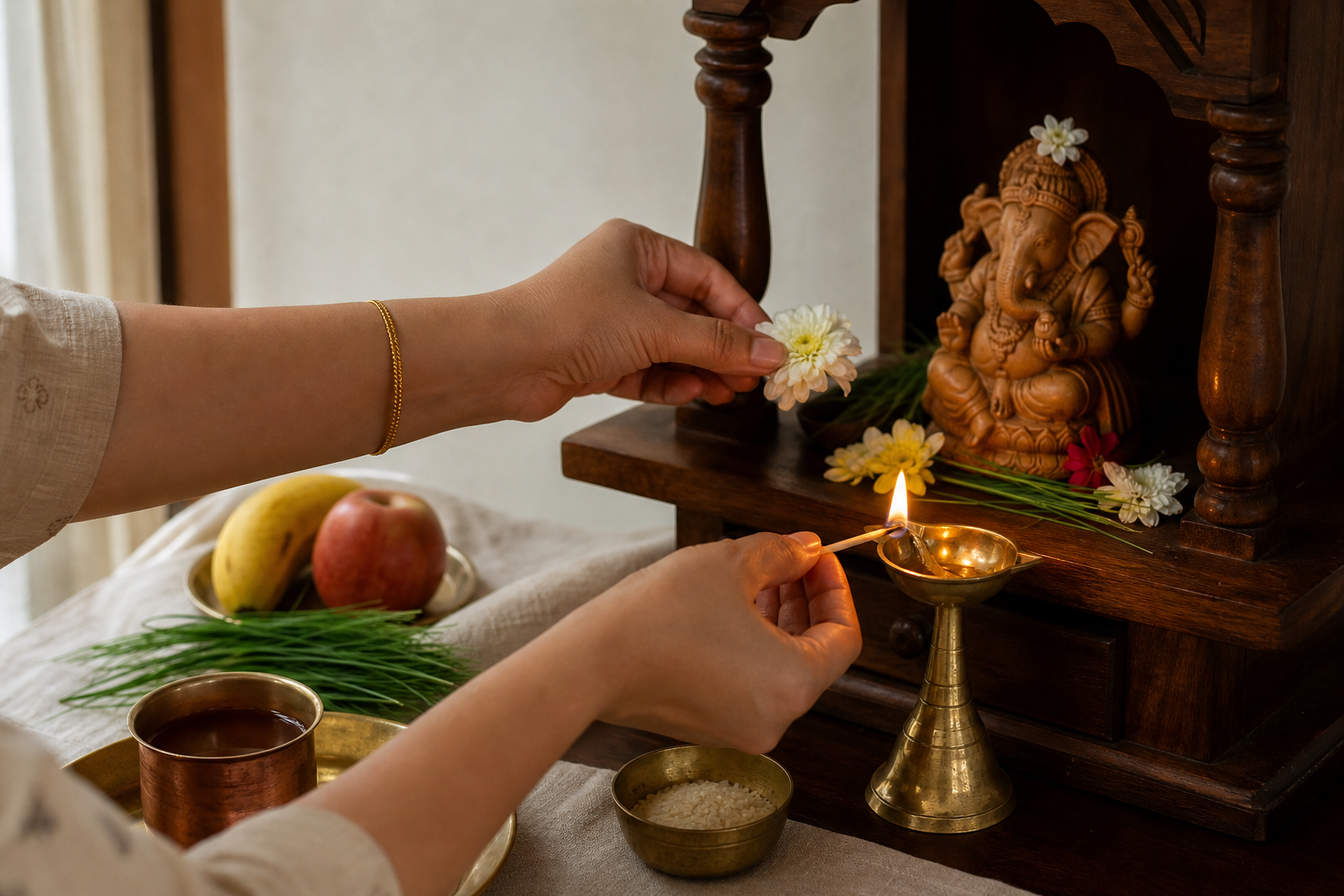
You do not need to invent an elaborate ceremony to honour the change in tithi. Keep the observance proportionate to your family practice and to the action you actually intend to sustain.
- Set one clear intention in the morning. Decide whether the day’s priority is study, a constructive beginning, dana, worship, or resolving a delayed responsibility.
- Use Tritiya for growth-oriented action. Complete the first real unit of work before the verified transition rather than merely announcing that you have begun.
- Pause briefly when the emphasis changes. You do not need to interrupt ordinary duties, but you can consciously move from expansion to steadiness and obstacle clearing.
- Remember Sri Ganesha after Chaturthi begins. Follow the mantra, puja method, or quiet prayer customary in your household or lineage. Avoid presenting an unfamiliar ritual as though it were universally required.
- Act on the obstacle you named. Send the delayed message, organise the neglected material, correct the unfinished plan, or resume the work you have been avoiding. Let the devotional intention produce a visible next step.
If you observe a vrata or temple-specific practice, its rules take priority over a general home schedule. Regional calendars and sampradaya conventions can differ, and a concise daily Panchang cannot settle every ritual question.
Verify the local details that the date alone cannot provide

The 3:05 PM transition is useful for planning, but it should not be treated as a universal clock reading. Sunrise, locality, calculation method, and regional convention affect how a daily Panchang is applied. Check a trusted local calendar, temple noticeboard, or knowledgeable purohit when the exact tithi is essential.
- Location: Make sure the Panchang is calculated for your city or a genuinely nearby place, not merely for the same country.
- Tithi end time: Confirm when Tritiya ends locally and Chaturthi begins.
- Rahu Kalam: Do not calculate or guess it from the tithi. Use the locally listed interval before selecting a start time.
- Nakshatra and Moon’s Rashi: These can refine a sankalpa or personal muhurat, but their values should be read from the local Panchang rather than inferred from the date.
- Named muhurat windows: If your calendar lists a period such as Abhijit Muhurat, check its actual local timing and whether it is appropriate for your intended activity.
- Ritual context: A wedding, samskara, major purchase, or formal vrata may have requirements that a general daily indication does not address.
This prevents a common mistake: finding one favourable feature and treating it as permission for every kind of undertaking. Tithi is one part of muhurat selection. For ordinary devotional and household planning, it provides a meaningful rhythm; for a major ceremony or irreversible commitment, use the fuller local calculation.
Key takeaways for February 20
- Use Shukla Paksha Tritiya before 3:05 PM for constructive beginnings, study, creative effort, modest purchases, and dana.
- After 3:05 PM, turn toward Shukla Paksha Chaturthi, Ganesha worship, disciplined effort, and practical obstacle clearing.
- Do not interpret the transition as a division between a wholly auspicious period and a wholly inauspicious one; match each action to the tithi’s emphasis.
- Check the local tithi change and Rahu Kalam before fixing an exact start time.
- Do not guess Nakshatra, Moon’s Rashi, or a named muhurat from the date alone.
Before February 20 arrives, choose the one action you want the day to support and open a trusted Panchang for your location. Put growth-oriented work in the verified Tritiya period; after Chaturthi begins, offer your Ganesha remembrance and take one deliberate step through the obstacle in front of you.
References
