
Dwadashi is often described simply as the lunar day after Ekadashi, but the three supplied articles present a more consequential role: it carries a vrata from restraint into nourishment, gratitude, and renewed participation in ordinary life. Its meaning emerges from the relationship between accurate calendrical timing, proper parana, and devotion to Vishnu.
Read together, the reports show both a stable ritual pattern and meaningful variation. A daily Panchang entry, a Damodara observance, and a Vamana observance all interpret the twelfth tithi through different devotional settings while retaining the same movement from discipline toward integration.
Why Dwadashi completes rather than merely follows Ekadashi

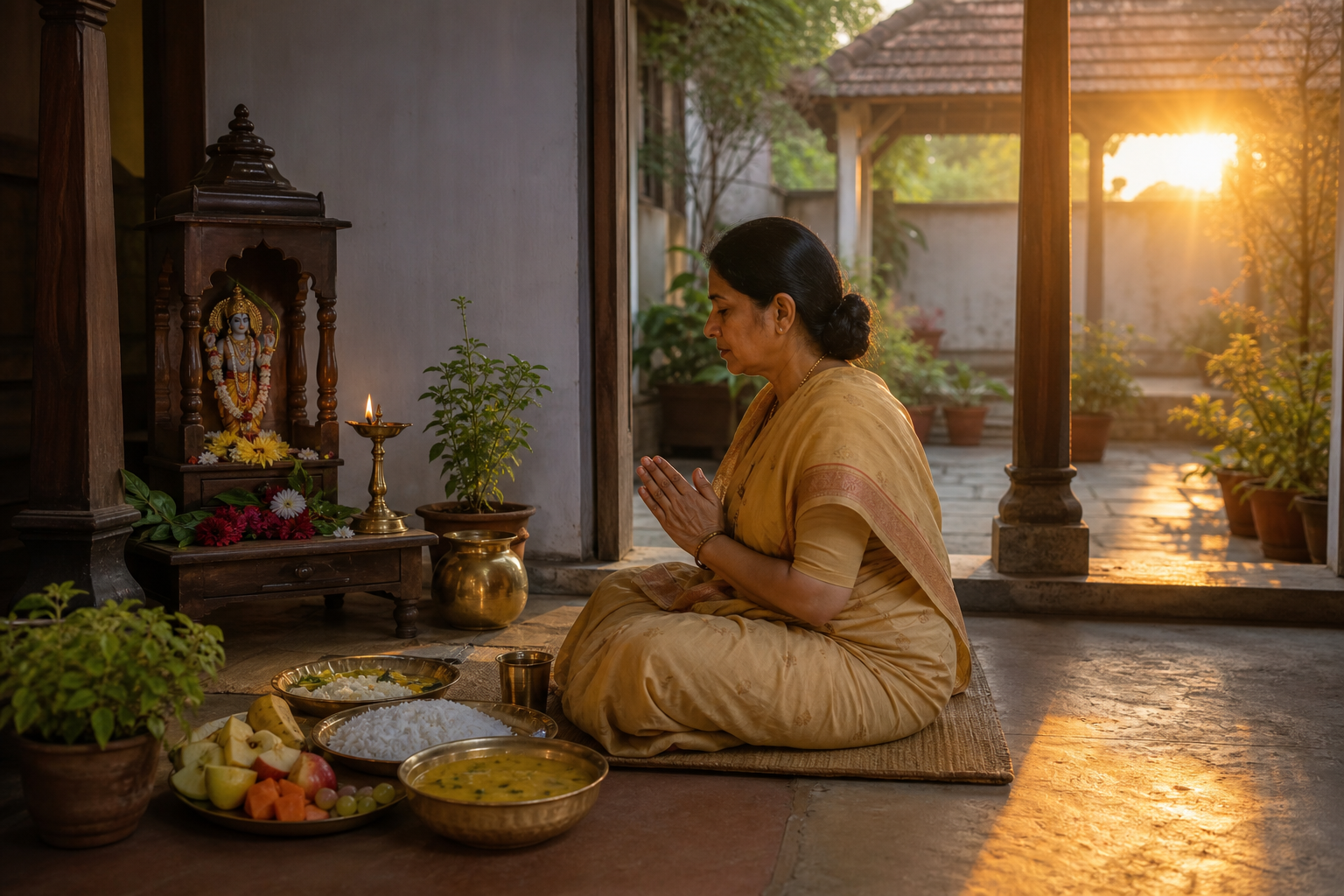
Ekadashi and Dwadashi form a sequence. The first concentrates attention through fasting, prayer, restraint, and remembrance of Vishnu; the second formally concludes that discipline through parana, the prescribed breaking of the fast. The reports on Damodara Dwadashi and Vamana Dwadashi both treat this completion as part of the vrata itself, not as an incidental meal after it.
This structure prevents fasting from becoming an isolated display of austerity. Abstinence creates space for devotion, while parana restores nourishment as prasadam received with awareness. The cycle therefore teaches two complementary disciplines: the ability to refrain and the ability to receive without falling immediately back into distraction.
The calendrical precision matters because a tithi does not necessarily begin at midnight. The July 11 Panchang report explains that each tithi corresponds to a 12-degree segment in the angular relationship between the Sun and Moon. For its New Delhi reference, Ekadashi reportedly ended at about 1:21 AM on July 11, 2026, and Dwadashi continued until approximately 2:04 AM on July 12. These were explicitly presented as location-specific timings rather than universal ritual hours.
Three observances reveal one devotional pattern
The articles address different Dwadashis rather than competing accounts of a single festival. Their comparison shows how the month, fortnight, preceding Ekadashi, and form of Vishnu give each observance its particular character.
| Reported 2026 setting | Relationship to Ekadashi | Distinct devotional emphasis |
|---|---|---|
| July 11: Krishna Paksha Dwadashi for most practical observance after an early Ekadashi remainder | Associated in the report with Yogini Ekadashi parana | Attentive use of the Panchang, timely completion, Vishnu worship, charity, and a measured return to routine |
| July 26: Ashadha Shukla Dwadashi, identified as Vamana, Vasudeva, or Maha Dwadashi in the source | Reported as following Devshayani Ekadashi and entering the devotional atmosphere of Chaturmas | Vishnu as Vamana; humility, responsible power, surrender, and renewed alignment with dharma |
| August 24: Shravana Shukla Dwadashi, observed as Damodara Dwadashi | Reported as following Putrada Ekadashi, also called Pavitra or Pavitropana Ekadashi in many traditions | Vishnu or Krishna as Damodara; loving accessibility, household prayer, family welfare, gratitude, and prasadam |
The comparison also cautions against treating festival names as universally standardized. The Vamana article distinguishes its Ashadha observance from Vamana Jayanti traditions associated in many calendars with Bhadrapada Shukla Dwadashi. It attributes such differences to regional calendars, temple lineages, family practices, and sampradaya traditions. The July 11 report similarly notes that Ashadha in the Purnimanta system can correspond to Jyeshtha in the Amanta system without either designation necessarily being erroneous.
Vishnu’s forms turn the calendar into ethical reflection
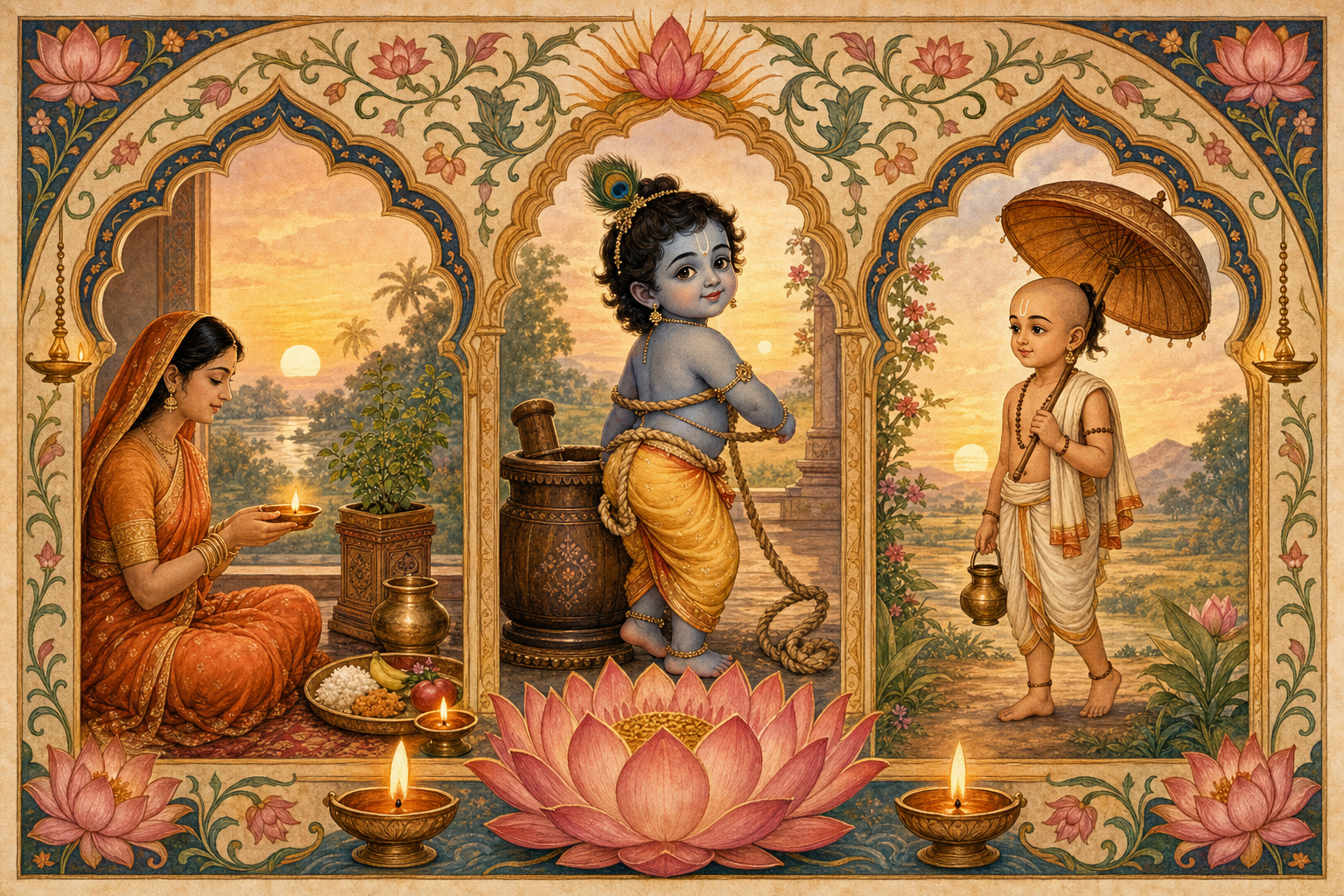
The Damodara and Vamana traditions add theological depth to the shared ritual framework. The Damodara report recalls the name as referring to Krishna whose belly was bound with a rope by Yashoda. Its devotional significance lies in the paradox of the Supreme becoming approachable through intimate love. In this setting, restraint is meant to deepen tenderness, remembrance, and gratitude rather than produce spiritual severity.
The Vamana report develops a different dimension of Vishnu devotion. It recounts the young Brahmachari approaching King Mahabali for three paces of land and then manifesting as Trivikrama, whose steps encompass the worlds. The article reads Bali as more complex than a simple antagonist: generous and committed to his word, yet confronted with the limits of possession and expanding power. The resulting lesson concerns the purification of generosity from pride.
Together, these forms of Vishnu correct opposite distortions. Damodara devotion prevents transcendence from becoming remote by emphasizing divine accessibility through love. Vamana devotion prevents achievement and generosity from becoming self-magnifying by placing them within a larger moral order. The daily Panchang perspective supplies the practical counterpart: lofty meanings are embodied through a correctly timed, repeatable discipline.
Observance should unite precision, devotion, and capacity
A careful observance begins with a reliable local Panchang or temple calendar. All three reports emphasize, directly or through their timing discussions, that tithi boundaries and parana windows depend on location, sunrise, and regional reckoning. A Gregorian date may assist planning, especially in the diaspora, but it does not by itself determine the complete ritual schedule.
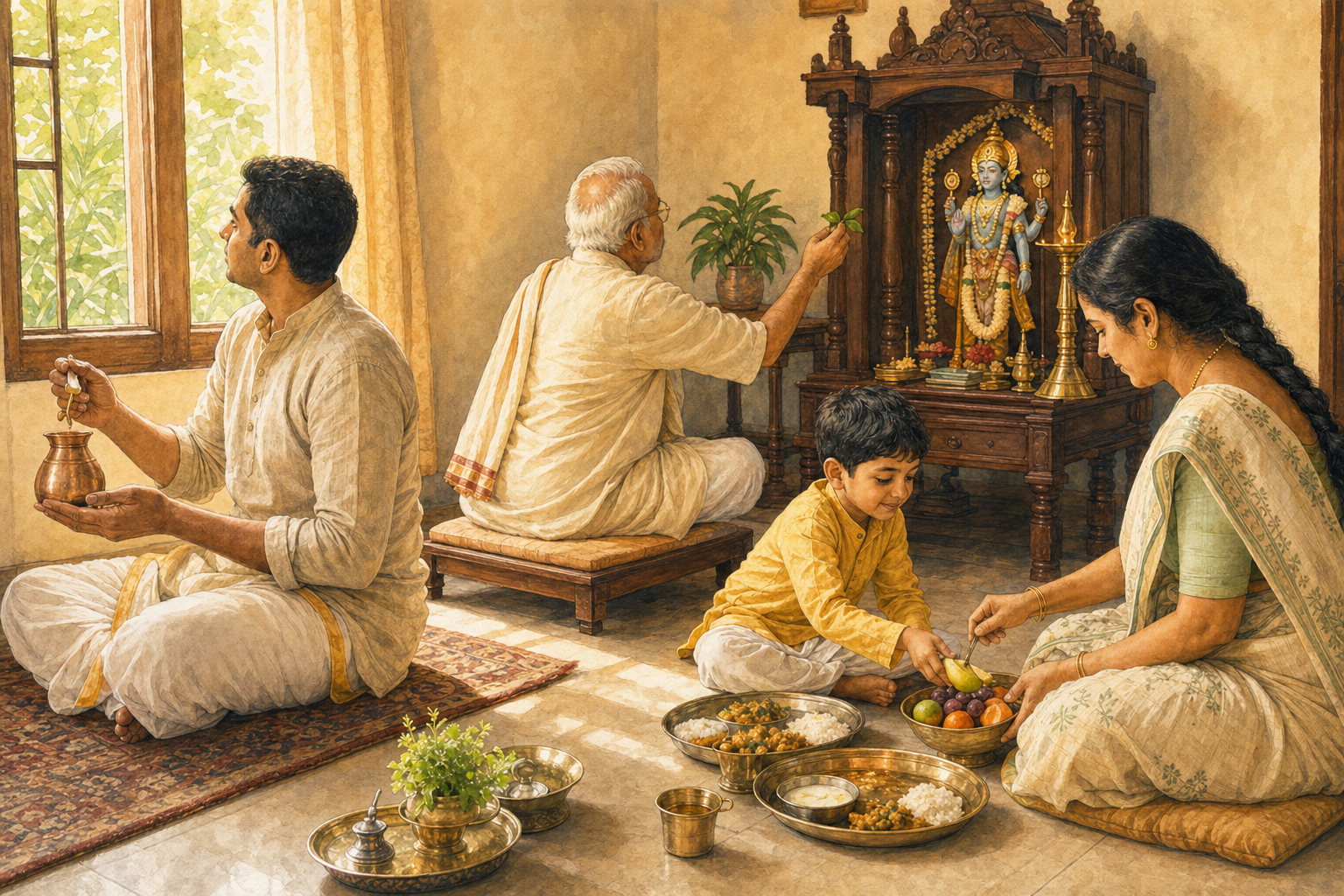
The forms of worship described across the sources are adaptable to home practice: early prayer, a clean puja space, a lamp, water, flowers, tulasi where appropriate, naivedya, Vishnu or Krishna names, and devotional reading. The Damodara article mentions the Bhagavad Gita, Srimad Bhagavatam, and Vishnu Sahasranama; the Vamana article also recommends Vishnu stotras and contemplation of the avatar narrative. Charity, feeding guests or people in need, and sharing sattvic prasadam extend worship into relationship and service.
Physical austerity is not presented as identical for every devotee. The Damodara report describes full and partial fasting as well as food restrictions shaped by family custom, health, age, and capacity. Although it reports a tradition that regards abstaining from rice and food salt for two days as meritorious, it also counsels sincerity and moderation. This distinction is important: the devotional purpose is disciplined attention, not competition over hardship.
The most coherent household pattern is therefore preparation, observance, completion, and integration. The devotee verifies the local calendar, undertakes an appropriate Ekadashi discipline, performs Dwadashi parana within the applicable guidance, and carries the resulting attentiveness into food, speech, family responsibilities, and service.
Key takeaways
- Dwadashi is the formal completion of an Ekadashi vrata, with parana belonging to the discipline rather than merely ending it.
- The three reported 2026 observances share a Vishnu-centered structure but differ in lunar setting, preceding Ekadashi, and theological emphasis.
- Damodara highlights divine accessibility through loving devotion, while Vamana directs attention toward humility, responsible power, and surrender.
- Exact tithi and parana times require a location-specific Panchang; a civil date alone is insufficient for formal observance.
- Fasting should be adapted to health and capacity, while prayer, sattvic nourishment, charity, and ethical self-control preserve its spiritual purpose.
Approached in this way, future Dwadashi observances can become more than dates to remember: they can serve as recurring points at which restraint is converted into steadier devotion and more responsible daily conduct.
References
- DharmaRenaissance Blog — July 11, 2026 Panchang: Essential Dwadashi Timings, Nakshatra and Rashi Guide
- DharmaRenaissance Blog — Damodara Dwadashi 2026: Sacred Shravana Dvadasi for Vishnu Devotion
- DharmaRenaissance Blog — Vamana Dwadashi 2026: Powerful Vishnu Worship, Humility, and Sacred Renewal