
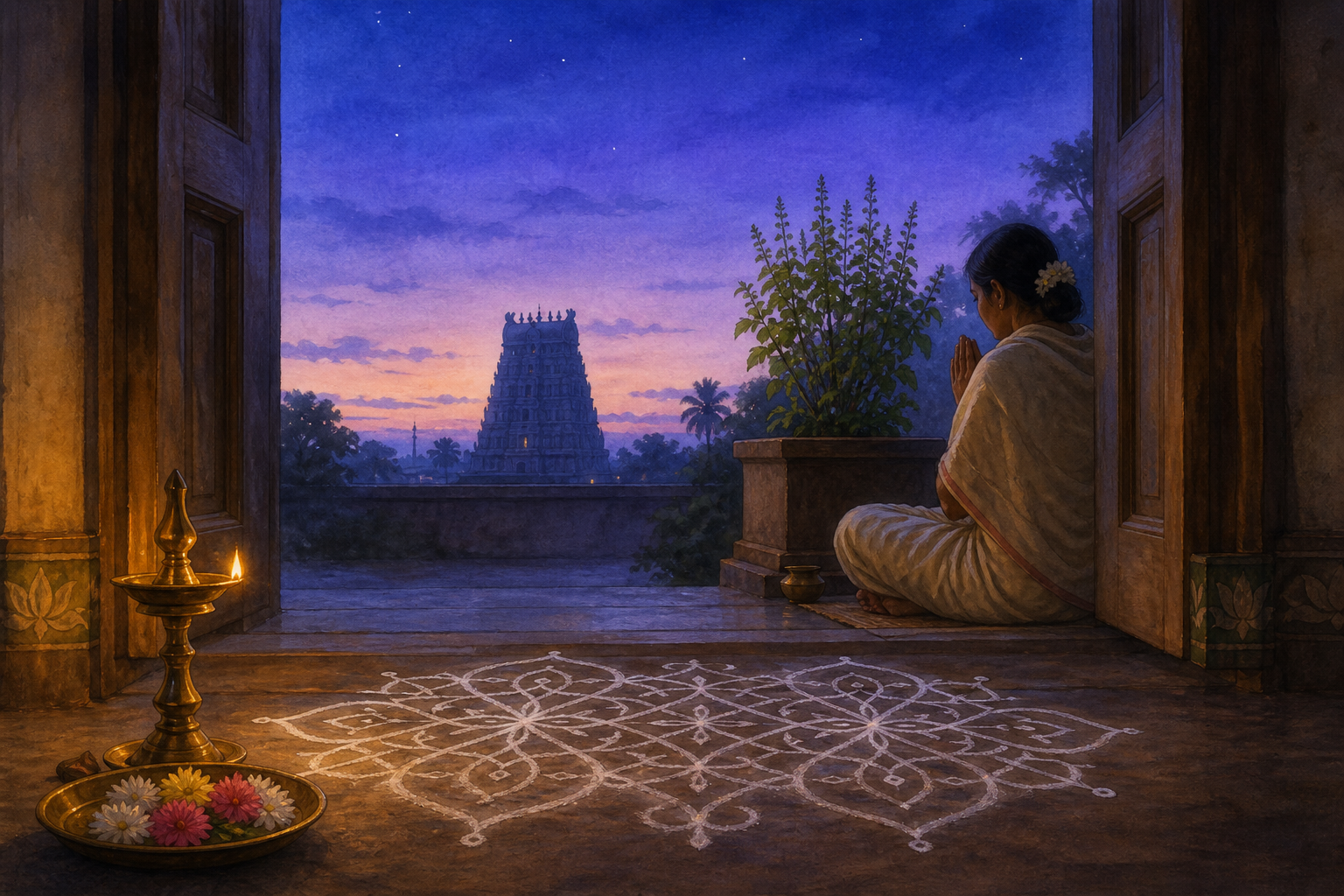
You want to observe Dhanurmasam or Margazhi with sincerity, but the practical questions arrive quickly. Which dates should you follow? Is Tiruppavai recitation essential? How much should you attempt before sunrise when work, school, and family duties still have to continue?
You do not need to reproduce an elaborate temple schedule at home. You need the right calendar anchor, a predawn discipline you can sustain, and respect for the sampradaya that gives each observance its meaning. Start there, then add only what deepens your bhakti.
Begin with the solar markers, not a guessed date

Dhanurmasam is framed by the Sun’s transit through Dhanu Rashi, or Sagittarius. It begins at Dhanur Sankramanam and ends as the Sun enters Makara, or Capricorn, at Makara Sankranti. Margazhi is the corresponding sacred month in the Tamil calendar. Dhanu Masam, Dhanur Masam, Dhanumasam, and Margazhi therefore name the same broad devotional season through different regional calendars and languages.
For the 2025-2026 cycle, the period began on 16 December 2025 and concluded on 14 January 2026. Do not carry those dates into another year. Solar transitions, local calendar conventions, and panchang calculations must be checked for the year and place in which you are observing.
This matters especially outside Bharat. Your local sunrise and temple calendar are more useful than a schedule copied from another longitude. Before the month begins, confirm three things with your local temple or trusted panchang:
- The local date and time of Dhanur Sankramanam.
- The temple’s Margazhi or Dhanurmasam worship schedule.
- The local observance date for Makara Sankranti and any special events you intend to attend.
Once those anchors are fixed, put them on the household calendar. The first marks the beginning of your discipline; the second prevents the month from fading out without a conscious close.
Choose a dawn practice you can keep for the month
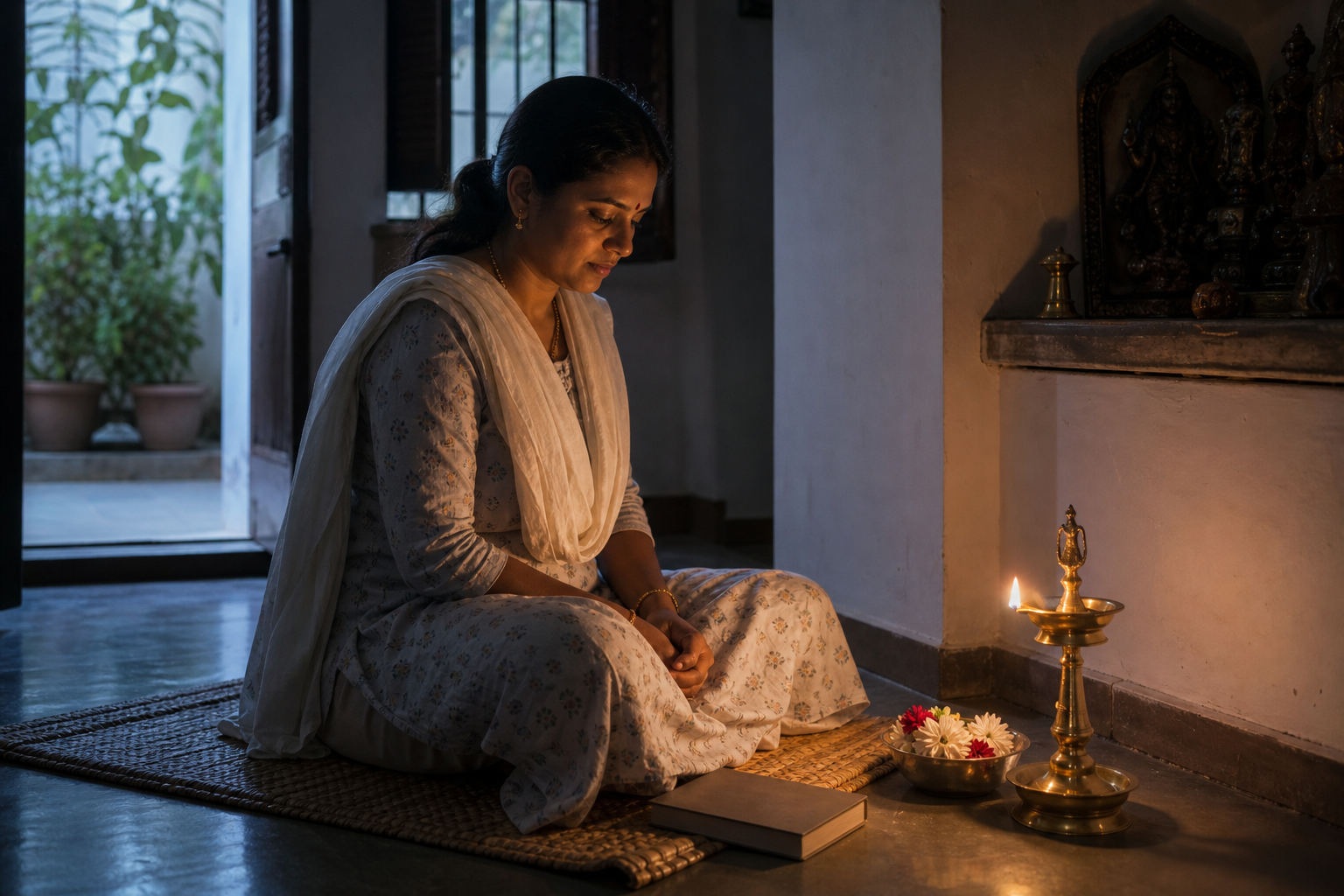
The distinctive rhythm of Dhanurmasam is predawn worship. The quiet before sunrise supports mantra-japa, contemplation, lamp offering, and focused remembrance of Vishnu. The value lies in returning to that rhythm steadily, not in building an impressive routine that collapses after a few mornings.
Decide your core practice before the month starts. A workable household sequence is:
- Prepare the lamp, text, and offering the previous evening so that searching for materials does not consume the predawn quiet.
- Rise before sunrise and begin with a lamp and a brief period of stillness.
- Recite Tiruppavai, Vishnu Sahasranama, or the mantra-japa followed in your family or sampradaya.
- Offer simple naivedya according to your household tradition.
- Carry the worship into the day through one deliberate act of dana, seva, patience, or restraint.
If your family has an inherited procedure, follow it. If it does not, ask a temple acharya or knowledgeable elder for the smallest complete form appropriate to your tradition. Internet fragments can produce a crowded ritual without giving you a coherent practice.
On a difficult morning, keep the core rather than abandoning the day. Light the lamp, offer a short recitation, and remember the Divine with attention. A modest practice maintained sincerely is closer to the purpose of the month than occasional excess followed by exhaustion.
Predawn worship also begins the night before. Move unnecessary late-evening activity out of the month where you can. Lay out what you need, settle on one text, and decide who in the household is responsible for each task. The friction usually comes from preparation, not from the worship itself.
Let Tiruppavai, kolam, temple worship, and seva do different work
Keep Tiruppavai at the Vaishnava centre
Tiruppavai, traditionally attributed to Andal, gives Margazhi its most recognisable Vaishnava voice. Recitation is not merely a seasonal cultural performance. It is a disciplined movement toward Vishnu through remembrance, surrender, shared devotion, and the spirit of a sacred vow.
If the language is unfamiliar, do not let imperfect pronunciation become an excuse to remain outside the practice. Learn from a temple, teacher, or reliable family tradition. Read the meaning alongside the recitation so that sound and understanding grow together. Choose a stable method for the month instead of changing versions every few days.
Vishnu Sahasranama can accompany this discipline, as can mantra-japa and sacred-text study. Treat them as supports for attention, not as items to accumulate. The useful question is not, “How many observances can I fit in?” It is, “Which practice helps me return to Bhagavan every dawn?”
Use kolam and bhajan to bring devotion beyond the puja room
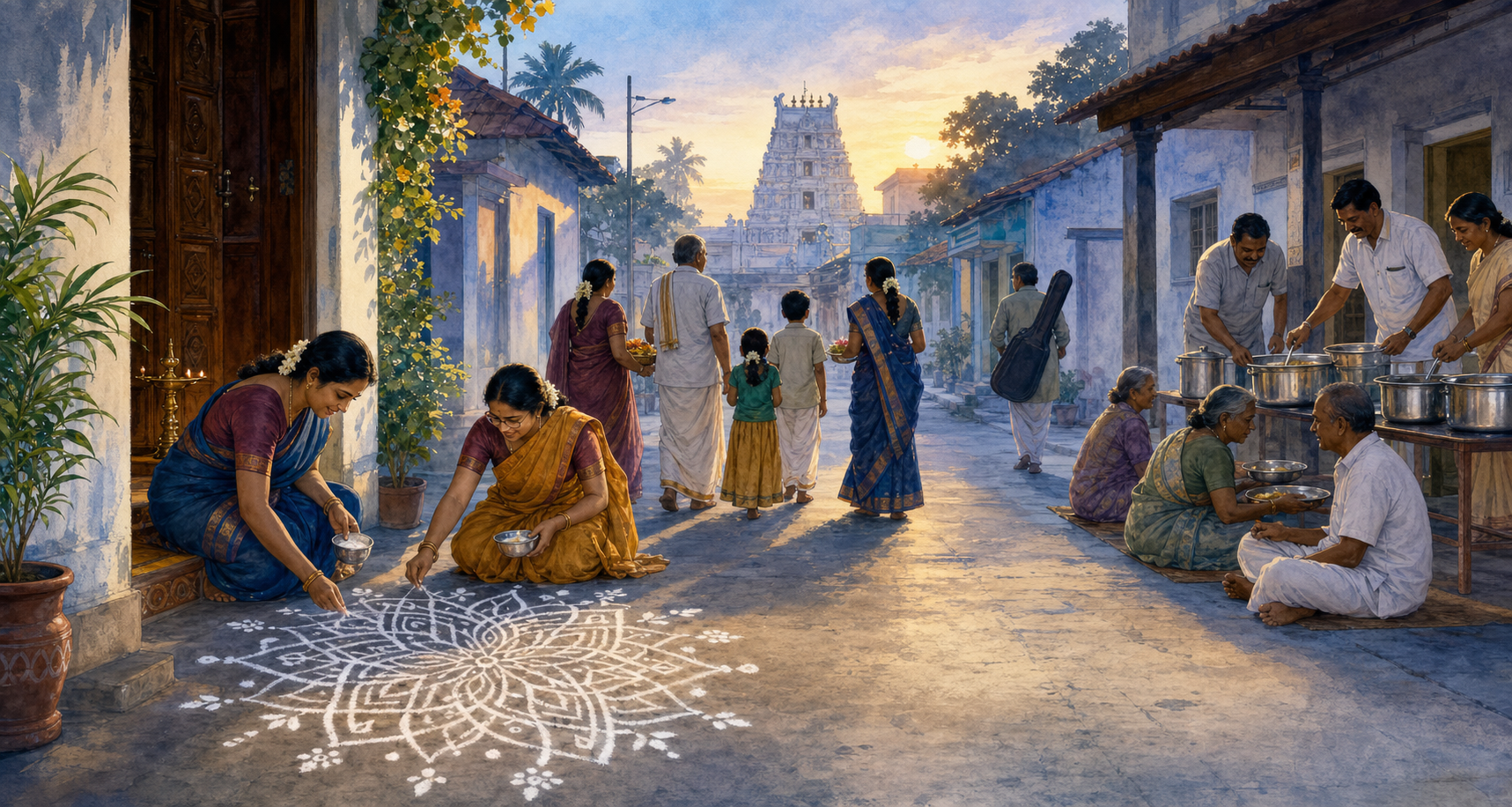
Across Tamil Nadu, Margazhi becomes visible at the household threshold through kolam and audible in streets and temples through bhajans. These practices turn private discipline into a shared sacred atmosphere. A kolam need not be elaborate to serve that purpose. A simple, carefully made design can mark the morning as intentional and welcome the household into its devotional rhythm.
Collective chanting adds something solitary worship cannot: you lend your voice to a community, and the community helps carry your attention when personal resolve is weak. If a nearby temple offers suprabhata seva, special aradhana, or Margazhi bhajans, choose the gatherings your household can attend without making the remaining days unmanageable.
Turn dana and seva into named commitments
“Do more seva” is too vague to guide action. Before Dhanurmasam begins, name the recipient, need, or institution you intend to support. Decide whether your household will contribute food, time, money, temple assistance, or another form of service appropriate to its circumstances. Complete the commitment during the sacred period rather than leaving it as a good intention.
This is where predawn worship meets the rest of the day. The lamp trains attention; dana loosens possessiveness; seva tests whether devotion changes conduct. Keeping those functions distinct prevents the month from becoming either private sentiment or public display.
Respect Margazhi’s breadth without flattening its traditions
Dhanurmasam has a pronounced place in Vaishnava sampradayas, but Margazhi is not exhausted by one form of observance. Pavai Nombu and Katyayani Vratam are associated with vows of purity and spiritual aspiration during this season. Arudra Darshan honours Lord Nataraja and brings Shaiva worship, sacred dance, and contemplation of Shiva’s cosmic movement into the same Tamil month.
These observances should not be blended as though their names, deities, vows, and theological meanings were interchangeable. If your family keeps Pavai Nombu, Katyayani Vratam, or Arudra Darshan, follow the procedure received through that tradition. If you are approaching one for the first time, learn its requirements before adopting it. Curiosity is welcome; improvised ritual equivalence is not.
A mixed-sampradaya household can preserve both unity and distinction. Establish one shared dawn practice, such as lighting the lamp or joining a bhajan, while allowing family members to keep the deity-specific recitation or vrata they have inherited. Shared reverence does not require erasing the forms through which that reverence is expressed.
The month also carries values recognisable across the Dharmic family: disciplined self-cultivation, remembrance, community singing, compassion, and service. Hindus, Buddhists, Jains, and Sikhs articulate these through distinct teachings and practices. The honest common ground lies in ethical discipline and inner refinement, not in claiming that the paths are identical.
Adapt the observance without losing its centre
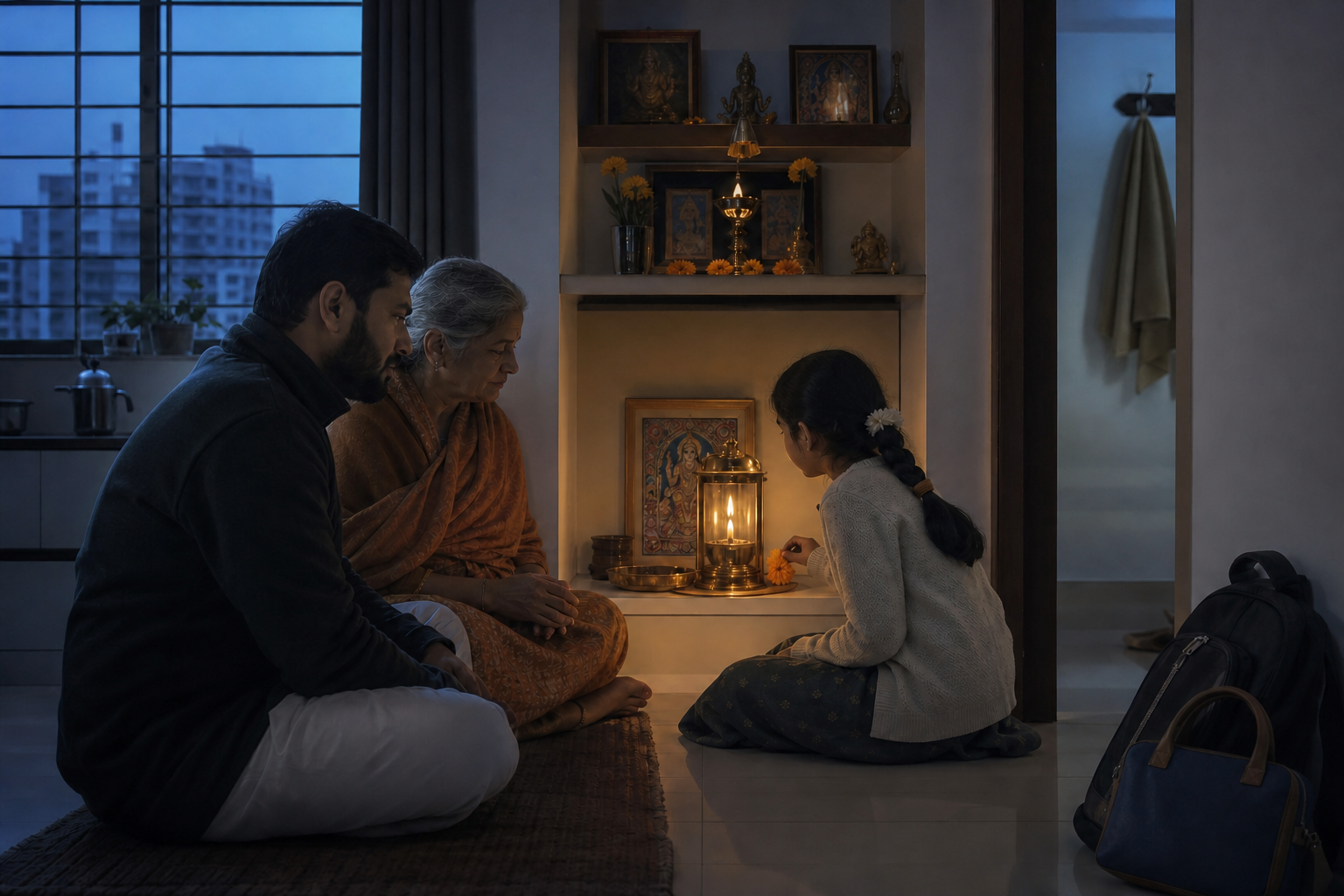
A modern schedule may force you to simplify, but simplification should protect the central action: a consistent turn toward the Divine in the quiet before sunrise. Use the structure that fits your household:
- If you work early: prepare everything the night before and keep a shorter weekday recitation. Reserve additional study or temple attendance for days when it can be done attentively.
- If you have children: give them visible, bounded responsibilities such as helping prepare the lamp area, making a simple kolam, carrying flowers, or joining a short portion of the recitation. Participation forms memory more reliably than forcing them through an adult-length routine.
- If you live far from a temple: keep the home practice steady and identify community bhajans or temple visits in advance. Do not wait until the month is underway to discover that travel requires planning.
- If you are new to Tiruppavai: pair recitation with meaning and seek guidance on pronunciation. Depth grows through repetition; constant switching slows it.
- If predawn worship is genuinely impossible: retain a consistent quiet practice at the most workable time while recognising that dawn remains the season’s traditional centre. Do not let an imperfect schedule become a reason to do nothing.
Keep food observance equally clear. A sattvic diet and simple naivedya can support the month’s inwardness, but the exact rules should come from your family practice or vrata, not from competitive austerity. Decide the rule beforehand, apply it without judging another household, and let restraint make the mind more available for worship.
Watch for four common errors: copying dates from the wrong locality, attempting too many practices at once, reducing Margazhi to decoration and performance, or speaking of all its traditions as though they were the same. Each error moves attention away from disciplined bhakti. Calendar accuracy, a restrained routine, and sampradaya-specific guidance correct them.
Key takeaways
- Dhanurmasam runs from Dhanur Sankramanam to Makara Sankranti; verify the dates for your year and locality.
- For 2025-2026, the observance ran from 16 December 2025 through 14 January 2026.
- Predawn worship is the practical centre: light a lamp, recite, offer simple naivedya, and begin the day in remembrance.
- Tiruppavai gives the season its characteristic Vaishnava focus, while Vishnu Sahasranama, mantra-japa, temple worship, dana, and seva can support it.
- Kolam and bhajan extend household devotion into community life.
- Pavai Nombu, Katyayani Vratam, and Arudra Darshan belong within Margazhi’s wider sacred landscape, but they should be followed according to their own traditions.
- A short practice kept steadily is better than an overloaded plan that cannot survive the month.
Before the next Dhanur Sankramanam, write one sentence that your household can actually follow: “During Dhanurmasam, before sunrise, we will…” Complete it with one recitation, one simple offering, and one concrete commitment to dana or seva. Confirm the dates locally, prepare the night before, and let the discipline begin quietly.
References
