
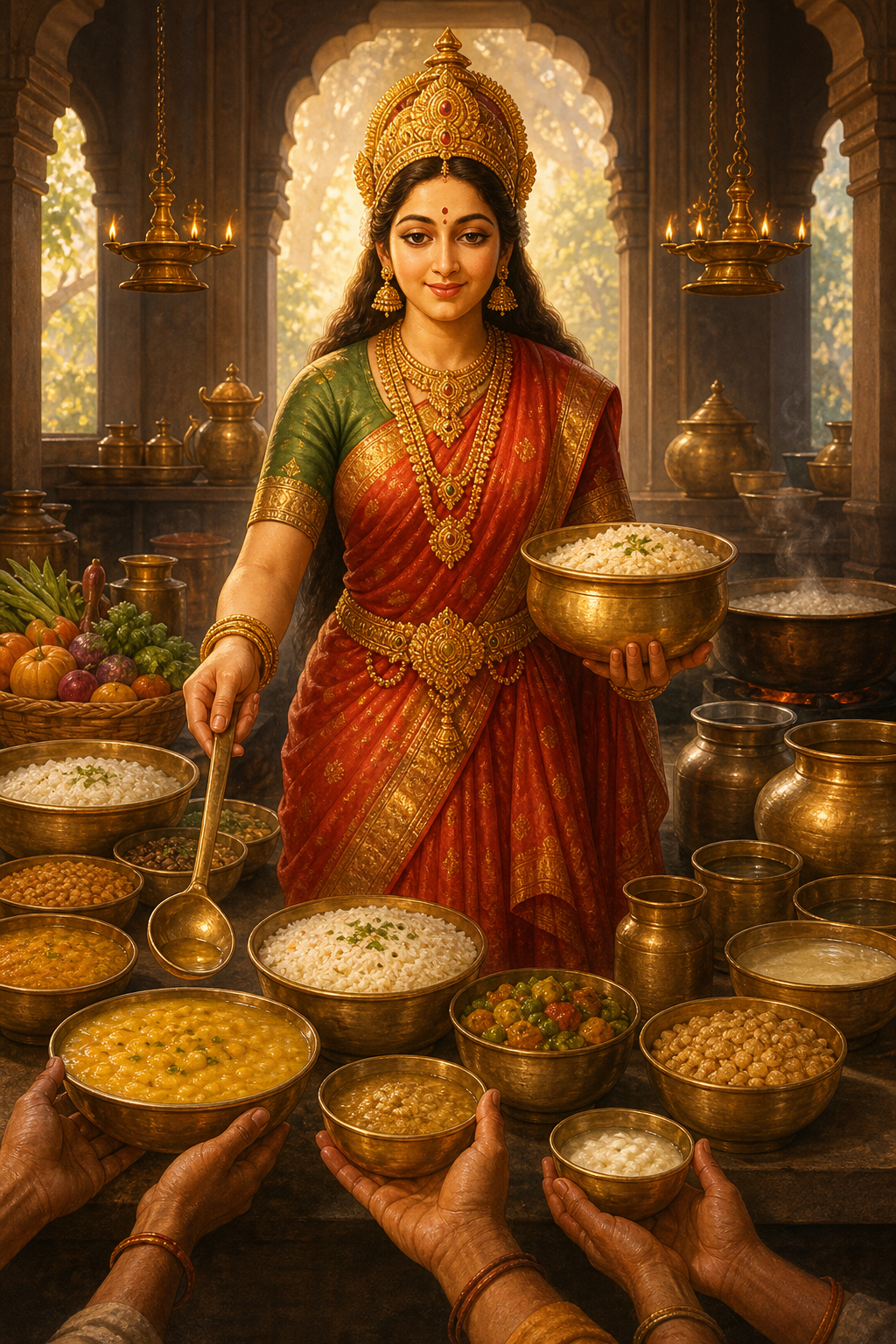
You can perform a careful puja and still miss the hardest part of Annapurna worship. The test comes after the lamp is extinguished: how you buy food, how much you cook, who is served, whether the cook is respected, and what happens to the last handful of rice.
If you want this devotion to shape your life, begin with one ordinary meal. Receive it with gratitude, prepare it cleanly, offer it before consuming it, serve it with dignity, and refuse to treat the remainder as disposable. Annapurna worship then becomes more than an annual observance. It becomes a practical discipline for the kitchen, the dining table, and the community.
The pot and ladle belong together
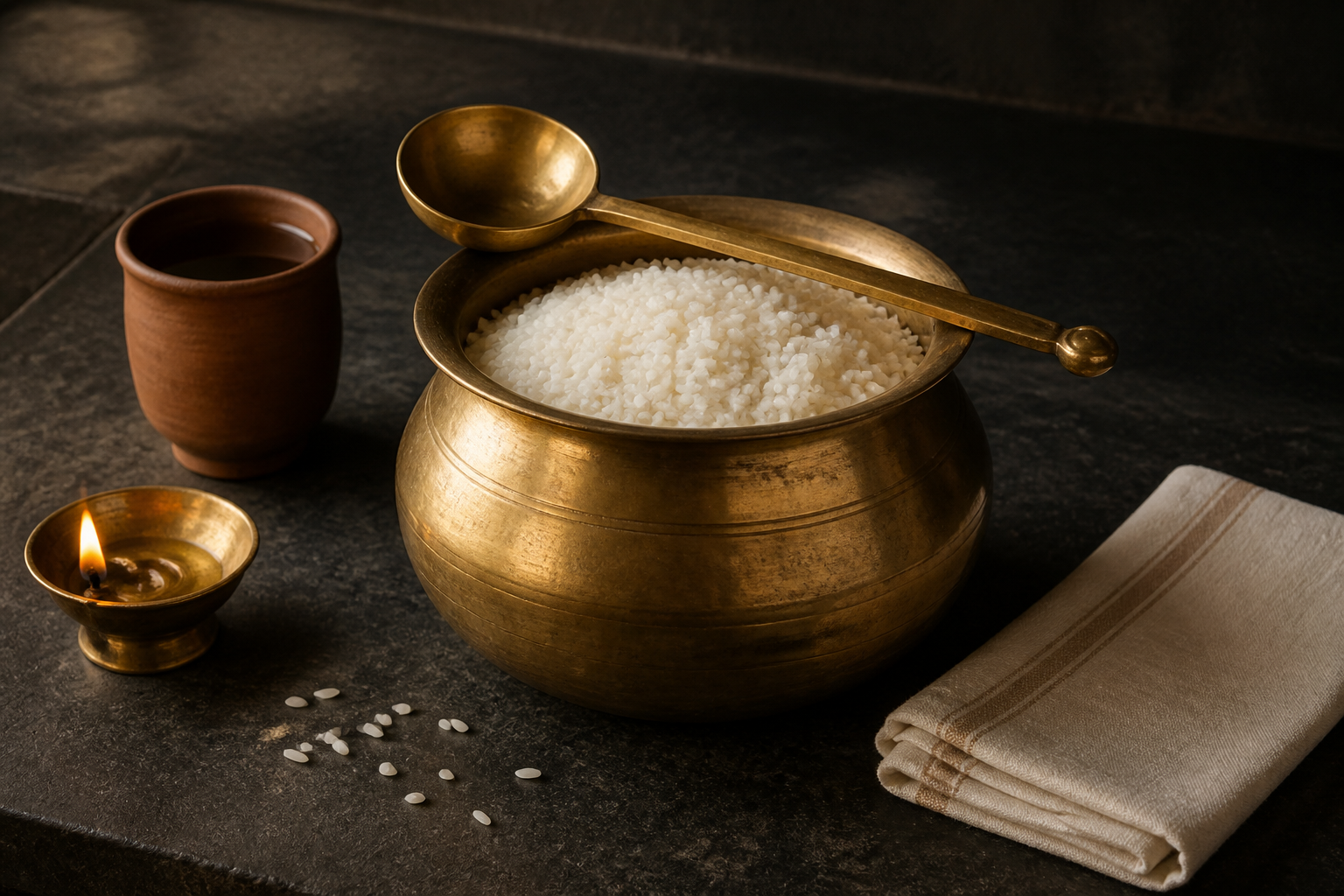
The name Annapurna brings together anna, food, and purna, fullness. Yet fullness is not the same as accumulation. Annapurna is revered as a compassionate manifestation of Parvati, and her familiar symbols place possession beside responsibility: the food-filled pot signifies abundance, while the ladle signifies distribution.
That pairing corrects two common mistakes. The first is to treat prosperity as a private stockpile. A full vessel that never reaches another person’s plate does not express the whole symbolism. The second is to romanticize renunciation while overlooking the bodily dependence that makes study, prayer, work, and service possible. In Annapurna’s theological frame, even ascetic wisdom depends upon Shakti for sustenance. Feeding the body is not automatically a distraction from spiritual life; it can be one of the conditions that supports it.
This does not mean that every desire for food is sacred or that abundance means endless consumption. Annapurna’s pot represents sufficiency, while her ladle directs that sufficiency toward need. Contentment and generosity therefore restrain each other in a healthy way: contentment prevents appetite from becoming greed, and generosity prevents contentment from becoming indifference to another person’s hunger.
A useful way to examine a meal is to follow the grain through its whole journey. How was it obtained? Was it handled with care? Was the portion sensible? Did everyone who depended on the kitchen receive food? Was anyone humiliated while being served? Was the remainder preserved or wasted? Worship becomes ethical when these questions matter as much as the visible ritual.
Make one daily meal an act of worship
A six-step household practice
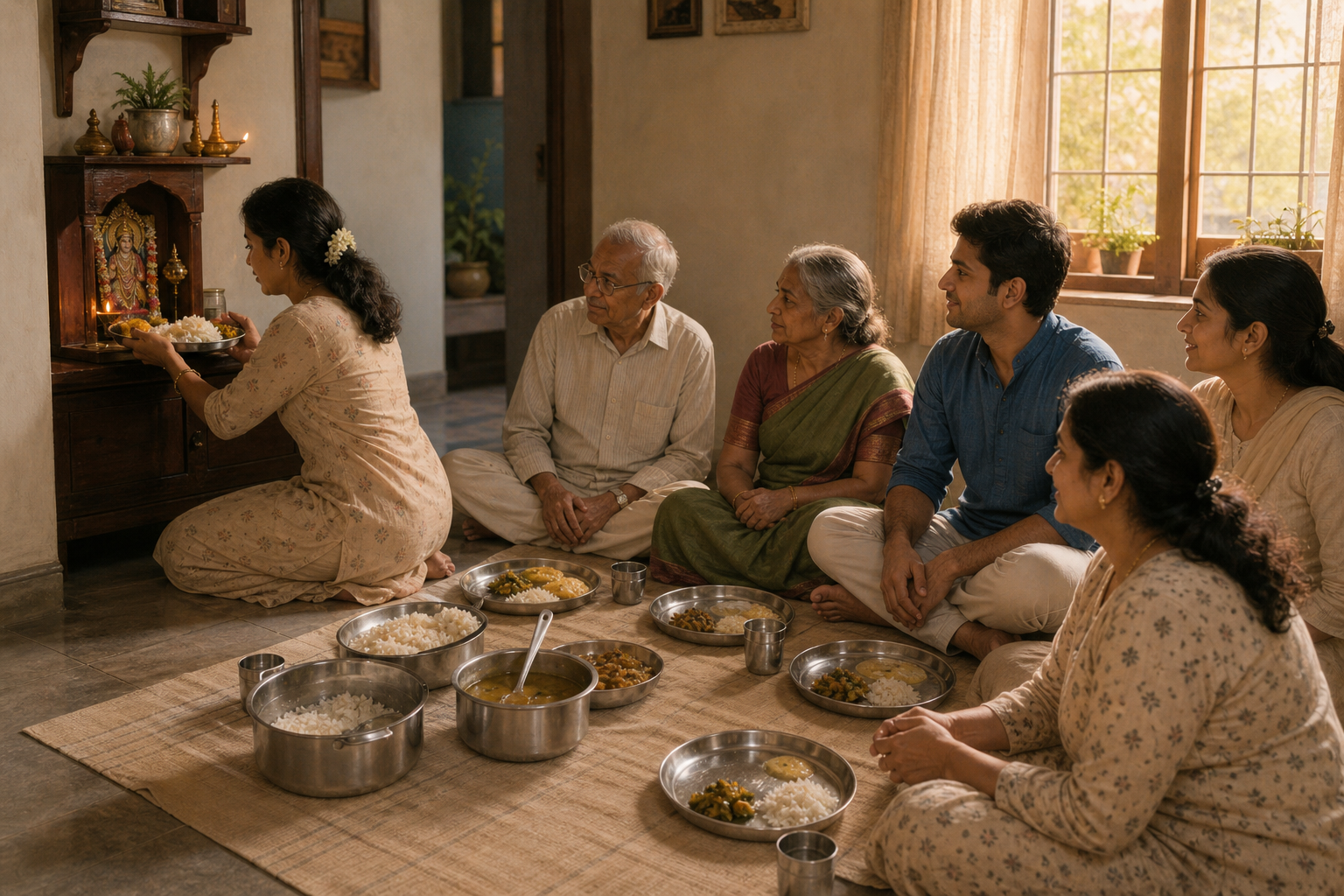
You do not need an elaborate ceremony at every meal. Choose one meal each day, or the meal your household most often shares, and give it a stable devotional form. Consistency will teach you more than occasional complexity.
- Look before you cook. Check what is already available and what must be used first. Count the people who will eat and consider their actual appetites. This small pause prevents devotion from ending in an unnecessarily full waste bin.
- Clean the place of preparation. Wash your hands, clear the working surface, and use clean utensils. The kitchen is treated as a sacred space in Annapurna observance because reverence must appear in the handling of food, not only in words spoken over it.
- Prepare with a deliberate intention. Decide that this meal is for nourishment, hospitality, and service. If irritation arises during cooking, notice it before it is passed to the people who depend on the meal. Sacred cooking is careful work, not a performance of cheerfulness.
- Offer before taking. Set aside a small, freshly prepared portion as naivedya before tasting or serving yourself. You may recite Hrīm Annapurnāyai Namah – ह्रीं अन्नपूर्णायै नमः॥ – with steady attention. The point is not to make the food magically exempt from ordinary responsibility, but to receive it as something entrusted to you rather than something owed to you.
- Serve with attention to need. Ask how much each person wants, begin with a modest portion, and make more available. If you are serving family members, guests, or others who rely on the kitchen, make sure their meal is ready before settling into your own. Feeding others first should produce care, not theatrical self-denial.
- Close the meal properly. Identify what remains, store usable food according to safe household practice, and decide when it will be eaten. Clean the cooking and eating space. A meal is not complete while edible food has been abandoned without a plan.
Do not turn this routine into purity anxiety. A spotless worktop does not compensate for contempt toward the person washing it. A perfect offering does not excuse an oversized portion scraped into the bin. Ritual cleanliness, emotional restraint, gratitude, and practical care belong to the same act.
A fuller observance on Annapurna Jayanti
Annapurna Jayanti is observed on Margashirsha Purnima. Because the beginning and end of a tithi vary by location, consult a reliable local Panchang before fixing the time for your sankalpa or puja. This is especially important when a civil calendar date covers only part of the relevant tithi.
A straightforward home observance can follow this order:
- Clean the kitchen, hearth, or principal cooking area before beginning.
- Set a clear sankalpa centered on gratitude, restraint, and feeding others.
- Light a lamp safely near the worship space or hearth.
- Prepare a simple sattvic meal. Rice, dal, vegetables, and kheer are among the customary examples of food that may be prepared as naivedya.
- Offer the freshly cooked food to Annapurna before the household eats.
- Recite ह्रीं अन्नपूर्णायै नमः॥. If you undertake the traditional practice of 108 repetitions, keep a calm pace and return your attention to the meaning whenever the count becomes mechanical.
- Complete the observance through annadanam or by making a concrete commitment to support it.
Annapurna Vrat is commonly expressed through sattvic discipline, simple food, mantra, naivedya, and service. Do not assume that vrat must mean a severe or medically risky food restriction. Follow your family or sampradaya practice where one exists, and adapt dietary restraint to genuine health needs. The purpose is disciplined devotion, not harm to the body that must carry out the service.
Let food ethics govern the whole kitchen
Improve one source of food at a time
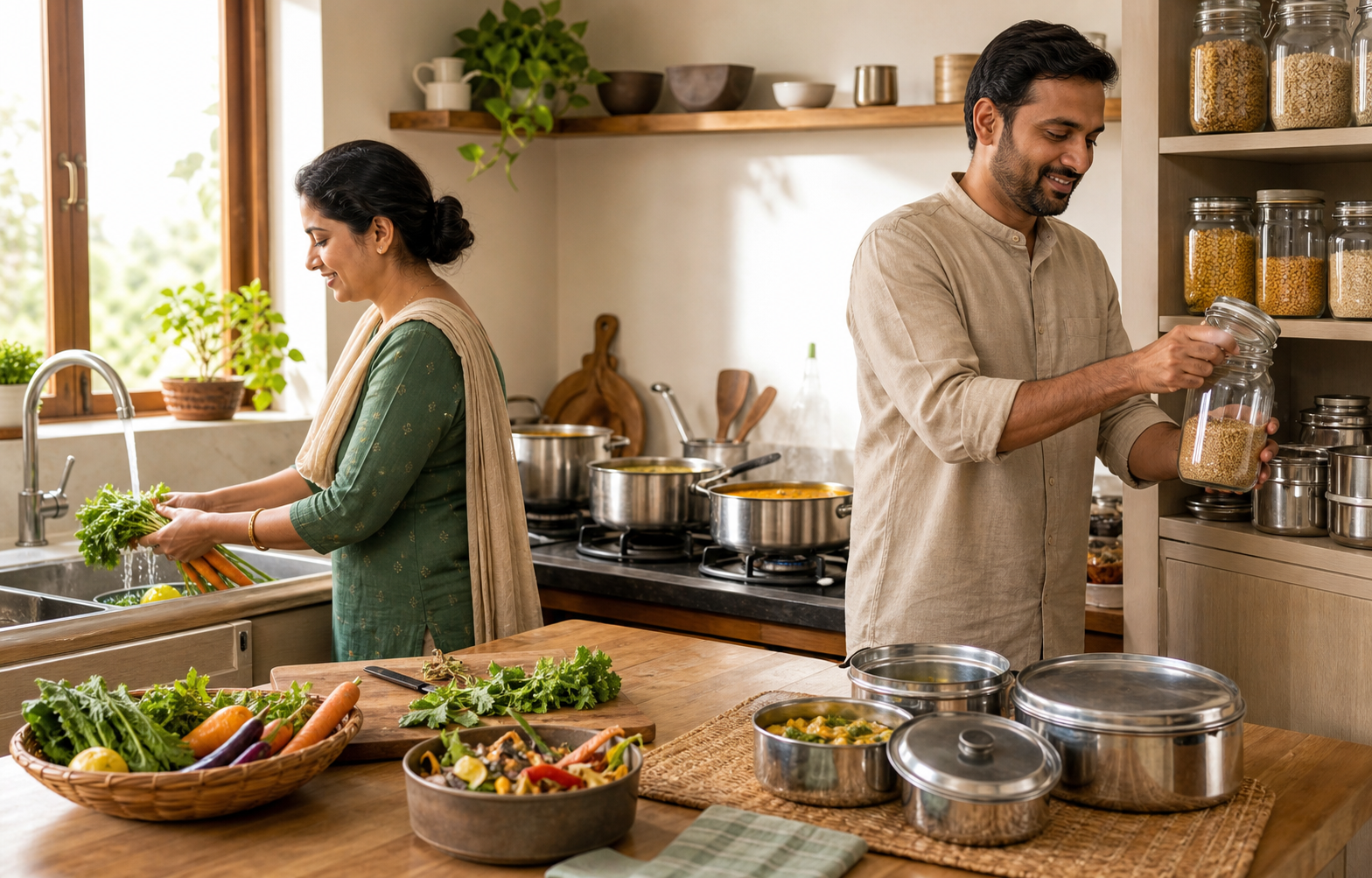
Ethical sourcing can feel too large when you try to solve every question in a single shopping trip. Begin with one staple or one regular purchase. Ask where it comes from, whether you can buy a suitable seasonal option, how much packaging accompanies it, and whether you repeatedly purchase more than the household uses. Once that decision becomes stable, move to the next item.
This is a more honest expression of reverence than making sweeping claims about a perfectly pure kitchen. Most households face constraints of price, availability, time, and dietary need. Dharma works within those facts by improving the next available choice, not by pretending the constraints do not exist.
Measure abundance by sufficiency, not excess
Food waste often begins before anyone sits down. It begins when hospitality is confused with producing more than people can reasonably eat, or when a large first serving leaves a guest embarrassed to refuse it. Offer a modest portion and a welcome second serving. This preserves generosity while allowing the eater to judge hunger.
Before preparing something new, inspect what is already cooked. Give leftovers a specific next use rather than the vague status of “for later.” If food remains safe and suitable, place it where it will be seen and name the meal at which it will be used. If scraps cannot be eaten, use an appropriate composting route where one is genuinely available. Mindful consumption, reduced waste, and ecological responsibility are natural extensions of Annapurna’s symbolism.
Prasad deserves particular honesty. Calling food sacred does not prevent spoilage, and devotional intention does not make unsafe handling safe. Prepare a reasonable amount, distribute it promptly, and handle the remainder responsibly. Reverence should increase care rather than suspend judgment.
Honor the person whose labor makes the meal possible
If the kitchen is a sacred place, its labor cannot remain invisible. Notice who plans the meals, checks supplies, cooks, serves, stores leftovers, and cleans. Thanking that person is a beginning; sharing the recurring work is stronger. Assign cleanup rather than waiting for the same person to notice it, and teach children that clearing a plate and storing food are part of the meal.
There is also a necessary distinction between voluntary service and enforced self-erasure. A cook may lovingly choose to serve others first. That does not justify making the cook eat cold scraps, denying them rest, or treating their labor as naturally owed. Annapurna’s ladle represents responsible distribution, and that responsibility includes the dignity of the person holding it.
Make annadanam generous, dignified, and dependable
Give a meal, not a disposal problem
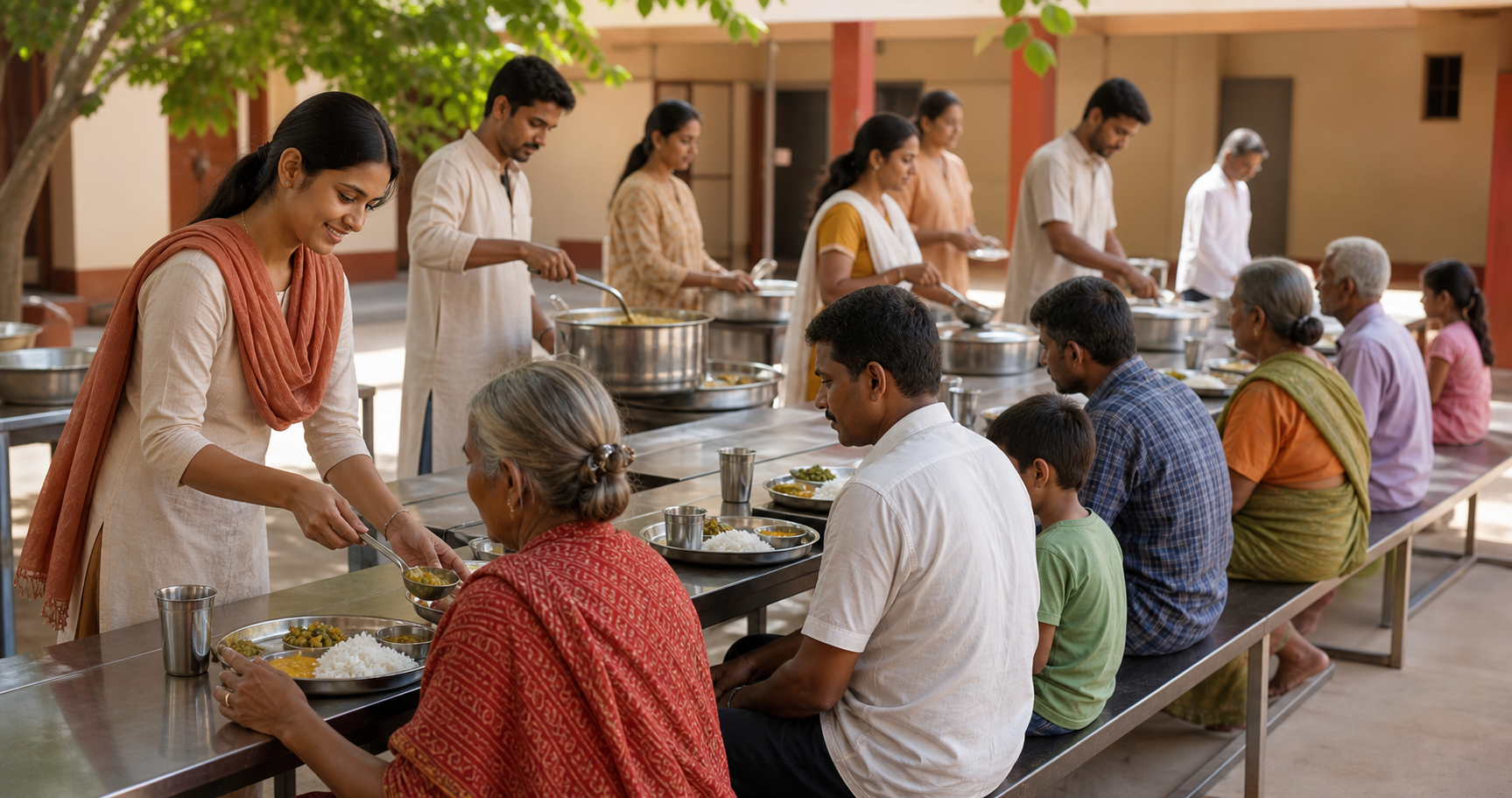
Annadanam is central to Annapurna worship because it turns gratitude outward. Yet the mere transfer of food is not enough. Food that you would be ashamed to offer an honored guest should not be passed to someone in need merely because refusing waste feels virtuous.
Plan the act of giving before you begin cooking:
- Choose the temple, community kitchen, household, or local service through which the food will reach people.
- Confirm the quantity needed instead of guessing and creating a second surplus.
- Prepare food that can be served fresh and handled safely.
- Ask about dietary requirements when the setting allows, and describe ingredients honestly.
- Serve without making recipients perform gratitude or surrender privacy for a photograph.
- Plan transport, serving utensils, drinking water, and cleanup as parts of the donation rather than afterthoughts.
- If possible, turn a festival donation into a modest recurring commitment that the receiving community can rely on.
The giver’s mood matters as well. Annadanam is not a stage on which the donor becomes the central figure. Speak respectfully, allow people to choose a suitable portion, and make second servings available where the supply permits. Dignity is not an ornamental addition to nourishment; it determines whether the act treats another person as a participant in sacred hospitality or as a prop.
Recognize the shared Dharmic ethic without flattening it
Hindu annadanam is not identical to every other Dharmic practice of giving. Each tradition has its own teachings, communities, disciplines, and theological language. Still, Sikh langar, Buddhist dāna, and the Jain commitments to ahiṁsa and aparigraha converge around a recognizable ethical demand: nourishment must not be separated from compassion, restraint, and service.
You can honor that convergence in a shared community meal without claiming that all traditions are interchangeable. Consult participants about dietary commitments, label ingredients, keep service free from status distinctions, and give everyone a role in preparation or cleanup where appropriate. The common ground is strongest when it produces cooperation while leaving real differences intact.
This shared ethic also offers a clear answer to sectarian pride. A tradition is not strengthened by praising generosity while neglecting hungry neighbors or demeaning the people who cook. It is strengthened when theology becomes dependable conduct: a clean kitchen, a fair portion, an open place at the table, and food offered without humiliation.
Key takeaways
- Annapurna’s pot signifies abundance, while her ladle makes distribution part of that abundance.
- Daily worship can begin with one meal: inspect supplies, cook a sensible quantity, make naivedya, serve attentively, and plan for every usable remainder.
- The mantra ह्रीं अन्नपूर्णायै नमः॥ may be recited during worship; 108 attentive repetitions are a traditional Annapurna Jayanti practice.
- Annapurna Jayanti falls on Margashirsha Purnima, but local tithi timings should be checked in a reliable Panchang.
- Annadanam should provide fresh, suitable food with privacy, choice, and dignity rather than functioning as a way to discard surplus.
- Sacred food ethics includes the treatment of the cook, the use of leftovers, responsible purchasing, and the willingness to share.
At your next meal, choose three actions: cook for the people actually eating, offer the first portion with gratitude, and decide the destination of the remainder before you sit down. Then put one act of annadanam on your calendar. That is enough to begin moving Annapurna worship from the altar into the life of the household.
References
