
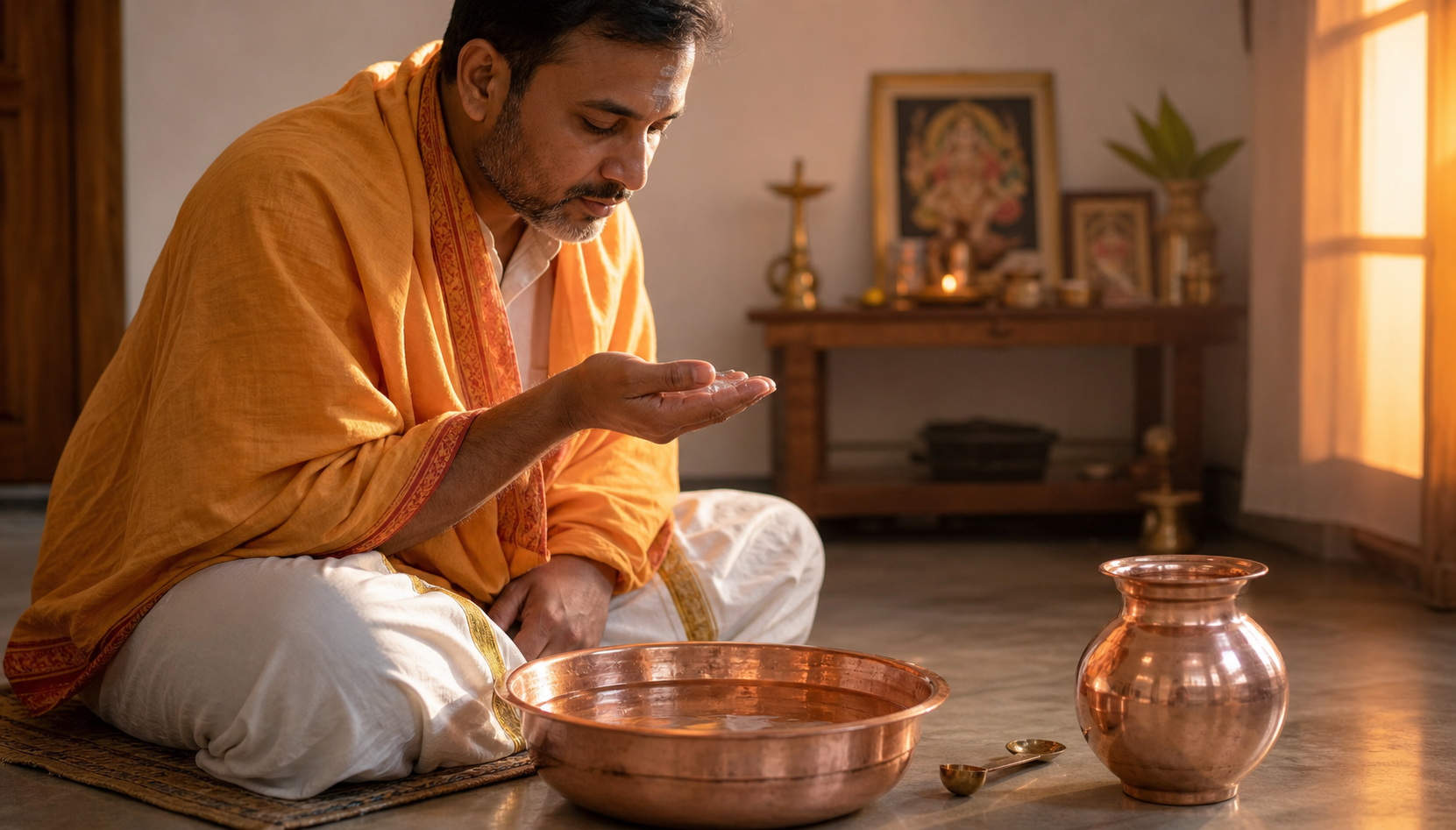
You are ready to begin puja, japa, or study, but the instructions in front of you do not agree. One sequence invokes Keśava, Nārāyaṇa, and Mādhava. Another uses Achyuta, Ananta, and Govinda. The difference may reflect lineage rather than error.
The safest way to practise Achamanam is to preserve its common core while following one received tradition for its exact mantras and gestures. That approach gives you something more valuable than a supposedly universal script: a rite you can perform with confidence, attention, and respect.
Key takeaways
- Achamanam prepares you for a sacred act; it is neither ordinary drinking nor a substitute for physical cleanliness.
- The shared core is clean water, a small quantity placed in the right palm, mindful sipping, and divine remembrance. Three sips are common, but the accompanying names and later gestures vary.
- Follow the complete method of your family, guru, temple, or sampradāya instead of combining fragments from different traditions.
- Apa means water generally. Ācamanīya, often rendered as Achamanyam, means water designated for Achamanam.
- The practical test is whether the rite makes your next action steadier, your speech more deliberate, and your intention clearer.
Begin with your lineage, not a universal script
Achamanam, or ācamana, names the rite of ritually sipping water. Achamanyam does not name a different substance. Apa is the general word for water, while ācamaniya or Achamanyam is water prepared or set aside for this particular ritual use. The change is one of purpose and designation, not chemical composition.
This distinction matters in practice. If an instruction asks for Achamanyam, you do not need to search for a special variety of water. You need clean water that you can respectfully designate for the rite. Because you will sip it, use only water you would ordinarily consider safe to drink. A sacred designation does not make contaminated water potable.
The rite commonly precedes Sandhyā-vandanam, worship, mantra, japa, homa, daily devotion, and sacred study. Across those settings, its stable function is to mark a threshold. You stop carrying the previous activity into the sacred one. Water, mantra, and measured movement gather your attention before you proceed.
The details are not identical in every Hindu tradition. Vaishnava, Shaiva, and Smārta forms retain their own sequences. One lineage may use Keśava, Nārāyaṇa, and Mādhava; another may use Achyuta, Ananta, and Govinda. Some forms continue with mantras and touches to specified parts of the body. A difference in divine names or order is therefore not enough to prove that one practitioner is careless.
If your household has an inherited method, keep that sequence intact unless a competent teacher in the same tradition corrects it. When participating in a temple rite, follow the officiant’s directions. If you are learning for regular practice, obtain one complete sequence from a teacher who knows the sampradāya you intend to follow. Write it down as a single sequence until you know it; do not construct a hybrid from isolated demonstrations.
Use this practical sequence as a framework
The following framework identifies the common actions without pretending that lineage-specific details are universal. Where your received instruction differs, the received form governs.
- Prepare clean, drinkable water in a clean vessel. Wash your hands if they are not already clean.
- Set aside only the small amount required. Let the act of separating the water also mark your decision to leave distractions behind.
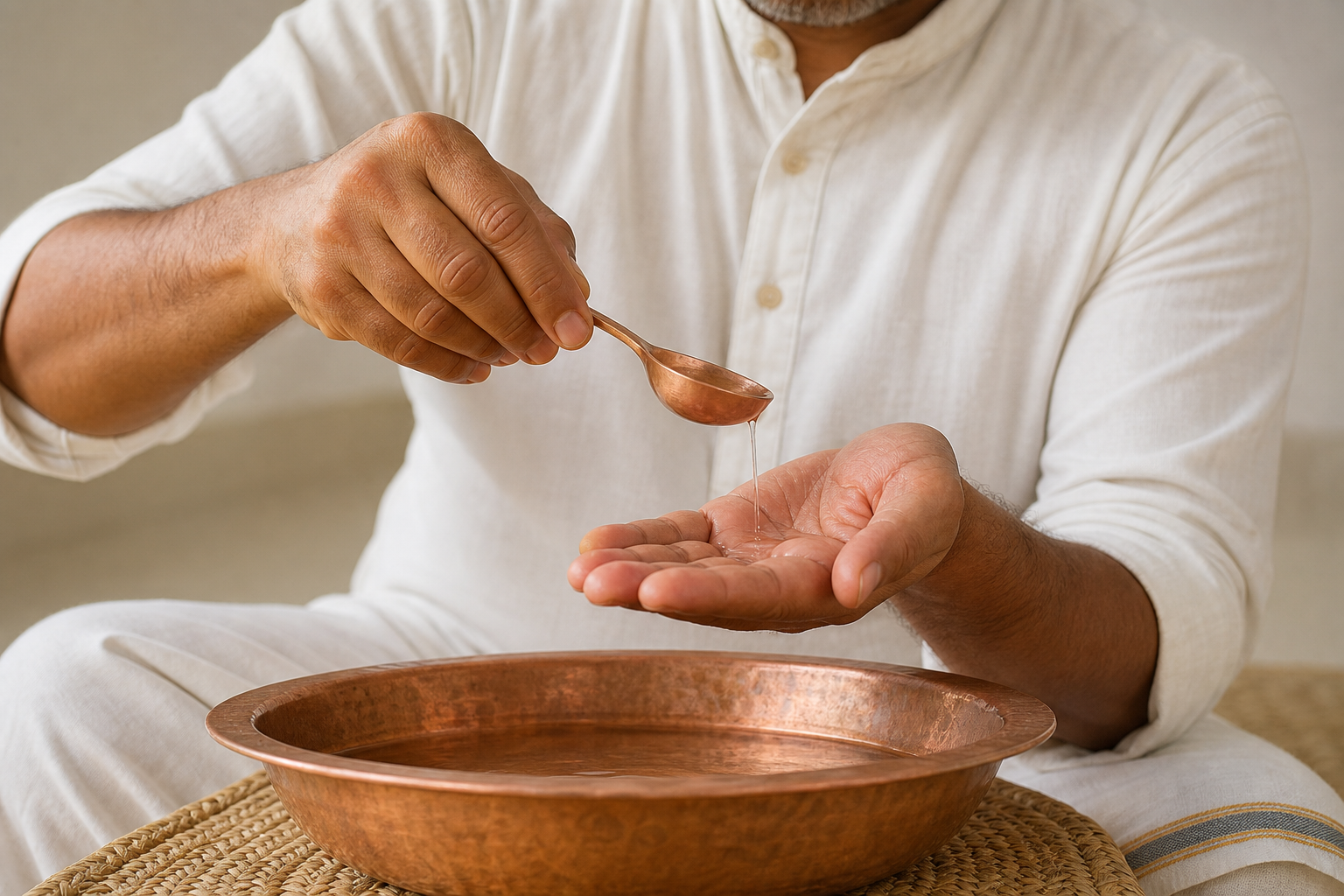
- Place a small quantity in the right palm. It should be enough for a restrained sip, not a mouthful that forces you to gulp.
- Recite the divine name prescribed by your tradition and sip with attention. Three small sips are common, but use the number and names taught in your lineage.
- If your form includes touching particular parts of the body with further mantras, complete the prescribed order. Do not invent this portion when you have not learned it.
- Begin the intended worship, japa, homa, meditation, or study without inserting casual conversation or another unrelated task between the preparation and the practice.
The quantity of water is deliberately modest. More water does not create more purity. Restraint keeps the movement clean, prevents distraction, and respects the element being used. If you find yourself managing spills, swallowing a large mouthful, or reaching repeatedly for more water, reduce the amount rather than trying to make the gesture impressive.
If you have never received a formal method, be honest about that boundary. You can still pause before meditation, study, or work, take a mindful sip of clean water, breathe quietly, and express gratitude. That is a meaningful personal preparation, but it should not be presented as a complete inherited ritual sequence. To learn formal Achamanam, ask a suitable teacher which names to use, how many sips belong to that form, and whether bodily touches follow.
Let purification reach body, speech, and mind
The outer action is brief, but its discipline is broad. Achamanam is commonly understood as preparation of kāya, vāc, and manas: body, speech, and mind. These are not three decorative ideas placed around the rite. They tell you what to regulate as you perform it.
- Body: Handle the water cleanly, use a restrained amount, and make each movement deliberately. The body should stop broadcasting haste before worship begins.
- Speech: Give the divine names your full attention. Do not let mantra become background sound beneath conversation, a notification, or a wandering argument.
- Mind: Know what you are about to do and why. If the next act is japa, bring the chosen mantra to mind. If it is study, become receptive to learning. If it is worship, set aside the demand to be entertained or rewarded.
Water carries an especially fitting symbolism here: life, clarity, and receptivity. The measured sip invites sattva, the quality of balance and lucidity, into the act that follows. Yet the symbolism becomes practical only when it changes your conduct. A mechanically perfect gesture followed immediately by careless speech leaves the ethical work unfinished.
Before moving on, make a brief three-part check. Is the body settled enough to act carefully? Is the speech ready to carry mantra truthfully? Is the mind directed toward the sacred task rather than merely trying to finish it? You do not need to manufacture a special feeling. You need enough awareness to notice when one of those three has drifted.
This is why Achamanam should cultivate humility rather than a claim of superiority. Ritual purification is a willingness to become fit for the next responsibility. It is not permission to judge everyone around you as impure.
Keep the rite precise in contemporary life
A short rite is easy to preserve, but it is also easy to empty of attention. The most common practical failures arise when you exaggerate the outer action or neglect the transition it is meant to create.
- Do not chase a single universal version when your sampradāya already provides a coherent method.
- Do not mix one tradition’s divine names with another tradition’s bodily sequence merely because both appeared in separate instructions.
- Do not use a large quantity of water as a display of devotion. Minimal, careful use preserves both dignity and ecological responsibility.
- Do not sip water that is not safe to drink. Ritual intention cannot replace ordinary care for the body.
- Do not perform Achamanam while multitasking and then assume that purification has been completed. Attention is part of the act, not an optional mood added afterward.
- Do not treat the rite as the destination. Its purpose is to improve the worship, study, mantra, or service that begins next.
You can also explain Achamanam without flattening the wider dharmic family into one practice. Buddhist water offerings can cultivate purity and generosity. Jain snātra-pūjā and daily disciplines connect cleanliness with non-violence. Sikh reverence for Amrit and seva around sarovars joins sanctity with service. These are distinct practices sharing an ethical concern with inner and outer purification, not interchangeable versions of Achamanam.
That distinction is especially useful when teaching children or speaking across traditions. Begin with the shared principle: purification should make conduct more disciplined, compassionate, and truthful. Then preserve the proper name, theology, and procedure of each tradition. Unity does not require vagueness.
The next time you prepare for a sacred act, decide which form you are following before you lift the water. Take only what is needed, recite without hurry, and begin while your intention is still clear. A small threshold, crossed consciously, can change the quality of everything that follows.


References
