

Aadi Amavasai brings together three concerns that are easily blurred: identifying the correct lunar observance, understanding the ancestral obligation it represents, and choosing a form of remembrance appropriate to a family’s tradition. Distinguishing these concerns makes the day more intelligible without reducing it either to a calendar entry or to a fixed ritual checklist.
For 2026, the supplied DharmaRenaissance guide places the Indian observance on Wednesday, August 12. Its broader account shows why timing, ritual guidance, family memory, charity, and responsible conduct around sacred waters all belong to the same observance.
Key takeaways
- Aadi Amavasai is the no-moon observance within the Tamil solar month of Aadi, with ancestral remembrance at its center.
- The DharmaRenaissance guide identifies August 12 as the principal Indian date in 2026, while advising families to verify local Tithi and sunrise calculations.
- Tharpanam commonly uses water and black sesame; rice, darbha grass, ancestor names, and Pinda offerings may also feature according to custom.
- The rite expresses Pitru Rina: the spiritual and ethical obligation owed to the generations from whom families receive identity, culture, knowledge, and material inheritance.
- When a complete rite is not possible, remembrance, restrained conduct, prayer, charity, and the recovery of family history can still preserve the day’s ethical purpose.
Why the correct date depends on Tithi, not midnight

Aadi Amavasai is determined by Amavasya Tithi occurring during the Tamil month of Aadi. A Tithi is a lunar measure based on the changing angular relationship of the Sun and Moon; it does not necessarily begin or end with a civil calendar day. That distinction explains why a Gregorian date alone cannot settle every family’s observance.
The DharmaRenaissance article reports that standard panchang references for New Delhi place Amavasya Tithi from 1:52 AM until 11:06 PM on August 12, 2026. On that basis, it treats August 12 as the primary date for India and Tamil Nadu. Those times should not be generalized to every location: the same article notes that local sunrise, regional calculations, and temple practice can produce slight variations.
This matters especially outside India. Families in the Americas, Europe, the Gulf, Southeast Asia, Australia, or New Zealand should not simply copy the Indian civil date. A location-specific panchangam can show how the Tithi aligns with sunrise in the city where the rite will actually occur. A family priest or the temple conducting the observance can then resolve questions about the appropriate period.
The practical distinction is straightforward: August 12 is the source-reported Indian date for 2026, while the governing religious measure remains the locally calculated Tithi. Calendar precision serves the rite; it does not replace its intention.
What ancestral offerings are meant to express
The central idea is Pitru remembrance, understood through Pitru Rina, or the obligation owed to forebears. The DharmaRenaissance account presents this obligation as more than repayment for material support. Each generation inherits language, family identity, ritual knowledge, values, places, and forms of belonging that it did not create by itself.
On this reading, ancestral rites oppose the idea that a life is wholly self-made. Remembering departed parents, grandparents, protectors, teachers, and less familiar members of the lineage places the living within a longer chain of receiving and transmitting. Speaking known names can make that continuity personal; remembering unnamed elders acknowledges that a family’s inheritance exceeds what its records preserve.
The no-moon setting reinforces the inward character of the day. The source associates Amavasya with restraint, contemplation, humility, prayer, and charity rather than with fear. Aadi gives that lunar observance a specifically Tamil cultural setting linked in the article with transition, sacred waters, devotion, feminine divinity, and agricultural rhythms.
This interpretation also clarifies the purpose of offerings. They are not described as a commercial exchange with the departed. They enact gratitude and continuity while directing the household toward peace, family harmony, clarity, and spiritual responsibility.
How the ritual elements form a coherent practice
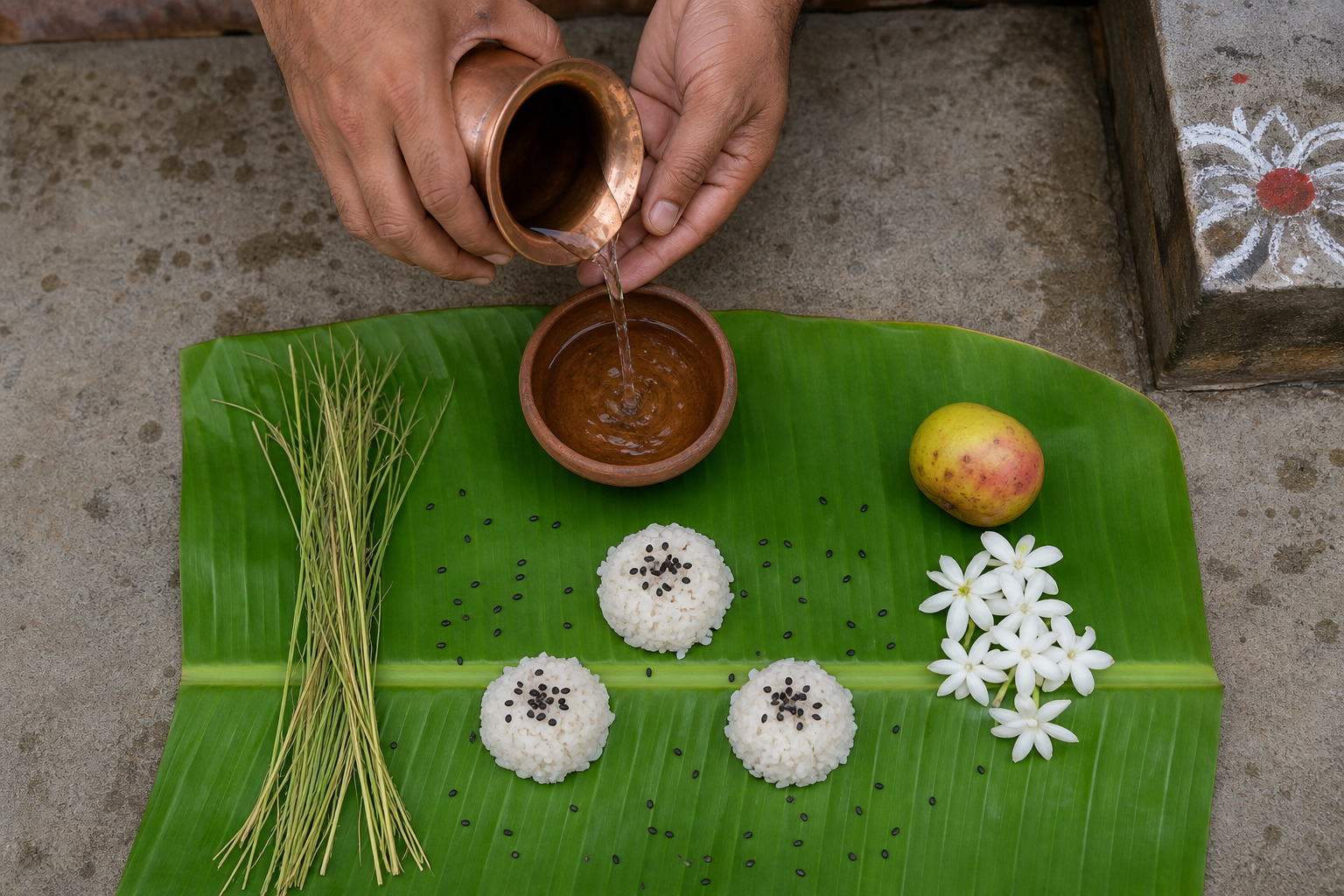
Tharpanam is the most widely recognized rite associated with Aadi Amavasai in the source. Water mixed with black sesame is offered while ancestors are remembered, often through names and lineage. Darbha grass and rice may be used, and some traditions include Pinda offerings of cooked rice in rites connected with Shraddha or Bali.
These materials should be understood as parts of a ritual grammar rather than as a universal do-it-yourself formula. The DharmaRenaissance guide repeatedly notes variation by family custom, sampradaya, region, and priestly direction. Prescribed orientation, recitations, eligibility, sequence, and the treatment of offerings may therefore differ. Guidance from the family’s customary authority is more reliable than combining isolated instructions from unrelated traditions.
Water unites many forms of the observance. Families may conduct rites at home or travel to temple tanks, riverbanks, seashores, confluences, and pilgrimage centers. The source identifies Rameswaram and other sacred water sites in Tamil Nadu as important destinations. Water functions simultaneously as an offering, a medium of purification, and a symbol of surrender and continuity.
The same symbolism creates practical obligations. The article advises visitors to anticipate crowds, queues, traffic controls, bathing arrangements, and priest availability at major sites. Cleanliness, adherence to temple rules, and avoidance of plastic offerings near water are not peripheral concerns; they are ways of ensuring that devotion does not damage the place through which it is expressed.
Meaningful observance when circumstances have changed
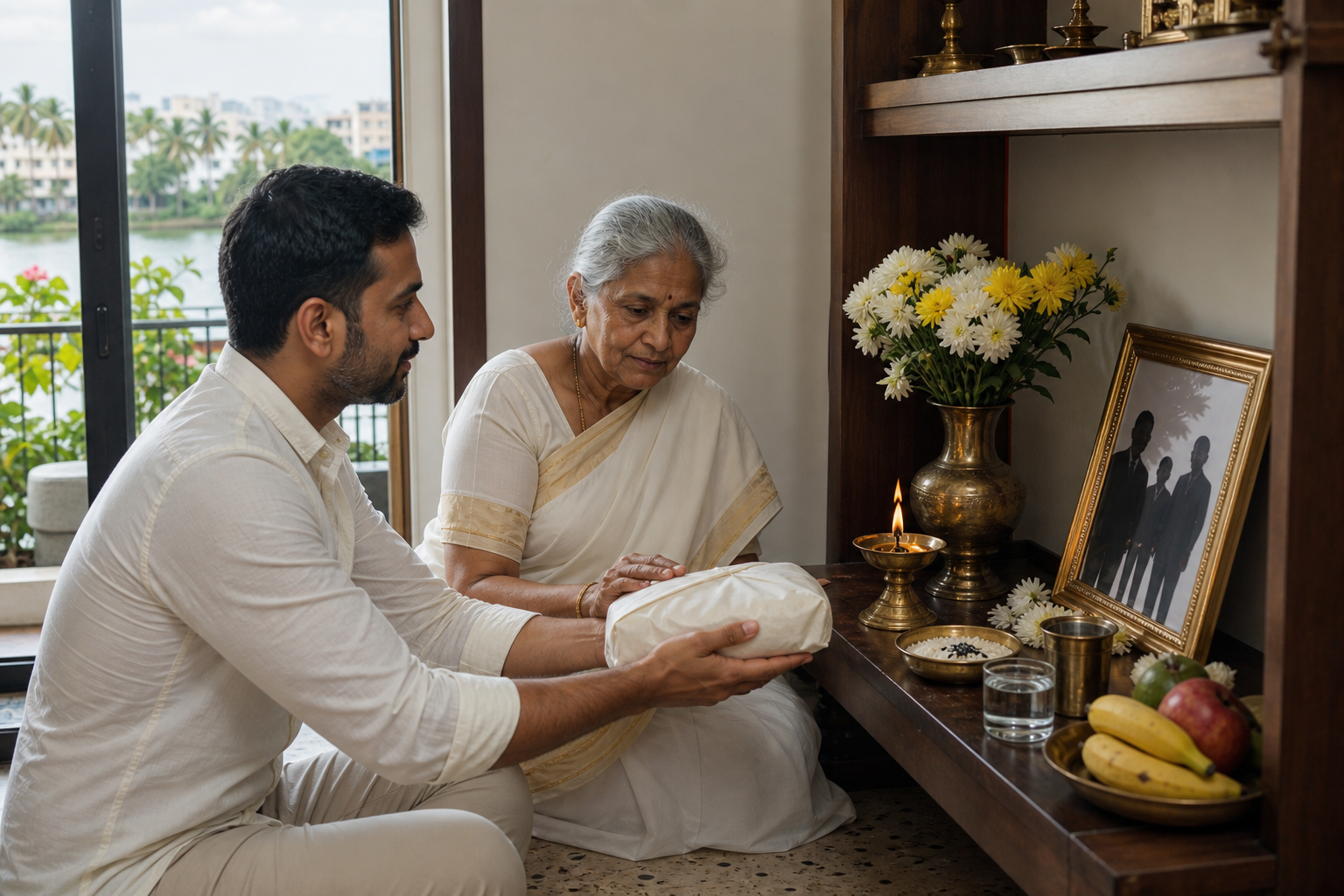
Migration and fragmented family memory can make traditional observance difficult. A household may live far from its ancestral village, lack access to a familiar priest, or know only a few names from earlier generations. The source treats Aadi Amavasai as an opportunity to respond constructively to that distance by recovering names, photographs, places of origin, stories, and inherited values.
Where a complete rite cannot be performed, the DharmaRenaissance guide suggests modest forms of participation: respectful remembrance, prayer, a temple visit, offering water with devotion, feeding people in need, reading family history, and expressing gratitude for the sacrifices of elders. These acts should not be presented as identical substitutes for lineage-specific rites. They preserve the disposition of gratitude while acknowledging practical limits.
The article also places the Tamil observance beside related regional practices. It mentions Karkidaka Vavu Bali in Kerala and names such as Hariyali Amavasya or Shravan Amavasya in northern contexts, while noting that other regions embed the day in their own calendars. The useful connection is not ritual uniformity but a shared concern with lineage, remembrance, and responsibility.
As families prepare for 2026, the most durable approach is to confirm the local Tithi early, learn the relevant family procedure from an appropriate guide, and preserve the stories that give the rite emotional substance. In that way, calendrical accuracy and living memory can support one another rather than becoming separate concerns.