
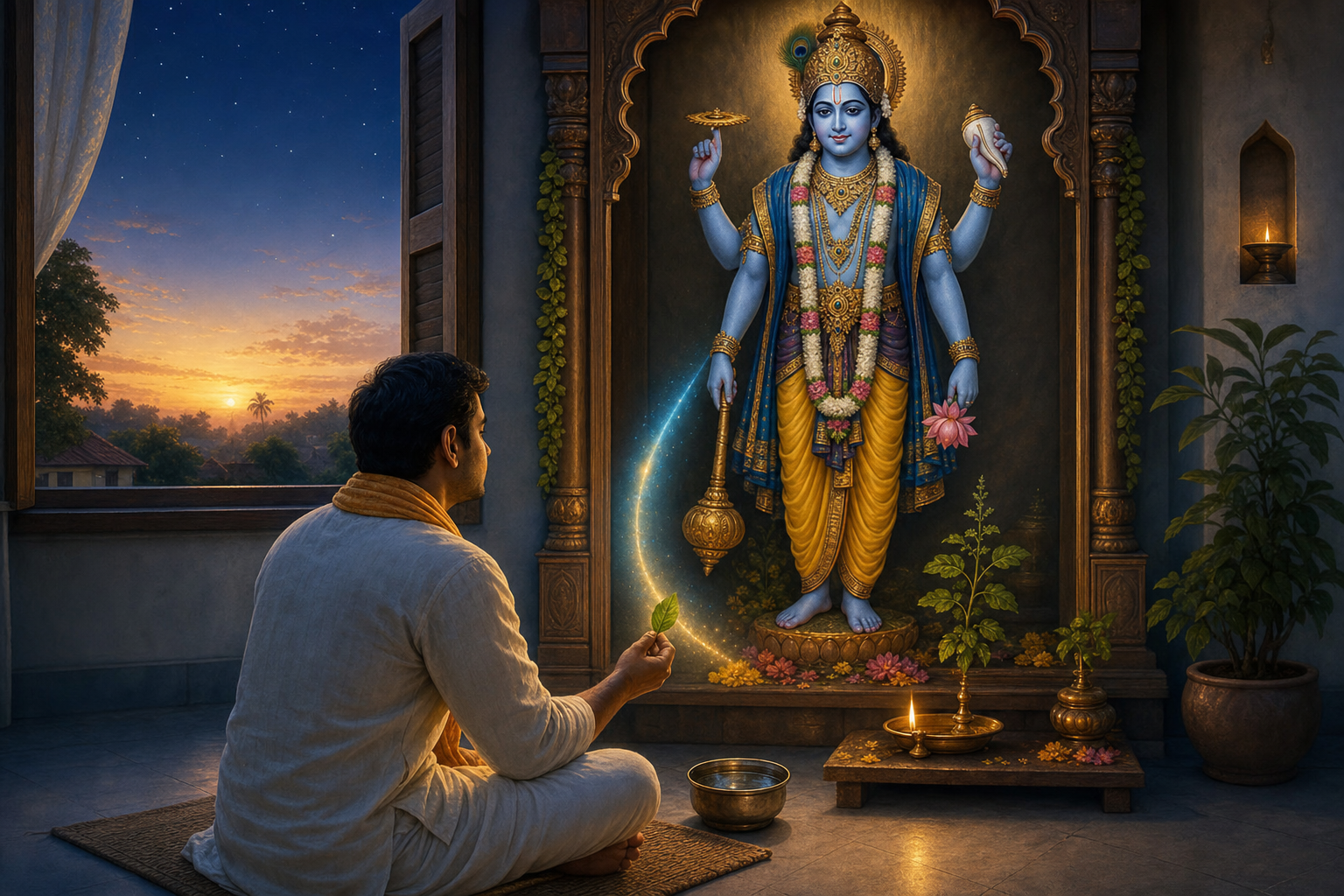
You may want to worship Vishnu sincerely yet feel caught between two doubts: Is simple remembrance enough, or must every rite be performed exactly? And if you miss an auspicious time, have you somehow missed Bhagavan’s grace?
The answer lies in keeping grace and observance in their proper relationship. Anugraha is not a wage paid for flawless ritual. Sacred observance gives your attention, conduct, and household a disciplined shape in which devotion can mature. Once that order is clear, you can practise earnestly without turning bhakti into spiritual scorekeeping.
Put grace before spiritual scorekeeping
The name Bhagavatha Anugraha Moorthy presents Vishnu as the embodiment of grace toward Bhagavathas, the devotees who orient their lives through bhakti, remembrance, and service. In this devotional understanding, compassion is not reserved for the socially important, the ritually accomplished, or the person who never struggles. Sincerity, humility, remembrance, and dharmic conduct matter more than religious display.
That does not make practice optional. It changes why you practise. You chant, make offerings, visit a temple, and serve others because you are responding to grace and becoming receptive to it. You are not trying to force Vishnu into granting a preferred result.
This distinction is especially important when you are praying about illness, conflict, employment, examinations, family strain, or another uncertain outcome. Asking for help is natural. The trouble begins when the mind quietly converts prayer into a contract: I performed this observance, so this particular result must follow. Such a bargain makes every delay feel like rejection and every ritual imperfection feel dangerous.
Before beginning worship, state your intention plainly: this is an offering, not a purchase. Then ask three questions. Would I still remember Vishnu if the answer did not arrive in the form I prefer? Is what I am requesting compatible with dharma and compassion? Will this worship make me more responsible for the conduct that remains in my hands? These questions do not weaken prayer. They remove the demand hiding inside it.
Dhruva: choose steadiness over novelty
Dhruva’s tapas and remembrance culminate in Vishnu’s darshan and the enduring position of Dhruva-loka. The devotional lesson is not that intensity gives you leverage over Bhagavan. It is that a wavering heart can become steady when it stops changing direction.
If you repeatedly abandon one mantra for another, replace your routine whenever enthusiasm falls, or collect practices without inhabiting any of them, take Dhruva as your corrective. Choose one form of remembrance and remain with it through ordinary days, not only emotionally charged ones.
Prahalada: do not let fear own remembrance
Prahalada’s devotion continues under persecution, and Narasimha’s protection answers the terror surrounding him. For a devotee, this makes remembrance an inner refusal to let hostility define the whole field of consciousness.
It is not an instruction to remain in danger, tolerate abuse, or refuse practical help. If you face a real threat, seek safety and appropriate assistance. Let nama accompany those steps. Courageous devotion and responsible action belong together.
Narada: let received grace become service
Narada represents continuous devotion joined to compassionate guidance. He does not treat spiritual blessing as private possession. Remembrance moves outward through encouragement, inquiry, and the awakening of devotion in others.
Use this example carefully. Sharing bhakti does not mean pressuring relatives or winning arguments. It can mean making worship accessible to a child, helping an elder reach a temple, preparing food for another person, or answering a sincere question without contempt. Grace circulates most convincingly through conduct.
Build a daily practice that survives ordinary days
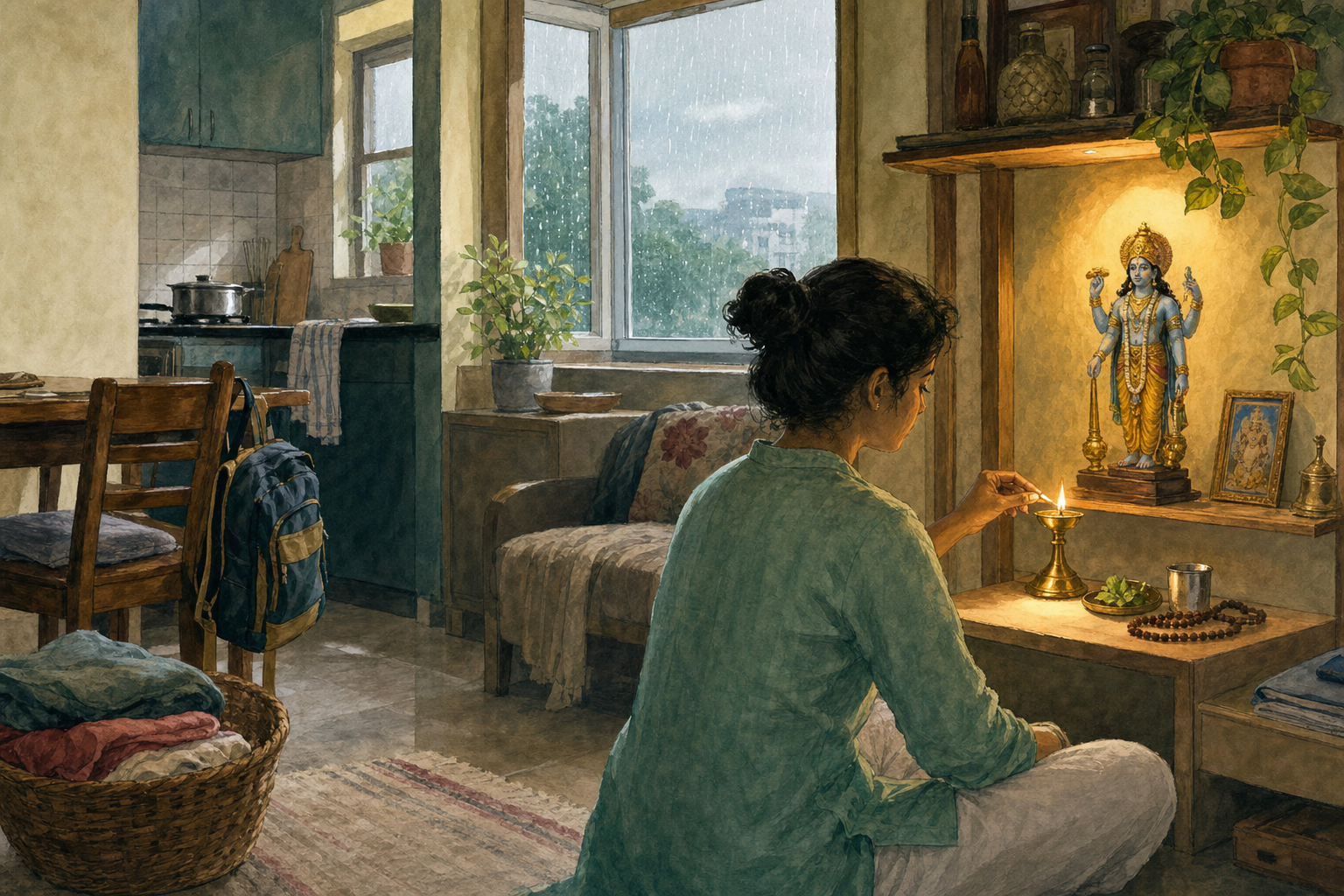
A practice becomes durable when its minimum form is clear. If your routine exists only when you have abundant time, privacy, energy, and enthusiasm, it will disappear precisely when you most need an anchor. Begin with a form that can live inside your actual responsibilities.
- Choose one anchor. Use Om Namo Narayanaya, Vishnu-nama, a manageable recitation from Vishnu Sahasranama, silent remembrance, or a moment of gratitude before Vishnu. One stable anchor is better than a crowded routine you continually avoid.
- Prepare one simple act of offering. You may light a lamp or offer tulasi where this is safe, available, and consistent with your household tradition. Folded hands and attentive remembrance still give the moment a devotional form when physical offerings are impractical.
- Make a direct sankalpa. Name whom the worship is for, what you are offering, and the quality you intend to cultivate. Keep the language honest. A simple resolve you understand is more useful than an elaborate formula recited without attention.
- Complete the chosen minimum without rushing. On a spacious day, add Sahasranama recitation, devotional music, temple darshan, or meditation. On a crowded day, retain the anchor instead of abandoning worship because the expanded version is impossible.
- Close with one dharmic consequence. Decide what remembrance requires from you now: patience in a difficult conversation, food shared with someone, a duty completed properly, an apology that is owed, or another concrete act of seva.
Do not measure the day mainly by the length of recitation or by whether you experienced an unusual emotion. Ask whether you actually showed up, attended to the name, and carried something of the worship into conduct. Devotional feeling naturally varies. The routine must not depend on producing a particular inner sensation on command.
If you miss your daily anchor, resume it at the next genuine opportunity. Do not punish yourself with a suddenly inflated routine that you cannot sustain. The practical answer to inconsistency is renewed consistency, not self-condemnation.
A household practice should also have a clear, low-friction form. Let one person prepare the lamp, another bring tulasi or flowers, and another lead a familiar nama or recitation. Children and elders do not need identical roles. The aim is shared attention, not a performance in which one person’s anxiety controls everyone else.
Use sacred timing as a container, not a gate
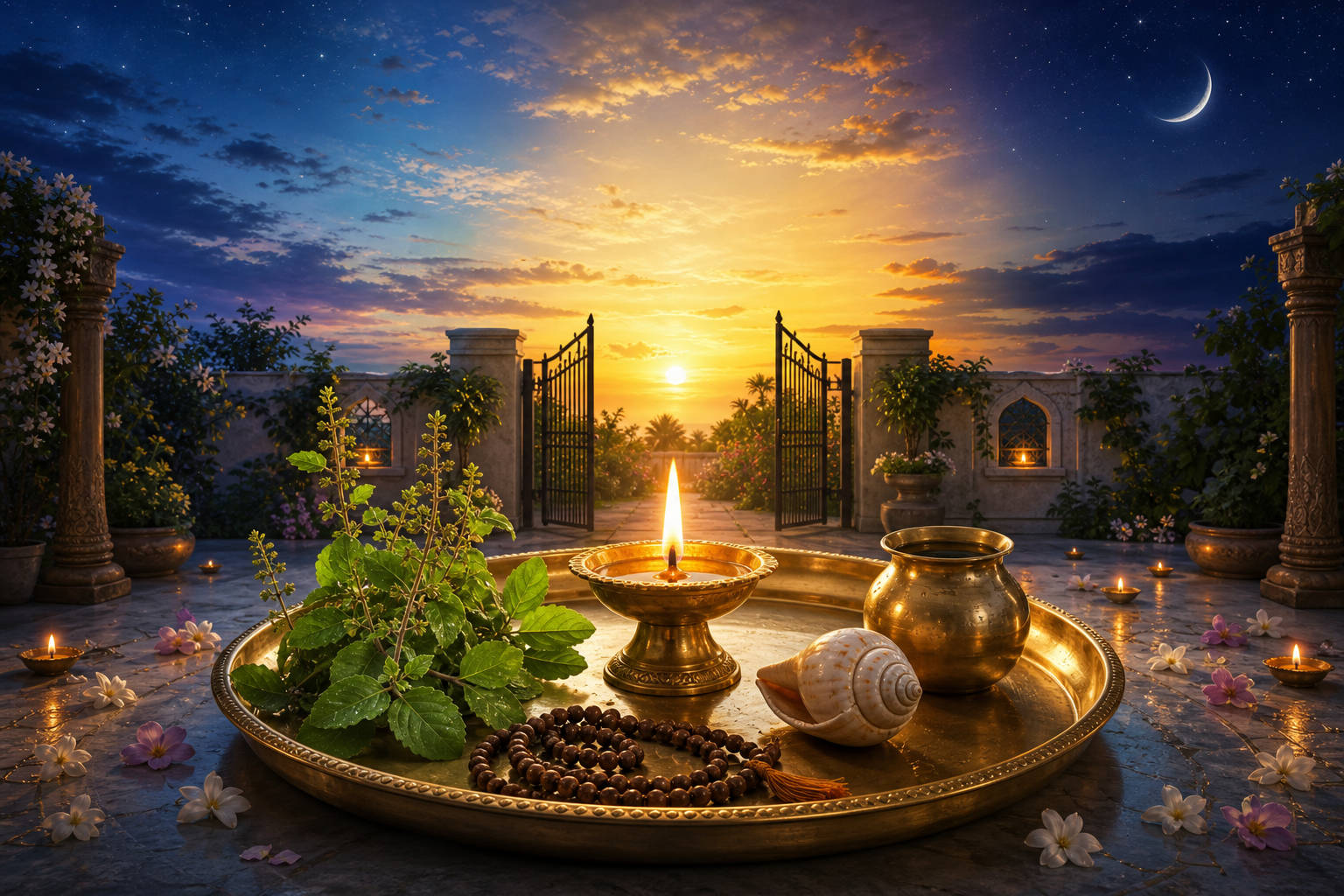
Auspicious timing concentrates intention. It tells you when to set ordinary distractions aside and give worship priority. It does not mean Vishnu is inaccessible outside a muhurta, nor does it turn a time window into a guarantee of the result you requested.
Vishnupathi Punyakalam is traditionally associated with the Sun’s transit into a fixed zodiac sign; the February observance typically coincides with Kumbha Sankranti. A concrete example shows how exact the planning can be: on 13 February 2026, the stated Vishnupathi interval was 01:30 to 10:30 Indian Standard Time.
That exact interval belongs to that date. Do not copy it into another year or assume that an IST conversion settles every local question. Panchang calculations can reflect locality, longitude, and traditional method, and some regional almanacs may use the related name Haripada Punyakalam with minor local adjustments.
- Verify the occasion locally. Check a trusted panchang or temple notice for the relevant date and place.
- Write down both boundaries. Record the start and end in your local time zone. Do not rely on remembering a conversion while sleepy or rushed.
- Select the part you can truly observe. If the window is long, choose a realistic period for focused worship rather than leaving the whole interval undefined.
- Prepare before it begins. Set out the lamp, tulasi, recitation text, and anything required for dana or annadanam. Preparation keeps the muhurta from being consumed by searching and arranging.
- Take sankalpa at the opening or at dawn. Complete the worship before the verified interval closes when the observance calls for action within the muhurta.
- Separate the core from the optional. Protect your chosen nama, prayer, and act of giving first. Add music, extended recitation, or a temple visit only when they fit without turning worship into frantic logistics.
A useful Vishnupathi sequence is simple: begin with sankalpa, offer lamp or tulasi, undertake japa or Vishnu Sahasranama recitation, sit briefly in quiet remembrance, and connect the worship to dana, annadanam, or another form of seva. Families can share the recitation or devotional music, but the household should know beforehand who is responsible for each practical task.
If circumstances make the verified window impossible, do not invent a timing or declare ordinary devotion worthless. Offer the remembrance you can perform sincerely, then prepare earlier for the next observance. A muhurta should focus devotion; anxiety about the muhurta should not displace devotion.
Let the grace you invoke cross the threshold
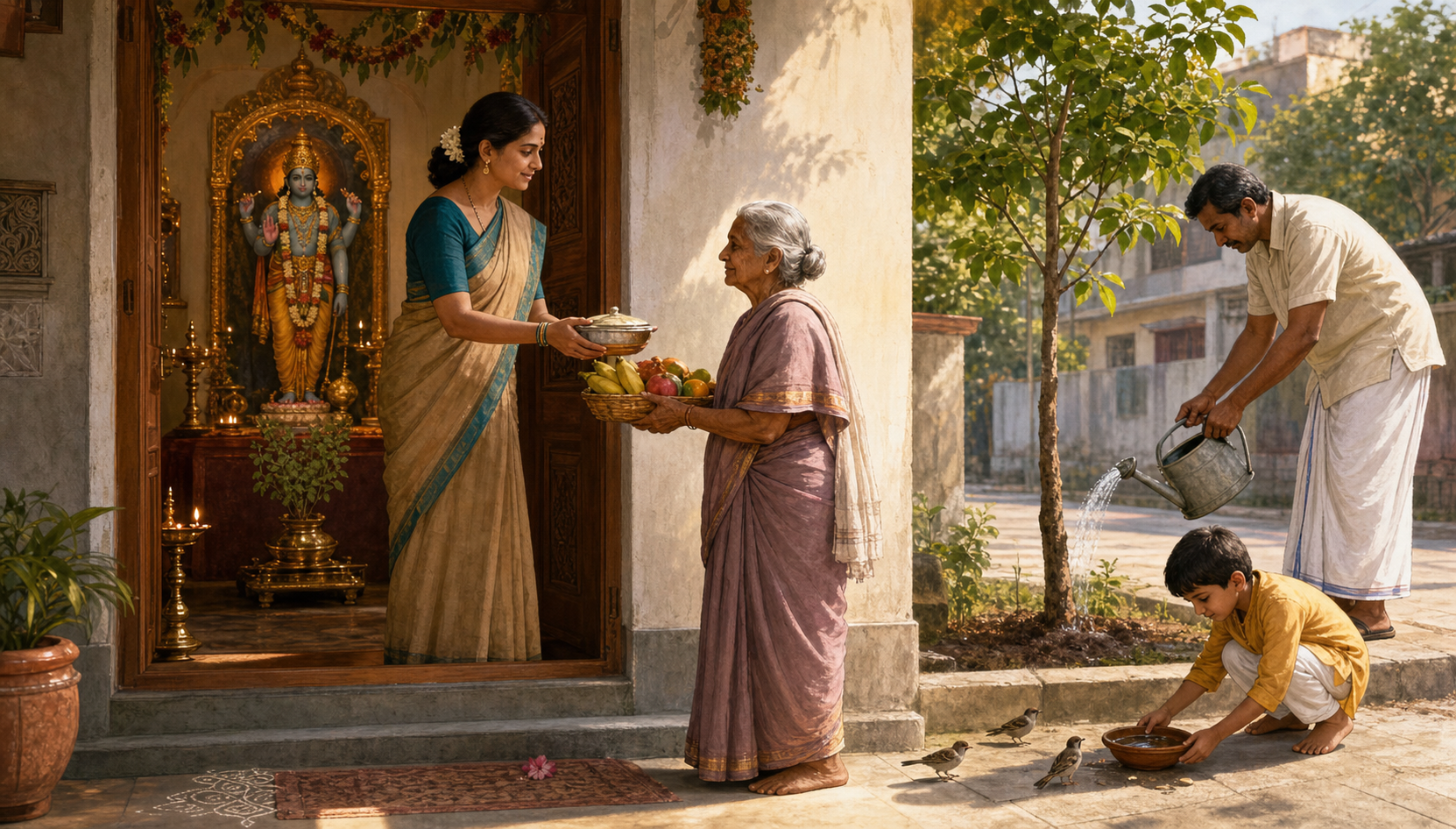
The most revealing part of an observance may begin after the lamp is extinguished. If worship leaves you more irritable with your family, less honest in duty, or indifferent to another person’s hunger, the outer rite has not yet penetrated conduct. The response is not to discard ritual. It is to reconnect ritual with what it was meant to train.
Vishnupathi practice commonly joins Vishnu worship to dana, annadanam, self-discipline, and sattvic living. Make that link explicit. Decide on the act of service while taking sankalpa, prepare it before the sacred window, and complete it as part of the observance where feasible. This prevents seva from becoming a good intention permanently deferred until later.
Service need not become a display of piety. Feed someone without making the recipient an accessory to your ritual. Give without humiliating. Help without demanding agreement with your theology. The recipient’s dignity is part of the dharmic quality of the act.
This outward movement also creates a respectful bridge across the dharmic family. Vishnu-bhakti remains distinctly Vaishnava, while compassion and ethical discipline have recognizable counterparts in Buddhist karuna, Jain anukampa and ahimsa, and the Sikh language of nadar. These are not interchangeable doctrines. They are points at which different traditions can cooperate in care, restraint, and service without pretending their theologies are identical.
That distinction matters in a mixed dharmic household or community event. Name the rite honestly as Vishnu worship. Then invite others, without compulsion, into the ethical work that can be shared: preparing a meal, assisting a neighbour, sitting in respectful silence, or expressing gratitude. Unity becomes stronger when difference is acknowledged rather than blurred.
After worship, use three practical tests. What fear has become less dominant because you remembered Vishnu? Which duty can you now perform with greater steadiness? Who other than you benefits from this observance? If the answers remain unclear, choose one modest action before the day ends. Bhakti becomes visible through the direction it gives life.
Key takeaways
- Vishnu’s grace is not a payment earned through technically flawless ritual; observance is a disciplined response to grace.
- Keep one daily anchor, such as Om Namo Narayanaya, Vishnu-nama, Sahasranama recitation, or attentive gratitude.
- Give your practice a minimum form that survives busy and emotionally flat days, then expand it when circumstances allow.
- Confirm Vishnupathi and other sacred timings through a trusted local panchang or temple, and never reuse a date-specific interval for another year.
- Prepare offerings, recitation materials, and charitable action before a muhurta so logistics do not consume the sacred window.
- Judge the fruit of worship partly by conduct: steadier duty, less domination by fear, greater compassion, and concrete seva.
At your next daily anchor, choose one name or recitation, one honest sankalpa, and one action that carries remembrance into the rest of the day. Keep that form steady before adding more.
When the next sacred observance approaches, verify its local timing early and prepare the devotional and charitable parts together. You will then enter the muhurta with attention available for Vishnu, not trapped in last-minute calculation.
References
- DharmaRenaissance Blog — Vishnupathi Punyakalam on 13 February 2026: Auspicious Timings, Meaning, and Devotional Guidance
- DharmaRenaissance Blog — Bhagavatha Anugraha Moorthy: Vishnu’s Boundless Grace, Hope, and Protection for Devotees
