
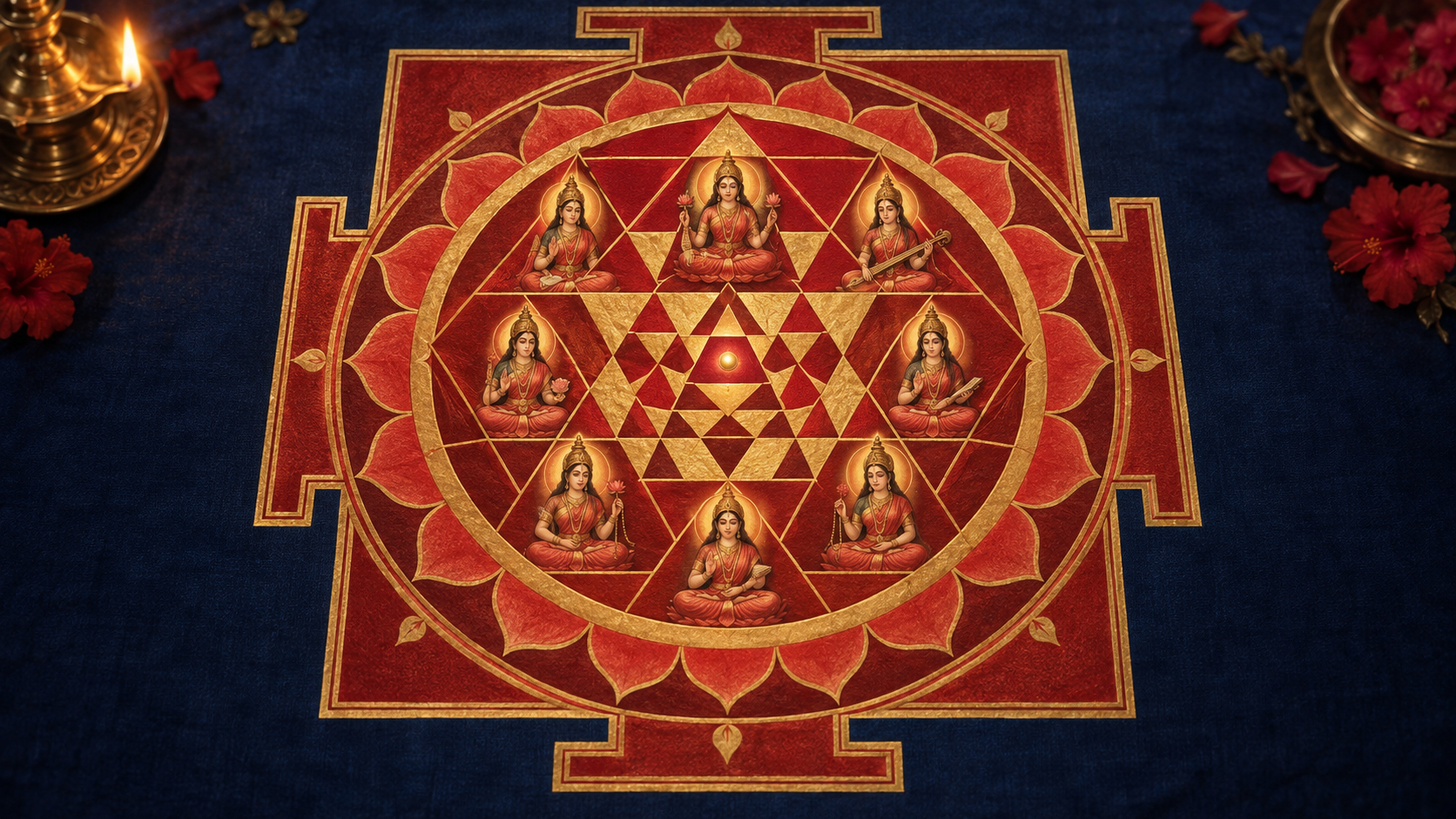
You may recognize the Vasini Vagdevis as important deities of Sri Vidya yet still be unsure where they belong in the Sri Chakra, what their placement means, or how to approach them without borrowing fragments from an unfamiliar ritual system. The first step is not memorizing more mantras. It is locating them correctly and understanding why powers of sacred speech stand so close to the centre.
Once that orientation is clear, the Vasini Vagdevis stop looking like an isolated list of goddesses. They become an inner mandala: eight expressions of Vak Shakti through which speech is gathered, refined and turned toward the Divine Mother.
Locate the Vasini Vagdevis in the eight inner triangles
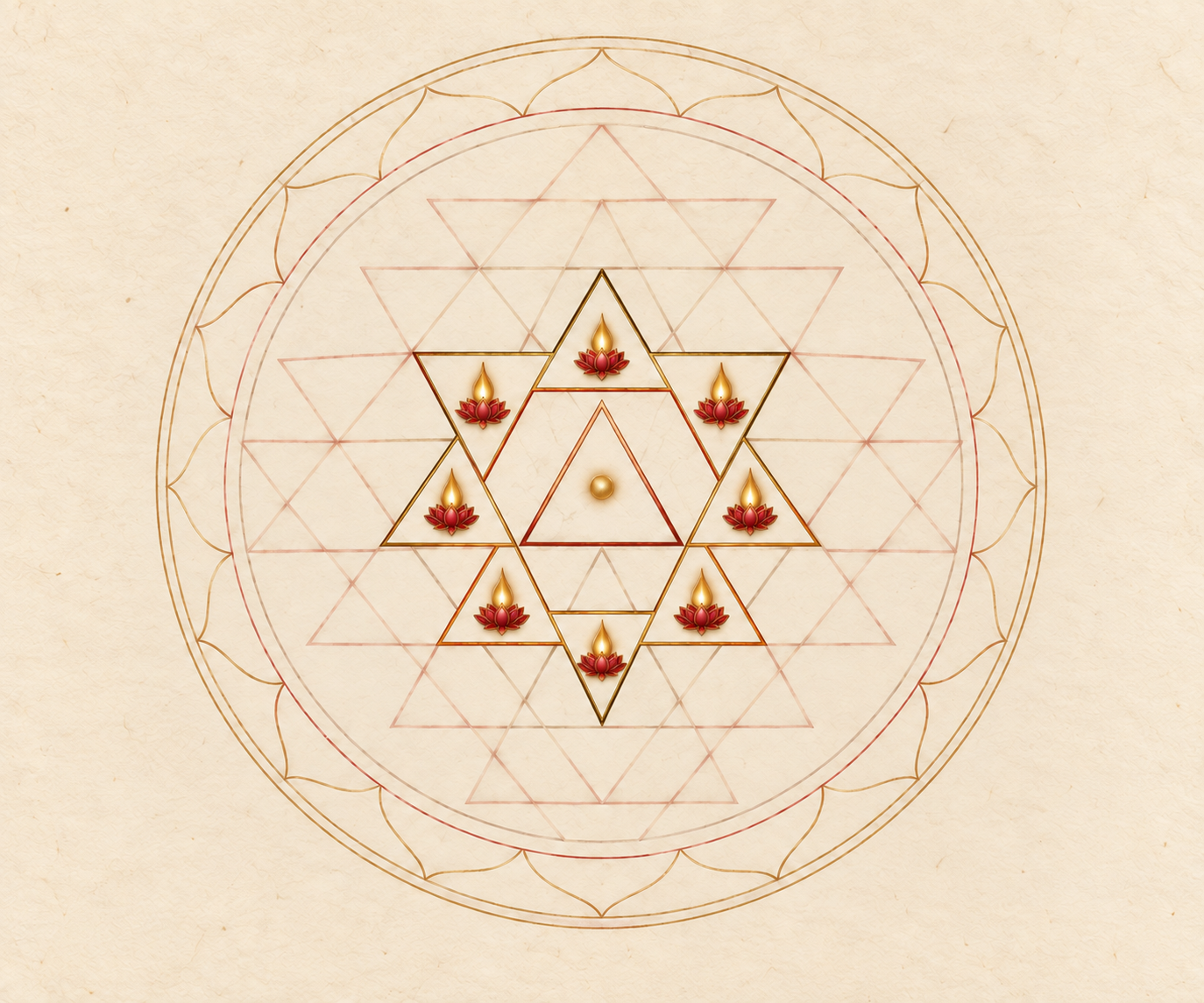
The Sri Chakra leads the worshipper inward through successive avaranas, or enclosures. Each enclosure has its own geometry, presiding powers and spiritual function. This ordered movement matters. An avarana is not merely a decorative band surrounding a more important centre; it is a necessary stage in the worshipper’s approach to that centre.
Within this inward arrangement, the eight Vasini Vagdevis occupy the seventh avarana, represented by eight inner triangles. They are also identified as Rahasya Yoginis. The central triangle and bindu lie still further inward, so the eight-triangle enclosure must not be confused with either of them.
This distinction corrects a common visual mistake. When someone loosely says that the Vagdevis are in the “inner triangle,” a newcomer may look only at the single central triangle. Look instead for the ring of eight small triangles immediately within the deeper structure of the yantra. Whether you are studying a flat Sri Chakra or an elevated Mahameru, establish this location before trying to interpret the deities.
The number and geometry also tell you how to think about the group. There are eight deities corresponding to eight triangles. They should therefore be contemplated as a coordinated mandala, not as unrelated divinities gathered under a convenient label. If your diagram, book or ritual sheet does not let you match the prescribed sequence to the geometry with confidence, pause there. Do not invent the order from appearance alone.
Why powers of speech appear so near the centre

Vagdevi means a goddess of Vak, or speech. In ordinary life, speech can look like the final and most external part of a process: you think, choose words and then speak. Sri Chakra worship asks you to notice something deeper. Speech is not only sound leaving the mouth. It carries intention, meaning, knowledge and power.
The inward placement of the Vasini Vagdevis therefore changes the question. Instead of asking only, “Which goddess gives eloquence?” ask, “What must happen to speech as consciousness approaches the Divine Mother?” The answer is not simply that speech becomes more impressive. It becomes more truthful, disciplined and transparent to its sacred ground.
This is especially important in mantra-oriented worship. A mantra is not ordinary conversation decorated with Sanskrit syllables. Pronunciation matters, but sound alone is not the whole practice. Attention, authorized transmission, inner orientation and the relationship between the mantra and its deity also matter. The Vagdevis direct your attention toward that unity of sound, knowledge and Shakti.
The designation Rahasya Yoginis adds another useful emphasis. Their place belongs to the inward and subtle movement of worship. “Secret” should not be treated as a marketing word suggesting forbidden information that can be collected online. In a living Tantric setting, secrecy protects context, sequence and fitness for a practice. It reminds you that sacred knowledge is received responsibly, not merely accumulated.
Choose the right level of practice

You do not need to pretend that all forms of engagement are identical. Study, devotional contemplation and initiated avarana puja are related, but they are not interchangeable. Confusion begins when a general reader copies the outer form of a lineage practice and assumes that the copied sequence has become complete worship.
If you are studying the Sri Chakra
Begin with a clearly drawn diagram. Learn to distinguish the seventh enclosure of eight triangles from the central triangle and bindu. Then remember three facts together: eight triangles, eight Vasini Vagdevis and the designation Rahasya Yoginis. That compact map is more useful than a long list learned without location.
When you encounter different spellings, arrangements or ritual instructions, record where each version came from. Do not silently combine them. A sequence belonging to one paddhati may not be a universal template, and an unexplained diagram may follow conventions that are not visible from the image itself.
If you want a devotional contemplation
You can approach the group reverentially without claiming to perform the full esoteric rite. Use this simple study-and-contemplation discipline:
- Place a Sri Chakra image where you can see its geometry clearly.
- Trace the enclosures inward slowly and stop at the group of eight inner triangles.
- Recognize the eight Vasini Vagdevis collectively as the powers of sacred speech established there.
- Examine your own speech through five practical questions: Is the intention clean? Is the statement true? Are the words necessary? What consequence may they produce? Would silence serve dharma better?
- Close with a respectful salutation or a prayer already accepted in your family or tradition.
Those five questions are a contemporary contemplative aid, not a canonical assignment of five functions to the eight goddesses. Their purpose is to carry the symbolism into conduct. If contemplation of Vak does not affect how you speak to another person, it has remained an attractive idea rather than becoming sadhana.
If you have received a formal Sri Vidya practice
Follow the paddhati and oral instructions given by your guru. Names, mantras, nyasa, directional placement, mudras and offerings must be learned as parts of one ritual system. Do not replace a difficult or missing instruction with a fragment taken from another lineage merely because both use the name Sri Chakra.
When your written instructions and a diagram appear to disagree, ask which orientation, starting point and counting convention the ritual uses. That is a better question than asking which image on the internet is “correct.” The aim is fidelity to a coherent transmission, not the construction of a hybrid ritual from the greatest number of available details.
Avoid the shortcuts that obscure their meaning

The first shortcut is reducing the Vagdevis to deities for persuasive speech. Eloquence may be associated with the power of speech, but sacred speech cannot be measured by verbal brilliance alone. A person can speak beautifully and still speak falsely, cruelly or for self-display. In worship, refinement of Vak must include restraint and responsibility.
The second shortcut is racing past the avaranas because the bindu appears to be the ultimate destination. The Sri Chakra is approached through ordered enclosures precisely because inwardness is not achieved by visual proximity. If you ignore the seventh avarana while staring at the centre, you miss the demand it places on the faculty with which you recite, teach, pray and make vows.
The third shortcut is treating geometry as optional. The eight triangles are not a background illustration for a verbal list. They establish multiplicity held within a single inward structure. During study, point to the relevant enclosure. During contemplation, let the coordinated form prevent you from isolating one power of speech from the whole.
The fourth shortcut is collecting restricted ritual material without the framework needed to use it. More syllables do not automatically create deeper worship. If you have not received the formal practice, learn the architecture, honor the deities collectively and discipline your everyday speech. These are substantial steps, not substitutes to be hidden behind claims of initiation.
Key takeaways
- The Vasini Vagdevis are eight Shaktis associated with the seventh avarana and its eight inner triangles.
- They are also known as Rahasya Yoginis and must not be placed in the single central triangle or at the bindu.
- Their position invites you to understand speech as Shakti, not merely as outward sound or social eloquence.
- Study, devotional contemplation and initiated avarana puja are different levels of engagement; do not present one as another.
- For formal worship, preserve the sequence and instructions of your own lineage rather than combining unrelated ritual fragments.
- A practical way to honor sacred speech now is to make your words more truthful, necessary, responsible and capable of yielding to silence.
Your next step can be modest and precise. Take a clear Sri Chakra, identify the eight-triangle seventh avarana, and remain there long enough to examine the speech you bring to worship. If you later seek the full ritual, approach a qualified Sri Vidya teacher with that foundation already in place.
References

Leave a Reply
You must be logged in to post a comment.