
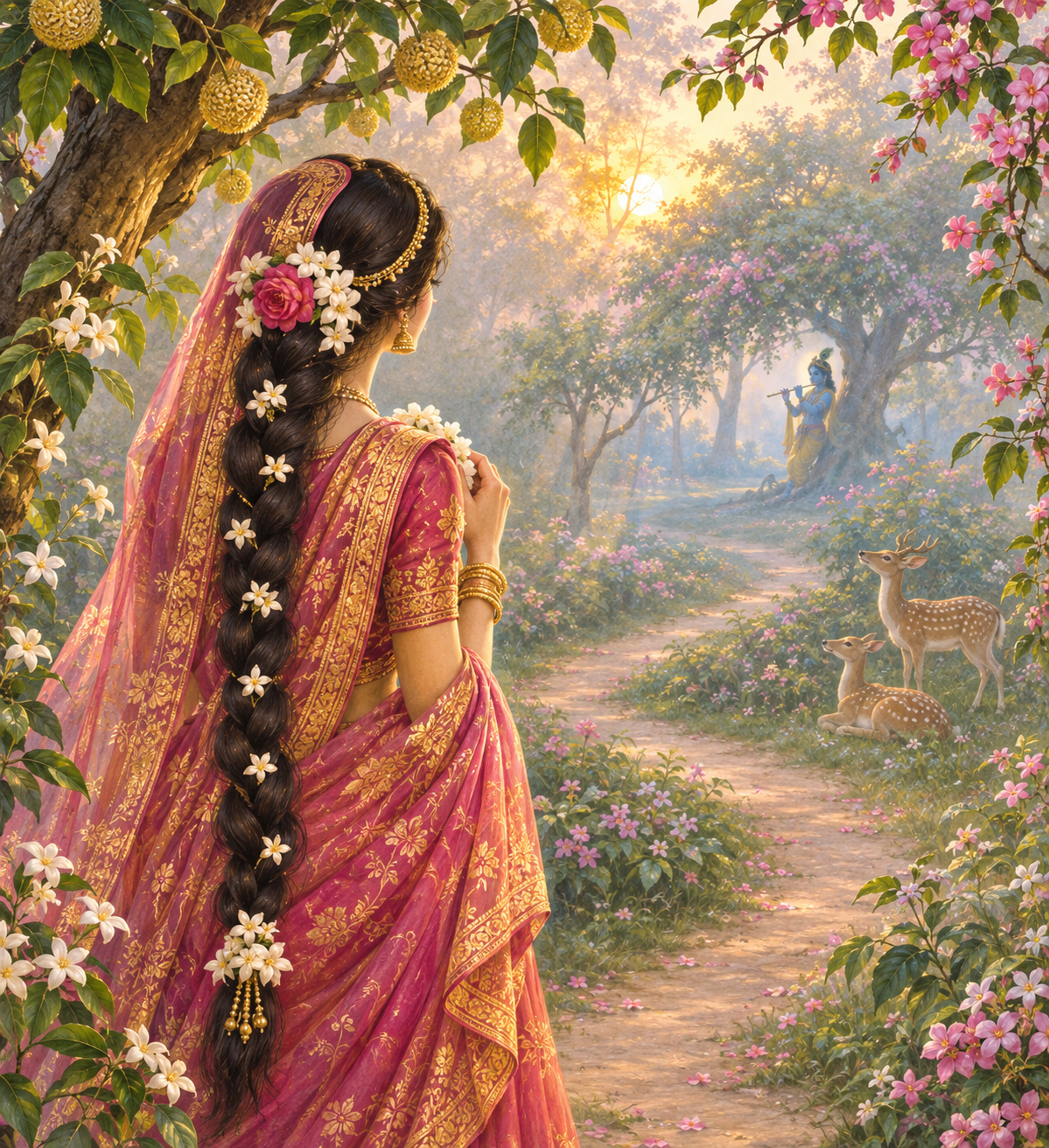
You may understand why Sri Radha’s name inspires devotion, yet still wonder how something as particular as her hair could awaken ecstatic love. Is the devotee simply admiring physical beauty, or is something deeper happening?
The answer lies in the direction of attention. In bhakti, a feature of the beloved is not contemplated as an isolated object. It is received as a sign of the whole person, the sacred relationship, and the opportunity to serve. Sri Radha’s hair matters because it can carry remembrance beyond appearance and into loving relationship.
A stimulus awakens a relationship already being cultivated
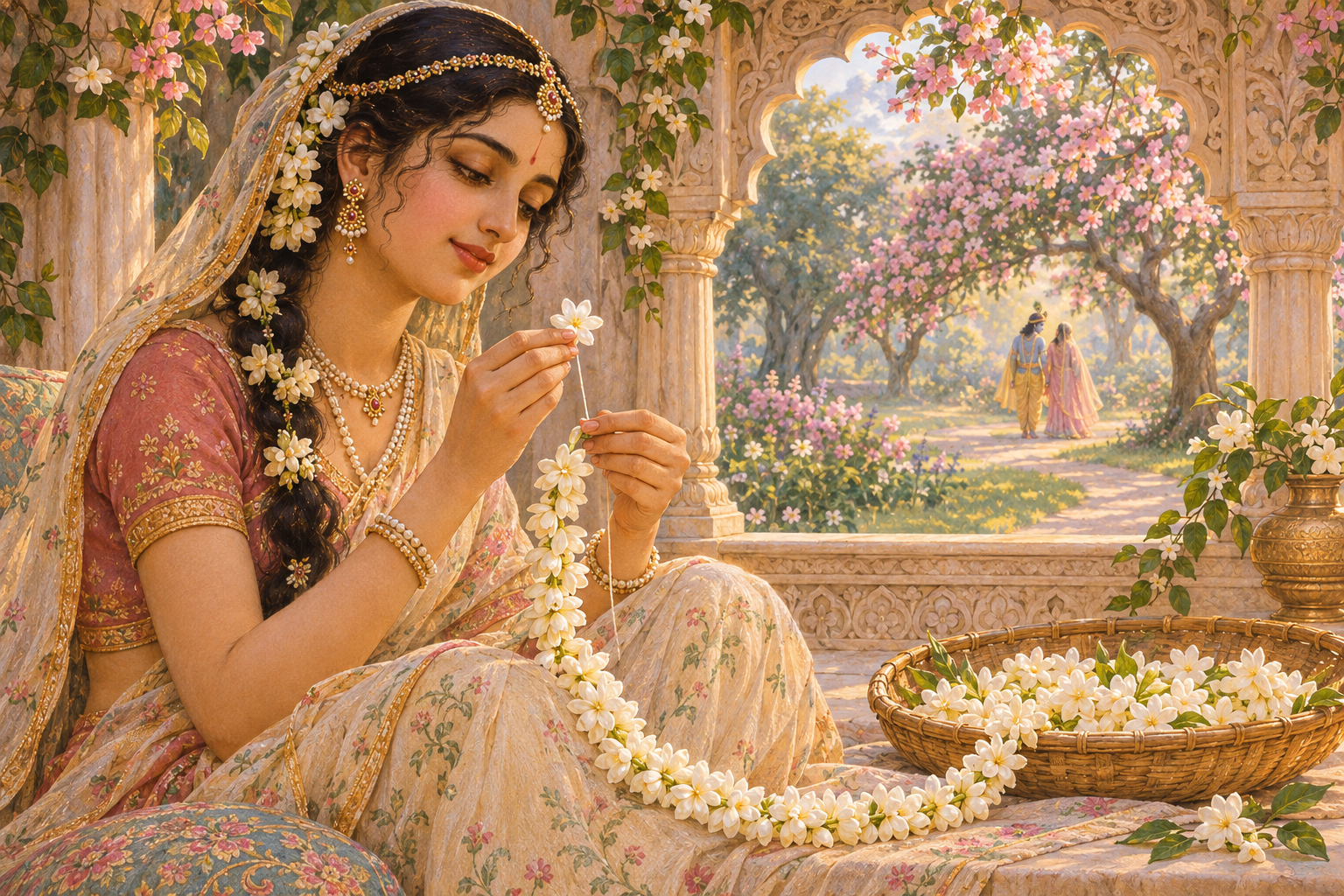
The devotional focus on Sri Radha’s hair as a stimulation for ecstatic love belongs to the language of rasa, the experienced flavour of a loving relationship. Within devotional aesthetics, an uddipana-vibhava is a feature of the beloved, or of the beloved’s surroundings, that kindles and intensifies an existing loving disposition.
That last point is essential. The stimulus is not a magical object that mechanically produces spiritual emotion. The same detail can pass unnoticed by one person and become profoundly meaningful to another because remembrance depends upon relationship. A familiar garment, gesture, path, or melody can bring someone dear immediately to mind. Its power comes from whom it recalls.
The phrase ‘stimulus for ecstatic love’ therefore operates on two related levels. Within sacred lila, a feature of the beloved can intensify the lover’s already-present affection. In a practitioner’s life, hearing or contemplating that feature can awaken remembrance, reverence, and the longing to serve. These levels shouldn’t be collapsed. Your sincere remembrance is valuable, but it isn’t a certificate that your present feeling equals the perfected love expressed in divine lila.
This distinction protects both humility and hope. You don’t need to imitate ecstasy. You need to place attention where love can be cultivated: on Sri Radha as a person, on her relationship with Krishna, and on the devotional response that remembrance asks from you.
Why hair can carry more than visual beauty
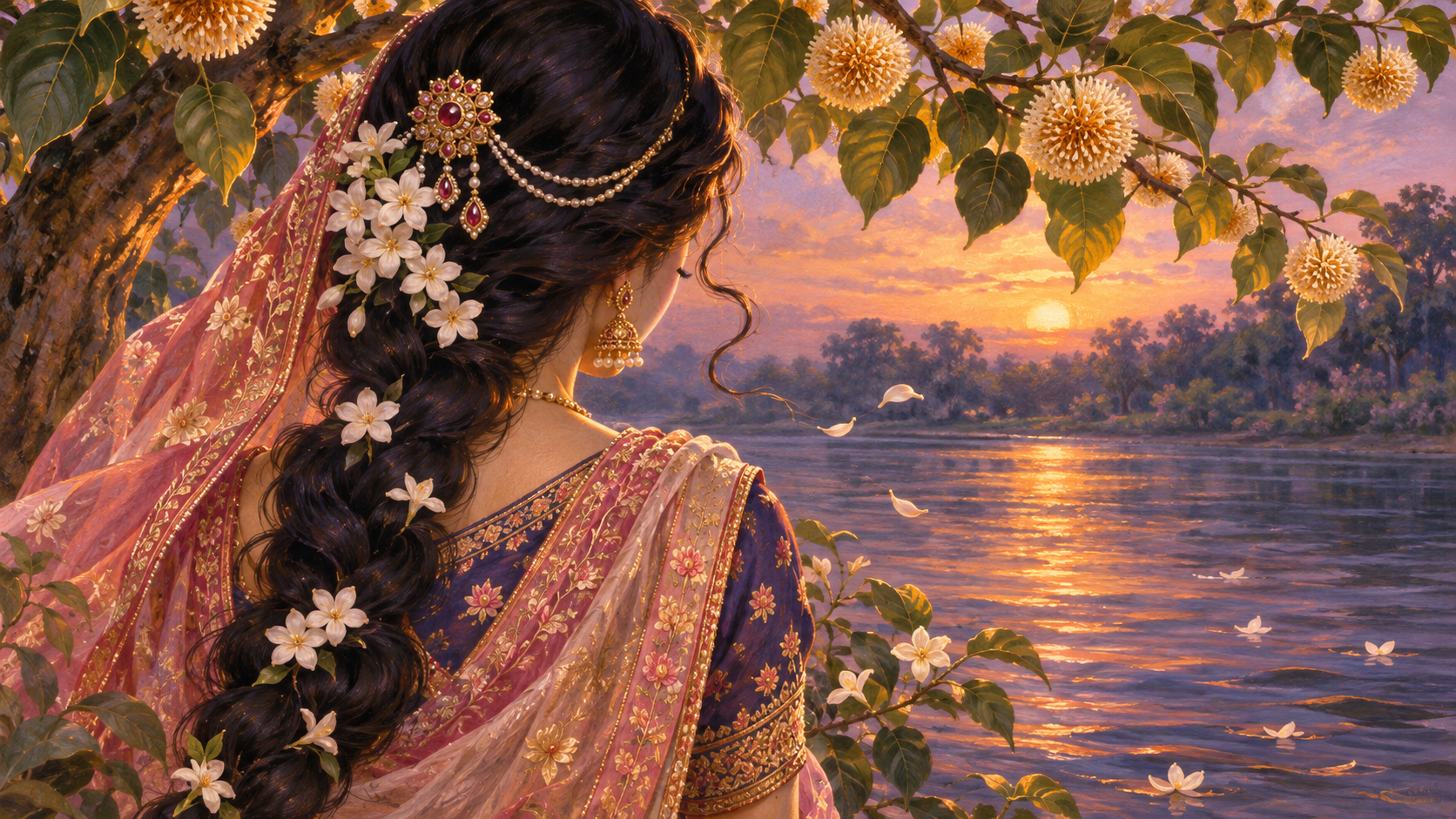
Hair is visually dynamic. It frames the face, responds to movement, can veil or reveal, and can be arranged with care. Unlike a fixed ornament, it subtly changes with the person’s activity. That makes it especially capable of suggesting presence rather than merely presenting a static form.
In devotional contemplation, those qualities can turn an ordinary visual detail into a relational one. A strand of hair is no longer just line, colour, or texture. It belongs to Sri Radha. It accompanies her movement and participates in the beauty through which her presence is remembered. Attention moves from the feature to the person, and from the person to loving service.
This movement of attention separates sacred contemplation from aesthetic consumption. Consumption isolates a beautiful feature and asks how much pleasure you can take from it. Bhakti keeps the feature within the wholeness of the beloved and asks what response is worthy of her.
You can test the direction of your contemplation with one question: after attending to Sri Radha’s hair, whom do you remember? If the feature remains detached from her person and sacred relationship, your attention has narrowed. If it deepens remembrance of Radha, Krishna, their lila, and your own aspiration for service, the detail is functioning as an uddipana rather than as an object of possession.
This is also why elaborate description is not automatically deeper devotion. Accumulating imagined details can keep the mind busy while leaving the heart untouched. One simple, trusted image held with reverence may do more than an ornate scene constructed mainly to entertain the imagination.
A disciplined way to contemplate Sri Radha’s hair
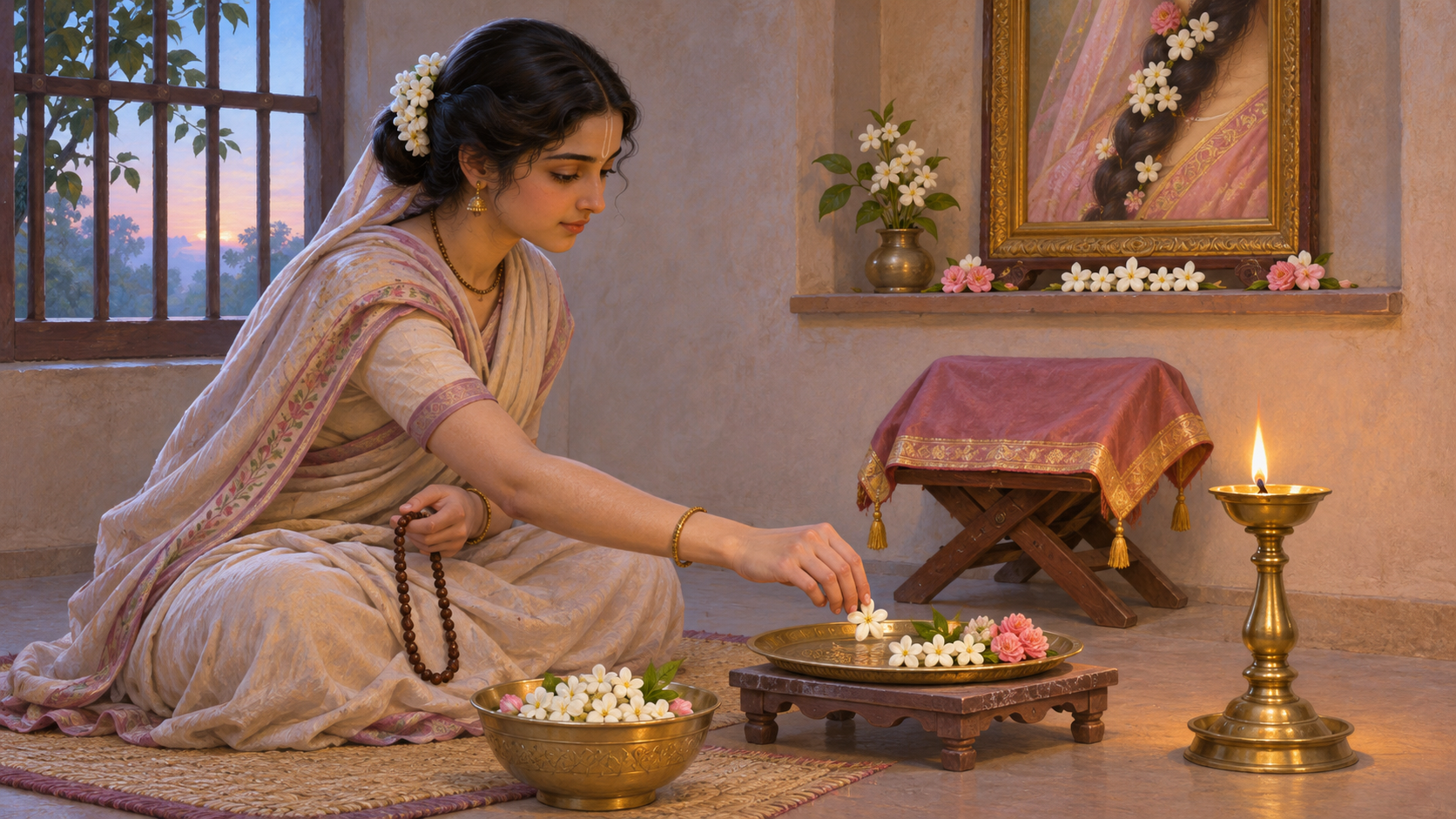
You don’t have to force a vision or manufacture an elevated mood. A sound practice gives the image a clear devotional frame, allows remembrance to arise, and then translates it into service.
- Set the intention before forming the image. Begin with a plain prayer that your remembrance may increase reverence, humility, and service. This prevents the exercise from becoming a search for an unusual private experience.
- Remember the whole person first. Invoke the names of Radha and Krishna, or use the prayer and mantra received in your tradition. Don’t begin with a detached close-up. Place the feature within their sacred relationship from the outset.
- Use one trusted description or depiction. If your lineage gives you a text, image, song, or teaching for contemplation, remain close to it. You don’t need to invent colours, ornaments, gestures, or confidential scenes that haven’t been given to you.
- Attend without grasping. Notice Sri Radha’s hair as part of her living presence. Let it recall her beauty and grace, but don’t mentally seize the image or treat it as material for fantasy. The aim is receptive remembrance.
- Follow the remembrance toward relationship. Ask what the image awakens in you: reverence, tenderness, gratitude, longing for devotion, or a desire to serve. If attention turns into detached sensual curiosity, widen the frame. Return to the holy names and to Radha-Krishna together.
- Complete the contemplation through an offering. Chant attentively, offer a prayer, perform a concrete act of seva, or carry greater patience and honesty into your next duty. A devotional stimulus has done useful work when remembrance changes how you serve.
The final step is easy to neglect. A beautiful meditation can become self-contained: you enjoy a tender moment and then return unchanged to distraction, irritation, or carelessness. Bhakti asks the experience to bear fruit. Even a small increase in attentiveness, restraint, kindness, or steadiness is more useful than a dramatic feeling that produces no service.
If visual contemplation isn’t natural for you, don’t strain to make the mind produce pictures. You can hold the same devotional meaning through the name ‘Radha,’ through prayer, or through hearing. The essential movement is remembrance of the beloved, not mastery of a visual technique.
Keep beauty, emotion, and attainment in their proper places
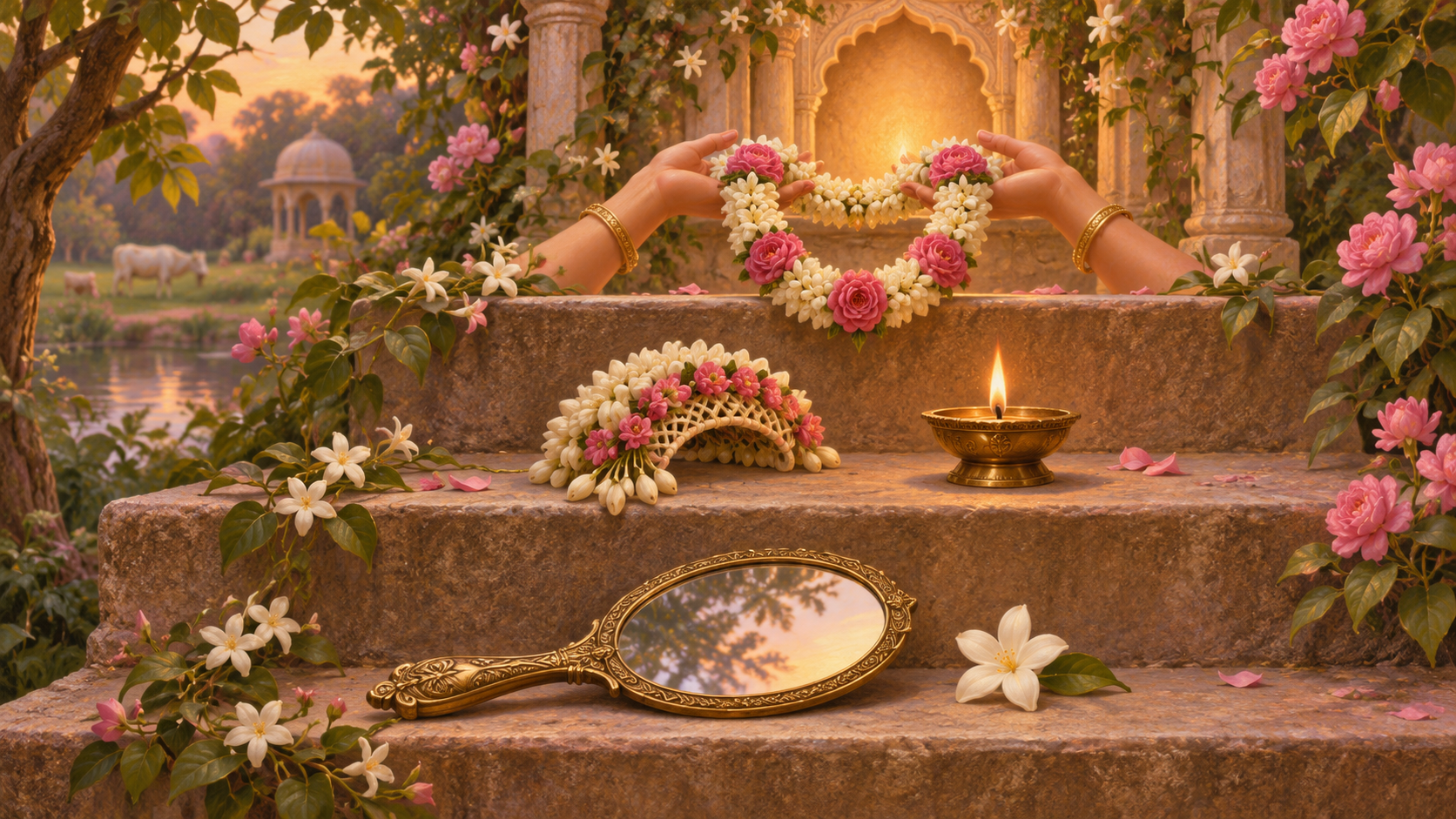
Devotional beauty is powerful, which is precisely why it needs a clear orientation. Several common mistakes can turn a helpful stimulus into confusion.
- Trying to manufacture ecstasy: Intensity produced by effort, music, imagery, or expectation is still intensity; it isn’t automatically prema. Receive whatever sincere feeling arises without awarding yourself a spiritual rank.
- Separating Radha’s beauty from Radha: Sri Radha isn’t a collection of attractive features. Whenever one detail begins to dominate, return to her person, her devotion, her relationship with Krishna, and the mood of service.
- Treating emotion as the only result: Tears, stillness, warmth, and absence of feeling are unreliable scorecards when taken by themselves. Look instead for greater steadiness in remembrance and better conduct after practice.
- Borrowing a mood you haven’t been taught to inhabit: Respect the vocabulary, boundaries, and sequence of your own lineage. Sacred intimacy isn’t improved by improvising claims to an inner identity or relationship you haven’t received.
- Comparing experiences: Another devotee’s visible emotion tells you little about what your practice should feel like. Comparison quickly replaces remembrance with self-observation. Return to the object of devotion rather than monitoring your performance.
These guardrails aren’t a rejection of beauty. They allow beauty to perform its devotional work. The aim isn’t to become suspicious of feeling, but to keep feeling connected to truth, relationship, humility, and service.
A useful standard is simple: genuine contemplation makes Sri Radha more central and your own spiritual performance less central. If you finish mainly fascinated by the quality of your meditation, the attention has curved back toward the self. If you finish more willing to remember, honour, and serve, it has moved in the right direction.
Key takeaways for your practice
- Sri Radha’s hair is spiritually significant because it recalls her person and sacred relationship, not because hair possesses independent mystical power.
- An uddipana intensifies a loving disposition; it isn’t a technique for producing ecstasy on demand.
- Keep every beautiful feature within the wholeness of Radha-Krishna remembrance.
- Use descriptions and images respected in your tradition instead of elaborating scenes merely to stimulate the imagination.
- Don’t measure devotion by emotional intensity alone. Notice whether remembrance produces humility, steadiness, and service.
- If visualization becomes strained or sensualized, return to the holy names, prayer, and the whole sacred relationship.
The next time you contemplate Sri Radha’s hair, make one deliberate change: don’t stop at seeing. Let the detail carry your attention to Sri Radha, let remembrance become reverence, and give that reverence a concrete form of service before the day moves on.
References
- Dandavats — Today’s Featured Video: Stimulation for Ecstatic Love Part 206 – Sri Radha’s Hair Part 2

Leave a Reply
You must be logged in to post a comment.