
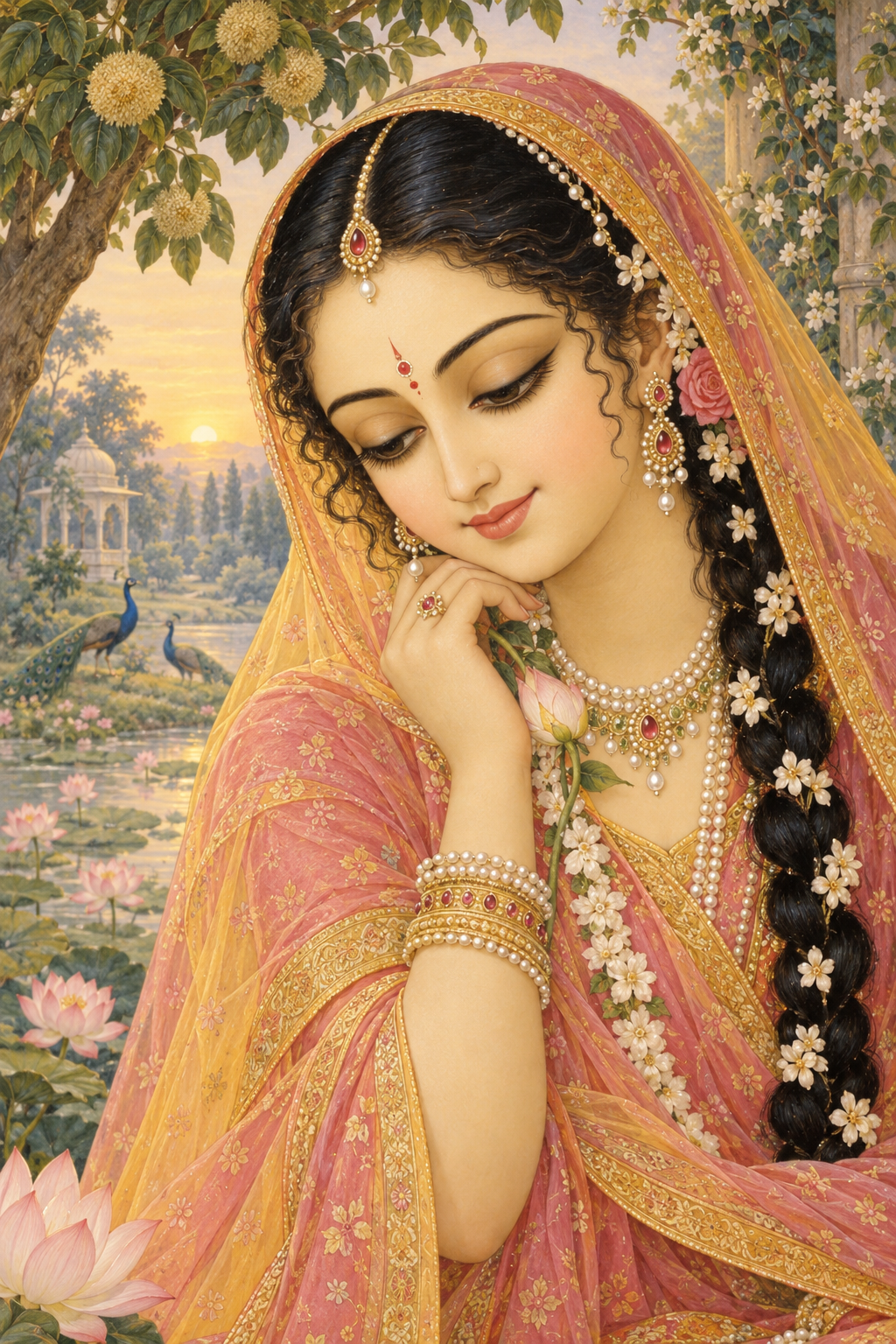
You may have paused before an image of Sri Radha and wondered why a poet, painter, or devotee would linger on something as particular as Her forehead. Is the detail merely decorative, does it carry a fixed symbolic meaning, or is it meant to change how you pray?
Within Radha-Krishna bhakti, the answer begins with how you look. Sri Radha’s forehead is not separated from Her person, and Her beauty is not separated from devotion. The detail becomes a doorway through which form, adornment, mood, and loving remembrance meet.
Why a single feature can hold a complete meditation
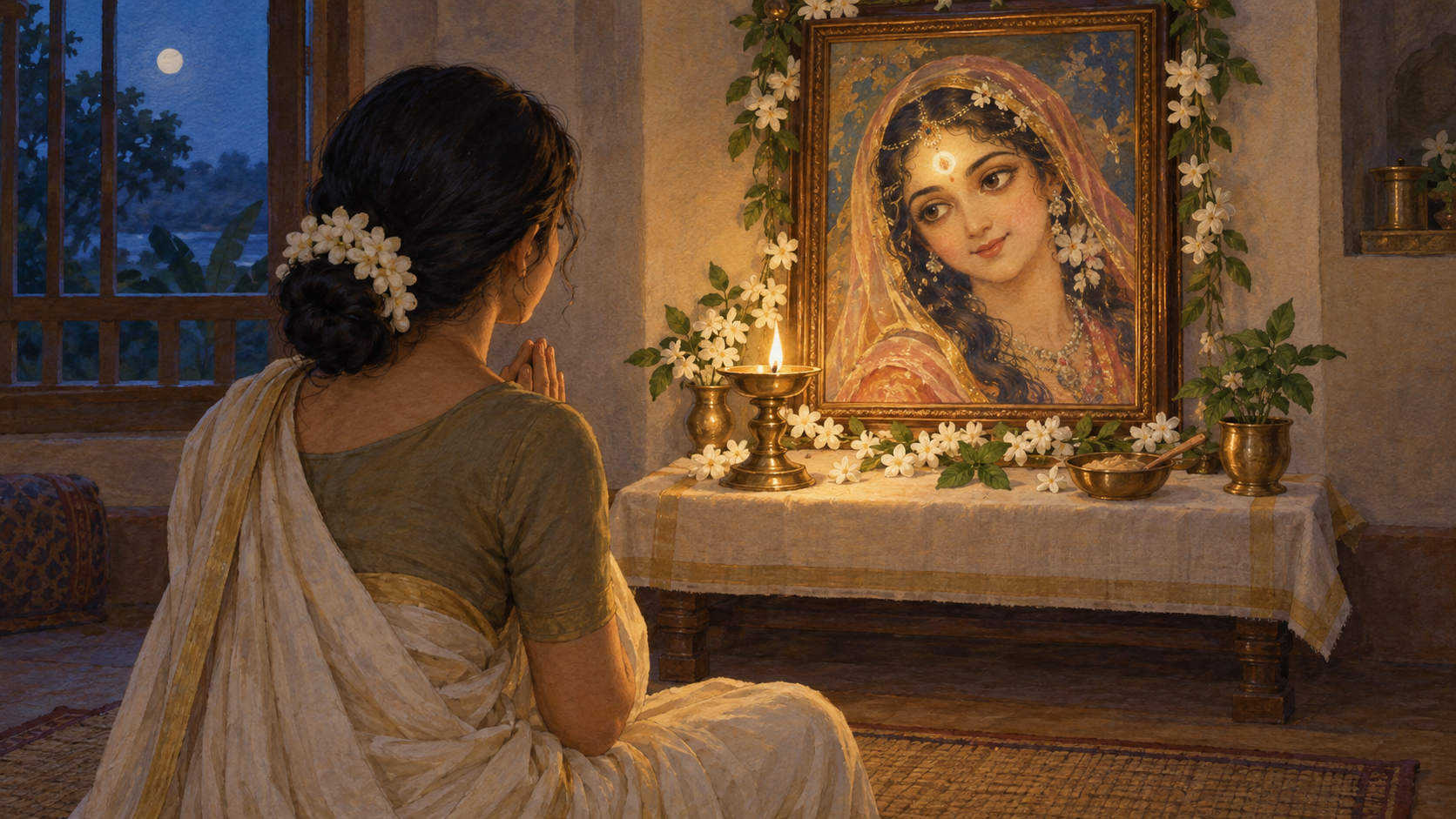
Close attention does not have to reduce the sacred form to anatomy. It can do the opposite. When your attention settles on one feature and then returns to the whole form, that feature helps you see the whole more carefully. The movement resembles meditating on one divine name: concentration does not deny everything else about the person named.
For a devotee, Sri Radha’s forehead can be contemplated as a stimulation for ecstatic love. The visible detail does not terminate in visual appreciation. It prompts remembrance of Sri Radha, Her qualities, Her relationship with Sri Krishna, and the devotional mood in which She is approached.
This distinction protects the meditation from two opposite mistakes. The first is to dismiss beauty as superficial ornament. The second is to consume sacred beauty as though the observer were collecting attractive details. Devotional seeing does neither. It receives beauty as an invitation to remember, revere, and serve.
The forehead is especially suited to concentrated seeing because it forms a quiet field between expressive and framing elements. Below it are the brows and eyes; above and around it may be the hairline, a veil, a curl, a mark, an ornament, or the light introduced by an artist. Not every image includes the same elements. What matters is how the visible arrangement leads your attention toward Sri Radha’s face and presence.
Use a simple discipline when you look: begin with the whole form, narrow your attention to the forehead, and then widen it again. If you remain trapped in the isolated detail, you are studying a fragment. If the detail returns you to Sri Radha with greater attention, it is serving contemplation.
Ask three different questions about what you see
Confusion begins when iconography, visual composition, and devotional response are treated as the same thing. They overlap, but each asks a different question. Separating them gives you a more careful way to approach a painting, temple image, photograph, or poetic description.
- What is visibly present? Describe the forehead’s shape, color, surrounding lines, and adornment without interpreting them yet. A disciplined observation might be: a dark curl crosses a luminous area above the brows. It should not begin with a claim about what the curl must symbolize.
- How does the composition guide your eye? Notice whether a mark creates a center, whether a veil frames the face, whether the brows direct attention toward the eyes, or whether a contrast of light and dark gives the forehead stillness. This is an aesthetic question about how the image works.
- What does the detail awaken devotionally? Ask whether the feature calls forth tenderness, reverence, longing, serenity, intimacy, or simply a more attentive remembrance of Sri Radha. This is not a test with one approved emotional answer.
The order matters. Observation restrains fantasy. Attention to composition prevents symbolism from becoming a guessing game. Devotional reflection then allows the image to affect your inner life without turning a personal association into a universal doctrine.
Suppose an image shows a bright ornament near Sri Radha’s hairline. You can say with confidence that the ornament draws the eye and frames the upper face. You may know its traditional name or significance if the temple, artist, caption, or lineage identifies it. You may also find that its brightness evokes radiance or auspiciousness. Those are three different levels of statement, and honesty requires that you keep them distinct.
The same care applies to poetic descriptions. A comparison may be intended to create mood rather than provide a physical specification. Instead of asking only, “What object does this metaphor decode?” ask, “What quality of Sri Radha does this language help me notice, and where does that attention lead?” Devotional aesthetics becomes intelligible when you follow the movement from image to remembrance.
Keep symbolism accountable to tradition and context
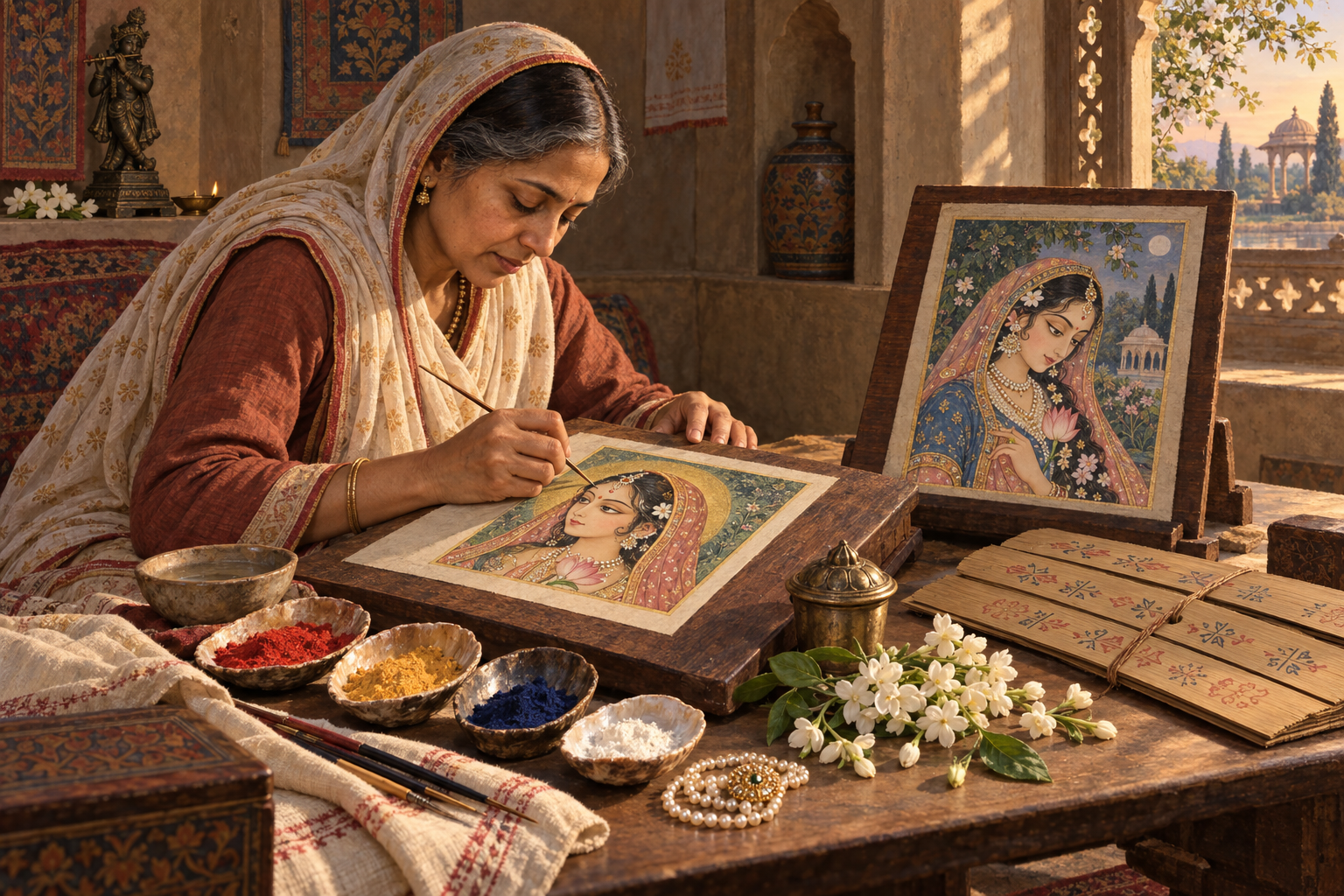
A forehead mark, jewel, curl, or color does not necessarily carry one meaning in every depiction of Sri Radha. Artists work within different regional, devotional, and visual conventions. Temples also preserve their own forms of adornment and seva. A symbol identified within one context should not automatically be imposed upon every other image.
Before repeating an interpretation, test it with three checks. Can you point to the feature actually present in the image? Has its meaning been identified within the relevant tradition? Are you describing a received meaning, or only a devotional association that arose in you? If only the third is certain, say that the detail “may evoke” a quality rather than declaring that it “always means” one thing.
This is particularly important when an image circulates without its original caption or temple setting. A cropped photograph may preserve the beauty of the face while removing information about the murti, festival, artist, or form of worship. Do not manufacture certainty to fill that gap. You can contemplate what is genuinely visible while leaving unidentified details unidentified.
In a temple setting, allow that temple’s seva tradition to lead. The external adornment of the deity is not an open canvas for whatever interpretation an online viewer prefers. Receive the form as it is presented, listen to knowledgeable practitioners when explanation is offered, and avoid correcting a local convention with symbolism borrowed from somewhere else.
Careful language makes a real difference. “I notice” introduces an observation. “Within this tradition” locates a received explanation. “This evokes” names a devotional response. Those phrases are not evasions; they preserve the boundary between what the image shows, what a community teaches, and what your heart experiences.
A practical way to contemplate Sri Radha’s forehead
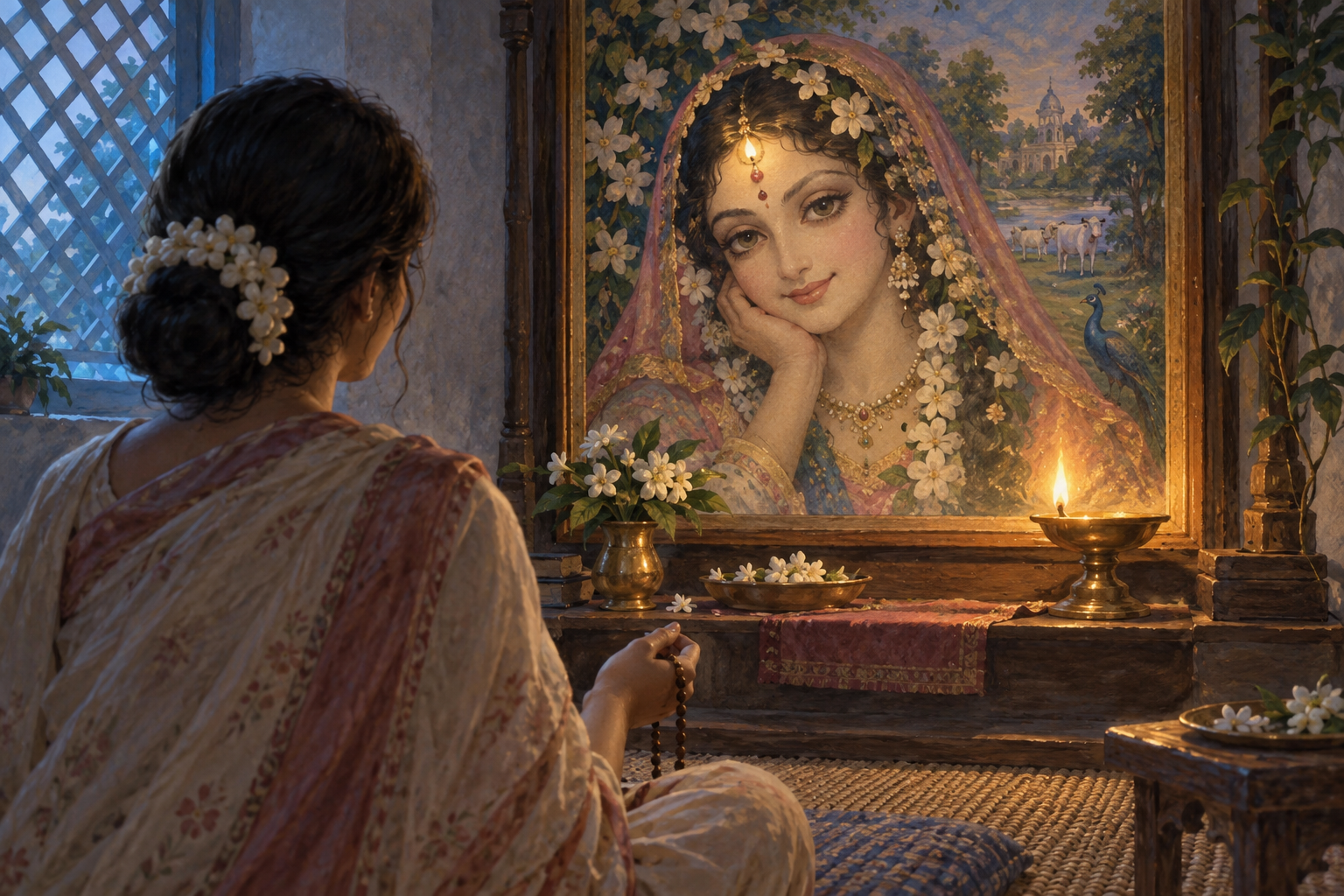
You do not need to manufacture an exalted emotion before beginning. Choose an image honored within a temple or devotional community you trust, and use the prayer, pranama, divine name, or mantra already proper to your practice. The aim is attentive remembrance, not a performance of spiritual intensity.
- Offer your usual salutation. Establish that you are approaching Sri Radha devotionally, not treating Her image as an aesthetic specimen.
- Receive the whole face first. Notice the general expression and the relationship among the eyes, brows, forehead, hair, and surrounding adornment.
- Rest attention on the forehead. Observe only what is present. Notice line, color, light, texture, and the way surrounding elements frame the area.
- Let one association emerge. The detail may suggest radiance, tenderness, dignity, serenity, delicacy, or another quality. Do not force a meaning merely because you think something dramatic ought to happen.
- Join the perception to remembrance. Repeat the divine name, mantra, or prayer you already use. Allow the visible feature to support remembrance of Sri Radha rather than replace it.
- Return to the whole form. See whether the concentrated attention has made the face, expression, or presence more vivid. End with pranama or with a concrete act of devotion appropriate to your practice.
If you keep a devotional journal, record only three lines: what you actually saw, what it awakened, and what response it calls for. That last response should be concrete. It might be a more attentive round of japa, a prayer offered without hurry, or greater care in an act of seva. The observation has completed its devotional movement when it changes the quality of your attention.
Some days the image may awaken a strong mood. On other days you may notice little beyond color and form. Both can belong to sincere practice. Sacred beauty is an invitation, not a lever that mechanically produces rasa. Trying to force ecstasy usually turns attention back toward your own performance: “Am I feeling enough?” A better question is, “Am I attending to Sri Radha with sincerity?”
This also explains why repetition matters. You are not trying to extract a new symbolic secret each time. You are learning to become less hurried, less possessive, and more receptive before a form you already revere. Familiarity need not make the image ordinary; disciplined attention can make familiarity deeper.
Key takeaways
- A close meditation on Sri Radha’s forehead should lead back to Her complete form and person, not end in an isolated physical detail.
- Separate three questions: what you can see, how the composition directs attention, and what devotional response it awakens.
- Do not assign a universal meaning to every mark or ornament. Follow the relevant temple, artistic, or lineage context when it is known.
- Use precise language: distinguish observation, received interpretation, and personal association.
- Do not measure the practice by emotional intensity. Measure it by the sincerity, steadiness, and devotional direction of your attention.
The next time Sri Radha’s forehead draws your eye, do one complete movement: behold the whole face, attend to the detail, join it to the divine name, and return to the whole. That small discipline turns looking into remembrance and adornment into an occasion for bhakti.
References

Leave a Reply
You must be logged in to post a comment.