
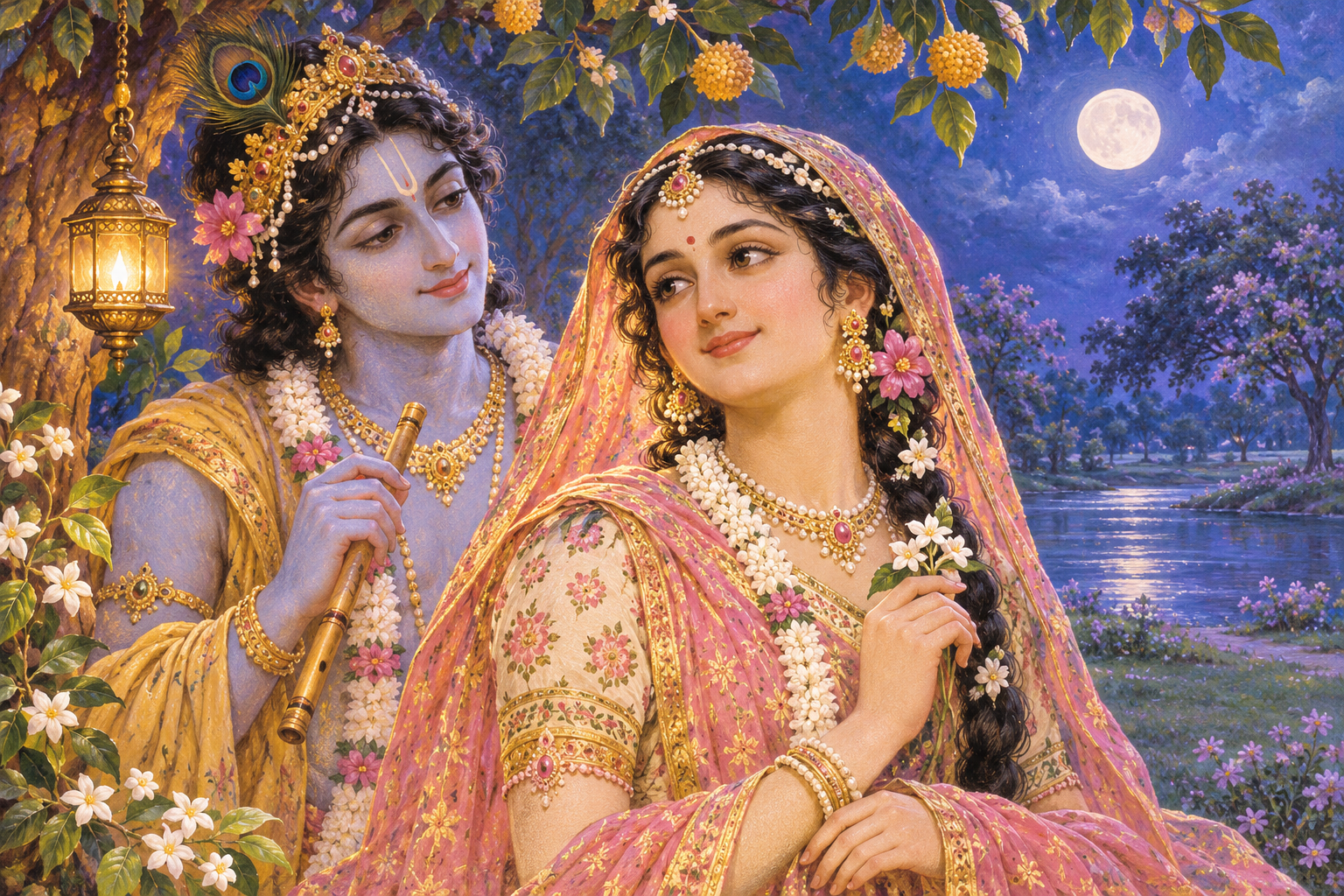
If you came here wondering why a devotee would contemplate something as particular as Sri Radha’s chin, you do not need to search for a secret anatomical code. The detail matters because it gives a wandering mind somewhere definite to rest. From there, attention can return to Sri Radha as a whole person, to Radha-Krishna, and to the devotee’s own relationship of remembrance and service.
This is also the test of the practice. If the chin becomes an isolated object of visual fascination, attention has stopped too soon. If it awakens reverence, loving remembrance, humility, or a desire for seva, the small detail has opened into devotion.
The chin is a doorway, not the destination
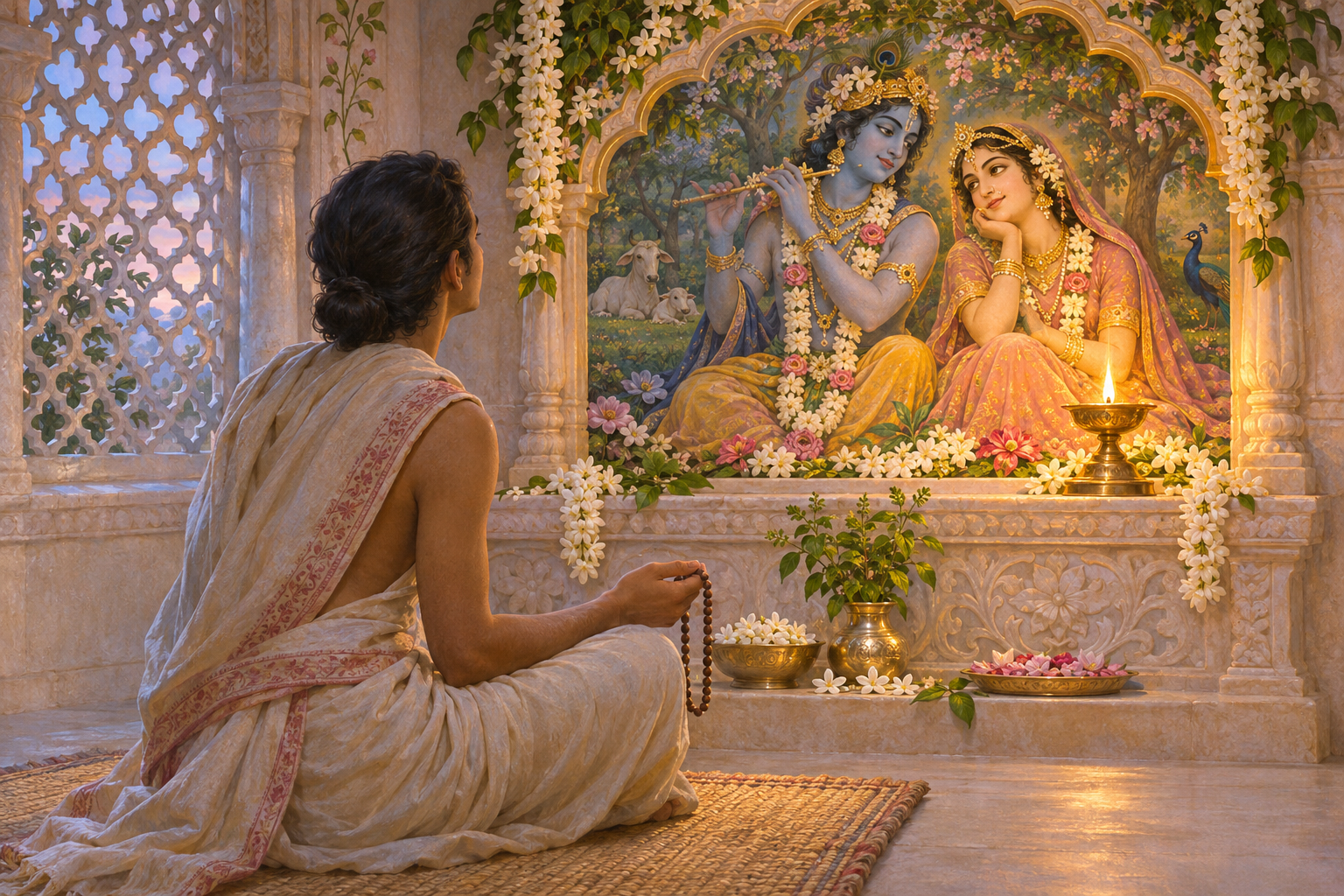
Sri Radha’s chin can serve as a stimulation for ecstatic love when that visible feature awakens remembrance of the beloved. Here, stimulation should not be misunderstood as emotional manipulation. You are not trying to force yourself into an impressive state. You are allowing a concrete reminder to gather attention that would otherwise scatter among abstractions, memories, and plans.
Ordinary affection already shows how this works. A turn of the head, a familiar expression, or a small gesture can recall an entire relationship. The remembered detail is powerful because it belongs to someone, not because the detail has been separated from that person. Devotional attention follows the same relational movement while directing it toward the sacred.
That gives you a simple sequence to remember: detail, person, relationship, response. You notice the chin. You remember Sri Radha. That remembrance opens toward Radha-Krishna and your place as a devotee. You then respond through prayer, chanting, conduct, or service. Do not remain mentally parked at the first step.
Ecstatic love is the horizon of this contemplation, not an emotional result you must produce on command. A quiet return of attention may be more honest than a dramatic mood. The important movement is away from self-absorption and toward loving remembrance.
What to notice without inventing a hidden meaning
A chin participates in the expression of the whole face. Its contour meets the cheeks and lips; its angle changes as the face lowers, lifts, or turns. When you contemplate a murti or devotional image, notice what is actually present. Does the line of the chin lead your attention back toward the face? How does the posture relate to the visible expression? Does the detail make the image feel less like an idea and more like a personal presence before whom you can offer respect?
Keep your observations modest. You may notice softness, composure, delicacy, reserve, or strength, but noticing a quality is not the same as declaring a fixed theological meaning. Say inwardly, I notice softness here, rather than insisting, This feature universally signifies softness. That difference protects contemplation from becoming invented doctrine.
Do not assume that every image, poem, temple tradition, or Vaishnava lineage assigns the same symbolism to the same physical detail. If your guru, lineage, or received devotional literature supplies a particular interpretation, stay with that teaching. If it does not, let attentive seeing remain attentive seeing. You do not have to manufacture an esoteric explanation to make the practice spiritually worthwhile.
The most useful question is not, What does the chin symbolize in isolation? Ask instead, What is happening to my attention as I behold it? Is your mind becoming quieter? Are you remembering Sri Radha rather than merely analyzing an image? Is possessive looking giving way to reverence? Does contemplation lead naturally toward a name, prayer, or act of seva? Those effects tell you more about the quality of your practice than an elaborate private theory does.
A repeatable practice for contemplating Sri Radha’s chin
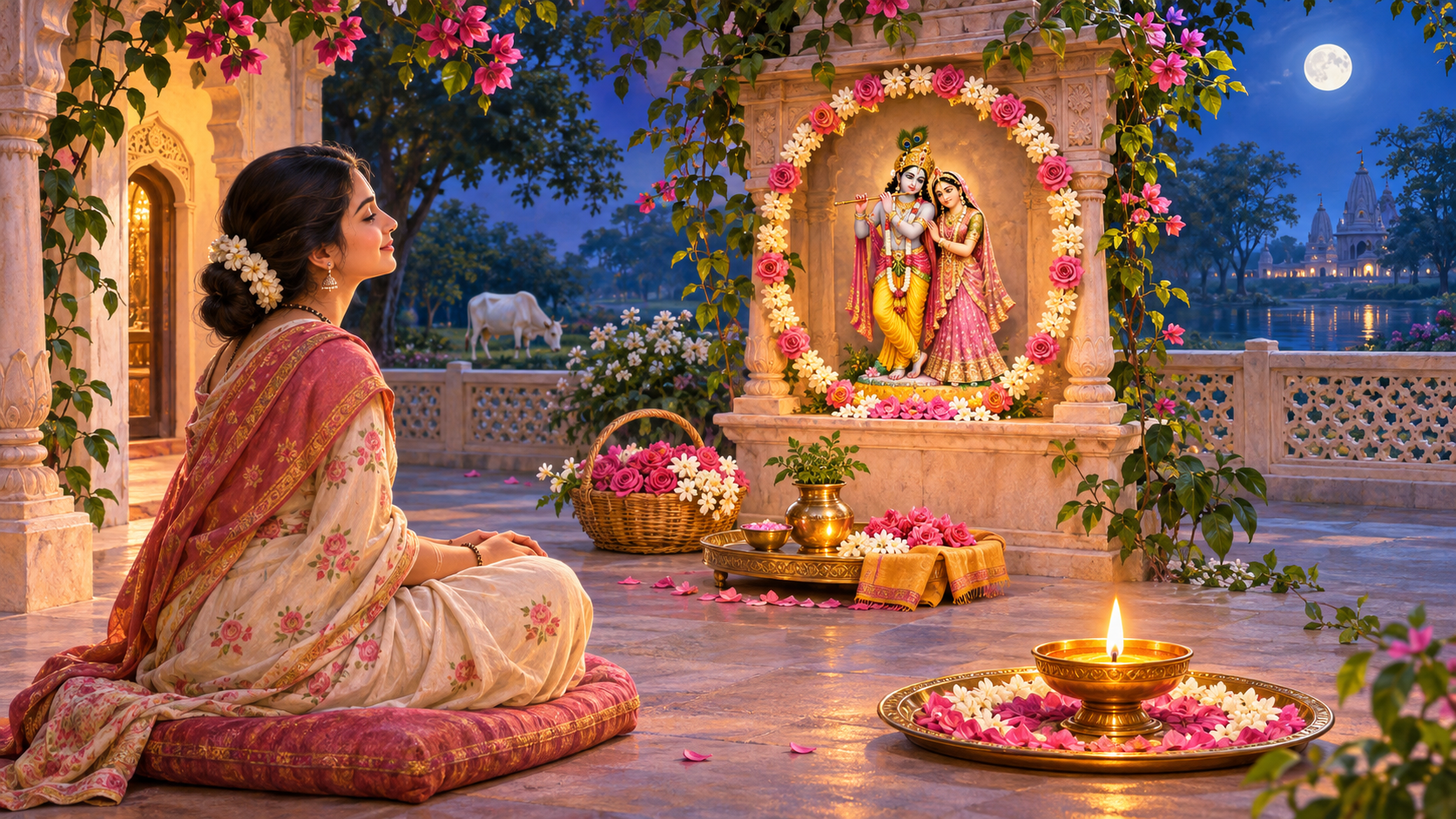
Use this practice with a familiar murti, devotional image, or remembered darshan. If your tradition has given you a particular form of Sri Radha on which to meditate, use that form consistently. Stability matters because constantly changing images encourages novelty-seeking, while repeated attention allows familiarity to deepen.
- Choose your intention before looking. Say inwardly: May this detail help me remember Sri Radha and become more ready to serve. This prevents the practice from turning into aesthetic consumption or a hunt for unusual sensations.
- Begin with the whole form. Acknowledge Sri Radha as a person worthy of devotion before narrowing your attention. Notice the face as a whole, and only then let your gaze or imagination rest gently on the chin.
- Observe only what is present. Notice contour, posture, light, ornament, and relation to the rest of the face when these are actually visible. Do not add an imagined color, measurement, gesture, or emotion and then treat your addition as revealed knowledge.
- Let the detail expand into relationship. Move naturally from the chin to the face, from the face to Sri Radha, and from Sri Radha to Radha-Krishna. If a name or mantra is already part of your practice, repeat it without trying to intensify your mood artificially.
- Widen your attention when it becomes strained. Forceful staring is not deeper devotion. If the mind becomes merely analytical, sensual, or tense, return to the whole form, remember your intention, and begin again. If necessary, release the visual detail and continue with prayer or nama.
- Examine the fruit and close with seva. Ask whether the contemplation has made you more attentive, humble, patient, and willing to serve. Then complete the practice through something concrete: continue your planned japa carefully, offer a prayer, perform a home or temple duty, or correct an unkind way of speaking.
End the contemplation when attention becomes dull or mechanical. Continuing merely to accumulate time can train the mind to associate sacred form with strain. A sincere return to the whole form, followed by a deliberate act of service, gives the practice a clean conclusion.
Guardrails that keep sacred beauty devotional
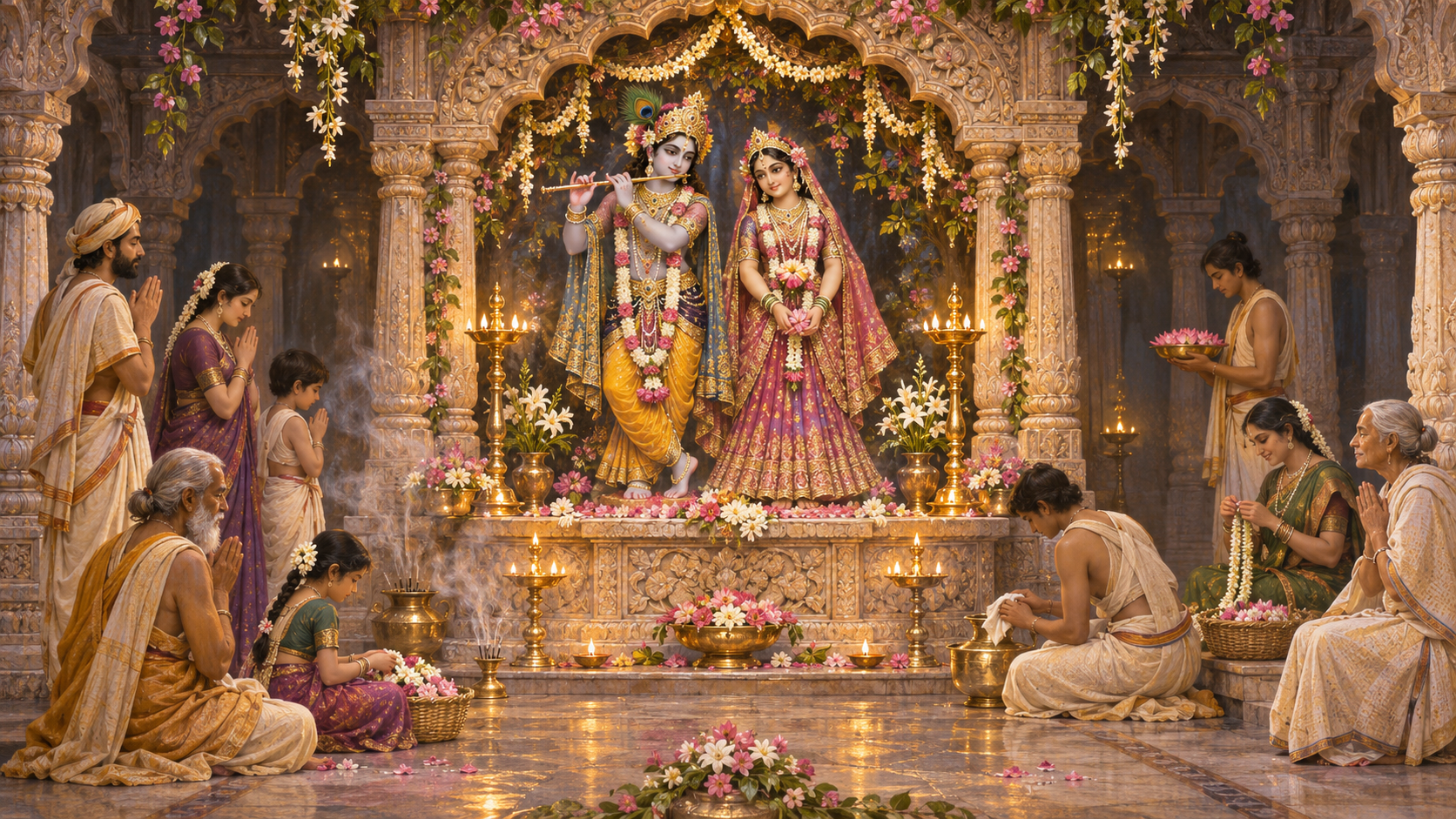
Do not manufacture ecstasy
The word ecstatic can tempt you to monitor yourself for strong feeling, tears, vivid imagery, or loss of ordinary awareness. That reverses the direction of devotion: Sri Radha becomes a means for producing an experience about yourself. Do not grade the practice by emotional intensity. Grade it by the direction of attention and the quality of the response that follows.
If strong feeling comes, receive it without turning it into a claim about your spiritual attainment. If no strong feeling comes, continue without self-condemnation. Steady remembrance and faithful service do not become worthless because they are quiet.
Do not turn devotional poetry into anatomy
Sacred description may invite close attention to beauty, but close attention does not authorize invented precision. Do not create exact proportions or physical specifications and present them as received teaching. The point is not to reconstruct Sri Radha as though solving a technical diagram. The point is to let beauty become personal remembrance.
Do not confuse reverence with refusing to look
You may hesitate because focusing on a bodily feature feels too intimate. The remedy is not necessarily to avoid sacred form. It is to correct the manner of seeing. Look as you would make an offering: carefully, without possession, and with awareness of the person to whom the feature belongs. Detailed attention becomes objectifying when it severs the feature from personhood and relationship, not merely because it is detailed.
Do not use private feeling as spiritual rank
A devotional impression may be meaningful to you without becoming a rule for everyone else. Keep private insight subordinate to received teaching, and do not use an emotional response to rank yourself above devotees whose practices or temperaments differ. A meditation centered on Sri Radha should weaken the desire for status, not give that desire sacred language.
Key takeaways
- Sri Radha’s chin is a point of entry for attention, not a self-contained object or a secret code that must be deciphered.
- The healthy movement is from the visible detail to Sri Radha as a person, then toward Radha-Krishna, remembrance, and seva.
- Notice what a particular image actually presents, but do not turn a personal impression into universal doctrine.
- Do not demand an ecstatic feeling. Test the contemplation by whether it produces humility, attentiveness, reverence, and concrete service.
- When attention becomes strained, sensual, or merely analytical, widen it to the whole form or return to nama and prayer.
The next time you contemplate Sri Radha, make the movement simple. See the whole form, rest gently on the chin, allow the detail to return you to her personal presence, and close with seva. If the detail deepens remembrance, keep using it. If it contracts into speculation or self-conscious performance, release it and return to the whole.
You do not need to produce ecstasy. You need to make your attention available to devotion. Let Sri Radha’s chin be the threshold, and walk through it toward loving remembrance rather than stopping at the threshold itself.
References

Leave a Reply
You must be logged in to post a comment.