
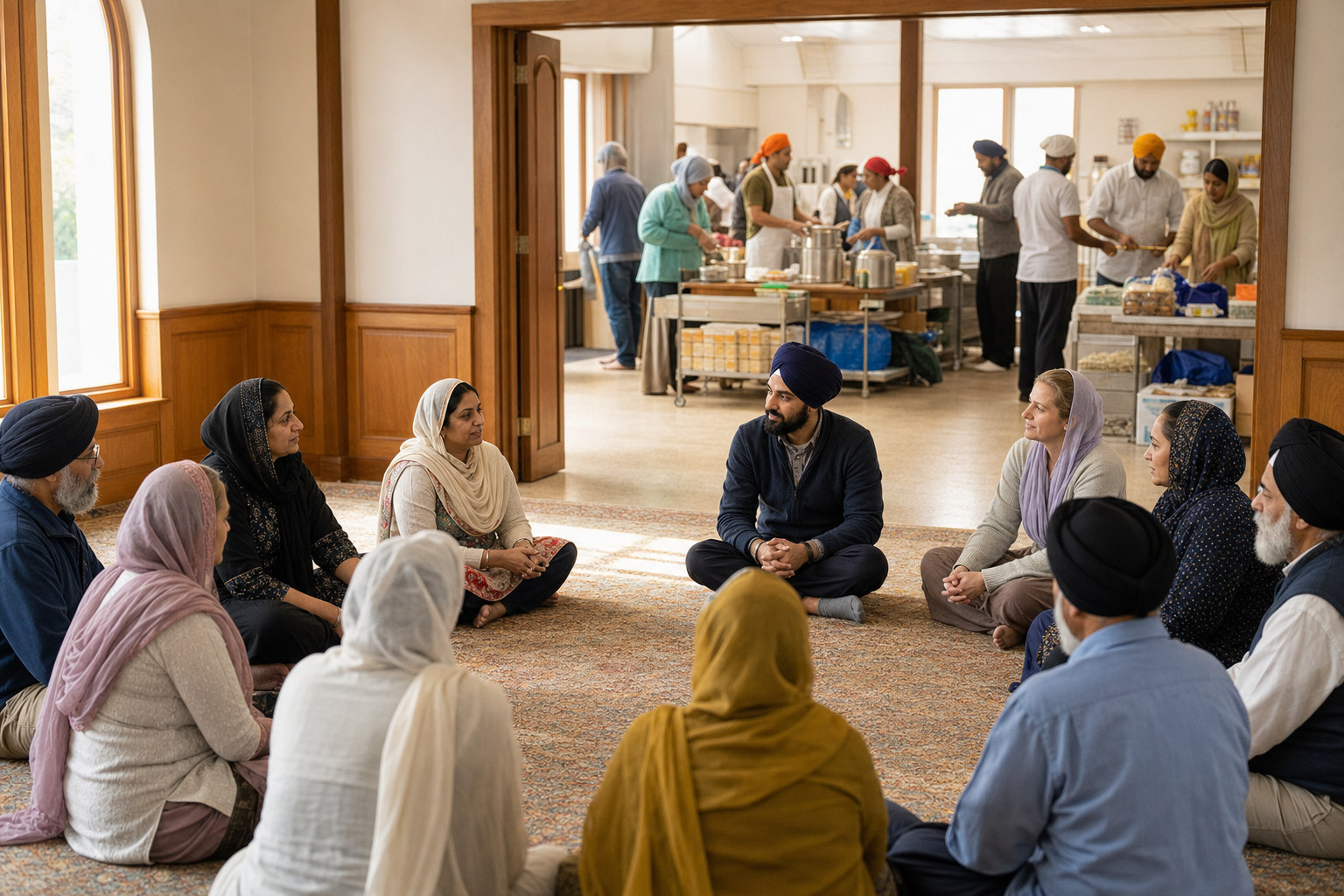
If you are trying to lead a gurdwara committee, seva team, youth group, family initiative, or community institution, the hardest problem is rarely a shortage of opinions. It is keeping authority from becoming ego, service from becoming display, and unity from becoming enforced silence.
Sikh tradition offers you a more demanding standard. A leader must cultivate judgment through Gurbani, make authority answerable to seva, protect people without hatred, and bring distinct groups into common action without erasing their legitimate differences. The standard is not whether you appear decisive. It is whether the people around you become more capable of truth, service, courage, and cooperation.
Begin with what the Guru requires, not what your side wants
Most community disputes arrive disguised as questions of principle. Look more closely and you may find a contest over recognition, control, access, family standing, or the fear of losing influence. The language can sound religious even when the real struggle is personal.
Your first responsibility is therefore inward. Before asking how to win the decision, ask what attachment may be shaping your judgment. Naam Simran matters to leadership because an unsettled ego can turn every disagreement into an insult and every compromise into a defeat. Humility is not passivity. It is the discipline of seeing your own motive clearly enough that it does not quietly become the community’s policy.
Sant Maskeen Ji modeled this kind of leadership through intensive engagement with the Guru Granth Sahib, clear katha, Naam Simran, humility, and seva. His teaching did not leave Gurbani suspended above ordinary life. It brought spiritual principles into questions of family conduct, work, responsibility, and communal understanding. That is the test for a leader using scriptural language: can you explain what a principle requires in the present situation, in plain words, without using quotation as a substitute for reasoning?
Before you advocate a decision, write down four things:
- The duty: What responsibility is actually at stake?
- The affected people: Who will carry the cost, especially if they are not in the room?
- The ego-risk: What outcome do you personally want, and could that desire be distorting the issue?
- The practical consequence: What will change for the sangat if your proposal is accepted?
If you cannot answer those questions without naming an opponent, you probably have not reached the real issue yet. Return to the duty. A decision framed around defeating a person will keep the conflict alive even if your motion passes.
It also helps to separate three kinds of disagreement. A question of Sikh principle needs careful engagement with Gurbani and established discipline. An administrative question needs relevant facts, workable options, and accountable judgment. A conflict driven by status needs honest mediation rather than increasingly elaborate theological arguments. Confusing these categories is one of the quickest ways to make a solvable dispute permanent.
Use a simple order in meetings: establish the shared duty, establish the facts, consider the options, and only then discuss names or assignments. When personalities come first, every fact is interpreted through faction. When duty comes first, people have a common standard against which to test their preferences.
Make seva the evidence that authority is being used well
A Sikh leader does not prove commitment by occupying the most visible place. The proof lies in what becomes possible for other people. Are the vulnerable protected? Is a burden removed? Can someone participate who was previously overlooked? Does the institution become more trustworthy, capable, and generous?
This distinction matters because public activity can resemble seva while serving the organizer’s reputation. A large event may generate attention without creating durable benefit. A modest intervention may be genuine service if it meets a neglected need and leaves the community stronger. Visibility does not invalidate seva, but visibility cannot be its measure.
Jassa Singh Ahluwalia provides a political expression of the same ethic. In the upheaval of eighteenth-century Punjab, his leadership joined collective defense to civilian protection, safer routes, support for religious institutions, and disciplined stewardship. The principle of Deg Tegh Fateh held the cauldron and the sword together: welfare and defense, nourishment and protection. Power had a moral purpose beyond possession.
You can apply that standard without holding public office. Before approving a project, run a seva audit:
- Identify the people who receive the direct benefit. Do not settle for saying that the project helps the community in general.
- Name the burden being reduced: hunger, isolation, confusion, exclusion, insecurity, or lack of access to learning.
- Check who performs the quiet work after the public moment has passed.
- Ask whether the same benefit could be delivered with less ceremony, expense, or competition for credit.
- Decide who remains responsible when enthusiasm fades or the original organizer steps away.
A project that cannot survive without one personality is not yet a community institution. Share the knowledge, document the process, and prepare another person to carry it. That is not a threat to leadership. It is evidence that leadership has succeeded.
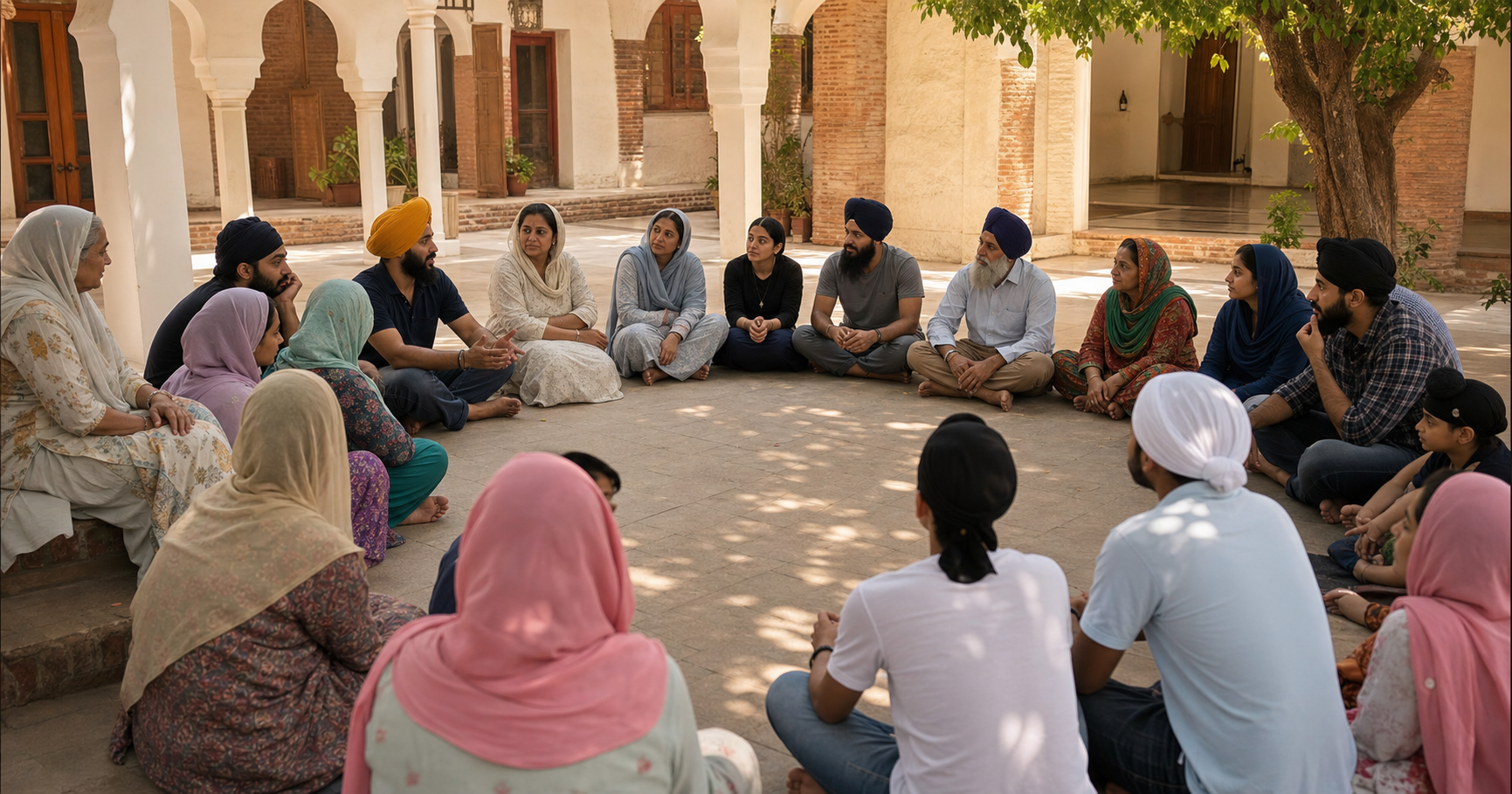
Service also changes the quality of disagreement. People who have worked beside one another on unglamorous tasks are less likely to reduce each other to political labels. If a committee is trapped in repetitive conflict, assign a shared responsibility that produces a visible benefit for others. Do not use seva to avoid the dispute; use it to restore the relationship and moral perspective needed to address the dispute properly.
Build unity around shared duty, not forced sameness
Unity is often invoked when someone wants dissent to end. That is too shallow. Silence can be produced by exhaustion, fear, exclusion, or control. None of those creates durable unity.
A better question is: unity around what duty? If the answer is loyalty to a personality, family, faction, or electoral slate, you are describing alignment, not Panthic unity. Sikh unity is meaningful when distinct people accept a shared responsibility larger than their private interests.
Jassa Singh Ahluwalia’s strength as a consensus builder lay in his ability to coordinate distinct Sikh bands within the wider Dal Khalsa. Common action did not require every misl to lose its identity. Coordination became possible because defense, civil protection, and stability supplied a purpose that no group could secure adequately on its own.
That federated instinct is useful for modern Sikh organizations. Decide explicitly what must be shared and what can remain local:
- Shared purpose: State the duty that requires cooperation in one sentence.
- Common boundaries: Agree on the principles, conduct, and treatment of people that no participating group may violate.
- Local discretion: Allow teams to choose methods suited to their circumstances where uniformity is unnecessary.
- Transparent resources: Make it clear who controls shared money, facilities, information, and public communication.
- Legitimate dissent: Give disagreement a defined path so that criticism does not have to become rebellion to be heard.
- Decision ownership: Once a fair decision is made, identify who will carry it out and how the sangat can assess the result.
This structure prevents two common failures. Total centralization breeds resentment and makes every local judgment a struggle for control. Total independence produces duplicated work, conflicting messages, and weakness when collective action is necessary. Unity lives between those extremes: firm on shared duty, flexible on method, and transparent about authority.
The same principle should guide relations across the wider dharmic family. Sant Maskeen Ji could emphasize ethical convergences among Sikh, Hindu, Buddhist, and Jain traditions without dissolving Sikh doctrine. You do not have to pretend that distinct traditions are interchangeable. You can cooperate around truthfulness, compassion, disciplined conduct, non-harm, service, cultural dignity, or the protection of places of worship while speaking honestly about differences.
When planning inter-community work, name both the shared purpose and the distinct identities involved. This avoids two opposite errors: sectarian isolation, which refuses cooperation where genuine duties overlap, and vague universalism, which treats particular traditions as inconvenient details. Respect becomes stronger when it does not require anyone to disappear.
Hold compassion and courage in the same discipline
Some leaders avoid necessary boundaries because they want to appear compassionate. Others use harshness as proof of courage. Sikh leadership asks more of you than either posture.
The discipline associated with nirbhau and nirvair joins fearlessness to freedom from enmity. Sant Maskeen Ji presented these not merely as elevated ideas but as habits of thought and action developed through steady spiritual practice. Applied to leadership, the combination is exacting: do not abandon a duty because you fear disapproval, and do not turn the person opposing you into an enemy.
Fearlessness without freedom from hatred becomes aggression. Freedom from hatred without fearlessness can become avoidance. The leader’s task is to protect the person, institution, or principle at risk while refusing the intoxicating story that cruelty is strength.
In a difficult conversation, use language that keeps the boundary clear and the person’s dignity intact:
- Describe the conduct or decision you are addressing rather than assigning a permanent character to the person.
- State the harm or risk plainly. Do not exaggerate it to recruit allies.
- Name the boundary and the reason for it.
- Offer a path back into cooperation when correction is possible.
- Refuse gossip and humiliation, even when you have the stronger case.
This is especially important when Partition, political violence, or inherited communal wounds shape the emotional background. Sant Maskeen Ji’s own journey from displacement in 1947 to a life devoted to spiritual learning and community cohesion shows that remembrance need not harden into permanent hostility. Memory can produce vigilance and empathy at the same time. You can tell the truth about suffering, protect against its repetition, and still refuse to make inherited hatred your organizing principle.
Accountability completes this discipline. A leader should be willing to explain a decision, disclose the relevant process, hear criticism, and correct an error. Humility does not mean pretending that every choice is uncertain. It means knowing that your authority is held in trust and that no title makes your judgment immune from examination.
Key takeaways for your next gathering
- Begin with the shared duty, not the personalities competing to define it.
- Translate Gurbani-centered wisdom into a clear ethical and practical reason for the decision.
- Test authority through seva: identify who benefits, whose burden is reduced, and who remains responsible afterward.
- Seek unity of purpose without demanding uniformity of method or suppressing legitimate dissent.
- Join compassion to courage: set necessary boundaries without humiliation, hatred, or factional storytelling.
- Build processes that can outlast the current leader, including shared knowledge, transparent responsibility, and accountable review.
At your next gathering, choose one decision that has become tangled in personalities. State the common duty first. Name the people affected. Apply the wisdom, seva, courage, and unity tests before discussing who gets the role or credit. Then record the responsibility clearly enough that the sangat can see whether the promised service was delivered.
That small change will not remove every disagreement. It will do something more useful: move the disagreement away from competing egos and toward accountable duty. Make that movement consistently, and leadership begins to form stronger people rather than merely stronger positions.



References
- SikhNet – Sant Maskeen Ji: From Partition Survivor to Panth Rattan, a Beacon of Sikh Wisdom and Unity
- SikhNet – Jassa Singh Ahluwalia’s Rise: Forging Kapurthala State and Sikh Unity in 18th-Century Punjab
