
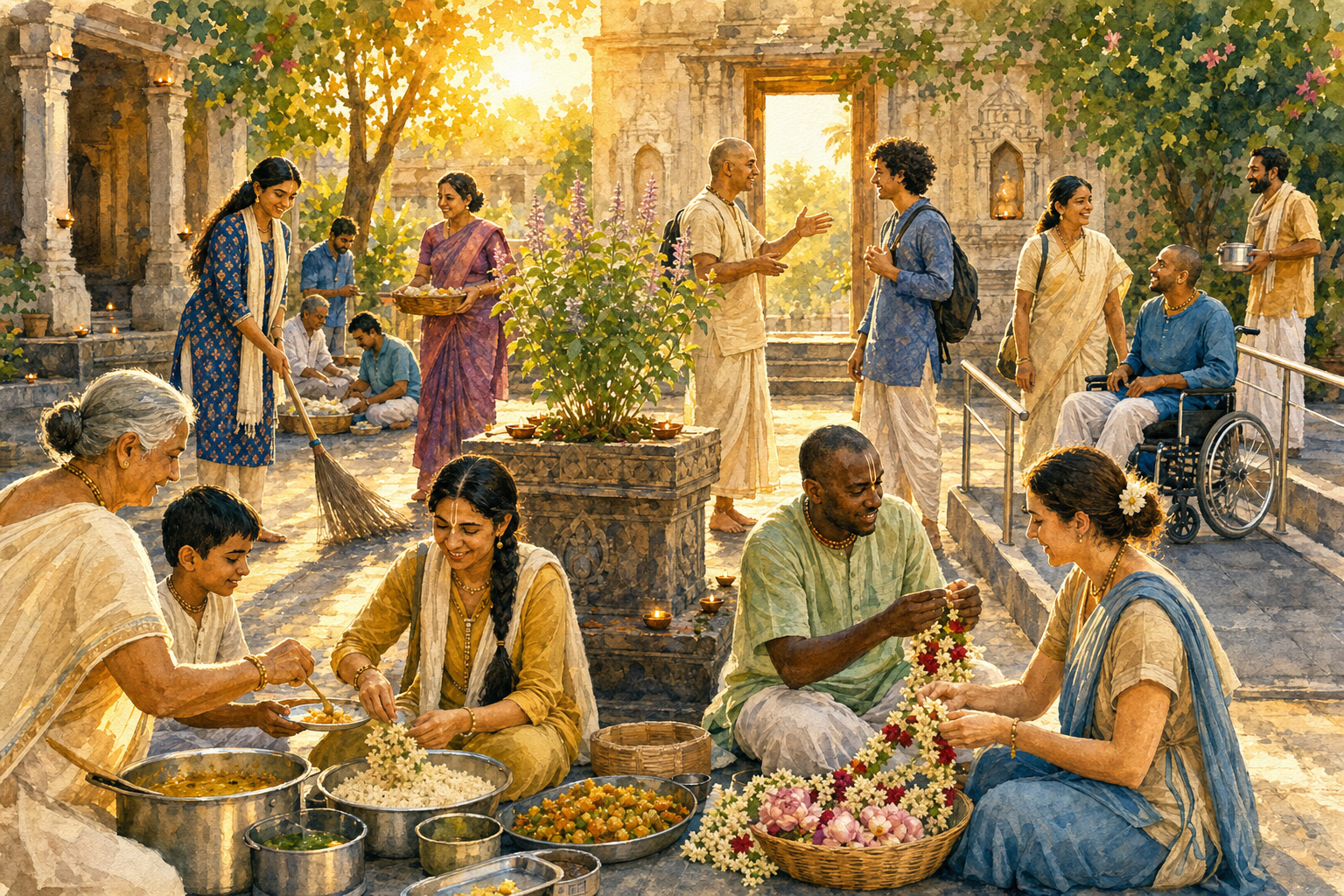
You may chant, study, visit temples, and still face an uncomfortable test: is bhakti making you easier to serve beside, or merely more certain of your own spiritual standing? Vaishnava devotion gives you a practical way to answer. Grace is received, service is your response, and inclusion reveals whether that response has reached beyond private feeling.
These three principles correct one another. Grace without service can become sentiment. Service without grace can become anxious performance. Inclusion without lineage can lose direction, while lineage without a welcoming spirit can harden into social possession. Holding them together gives you a devotional life that is disciplined, generous, and recognizably transformed.
Grace changes the question from worthiness to response
Many practitioners quietly treat spiritual life as an entrance examination. They assume they must first become pure enough, knowledgeable enough, or socially acceptable enough to approach Bhagavan. When progress is slow, they either conceal their struggle or withdraw. A second error runs in the opposite direction: if divine mercy is freely given, discipline must not matter.
Vaishnava grace breaks both patterns. In Sri Ramanujacharya’s Vishishtadvaita, Vishnu is personal and gracious, while bhakti, disciplined practice, and divine grace work together in spiritual realization. The same philosophical vision affirms the unity of Brahman without denying the real diversity of souls and the world. Difference is real, but it does not place anyone outside dependence upon the Divine.
Gaudiya Vaishnavism expresses the relationship through the extraordinary mercy associated with Sri Chaitanya Mahaprabhu and Lord Nityananda. Remembrance of Nityananda centers on forgiving grace that welcomes seekers without social distinction, calling them toward hari-nama, kirtan, humility, and service. Sri Vaishnava and Gaudiya traditions need not use identical theological language for a shared practical truth to become visible: you approach because mercy makes approach possible, and you practice because mercy deserves a response.
Grace is therefore neither a wage nor an excuse. You do not purchase it with a flawless record. You also do not invoke it to avoid repairing harm, keeping a commitment, or disciplining attention. Practice trains you to notice what ego normally ignores: what you have received, whom you have neglected, and where gratitude should become action.
Before your next period of japa, prayer, or temple worship, pause over these questions:
- What have I received that I could not have produced by effort alone?
- Where am I using spiritual difficulty as a reason to hide rather than seek shelter?
- What responsibility follows from the mercy I am asking to receive?
Do not force an elevated answer. A truthful answer may be as ordinary as gratitude for another opportunity to chant, an apology you still owe, or recognition that someone has been carrying work you take for granted. That honesty is already more useful than a dramatic devotional mood that changes nothing.
Service is how received mercy acquires a public life
Sri Vaishnava memory reveres Ramanujacharya as the earthly manifestation of Adisesha, Vishnu’s eternal support. The image teaches stability, humility, protection, and tireless service. Those qualities appeared not only in philosophical exposition but also in the stewardship of temple life at Srirangam, including organized kainkarya, ritual standards, and wider community participation.
This matters because service is not simply religious busyness. Kainkarya has an object: the pleasure of Bhagavan and the well-being of the community gathered in devotion. A task can be exhausting, visible, and praised while still feeding possessiveness. Another task can look small while expressing genuine surrender because it meets an actual need without demanding ownership.
Use four tests when choosing or reviewing a service:
- Need: Does this work answer a real need, or mainly create a role in which you can be seen?
- Reliability: Can others depend on you to complete it, including the unglamorous final steps?
- Dignity: Does your manner preserve the dignity of the people receiving and sharing the service?
- Accountability: Are you willing to follow legitimate standards, accept correction, and hand the role to someone else when appropriate?
At home, this can mean taking up an overlooked duty without turning it into evidence of your superiority. In a temple, it means asking what is needed, learning the standard, arriving prepared, and leaving the area ready for the next person. In an online devotional community, it may mean checking information carefully, helping a newcomer find the right entry point, or preserving sacred material without pretending that a digital interaction is identical to embodied worship.
Pay attention to who receives visible service and who performs invisible labor. If the same small circle always leads while newcomers remain permanent spectators, find out whether the barrier is necessary training, poor orientation, or social gatekeeping. Then make the next legitimate step explicit. An honest requirement can be learned; an unexplained barrier merely communicates that the community belongs to insiders.
Service also exposes the quality of your remembrance. Nama-japa and kirtan are meant to soften the heart toward responsible conduct, not create a protected devotional compartment separate from family, work, or community obligations. Steady chanting, attentive kirtan, intentional seva, compassion, and accountability belong in the same life. If chanting makes interruption intolerable, correction offensive, or ordinary duties contemptible, the response is not to abandon chanting. It is to bring the unsoftened part of the heart honestly into the practice.
Inclusive bhakti needs a real doorway, not diluted teaching
Inclusive bhakti does not require a tradition to become vague about its deity, lineage, practices, or sacred spaces. Nor does fidelity require making a sincere visitor feel that every unfamiliar rule is a test they were expected to pass without instruction. Ramanujacharya’s legacy holds together ritual order, philosophical precision, and accessibility across social boundaries. That combination gives communities a better model than either careless openness or defensive exclusion.
Equal spiritual dignity does not mean that every participant must immediately perform every ritual role. Training, vows, temple standards, and responsibility remain meaningful. Inclusion means that requirements are connected to dharma rather than humiliation, explained rather than hidden, and applied with consistency rather than social favoritism.
A usable path of welcome has several stages:
- Arrival: Make it obvious where a visitor may stand, sit, leave footwear, receive prasada, or ask a question.
- Orientation: Explain unfamiliar names, gestures, and expectations without treating ignorance as disrespect.
- Participation: Offer a meaningful and appropriate way to listen, chant, learn, or serve instead of allowing the visitor to remain socially invisible.
- Formation: Connect continuing interest with trustworthy teaching, regular practice, and accountable community rather than leaving the person dependent on impressions.
The same principle applies beyond a temple. A carefully structured digital presentation of Sri Ekacakra-dhama can give seekers access to sacred places associated with Lord Nityananda through site descriptions, context, and visual material. It can prepare a pilgrim, support family study, and preserve knowledge for people who cannot presently travel. Yet digital access does not replace embodied tirtha-yatra. Its value increases when that limit is stated honestly.
That is a useful rule for all inclusive outreach: lower needless barriers, but name the nature and limits of the experience. Translation can open a teaching without erasing its original vocabulary. An introductory kirtan can welcome participation without pretending that musical enthusiasm is the whole of sadhana. A public temple orientation can explain conduct without reducing a sacred place to a tourist attraction.
When assessing your own community, look for barriers that insiders have stopped noticing: untranslated terms, unexplained etiquette, inaccessible schedules or spaces, hidden costs, caste or class assumptions, and the habit of treating sincere questions as hostility. The remedy is not to discard every boundary. For each boundary, ask what dharmic purpose it serves, whether that purpose is being communicated, and whether the same purpose could be protected without unnecessary exclusion.
Share dharmic ground without flattening distinct paths
Vaishnava inclusion can also extend toward other dharmic traditions without claiming that all traditions teach the same theology. Buddhist karuna and mindfulness, Jain ahimsa, vinaya, and aparigraha, and Sikh seva and equality offer recognizable points of ethical cooperation. These similarities are strongest when used for shared action, not for erasing names, histories, or doctrinal differences.
If you are organizing a dharmic gathering, let each tradition speak in its own vocabulary. Build cooperation around a clearly shared responsibility such as service, non-harm, education, or care for sacred heritage. Do not demand theological sameness as the price of goodwill. Respect becomes credible when you can name both the common commitment and the real distinction.
Humility and lineage keep openness honest
CC Madhya 2.94-95 presents the desire to take the dust of the lotus feet of Sri Chaitanya Mahaprabhu, Nityananda Prabhu, Advaita Prabhu, Svarupa Damodara, Rupa Gosvami, Sanatana Gosvami, and Raghunatha dasa Gosvami. In the devotional language of the passage, the dust of the lotus feet signifies shelter, surrender, gratitude, and receptivity to grace. The named lineage also places personal aspiration inside a community of teachers and exemplars.
Humility here is not theatrical self-contempt. Calling yourself fallen while refusing correction is still ego. Remaining silent about preventable harm is not humility either. A workable humility makes learning possible: you can admit the limits of your understanding, receive a correction without immediate self-defense, and repair what your conduct has damaged.
When a disagreement arises, ask a precise question: is the disputed point a teaching of the lineage, a local custom, a practical rule, or one person’s preference? These categories should not be treated as interchangeable. Check the relevant authoritative teaching, consult someone accountable to the tradition, and listen closely enough to restate the concern before answering it. If your conduct caused harm, add a concrete repair rather than offering devotional language in place of one.
Parampara protects inclusion from becoming a project of personal charisma. No host, speaker, or organizer has to invent the path around their own preferences. It also protects tradition from being reduced to inherited social reflexes, because practices can be tested against the teachings and examples the lineage claims to honor. Remembrance, scriptural study, recitation, and service then become forms of accountability as well as devotion.
You can often see the depth of humility after a correction. Does the person become curious, evasive, resentful, or more careful? Apply that test to yourself before applying it to someone else. The ability to change conduct quietly is a stronger sign of humility than the ability to speak movingly about surrender.
Key takeaways for your next act of bhakti
- Approach Bhagavan from dependence, not from a claim that you have made yourself worthy.
- Keep grace and discipline together: practice receives and answers mercy; it does not purchase it.
- Give private devotion a public consequence through reliable, dignifying, accountable service.
- Make the entrance to bhakti understandable while preserving legitimate teaching, training, and ritual standards.
- Distinguish equal dignity from identical responsibility, and explain every genuine threshold clearly.
- Work with other dharmic traditions through shared ethical action without pretending their doctrines are interchangeable.
- Measure humility by teachability, repair, and changed conduct rather than devotional vocabulary.
Begin with your next act of worship. Name a mercy you have received, connect it to a service someone genuinely needs, and notice a barrier that prevents another person from participating with dignity. Then act before the insight becomes another pleasant thought.
Inclusive bhakti does not treat everyone as interchangeable. It refuses to treat anyone as spiritually disposable. When grace produces humble service and service opens an honest doorway for others, devotion becomes more than a private refuge. It becomes a way of sustaining dharma together.

References
- DharmaRenaissance Blog — Sri Ramanujacharya as Adisesha: Divine Grace, Vishishtadvaita, and Inclusive Bhakti
- Dandavats — Explore Sri Ekacakra-dhama Online: A Guided Digital Pilgrimage to Lord Nityananda’s Sacred Sites
- Dandavats — Glorifying Lord Nityananda: A Transformative Tribute to Bhakti, Compassion, and Dharmic Unity
- Dandavats — CC Madhya 2.94-95: Humility, Parampara, and the Blessings of Sri Caitanya’s Lotus Feet
