
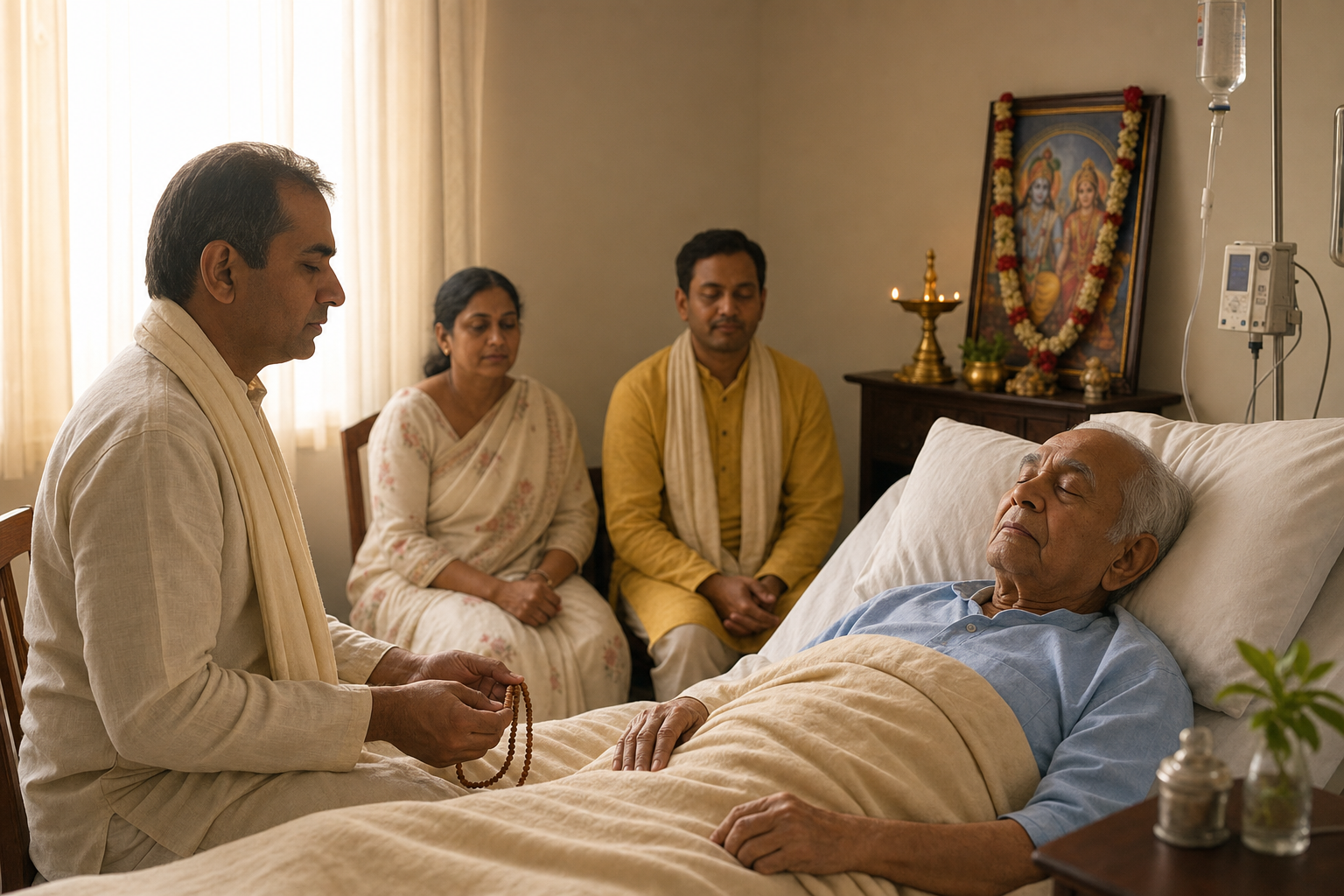
If someone you love is approaching death, the practical questions arrive quickly. What should you chant? Should the room have continuous kirtan? Is a recording acceptable? How do you include devotees without turning the bedside into a crowded gathering?
The governing principle is simple: sacred sound should make remembrance of Bhagavan easier for the person who is dying. It is not a performance, a test of the family’s devotion, or a way to control how death unfolds. A good plan protects the person’s chosen practice, physical comfort, and dignity at the same time.
Sacred sound serves remembrance, not performance
In Gaudiya Vaishnava theology, nama, the sacred name, is held to be non-different from nami, the Divine who is named. Chanting is therefore more than devotional background music. It is direct devotional association offered through the voice and received through hearing.
This explains why kirtana, hearing, and smarana belong together at the bedside. The community voices the name. The dying devotee hears or inwardly attends to it as far as they are able. That sound supports remembrance when fatigue, pain, medication, fear, or failing speech makes solitary japa difficult. If the person can still chant, follow their pace rather than asking them to keep up with yours.
The Bhagavad-Gita teaches that consciousness at the final moment bears upon the soul’s onward journey. That makes remembrance important, but it does not turn the last breath into a mechanical examination. A person may become confused, restless, sedated, or unable to speak. Death may also come suddenly. None of these circumstances gives relatives the right to issue a spiritual verdict on the devotee’s life.
Choose the sound from the person’s established sadhana. In Hare Krishna communities, the natural center is the maha-mantra preserved in the Kali-Santarana Upanishad:
Hare Krishna Hare Krishna Krishna Krishna Hare Hare
Hare Rama Hare Rama Rama Rama Hare Hare
Its balanced repetition and suitability for call-and-response kirtan make it easy for a group to sustain without complicated musical direction. Yet familiarity matters more than variety. If the devotee regularly prayed with names such as Radhe Govinda or Jaya Sri Krishna, or follows another Vaishnava sampradaya with its own prescribed mantra, do not replace that practice merely because visitors know a different chant. Ask the devotee, guru, priest, or a trusted senior from the person’s lineage.
A live voice is not automatically superior to a recording. Live chanting permits immediate adjustment to the person’s breathing, attention, and requests. A familiar recording provides continuity when relatives are exhausted or no confident leader is present. Recordings of Srila Prabhupada’s chanting and readings are often used in ISKCON homes and hospice settings because devotees recognize his pronunciation, voice, and place in their disciplic lineage. Use what the person finds spiritually familiar, not what visitors find musically impressive.
Write the bedside sound plan before a crisis

The last hours are a poor time to discover that siblings disagree about the mantra, the patient dislikes loud kirtan, or the hospital will not permit a large gathering. If the person can participate, ask direct questions while there is still time to answer them. Treat their choices as instructions, not suggestions.
A one-page plan the family can actually use
Put the following details on a single page and give copies to the main caregiver, the devotional coordinator, and the hospice or hospital team:
- Primary sacred sound: Write the exact mantra, prayer, or reading the person wants.
- Pronunciation or lineage guidance: Name the guru, priest, senior devotee, or family member who can resolve a genuine question.
- Live or recorded preference: Identify any favored recording and make it available without depending on one visitor’s phone.
- Volume and silence: Record whether the person wants continuous soft sound, scheduled periods, or chanting only when requested.
- Readings: Note whether Bhagavad-Gita, Srimad-Bhagavatam, Krishna-katha, or another familiar text should be heard, including any preferred passage if one has already been chosen.
- Sacred objects: List requested items such as Tulasi or a devotional image, subject to medical and facility rules.
- Visitors: Name the people who may lead and set a limit that protects rest and privacy.
- Decision-maker: Identify who speaks for the patient if they can no longer communicate.
- Final-breath contact: Record whom to call from the care team and the person’s Vaishnava community.
If the person can no longer answer, use their previously expressed wishes. Consult the authorized healthcare representative and the person who knows their actual devotional life, not simply the loudest relative. Silence or lack of response is not permission to introduce an unfamiliar ritual.
Ask the care team about constraints early
Hospice and hospital support for dharmic practice can include quiet space, devotional visitors, recorded chants, and access to readings, but the details vary. Ask the nurse or hospice coordinator about visitor limits, quiet hours, speaker use, infection precautions, and where devotional objects may be placed. Explain that the sound is a religious practice requested by the patient, while remaining willing to adjust its volume and format for clinical care.
Never light incense or a ghee lamp where medical oxygen is in use or where the facility prohibits flame. Oxygen can make fire spread rapidly. An unlit lamp, battery-operated light, or devotional image can provide a visual focus without creating that danger. Do not apply water, Tulasi, substances, or sacred objects to the patient’s mouth or body unless this accords with the person’s wishes and the clinical team confirms that it is safe.
If continuous devotional presence is wanted, appoint one coordinator and create a simple roster. Volunteer kirtan schedules can preserve continuity while allowing relatives and caregivers to rest. The coordinator should control numbers, brief newcomers, and tell people when the room needs quiet. Continuity of remembrance does not require unbroken volume.
Lead kirtan in a way the patient can receive
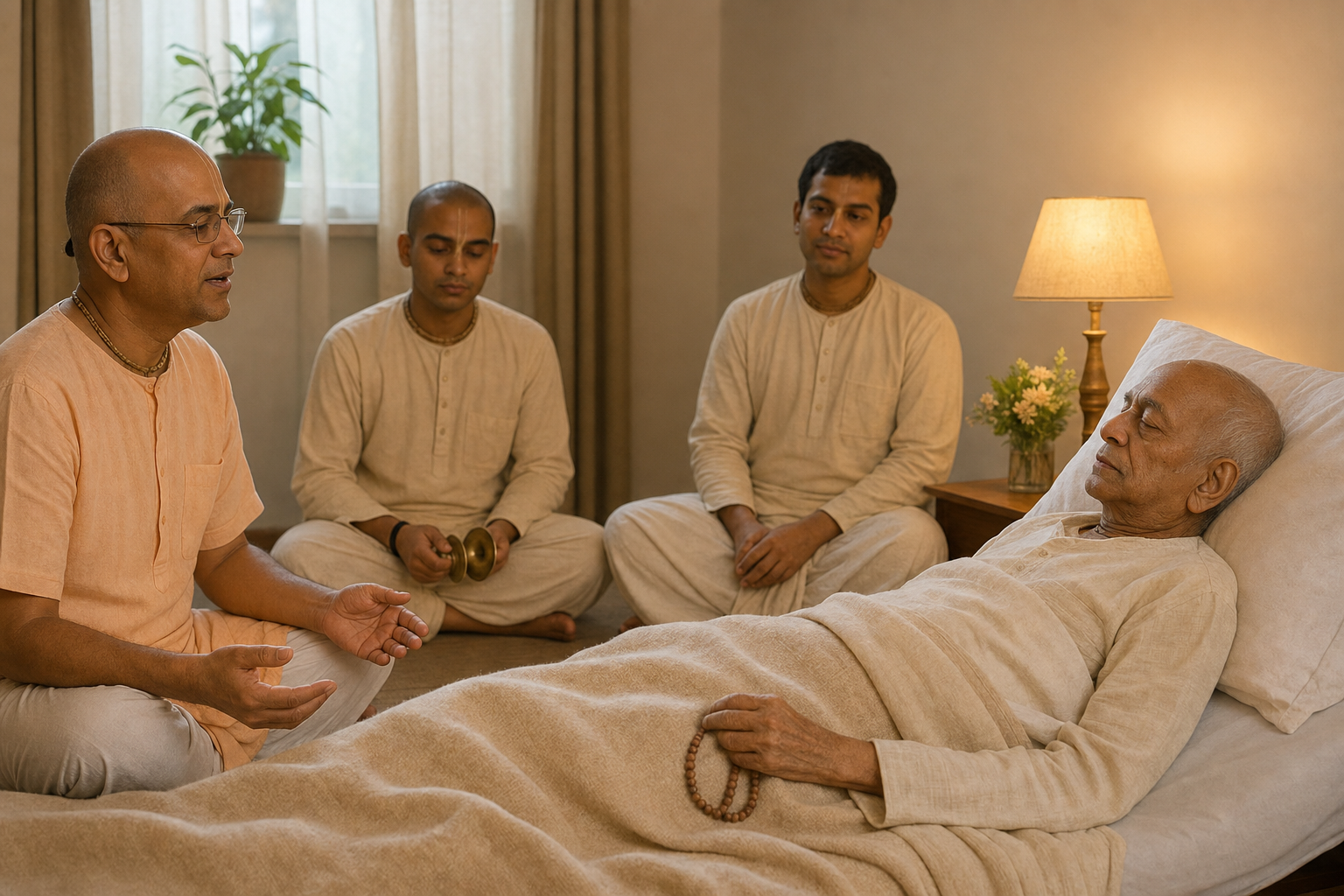
A bedside kirtan should be shaped around the person in the bed. The leader’s task is not to generate intensity. It is to keep the sacred name clear, steady, and easy to follow.
- Ask before beginning. If the person can communicate, ask whether they want chanting now. If not, follow the written plan or authorized decision-maker.
- Remove competing sound. Pause unrelated television, conversation, notifications, and overlapping recordings. One clear devotional stream is easier to attend to than several.
- Begin at the lowest useful volume. The words should be distinct at the bedside without filling the entire ward or forcing the patient to respond.
- Keep the musical form simple. Use one leader, an unhurried response, a stable melody, and restrained accompaniment. Avoid sudden tempo changes, long improvisations, or instruments that overpower the words.
- Follow the patient’s cues. A request for quiet, a gesture, visible tension, or an attempt to remove headphones or a speaker is a reason to pause and check. Do not interpret distress as a need to chant louder.
- Rotate people, not practices. When one leader tires, another can continue the same mantra and mood. The dying person should not have to adjust repeatedly to new songs and styles.
- Leave room for clinical care. Lower or pause the sound immediately when nurses need to communicate, assess symptoms, or perform a procedure. Resume gently afterward if the person still wants it.
Pronunciation matters because a divine name carries meaning, but the bedside is not a diction examination. Choose a recording or leader whose words are clear. Correct persistent uncertainty before the vigil begins, not by interrupting a grieving relative during the final hours.
Reading can alternate with chanting when that is the person’s preference. Select a short, familiar passage from Bhagavad-Gita or Srimad-Bhagavatam and read it slowly. A bedside reading is meant to nourish remembrance, not become a lecture, debate, or display of learning. If the person becomes tired, return to the simplest name or allow silence.
Silence is not a failure of bhakti. Some people need periods without external sound, especially during pain, procedures, or profound fatigue. Japa may continue quietly elsewhere, and a devotee can remain present without speaking. The patient’s ability to receive the practice matters more than the family’s desire to keep producing it.
The same discipline applies in a mixed-dharmic family. Sikh Naam Simran and shabad kirtan, Buddhist patha, and Jain stavans also use sacred sound to orient awareness. That shared dharmic intuition can help relatives understand why chanting matters, but it does not make practices interchangeable. At this bedside, honor this person’s chosen path.
Protect medical care and dignity at the final breath
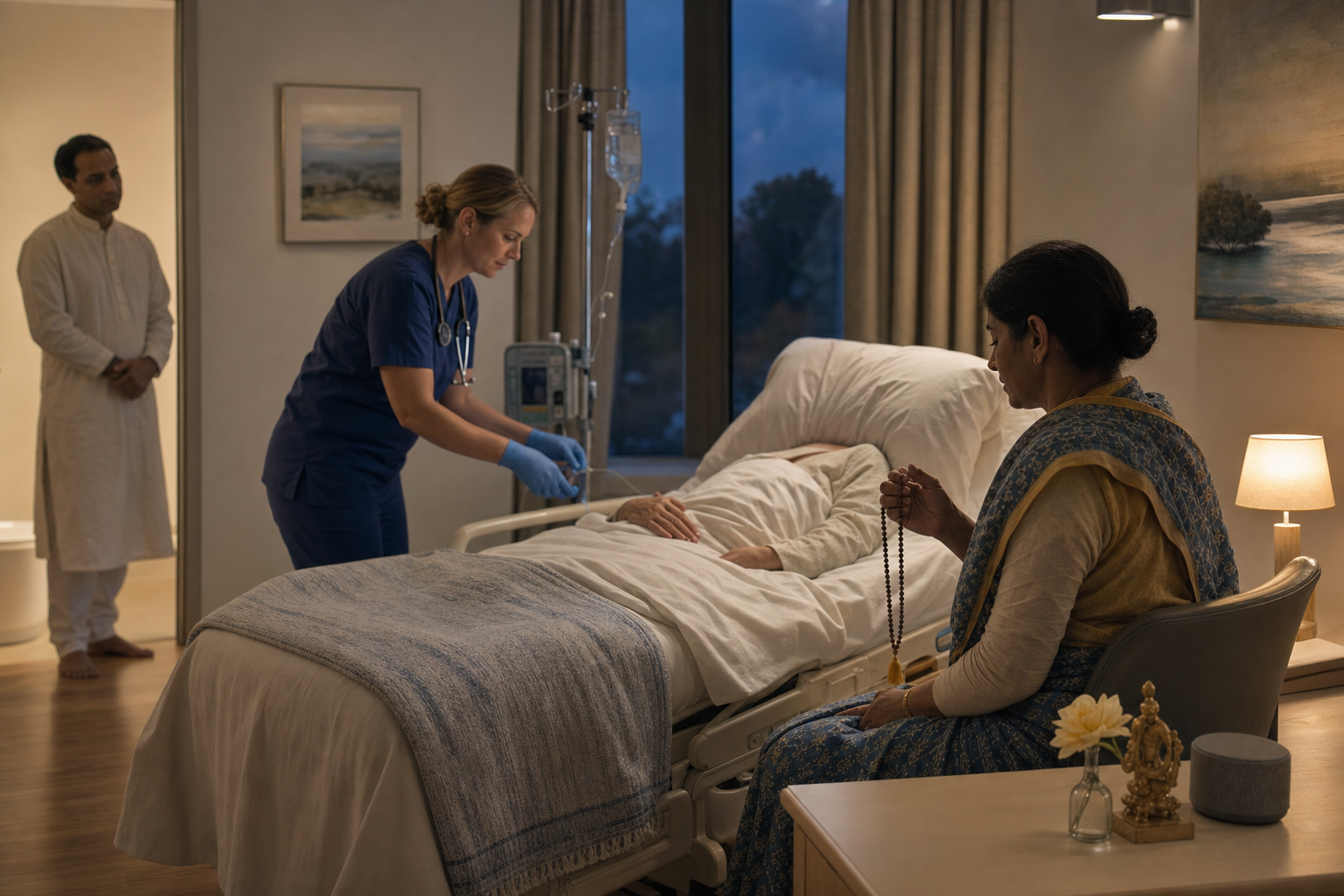
Sacred sound complements end-of-life care; it does not replace it. New or worsening pain, breathlessness, agitation, or other distress requires attention from the nurse, hospice clinician, or physician. Do not respond by increasing the chant’s volume, and do not assume that every physical change has a spiritual explanation.
Questions about alertness, sedation, and symptom relief belong in a conversation among the patient, their healthcare decision-maker, and the clinical team. Do not withhold or delay prescribed comfort care in an attempt to produce an idealized final moment. If alertness is an important goal for the patient, raise it early enough for clinicians to explain the available choices and tradeoffs.
Keep the room relational. Speak to the devotee by name. Tell them who is present. Offer the mantra without demanding a response. Let close family express grief without being told that tears show inadequate faith. Vaishnava families can hold separation and gratitude together; neither emotion cancels the other.
The phrase auspicious departure describes a devotional aspiration: remembrance, loving association, and an onward journey held in Krishna’s care. It is not a guarantee produced by a perfect room. A missed syllable, a medical interruption, an unexpected death, or the absence of devotees does not erase a lifetime of bhakti. This distinction protects mourners from turning sacred practice into retrospective blame.
When death appears to have occurred, notify the nurse, hospice service, or other responsible professional and follow local procedures for confirmation. If permitted, the mantra may continue softly. Do not rush to move the body or apply ritual substances before the responsible team has given instructions. Funeral and post-death observances vary by family and guru-parampara, so contact the designated priest or senior devotee rather than improvising.
In the following days, prayer gatherings, shared remembrance, and support around antyeshti can give grief a communal form. Keep the focus on the departed devotee’s service and relationships rather than evaluating the visible details of death. The community’s duty continues through meals, practical help, prayer, and patient companionship with those who remain.
Key takeaways for a Vaishnava bedside
- Use the mantra, reading, voice, and lineage that the dying person already trusts.
- Write down preferences before communication becomes difficult, including who may decide when the person cannot.
- Keep sacred sound clear, soft, steady, and responsive to requests for silence.
- Let one coordinator manage visitors and a kirtan roster so the room remains calm.
- Pause for clinical communication and seek medical help for distress; chanting is devotional care, not medical treatment.
- Treat an auspicious departure as an aspiration of remembrance, never as a grade assigned to the dying devotee or family.
The best time to make this plan is while the devotee can still choose. Write the single page, identify one coordinator, and show it to the care team and closest relatives. At the bedside, you will not need to invent sacredness. You will only need to protect the practice the person has already chosen.
References
- Dandavats – Radha-Krishna, Bhakti, and Opera: Sir John Tavener’s Mantra Quest and the Cosmic Rasa-lila
- Dandavats – A Sacred Farewell to His Grace Prana Das (ACBSP): Vaishnava End-of-Life Rites in Purusottama
