
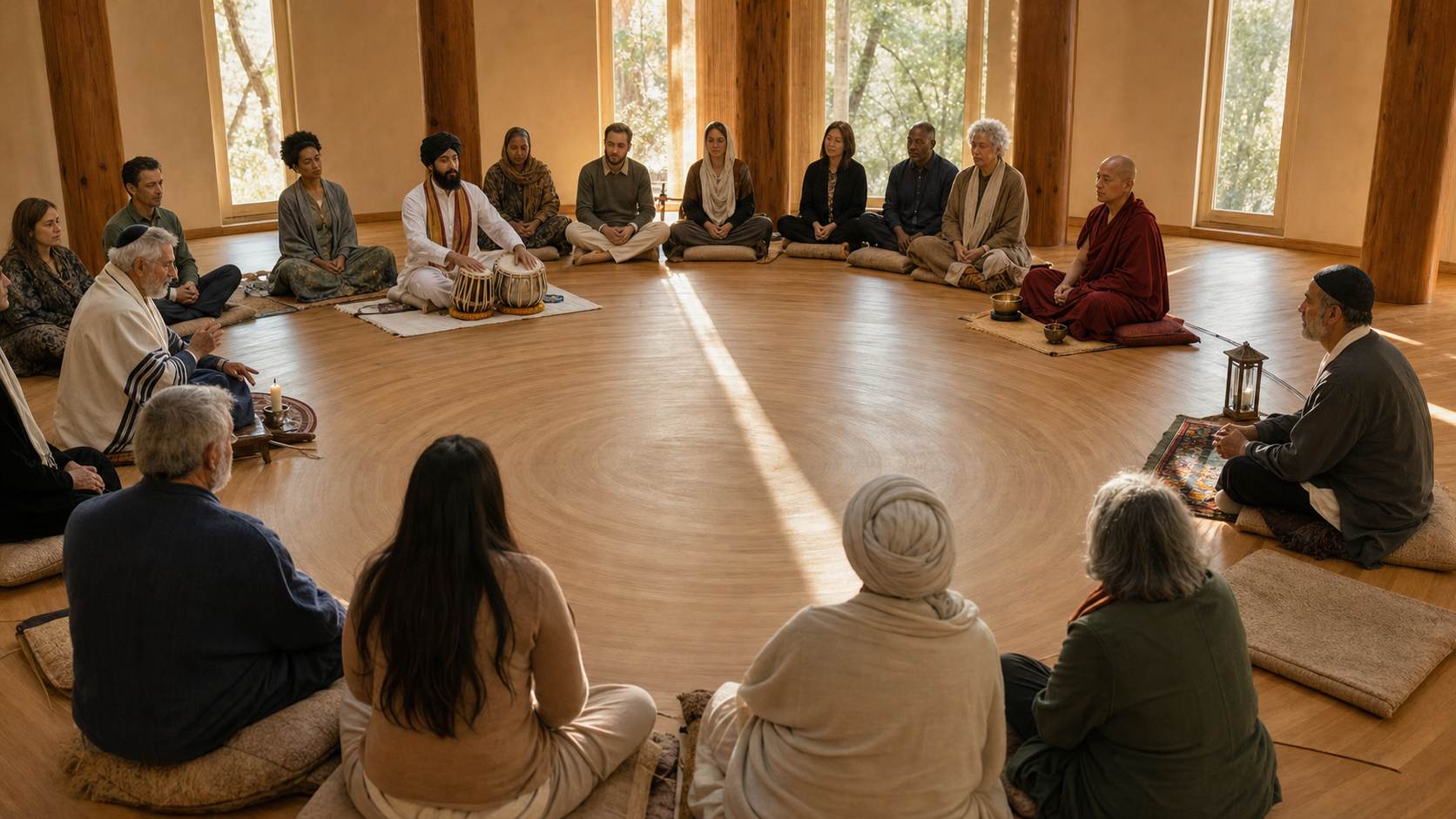
If you are planning an interfaith gathering, the hardest question is not which mantras belong on the program. It is how to let people meet through sacred sound without asking anyone to pretend that their traditions teach the same thing.
The most trustworthy format is simple: each lineage explains and leads its own practice, every participant may chant or listen, and the offerings remain distinct. You share attention, hospitality and an ethical intention. You do not manufacture a common theology. That distinction turns chanting from a display of diversity into a disciplined encounter with it.
Begin with unity of practice, not sameness of belief
An interfaith chanting event goes wrong when the host begins with the claim that every sacred name means the same thing. That may sound generous, but it quietly takes interpretive authority away from the people whose traditions are being invoked.
A Hindu bhakta may understand the holy name as inseparable from the presence of Bhagavan. A Sikh remembers Ik Onkar through Naam Japna, simran and Gurbani kirtan. A Buddhist mantra can cultivate mindfulness, compassion or insight without adopting a Hindu account of divine personality. The Jain Namokar Mantra salutes Arihants, Siddhas, Acharyas, Upadhyayas and Sadhus, directing attention toward perfected qualities and inner purification. Islamic dhikr belongs to yet another theological grammar, even when its use of repeated remembrance resembles a Dharmic contemplative form.
These are not interchangeable explanations of one generic exercise. They are distinct ways of disciplining attention through sacred remembrance. Their practical resemblance gives communities somewhere to meet; their doctrinal differences tell the organizer what must not be erased.
| Tradition | Practice that may be offered | What the host must preserve |
|---|---|---|
| Hindu bhakti | Japa or nama-sankirtana, including the Hare Krishna maha-mantra | The devotional understanding of the Name; it should not be presented as a generic sound exercise |
| Sikh | Naam Japna, Waheguru simran or Gurbani kirtan | Remembrance of Ik Onkar and the practice’s place within sangat |
| Buddhist | Om Mani Padme Hum or, in an appropriate Theravada setting, Buddho recollection | The purpose given by the school leading it, such as compassion, mindfulness or insight |
| Jain | Namokar, Namaskar or Navkar Mantra | Its salutation to spiritually perfected beings and its connection with purification and ahimsa |
| Muslim guest community | Dhikr using names such as Allah, Al-Haqq or Al-Rahman | Its Islamic theological frame; the host should not relabel dhikr as a mantra |
This is where Vasudhaiva Kutumbakam becomes a demanding principle rather than a slogan. A family does not become united by stripping its members of their names. Interfaith fellowship becomes credible when people can remain fully rooted while extending reverence to a neighbor.
What synchronized sacred sound can – and cannot – do
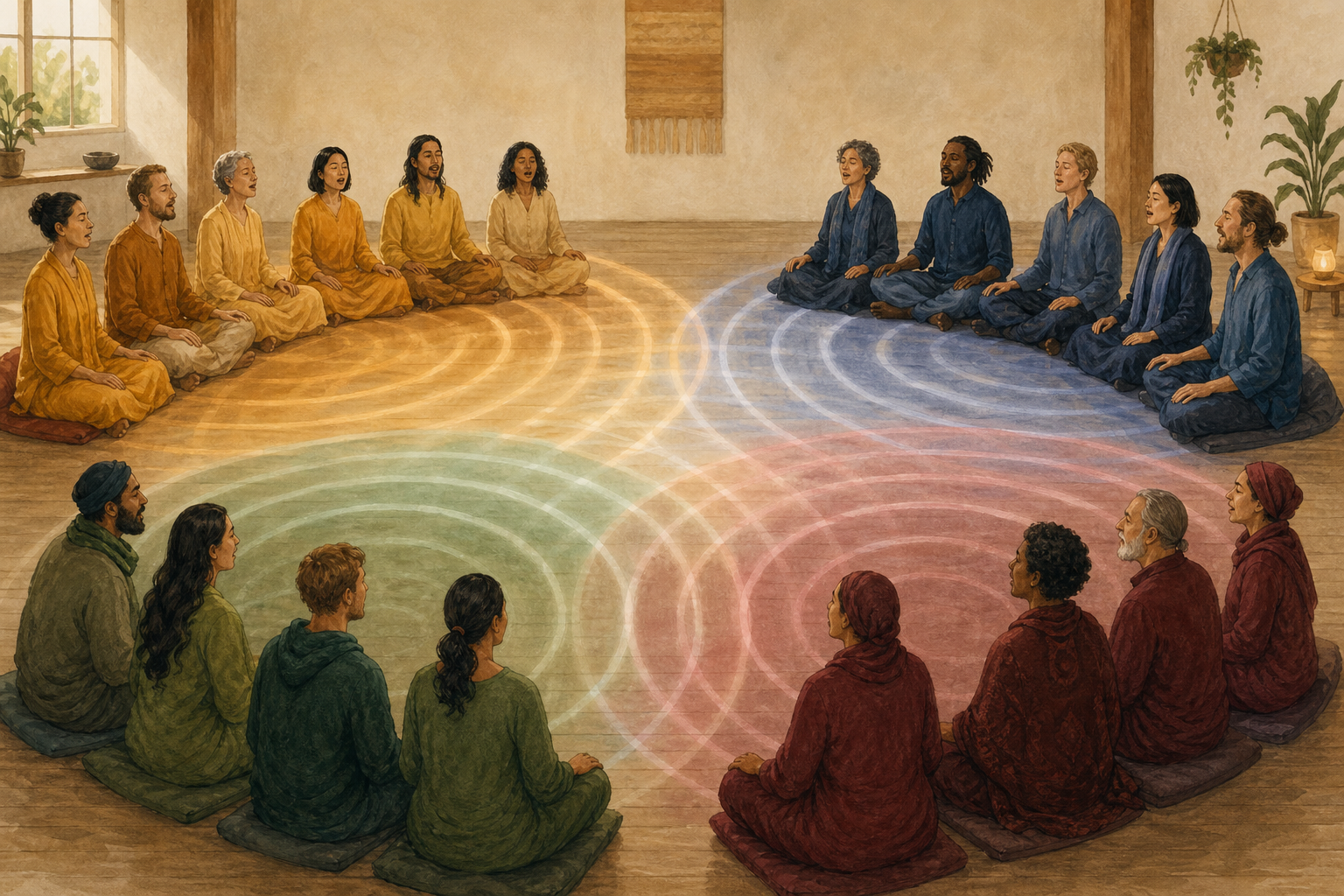
Sacred chanting creates a form of contact that ordinary panel discussions often cannot. Participants breathe, listen and direct attention together before they begin debating concepts. That shared rhythm can reduce the social distance between unfamiliar people. It gives the body an experience of coordinated presence while the mind remains anchored in a sacred word or aspiration.
In a late-1970s recollection from Tehran, Atreya Rsi reported that local Muslims had joined the Hare Krishna mantra. Srila Prabhupada welcomed their sincere glorification of God’s names rather than treating the cultural boundary as a reason for rejection. The incident does not establish that Islam and Vaishnava bhakti are doctrinally identical. It demonstrates something more practical: goodwill can allow a sacred name to become a point of hospitality instead of a border checkpoint.
There are plausible bodily and social mechanisms behind that experience. Group singing and rhythmic recitation can bring breathing toward roughly 0.1 hertz, or about six breaths per minute. Such coordination has been associated with heart-rate variability, vagal regulation and social engagement. Neuroimaging work on sacred-syllable recitation has also reported patterns consistent with focused attention, positive affect and reduced limbic reactivity.
Those findings do not turn every kirtan into a clinical intervention. Small pilot trials of mantra-based meditation, including kirtan kriya, have reported promising changes in stress, mood and some markers connected with cognitive ageing, but preliminary findings do not justify promises of treatment or prevention. Sacred chanting may support well-being; it is not a substitute for medical or mental-health care.
The same restraint applies to social claims. A powerful shared mood can open a door, but it does not prove that prejudice has disappeared or trust will last. Durable unity appears later: when participants respect another community’s boundaries, return after the novelty has faded, cooperate in service and accept correction without resentment.
Key takeaways
- Shared rhythm can make respectful contact easier, but it cannot erase doctrinal differences.
- Each lineage should choose, explain and lead its own sacred recitation.
- Listening must be treated as complete participation, not as a lesser alternative to chanting aloud.
- Keep offerings sequential and recognizable instead of blending sacred words into a single medley.
- Judge success by the trust and conduct that follow, not by the emotional intensity of the room.
Build a gathering each lineage can recognize
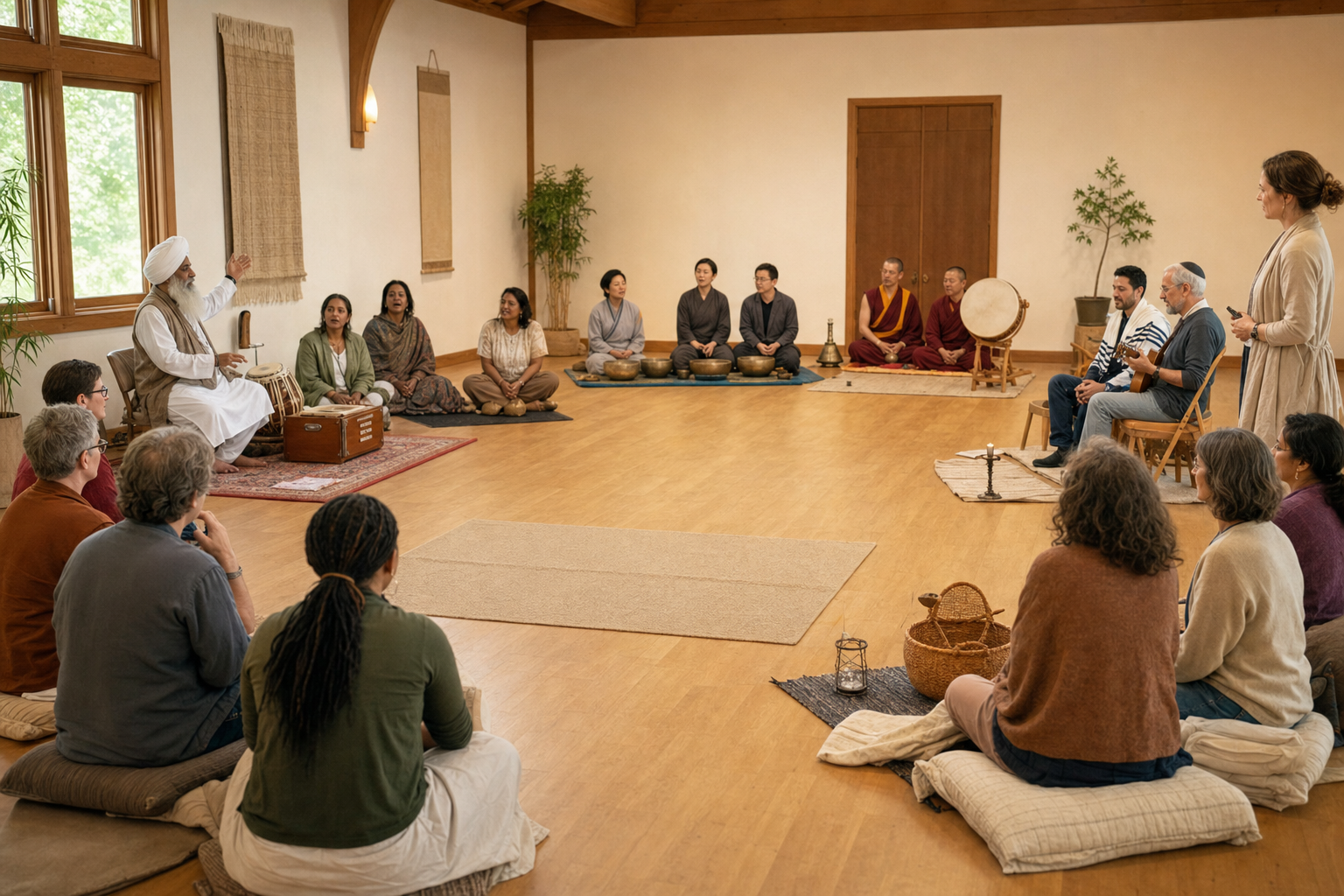
The program should be co-designed before it is publicized. Do not select another community’s sacred words from a playlist and then search for someone willing to perform them. Begin with trusted practitioners from every invited lineage and give them meaningful control over how their practice appears.
- Ask what is appropriate in a mixed assembly. Confirm which recitation may be shared, whether visitors may repeat it, which pronunciation and cadence should be used, and whether listening is preferable for guests. An invitation to participate is not permission to redesign the practice.
- Agree on the event’s purpose. Peace, compassion and friendship are workable shared intentions. A claim that all religions are secretly one is not required and may alienate the very people you hope to welcome.
- Publish the boundaries with the invitation. State that offerings will be sequential, participation is voluntary, listening is honored, and the event is neither a conversion program nor an attempt to create a blended religion.
- Let each community introduce itself. Before an offering, its own representative should briefly explain the sacred name or mantra, the attitude in which it is recited, and what guests are being invited to do. No host should explain another lineage over the objections of its practitioners.
- Open with silence and a shared intention. This gives everyone a common starting point without forcing a common creed. Keep the language concrete: peace among communities, compassion in conduct and friendship across difference.
- Offer each practice in a complete, recognizable segment. A workable Dharmic sequence could include Hindu nama-sankirtana with the Hare Krishna maha-mantra, Sikh Waheguru simran or shabad kirtan, a Buddhist mantra led by its community, and the Jain Namokar Mantra. A Muslim community may offer dhikr if it has helped shape the event and considers the setting appropriate.
- Use explicit participation language. Tell the room that people may join when comfortable or remain silently attentive. Do not ask anyone to justify abstention, and do not interpret silence as rejection.
- Close with silence and reflection. Invite participants to notice what changed in their attention, where they felt welcomed, and where the format could become more respectful. Do not turn the closing into a theological verdict on what everyone supposedly experienced.
- Create continuity before dispersing. If the aim is durable trust, agree on the next contact while the relationships are active. It may be another chanting assembly, a visit hosted by a different community, a shared meal or service conducted under mutually accepted boundaries.
The order of offerings carries meaning. If one tradition always opens, another always receives the longest musical segment and a third is repeatedly placed just before refreshments, participants will notice the hierarchy even if no one names it. Rotate the sequence and the chairing role at later gatherings. Equal dignity does not require equal musical style, but it does require equitable ownership.
Transliteration can make an unfamiliar recitation accessible, but accessibility is not a license to alter it. Ask the relevant leader to approve the text, pronunciation guide and short explanation. If a translation is contested or incomplete, say so rather than printing a smooth paraphrase that changes the theology.
Use guardrails before goodwill is tested
Good intentions are weakest precisely where clear rules are most useful. Establish the following boundaries with every participating community before anyone enters the room.
- No compulsory chanting. A person may listen, sit in silence or refrain from a particular offering without being questioned.
- No theological flattening. Avoid statements such as every name is the same name or every practice reaches an identical destination. Participants may personally hold such views, but the host should not impose them as the event’s doctrine.
- No sacred-word mash-ups. Do not place fragments of the Hare Krishna mantra, Waheguru, Om Mani Padme Hum, the Namokar Mantra and Islamic dhikr over one musical refrain. Sequential presentation lets each practice retain its cadence, purpose and integrity.
- No unapproved improvisation. Musicians should follow the leader of the tradition offering the chant. A more entertaining arrangement is not automatically a more respectful one.
- No covert proselytization. Participants may explain their beliefs and welcome genuine questions, but the shared platform should not become a captive audience for recruitment or denunciation.
- No reduction to cultural entertainment. Sacred recitation may be beautiful, but it is not merely a performance item between speeches. Introductions, silence and attentive conduct should make its devotional or contemplative purpose visible.
- No automatic permission to record. Photography, livestreaming and reuse of audio should be discussed in advance. A community’s willingness to chant publicly does not necessarily imply consent for every later use.
- No scientific sales pitch. Do not advertise stress relief, cognitive improvement or social healing as guaranteed outcomes. Let the spiritual practice be offered honestly, with preliminary well-being evidence kept in proportion.
When a disagreement appears in the room
If a leader says that guests should listen rather than repeat a particular recitation, honor that boundary immediately. Interfaith equality does not give outsiders an entitlement to vocalize every sacred formula.
If participants disagree about pronunciation or translation, pause the claim rather than staging an impromptu debate. The community leading that segment determines the form used in its own offering. A different school may present its own usage when it leads.
If someone begins recruiting, disparaging another lineage or declaring that the event proves all other paths incomplete, the moderator should intervene plainly. A soft boundary that is never enforced is not hospitality; it leaves the most restrained participants to absorb the cost of someone else’s aggression.
If a participant reports feeling misrepresented, do not answer first with the host’s intention. Ask which wording, sequence or action created the problem, record the correction and bring it to the relevant planning group. Interfaith trust grows when feedback can change the next gathering.
Measure the trust that remains after the chanting
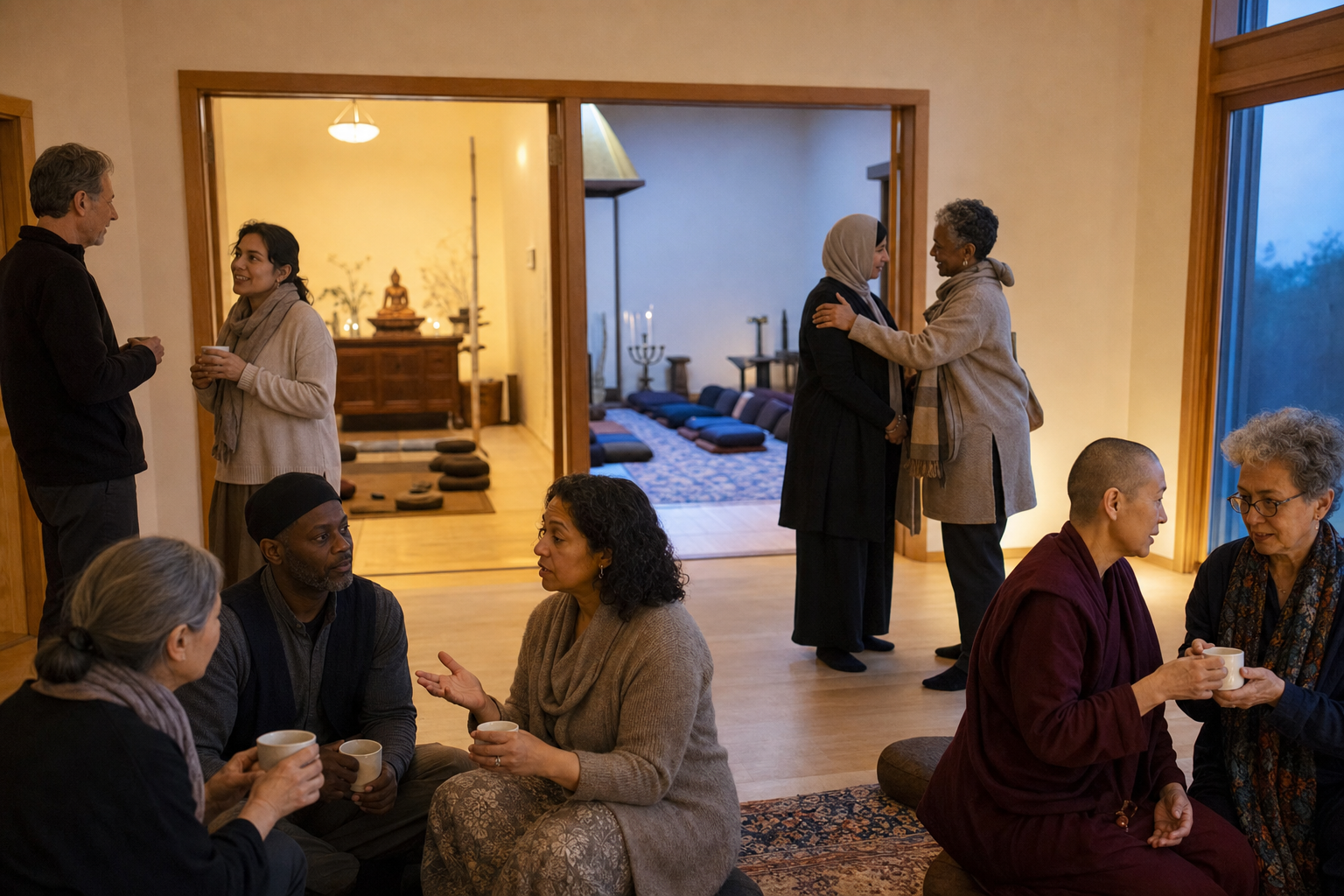
The loudest response is not necessarily the best result. Applause may reflect musical enjoyment, and an elevated mood may fade by the time participants reach home. If you want to know whether the gathering strengthened pluralism, ask about respect, safety and willingness to remain in relationship.
A light, optional check-in before and after the event can ask whether participants feel comfortable attending another community’s sacred gathering, whether they understood their freedom to chant or listen, and whether any introduction misrepresented a tradition. Leave room for criticism. A survey designed only to produce praise cannot tell you whether trust increased.
Review the event with the participating leaders as well. Useful questions include:
- Was every sacred name pronounced and introduced in a form its community recognized?
- Did participants understand that abstention required no explanation?
- Did any tradition receive less preparation, space or interpretive control?
- Did the audience confuse practical common ground with theological sameness?
- Was there any pressure, recruitment or use of sacred sound as spectacle?
- What concrete relationship will continue after the gathering?
Treat favorable responses as a signal, not proof. The stronger evidence comes through continuity: reciprocal invitations, leaders correcting one another without rupture, participants returning as guests and communities cooperating in ethically grounded service. Collective chanting can help begin that process because it synchronizes attention and affect; only conduct can carry it beyond the room.
Your next step is not to book a hall or assemble musicians. Draft a short covenant stating that each lineage leads its own practice, participation is voluntary, offerings will not be blended, proselytization is outside the program and leadership will rotate. Send it to the communities you hope to invite and ask them to correct it before the event is announced. Their corrections are not an obstacle to unity. They are the first evidence that the unity will be honest.