
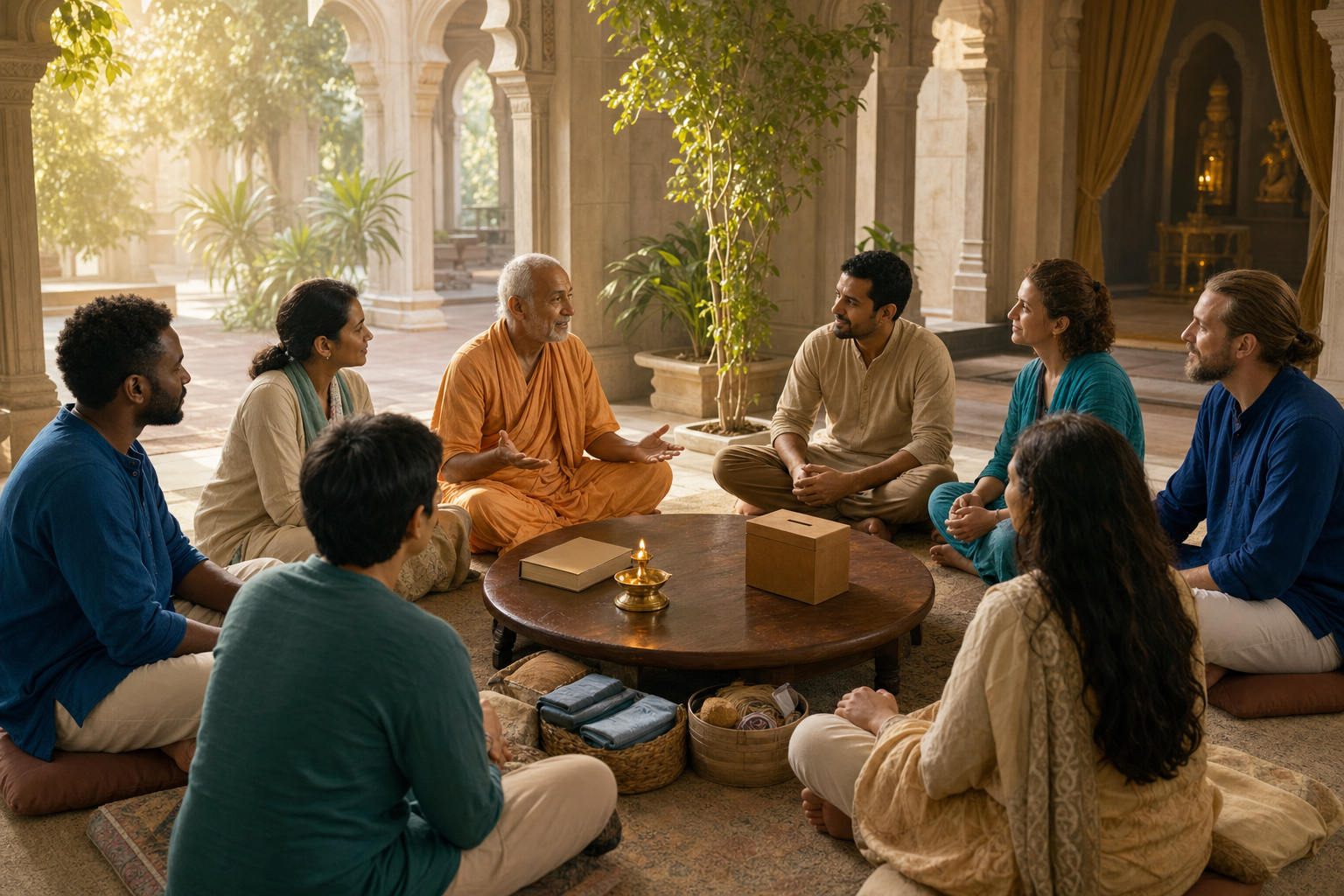
You may be trying to hold together a temple committee, cultural association, service project, or public institution. The immediate dispute may concern a budget, an appointment, a public statement, or who receives credit. The deeper decision is whether your group will be led by dharma or by ambition wearing the language of service.
Srila Prabhupada’s approach gives you two inseparable tests. Is authority disciplined by a higher duty, and can the people involved cooperate in carrying out that duty? Ethical intention without cooperation remains ineffective. Cooperation without ethical restraint merely gives collective force to whoever has the strongest personality.
Begin where ethical failure actually begins

Greed seldom introduces itself honestly. It can sound like urgency, efficiency, institutional growth, or the need for a respected leader to remain in control. A person may sincerely speak of serving society while quietly measuring success through recognition, influence, or personal prestige.
Prabhupada’s warning about political life reaches beyond elected office. When the pursuit of prosperity is driven by personal ambition, plans multiply without producing enduring harmony. A temple president, trustee, teacher, activist, civil servant, or community organiser can fall into the same error. The title changes; the temptation does not.
This is why ethical leadership begins before a policy is announced. It begins with the leader’s inner orientation. In Prabhupada’s Vaishnava understanding, God consciousness is not a decorative appeal to spirituality. Krishna is the centre, and the human being acts as servant rather than proprietor. In a broader civic setting, the corresponding disciplines include accountability to a higher moral order, restraint of desire, truthful conduct, and acceptance of responsibility.
The language of rajas and tamas offers a useful diagnostic lens. Rajas is restless activity: constant initiatives, hurried announcements, competition for visibility, and an inability to leave a decision unadvertised. Tamas is inertia: neglected duties, concealed problems, vague records, and resistance to correction. Neither busyness nor stillness proves virtue. The question is whether action proceeds with clarity and serves a purpose beyond the actor’s ego.
Before approving an important decision, ask:
- Would we still choose this course if nobody involved received public credit?
- What desire, attachment, or conflict of interest must the decision-makers disclose and restrain?
- Who receives the benefit, and who carries the burden?
- Which relevant fact would we be reluctant to place in the minutes?
- Can the decision be reviewed and corrected without treating correction as disloyalty?
One uncomfortable answer does not automatically prove corruption. A repeated pattern does reveal what formal mission statements can hide. If leaders resist disclosure, attach every initiative to themselves, or treat questions as personal attacks, the organisation has a motive problem before it has a strategy problem.
Make dharma visible in the decision
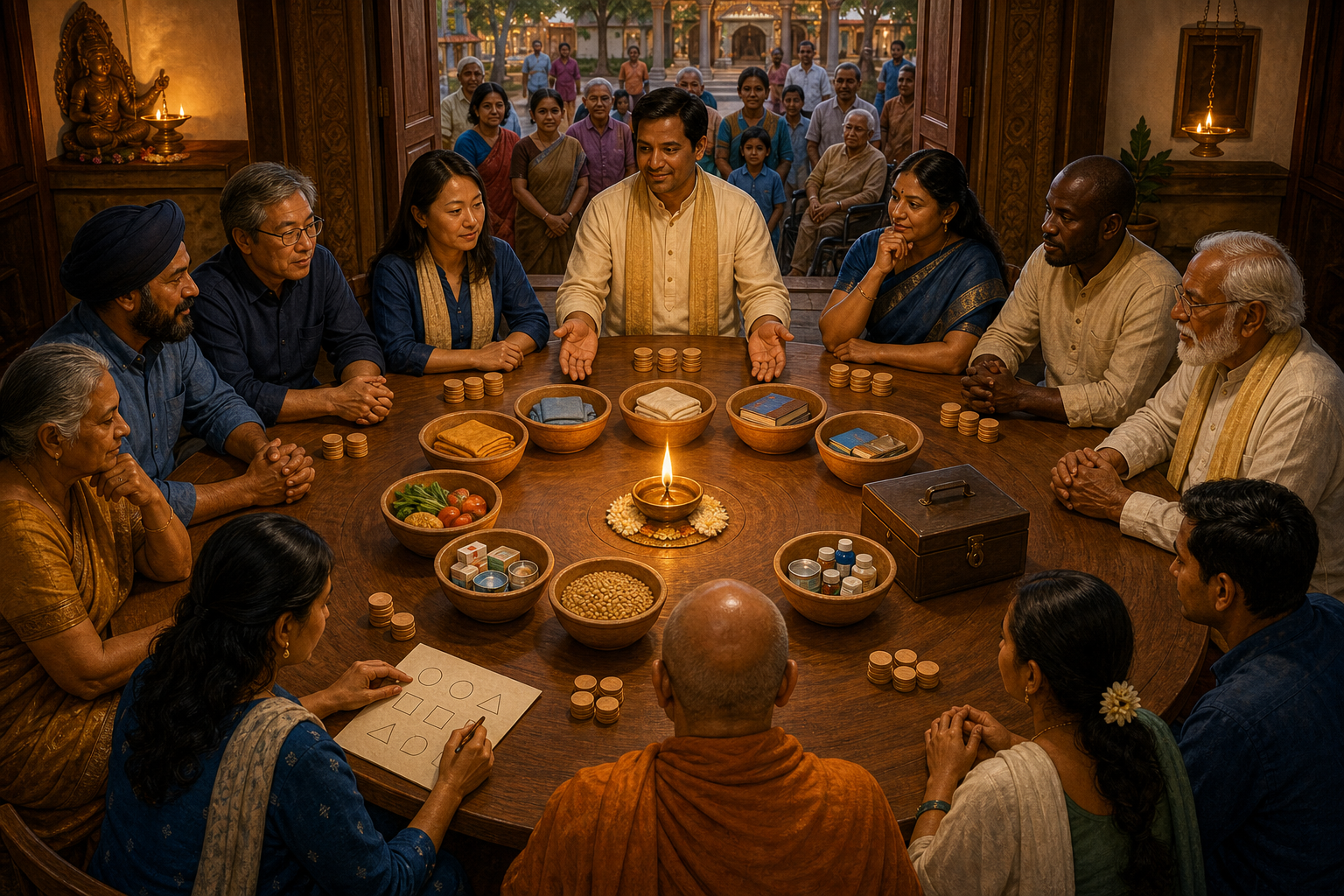
Dharma in leadership cannot remain a private feeling. Spiritual practice may form the character of a leader, but the resulting governance must become visible in decisions, records, conduct, and consequences. Satya, ahimsa, seva, compassion, and non-attachment are therefore not ornaments added after the practical work is done. They determine how the work is done.
| Dharmic discipline | Question to ask | Evidence to look for |
|---|---|---|
| Satya | What fact, uncertainty, or conflict have we not disclosed? | The record states the basis of the decision, its limits, and any relevant interests of the decision-makers. |
| Ahimsa | Who could be harmed, excluded, or humiliated by this choice? | Likely harm is named, affected people are heard, and practical steps are taken to reduce it. |
| Seva | Whose genuine need does this serve? | The public or community benefit is defined before benefits to a leader, donor, family, or faction. |
| Non-attachment | Would we support the same decision if someone else led it and received the recognition? | The decision survives a change of officeholder, title, or public credit. |
| Compassion | Have we understood the position of those who disagree? | Dissent is represented fairly, without ridicule, retaliation, or invented motives. |
| Accountability | Who owns implementation, and how will the result be reviewed? | Responsibility, expected conduct, and a review point are recorded rather than left as general promises. |
Do not turn this into a ceremonial checklist. Record the answers. If a proposal invokes seva but cannot identify who is served, send it back for clarification. If it invokes unity but requires hiding a conflict, it fails the test of satya. If it promises a noble outcome while allowing preventable humiliation or exclusion, ahimsa and compassion have not yet shaped the method.
Competence also belongs inside ethical leadership. Humility is not an excuse for poor preparation, and good intentions do not erase avoidable failure. Citizens and community members should therefore look for transparency, humility, and competence rather than rhetoric alone. A service-minded leader can explain what will be done, who is responsible, what remains uncertain, and how mistakes will be corrected.
This gives you a better way to assess a leader. Do not ask only whether the person speaks about dharma. Ask whether the person accepts limits, shares credit, discloses uncomfortable facts, keeps commitments, and permits scrutiny. Sacred vocabulary can be imitated. A sustained pattern of restrained and accountable service is harder to counterfeit.
Cooperate around service, not personality
Prabhupada treated cooperation as part of spiritual life itself. The distinction between kirtana and sankirtana makes the principle concrete: sankirtana is glorification performed by many people together. The plurality matters. Many voices become powerful through shared devotion, but they do not cease to be many voices.
United we stand; divided we fall.
Srila Prabhupada
That maxim must not be used to silence legitimate questions. Unity is not obedience to a personality, unanimous emotion, or the absence of disagreement. It is the willingness to place a shared spiritual duty above the need to dominate, win, or receive credit. If unity requires false records, concealed harm, leader worship, or abandonment of conscience, it has already separated itself from dharma.
When a group is stuck, use this meeting sequence:
- State the shared purpose in one plain sentence. If members cannot agree on the purpose, do not debate methods yet.
- Separate the dharmic principle from the preferred method. Truthfulness may be non-negotiable; the format of a programme usually is not.
- Place the known facts, uncertainties, responsibilities, and conflicts of interest before the group.
- Classify each objection. Is it ethical, factual, strategic, procedural, or personal? Different objections require different answers.
- Hear people who will carry the burden of the decision, including quieter members, before senior voices repeat their positions.
- Record the choice, the reason for it, any unresolved dissent, the person responsible for implementation, and the point at which the outcome will be reviewed.
This sequence prevents a common mistake: arguing over methods while pretending the argument concerns principles. One member may want a public programme and another a smaller gathering. That need not become a battle over devotion. First establish the shared duty. Then compare methods by their truthfulness, likely effects, available competence, and capacity to serve.
Leaders have a special obligation during disagreement. They should summarise an opposing view in terms its holder would recognise, distinguish correction from humiliation, and refuse to mobilise personal loyalty against a colleague. Members have corresponding duties: criticise conduct rather than invent motives, bring relevant facts, propose a workable remedy, and accept a fair decision when no dharmic principle has been violated.
Cooperation becomes durable when work is distributed as service rather than patronage. Assign responsibility according to competence and commitment. Make expectations visible. Share credit. Review the outcome without rewriting the original goal to protect reputations. These habits reduce the space in which factional loyalty can replace institutional duty.
Hold spiritual unity without erasing difference

A plural society presents a further challenge. People may share a civic or charitable purpose without sharing the same theology, guru, scripture, ritual, or account of liberation. Cooperation fails when leaders demand doctrinal sameness. It also fails when they pretend real differences do not exist.
Prabhupada compared a diverse spiritual assembly to a garland made beautiful by flowers of different colours. Bhagavad Gita 5.18 supplies the underlying vision through panditah sama-darsinah: the wise cultivate equal spiritual vision. Equality of spiritual regard does not make every claim identical. It changes how you treat the person who holds a different claim.
For Hindus, Buddhists, Jains, and Sikhs, shared work should begin with honest points of ethical contact: truthful conduct, compassion, disciplined desire, non-harm, responsibility, and service. The vocabulary, metaphysics, and devotional forms differ. A trustworthy coalition acknowledges those differences while defining a limited field in which cooperation is both truthful and useful.
Before entering an inter-tradition project, check these boundaries:
- Each tradition can state its own commitments without being pressured to adopt a manufactured common theology.
- The shared task is specific enough that participants know what they are agreeing to do.
- No declaration implies doctrinal agreement where only practical cooperation exists.
- Devotional participation is invited rather than coerced.
- Authority granted for the joint task cannot be quietly extended into control over each community’s internal religious life.
- Disagreement can be stated respectfully without threatening access, status, or participation in unrelated service.
These boundaries make cooperation stronger, not weaker. You can organise relief without merging metaphysics. You can host a learning circle without declaring all doctrines interchangeable. You can welcome neighbours of different religions into civic service while remaining clear about your own convictions. Joint festivals, coordinated assistance, study, chanting, and community projects can all serve harmony when the purpose and limits are explicit.
The same principle applies inside a single sampradaya. Shared doctrine does not eliminate differences of temperament, language, generation, region, or method. A leader who expects uniform personalities will create avoidable conflict. A leader who keeps the spiritual purpose clear can allow different capacities to become complementary forms of service.
Key takeaways for your next decision
- Test motive before strategy. Ask whether the decision would survive the loss of prestige, title, or public credit.
- Require visible evidence of dharma: truthful records, disclosed interests, reduced harm, accountable execution, and respectful treatment of dissent.
- Do not confuse cooperation with silence. A group becomes spiritually stronger when principled disagreement can be heard and answered.
- Separate non-negotiable ethical duties from negotiable methods. Many factional disputes persist because this distinction was never made.
- In plural settings, cooperate through clearly defined service while allowing each tradition to retain its doctrinal integrity.
- Judge leaders by repeated conduct rather than sacred vocabulary, public promises, or personal charisma.
At your next meeting, place two questions at the top of the agenda: What does dharma require of us here, and what form of cooperation will make that duty real? Record the answers, assign responsibility, and return later to the actual result. That modest discipline moves leadership away from self-image and towards seva.
References
- Dandavats – Srila Prabhupada’s Wake-Up Call for Political Leaders: Put Dharma Over Greed to Serve Society
- Dandavats – United in Sankirtana: Why Cooperation Powers Krsna Consciousness and Dharmic Harmony
