
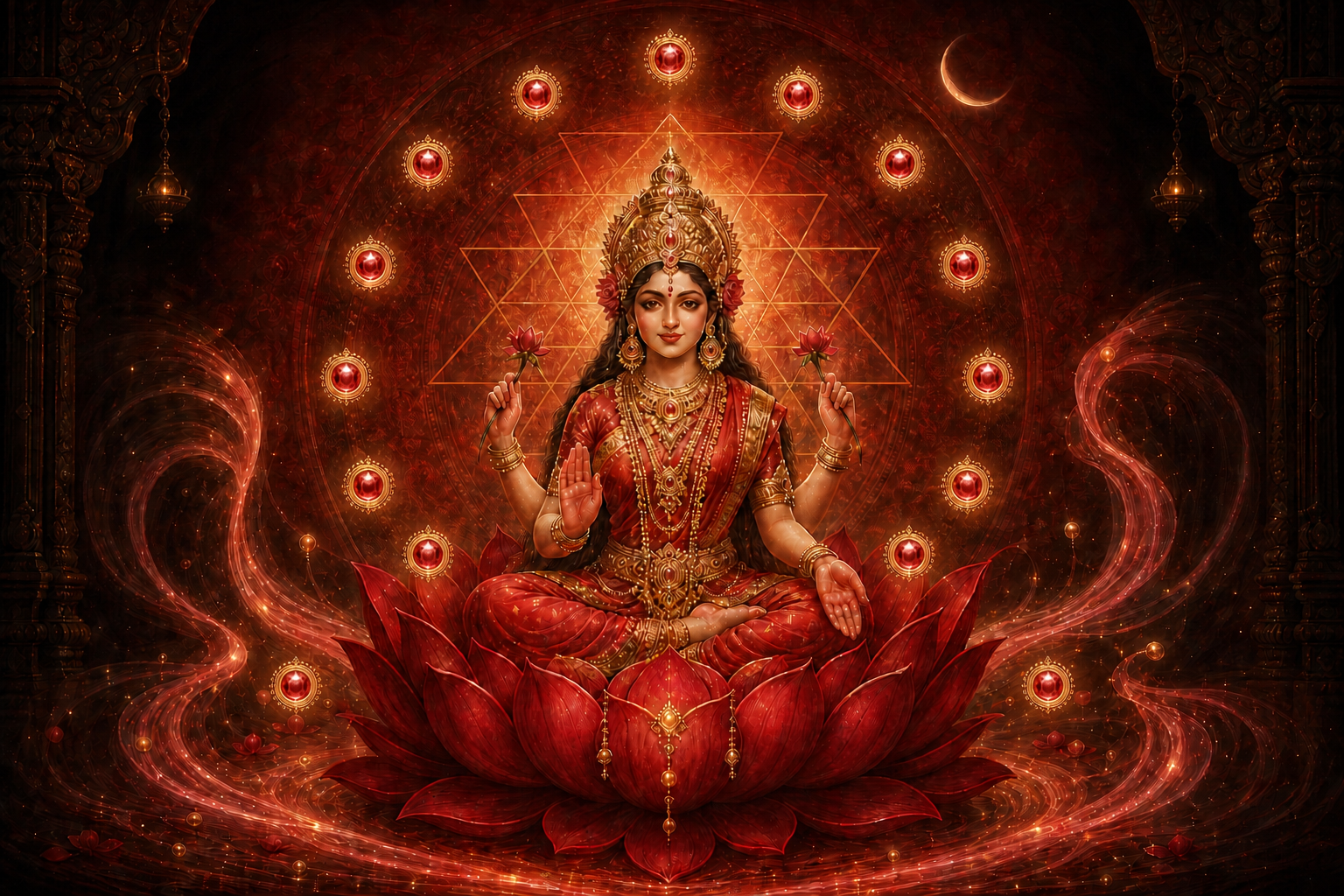
If you encountered Nityaklinna Devi in a list of Srividya deities, you may be wondering what her unusual name means, why she is connected with Tritiya, and whether that connection gives you a practice to perform. The first two questions can be answered directly. The third requires more care.
Nityaklinna becomes intelligible when you see her within the ordered mandala of the Nitya Devis. Her name points toward grace that remains fluid, but it is not a license to invent a ritual from an evocative translation. You need to distinguish symbolic understanding, calendar observance, and initiated sadhana.
Begin with her place among the Nitya Devis

Srividya does not present divine reality as a motionless abstraction. Devi is one, yet her power is encountered through ordered forms, rhythms, and relationships. Among these are the sixteen eternal powers known as the Nitya Devis. Nityaklinna is the Nitya Shakti associated with Tritiya, the third lunar day.
That placement tells you more than an isolated image or epithet can. Nitya means eternal. A Nitya Devi therefore isn’t created when her corresponding lunar day arrives or absent when it ends. The tithi reveals a particular articulation of an ever-present Shakti. Lunar time becomes a way of approaching Devi, not a boundary imposed upon her.
This corrects two opposite mistakes. Nityaklinna is not merely a calendar deity who becomes relevant once a month, but neither should she be detached from the Nitya order and treated as a free-standing symbol. Her place within that order is part of her identity.
If you are studying her, begin with the map before collecting details. Learn what the Nitya Devis represent in your branch of Srividya, how their sequence is taught, and where Nityaklinna stands within it. This prevents an attractive name from being separated from the system that gives it meaning.
Read “ever-moist” as flowing grace, not crude literalism
Nityaklinna is commonly rendered as the “ever-moist” Devi. The expression is deliberately vivid. Within the devotional meaning carried by her name, moisture indicates grace that continues to flow rather than becoming dry, rigid, or closed.
A useful way to understand this is to notice what dryness does in ordinary life. Dry earth resists the seed. A hardened heart resists relationship, correction, and compassion. What is moistened can soften, receive, and become responsive. Nityaklinna’s name turns that contrast into a theological image: divine grace does not exhaust itself, and the living relation between Devi and the devotee need not harden into mere formality.
This symbolism should not be reduced to sentimentality. Softness is not the same as weakness, emotional indulgence, or the absence of discernment. A heart made receptive by grace may become more capable of truth because it is no longer defending its rigidity. Nor should the epithet be forced into a purely physiological or erotic reading detached from Srividya’s larger theological structure.
You can use the name as a diagnostic question without pretending that the question is a formal ritual: Where has your spiritual life become dry? Perhaps recitation has become mechanical, intellectual certainty has displaced humility, or discipline has lost compassion. The point is not to manufacture an emotion. It is to notice where resistance has replaced receptivity.
Tritiya joins changing lunar time to eternal Shakti
A tithi is a lunar day, not simply a date printed on the civil calendar. Its beginning and end follow the relation of the sun and moon, so its boundaries do not necessarily coincide with midnight. If timing matters for an observance, use a reliable panchanga calculated for your location and follow the convention recognized by your tradition.
Nityaklinna’s association with Tritiya places her within this living measurement of time. The deeper lesson is not that an eternal Devi has been confined to one date. It is that change itself can disclose the eternal. The moon’s phases pass; the Shakti designated as Nitya does not. Srividya holds those truths together rather than choosing one and discarding the other.
This distinction matters in practice. A calendar can tell you when Tritiya occurs. It cannot tell you that you are authorized to use a particular mantra, nyasa, visualization, or ritual sequence. Timing and initiation answer different questions. Finding the right lunar day does not supply the rest of a lineage-based practice.
It is also wise not to assume that every Srividya lineage explains the Nitya sequence in exactly the same way. If a manual, teacher, or calendar gives you instructions, identify the tradition behind them before combining those instructions with material from somewhere else. Similar terminology can conceal important differences in sequence and application.
How to approach Nityaklinna without inventing a sadhana
Your next step depends on what you are actually seeking. Historical understanding, devotional reflection, calendar observance, and mantra-sadhana are related, but they are not interchangeable.
- Name your purpose. If you want to understand who Nityaklinna is, study her position among the Nityas and the meaning of her epithet. If you want to perform a prescribed practice, you need lineage-specific guidance rather than a general description.
- Keep interpretation distinct from instruction. Reflecting on flowing grace can deepen devotion, but a symbolic interpretation does not create a mantra, mudra, yantra, nyasa, or ritual procedure.
- Stay within practices already open to you. Without initiation, respectful reading, contemplation, and a general prayer to Devi remain different from claiming an esoteric Nityaklinna sadhana. Follow the boundaries given by the tradition you trust.
- Ask precise questions before accepting a ritual. Ask which lineage or paddhati the instructions belong to, whether initiation is required, how the mantra is pronounced, which preparatory and concluding acts accompany it, and how Tritiya is determined for that observance.
- Do not assemble a practice from fragments. A bija found in one place, a visualization found in another, and a calendar rule found in a third do not automatically form a valid sequence. In Srividya, arrangement and transmission matter alongside individual components.
A qualified teacher should be able to explain what is public teaching, what is interpretive commentary, and what belongs to initiated practice. Secrecy by itself is not proof of authenticity, but neither is online availability proof that a practice is unrestricted. Look for coherent transmission and clear boundaries, not theatrical claims.
Be especially cautious when a confident description supplies elaborate iconography, guaranteed results, or a complete mantra procedure without identifying its traditional setting. Nityaklinna’s name is evocative enough to attract imaginative additions. When a detail cannot be placed within a recognized teaching context, suspend judgment rather than filling the gap yourself.
Key takeaways
- Nityaklinna is one of the sixteen Nitya Devis of Srividya and is associated with Tritiya, the third lunar day.
- Her “ever-moist” epithet points toward grace that remains flowing, softening, and receptive rather than dry or rigid.
- Because she is Nitya, her reality is not limited to the hours of Tritiya; the tithi discloses an eternal Shakti through lunar time.
- A panchanga can establish timing, but it cannot confer initiation or determine a lineage-specific ritual.
- You can study and contemplate her meaning without turning that contemplation into an improvised esoteric practice.
If Nityaklinna has drawn your attention, begin with one disciplined act: place her back within the complete Nitya order. Then decide whether you need a calendar, a theological explanation, or a teacher. That single distinction will take you further than collecting disconnected mantras and images.
References
