
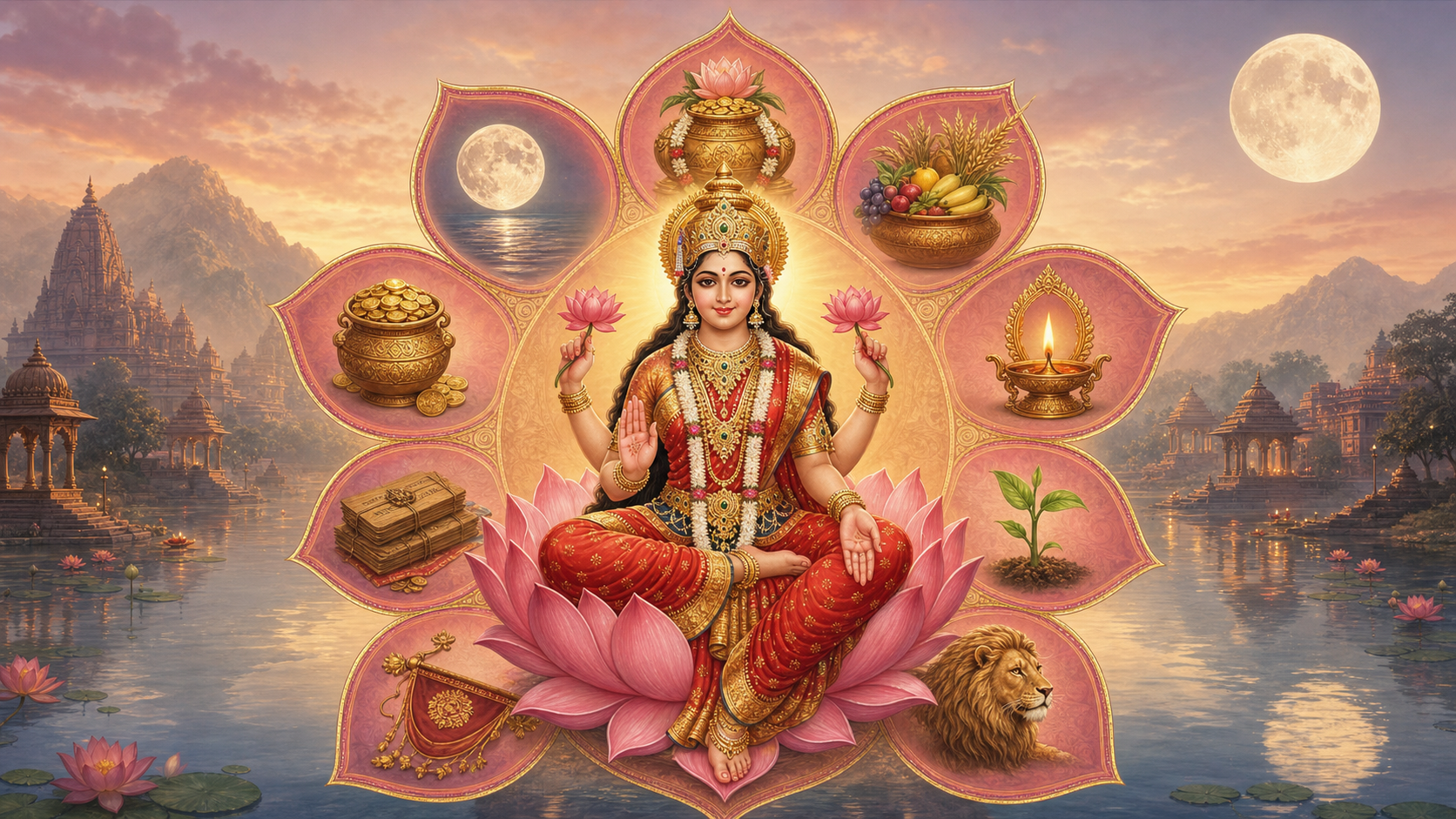
You may have come looking for the form of Lakshmi to worship for money. Begin one step earlier. Ask what kind of abundance is actually missing, and what duty would have to change if that blessing arrived. A household can have income but no peace, food but little gratitude, education but no courage, or success that damages relationships.
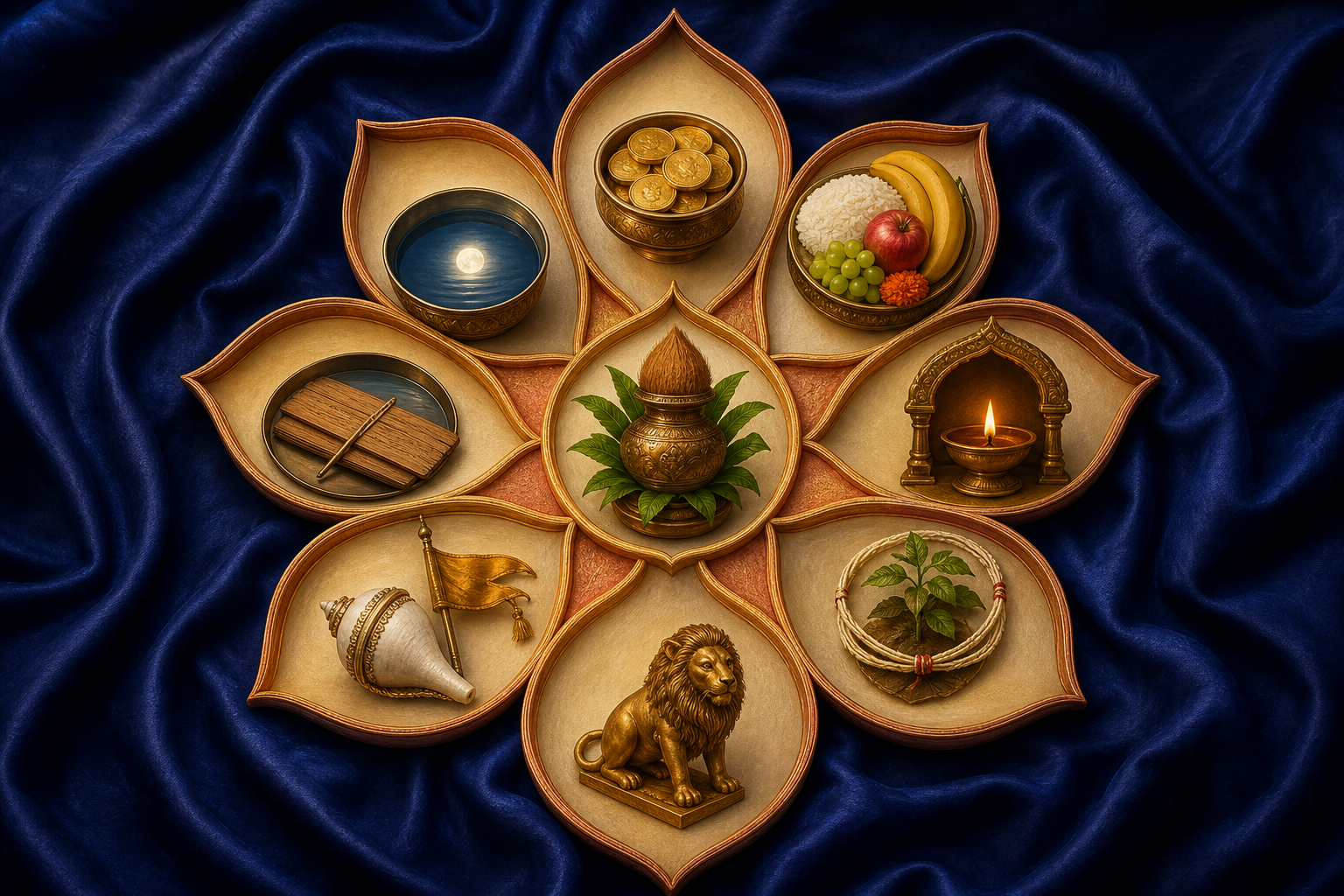
The familiar Ashta Lakshmi pattern names eight forms; a widely referenced ninefold framework adds Aishwarya Lakshmi. Enumerations differ across texts, regions, temples, and lineages. Treat this arrangement as a coherent devotional map, not as proof that every Hindu community preserves an identical list. You can respect your inherited practice while using these nine powers to examine whether prosperity in your life is whole, ethical, and sustainable.
The nine forms reveal nine different kinds of abundance
Dhana Lakshmi is the form most directly associated with wealth and resources, but she is only part of the picture. Money cannot nourish a family without Dhanya, survive difficulty without Dhairya, serve future generations without Santana, or remain beneficial without Vidya and righteous purpose. The nine forms help you notice which part of prosperity is strong, which part is neglected, and which apparent desire is concealing a different need.
| Form of Lakshmi | Sacred power | Question for your life |
|---|---|---|
| Adi Lakshmi | Primordial abundance, contentment, gratitude, and a stable inner center | Can you receive and hold prosperity without being ruled by fear, restlessness, or pride? |
| Dhana Lakshmi | Ethical wealth, livelihood, resources, generosity, and responsible stewardship | Are your earnings honest, your dealings transparent, your responsibilities honored, and your giving deliberate? |
| Dhanya Lakshmi | Grain, nourishment, health, food security, and reverence for the earth | Do you receive food gratefully, prevent waste, and help nourishment reach others? |
| Gaja Lakshmi | Dignity, protection, social harmony, and stable institutions | Does your authority make your household, community, or workplace steadier and more respectful? |
| Santana Lakshmi | Family continuity, education, caregiving, and the flourishing of future generations | What knowledge, culture, habits, and values are you passing forward through your care? |
| Dhairya or Veera Lakshmi | Courage, perseverance, ethical bravery, and disciplined action | Which dharmic duty are you postponing because it is difficult or uncertain? |
| Vijaya Lakshmi | Victory and fulfillment aligned with righteousness and the common welfare | Who benefits from your success, and what principles are you unwilling to sacrifice for it? |
| Vidya Lakshmi | Study, arts, practical skill, clear thought, and spiritual wisdom | What do you need to learn before greater effort will produce a worthy result? |
| Aishwarya Lakshmi | Plenitude that balances resources, relationships, responsibilities, peace, and virtue | Are the different parts of your life flourishing together, or is success in one area consuming the others? |
Do not read the table as a menu of isolated rewards. The forms disclose dependencies. A problem that looks like insufficient wealth may really be a Vidya problem if you lack the necessary knowledge, or a Dhairya problem if fear is preventing disciplined action. A victory that damages social harmony may satisfy ambition while violating the power represented by Gaja Lakshmi. Care for children under Santana Lakshmi still depends on nourishment, education, courage, and a stable environment.
Aishwarya Lakshmi therefore does not simply mean acquiring more than Dhana Lakshmi provides. Her plenitude is integrative. She asks whether assets, duties, relationships, inner peace, and moral character can remain in proportion. If an achievement enriches your accounts while impoverishing everything around them, the ninefold map identifies that condition as incomplete prosperity.
Choose the form by locating the real point of strain
A vague wish usually produces vague practice. Before choosing a form of Lakshmi for focused devotion, describe your situation without devotional language. This separates the blessing you imagine from the capacity you actually need.
- Name the condition plainly. Write a sentence such as: household expenses exceed reliable income; a necessary decision keeps being delayed; a child needs more attentive guidance; success at work is eroding peace at home; or food is available but regularly wasted.
- Identify the immediate bottleneck. Is it resources, nourishment, stability, continuity, courage, righteous completion, knowledge, inner contentment, or balance among several responsibilities?
- Choose the form closest to that bottleneck. When several forms seem relevant, begin with the most upstream need. If lack of skill is preventing advancement, Vidya should guide the work before Vijaya. If fear is preventing you from using skills you already possess, Dhairya may be the more honest focus.
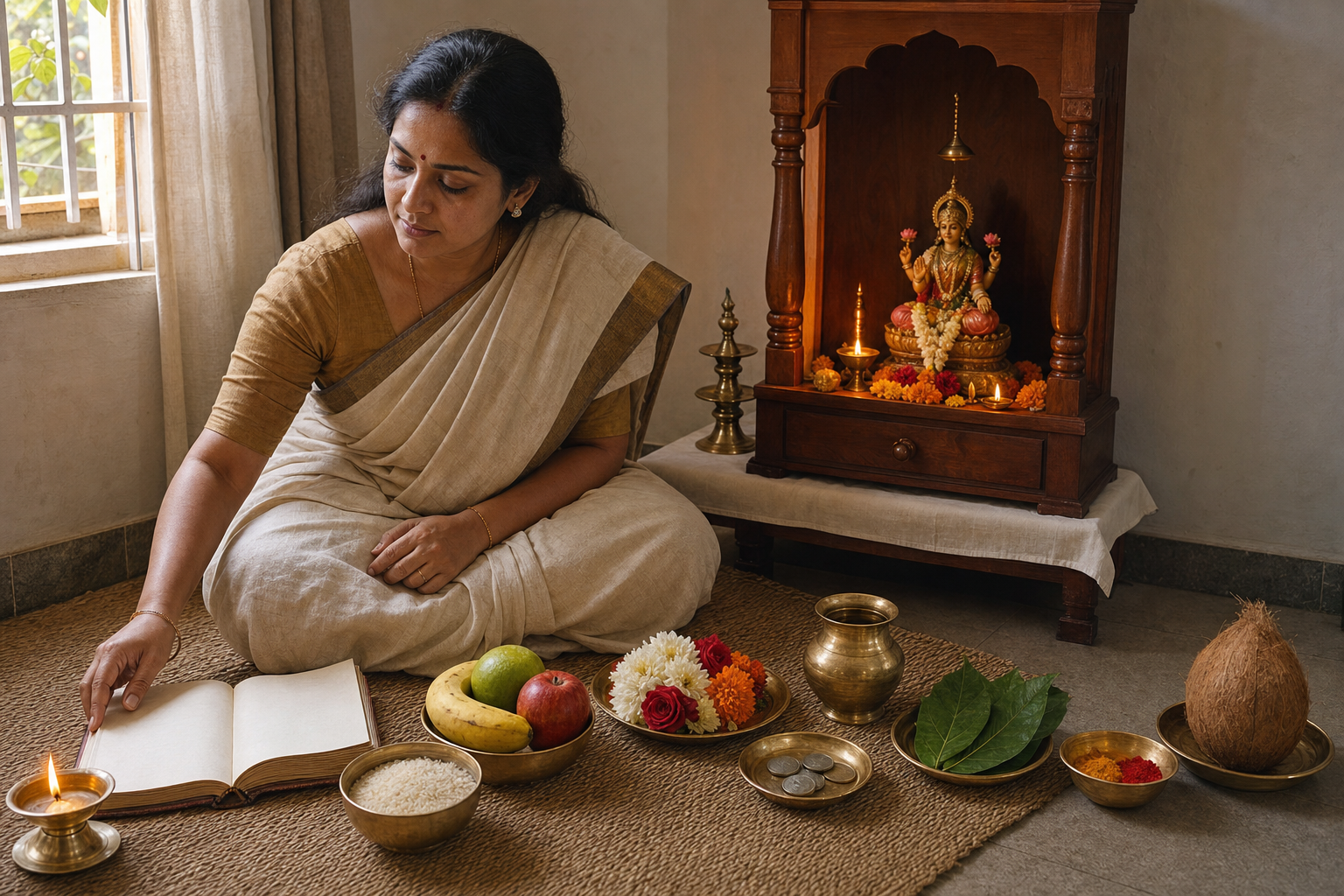
- Pair devotion with conduct. Select a practice such as puja or japa, then attach a visible duty to it. Dhana calls for honest stewardship and generosity. Dhanya calls for gratitude, reduced waste, and care for nourishment. Santana calls for actual time spent caregiving, teaching, or mentoring.
- Review the fruit in your character. Look for greater truthfulness, steadiness, courage, gratitude, restraint, and willingness to serve. An increase in craving without a corresponding improvement in conduct is a reason to correct the practice, not evidence that you need to demand more.
Suppose you are praying for career success. If you do not yet understand the work, Vidya Lakshmi leads. If you are capable but continually avoid a necessary step, Dhairya Lakshmi exposes the duty. If a worthy project needs to be brought to completion without compromising its purpose, Vijaya Lakshmi becomes central. If advancement would fracture your household, exhaust your health, or violate your principles, Aishwarya Lakshmi asks you to redesign what success means. Calling every version of this desire a request for Dhana Lakshmi hides the real work.
The same method applies when your concern is a child’s future. Santana Lakshmi is the natural center, but the practical duty may appear through Dhanya as nourishment, Vidya as education, Gaja as a stable and respectful environment, or Dhairya as patient caregiving through difficulty. You do not have to turn the forms into competing deities. Let the central form identify the purpose and the supporting powers identify what that purpose requires.
Give puja and japa a visible expression in daily conduct
Lakshmi worship becomes thin when ritual asks for an external result while daily conduct protects the cause of disorder. Puja, japa, seva, and mindful action belong together because prosperity is not sustained by desire alone. Character determines whether a blessing can be received, protected, and shared without becoming a source of anxiety or harm.
- Begin with the form or name that corresponds to the need you have honestly identified. If you follow a family, temple, or sampradaya practice, retain its mantras, names, and ritual order rather than forcing the ninefold arrangement over it.
- Name both the blessing and its obligation. A prayer for Dhana includes responsible stewardship. A prayer for Gaja includes protection without domination. A prayer for Vijaya includes moral limits on how victory may be pursued.
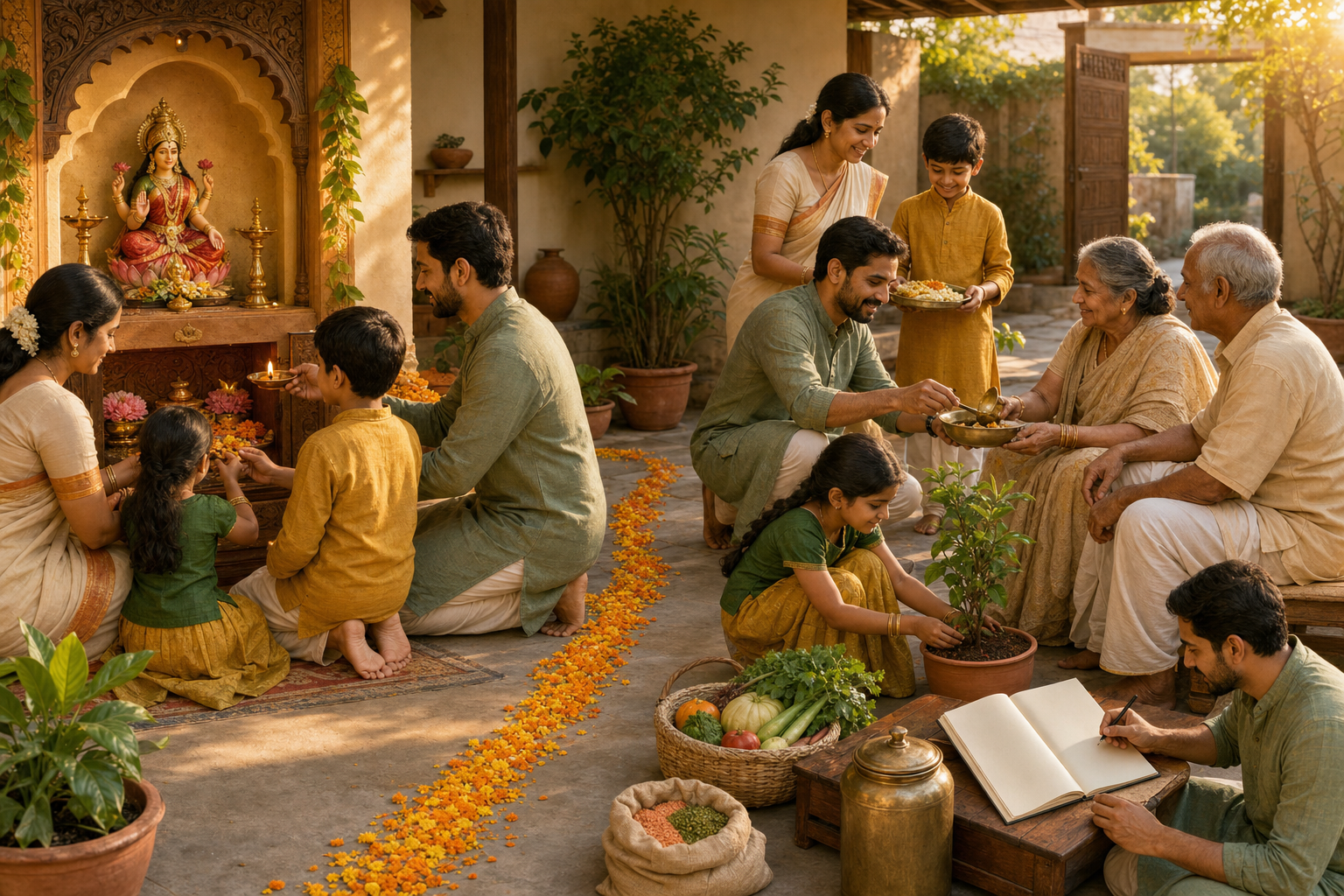
- Carry the prayer into seva or a matching duty. Feed someone, reduce avoidable food waste, teach what you know, mentor a younger person, make a financial dealing more transparent, or complete a difficult responsibility you have been evading.
- Observe what the practice is producing. If it deepens humility, clarity, courage, generosity, and steadiness, devotion and conduct are moving together. If it encourages entitlement or turns Lakshmi into a mechanism for obtaining whatever the ego wants, return to the contentment and stable center represented by Adi Lakshmi.
Recitation of the Lakshmi Ashtottara Sata Namavali, reflection on Puranic narratives, and community service can deepen this alignment. Navaratri and Varalakshmi Vrata offer natural occasions for concentrated reflection, but the nine powers belong in ordinary decisions throughout the year. A festival may intensify attention; it cannot carry duties that are ignored once the observance ends.
A ritual cannot turn dishonest income into Dhana Lakshmi, wastefulness into Dhanya Lakshmi, domination into Vijaya Lakshmi, or neglected caregiving into Santana Lakshmi. The sacred power and the matching conduct must point in the same direction. When the actual strain is unmanageable debt, illness, hunger, or a legal obligation, devotional practice should accompany competent practical help rather than replace it.
Recognize a shared Dharmic ethic without erasing differences
The concern for abundance governed by character has clear points of contact across Dharmic traditions. Buddhism honors dana and ethical discipline. Jainism emphasizes ahimsa and aparigraha, or non-possessiveness. Sikhism upholds seva and kirat karo, honest work. Lakshmi’s forms similarly refuse to separate prosperity from generosity, restraint, responsibility, and service.
Points of contact are not theological sameness. Lakshmi devotion belongs to Hindu theology and lived Hindu practice; Buddhist, Jain, and Sikh traditions retain their own teachings, disciplines, and sacred vocabularies. Respectful unity does not require flattening those differences. It asks whether distinct communities can cooperate around truthful livelihood, care for living beings, nourishment, education, generosity, and service.
If you are organizing an inter-Dharmic family or community observance, build cooperation around a visible duty: food distribution, teaching, mentorship, honest work, or community service. Let each tradition explain the sacred basis for that duty in its own terms. Shared values then become shared responsibility rather than a vague declaration that all traditions are identical.
Key takeaways for choosing a form of Lakshmi
- The ninefold framework joins the familiar eight forms of Ashta Lakshmi with Aishwarya Lakshmi, while allowing for legitimate variation among lineages and regional practices.
- Dhana Lakshmi concerns wealth and resources, but Lakshmi’s abundance also includes food, knowledge, courage, family continuity, protection, righteous success, contentment, and balance.
- Choose a form by diagnosing the real obstruction in your life, not simply by selecting the blessing whose name sounds most attractive.
- Pair puja or japa with conduct that embodies the same power. Ethical earning, gratitude for food, study, caregiving, perseverance, and seva are part of the practice.
- Judge prosperity by what it does to character and relationships as well as by what it adds to possessions or status.
- Honor shared Dharmic values through practical cooperation without treating Hindu, Buddhist, Jain, and Sikh teachings as interchangeable.
At your next prayer, choose the form that reveals the duty immediately in front of you. Name the blessing, name its obligation, and carry a matching action into your household or community. Sacred prosperity becomes durable when you learn not only how to seek it, but also how to receive, protect, and share it without being ruled by it.
References
