
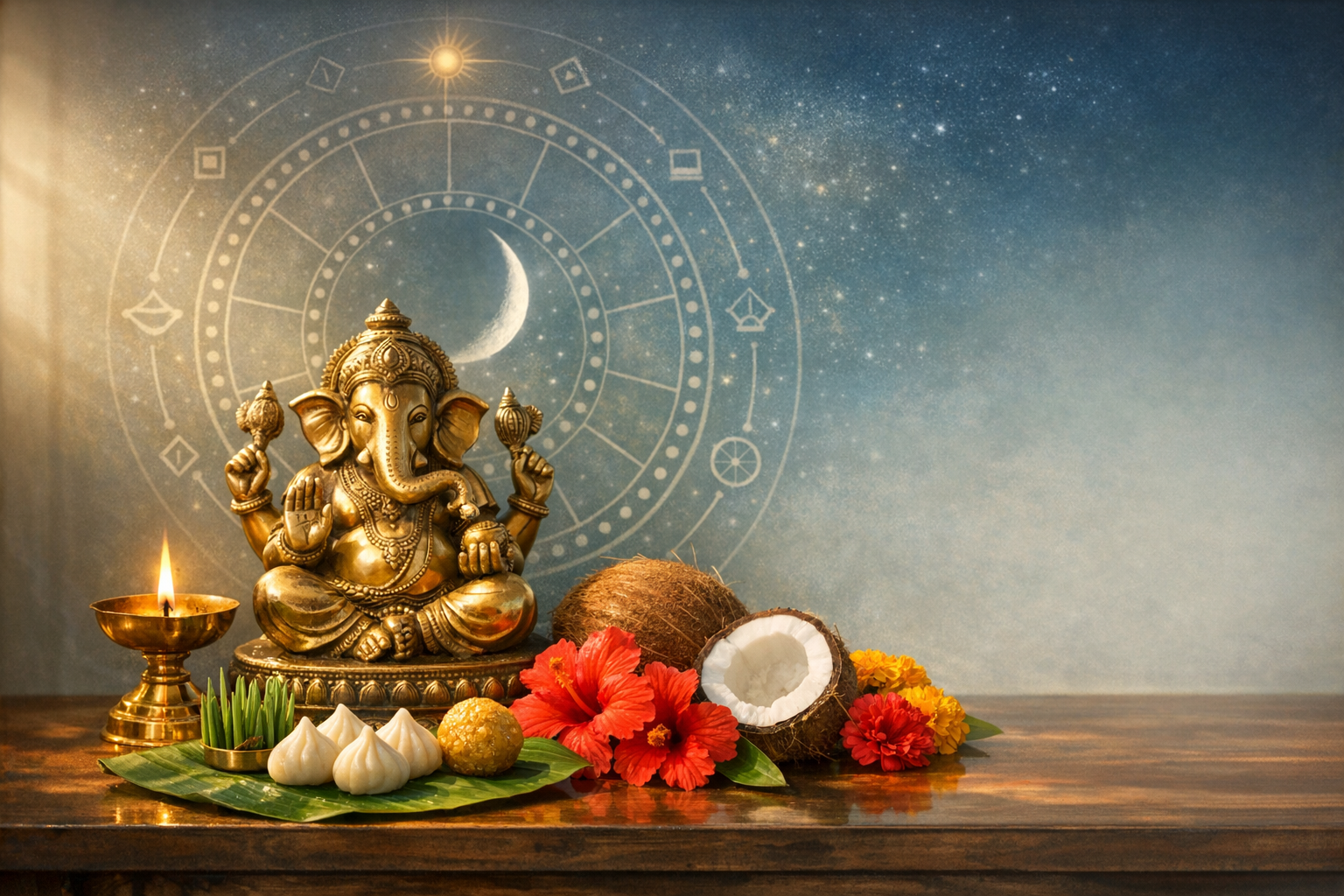
Sunday, March 22, 2026, in most regional Hindu Panchang computations (IST), transitions from Shukla Paksha Tritiya to Shukla Paksha Chaturthi at 01:48 AM. From that moment onward, Shukla Paksha Chaturthi prevails for the remainder of the civil day, making it the principal tithi for observance. Regional almanacs may show minor variations owing to local sunrise and longitude/latitude, but the transition time noted here aligns with widely used calculations in India.
Shukla Paksha Chaturthi is traditionally revered as the monthly Vinayaka Chaturthi. The day emphasizes vighna-nivṛtti (removal of obstacles) and buddhi-prasāda (clarity of intellect) through focused remembrance of Ganesha. Across households, the cadence of a simple vrata, the fragrance of durva grass, and the offering of modaka or laddu create a rhythm of devotion that supports new beginnings. Many practitioners find that beginning key tasks after a calm puja during the day helps translate inward steadiness into outward effectivenessan experiential alignment that resonates across dharmic traditions committed to mindfulness, seva, and ethical living.
Panchang, the Hindu calendar framework used for daily planning, classically enumerates five limbs: Tithi (lunar day), Vara (weekday), Nakshatra (lunar mansion), Yoga (a specific sum of solar–lunar longitudes), and Karana (half-tithi). While Vara shapes the day’s general tenor (here, Sunday), Tithi is primary for vrata and festival observances; Nakshatra and Rashi add finer contextual cues for personal undertakings, rituals, and samskaras.
Tithi is a geometric measure of lunar elongation relative to the Sun. Formally, the tithi number n (1–30) is determined by the geocentric ecliptic longitude difference Δλ = (λMoon − λSun) mod 360°, where n = ⌊Δλ / 12°⌋ + 1. Each tithi ends when Δλ crosses a multiple of 12°. Because the Moon’s motion is non-uniform, tithi duration is variable (roughly 20–27 hours), which explains why a civil date may contain two tithis or why a single tithi can span portions of adjacent civil days. On March 22, 2026 (IST), Δλ crosses the 36° threshold at 01:48 AM, marking the end of Shukla Tritiya and the onset of Shukla Chaturthi.
In practice, Shukla Paksha Chaturthi is associated with Vinayaka worship. A common guideline is to perform the Chaturthi vrata and puja during Madhyahna (the midday period defined astronomically by local solar transit and the traditional division of the daytime into 15 muhurta). This heuristic preserves continuity with the way festival Ganesh Chaturthi (Bhadrapada Shukla Chaturthi) is timed. As always, local panchangs indicate the precise window by anchoring Madhyahna to local sunrise and solar noon.
Muhurta selection for daily activities frequently draws from time-tested frameworks that complement tithi. The daytime is traditionally divided into 15 muhurta of equal length (daylight duration ÷ 15). Abhijit Muhurat aligns to the middle of the day (the 8th muhurta) and is generally treated as auspicious for initiating tasks when specific festival rules do not override it. Pre-dawn practice, often called Brahma Muhurta (occurring before sunrise), remains favored for meditation, japa, and pranayama, supporting clarity and steadiness before the day’s engagements. Practitioners outside India should compute these windows from local sunrise and solar noon to preserve accuracy.
For Vinayaka Chaturthi puja, many households adopt a simple, time-honored sequence: a brief sankalpa acknowledging Shukla Paksha Chaturthi; achamana and purification; invocation of Ganesha with Om Gam Ganapataye Namah; offering of durva (traditionally 21 blades), red flowers, fruits, coconut, and naivedya such as modaka; recitation of Ganesha Atharvashirsha or Ganesha Ashtottara Shatanamavali; and a concluding arati with contemplation. The vrata is often a light, sattvic fast adjusted for health and family needs. The well-known admonition to avoid moon-sighting relates primarily to the Bhadrapada festival Ganesh Chaturthi; monthly Vinayaka Chaturthi is typically observed without that restriction unless a local sampradaya advises otherwise.
Nakshatra and Rashi offer an additional interpretive layer. Nakshatra refers to the lunar mansion (one of 27 sectors along the ecliptic), guiding the tonal quality of the day and personal samskara planning. Rashi denotes the Moon’s sign, shaping mood and receptivity. For decisions with personal impacttravel, learning milestones, or contractual workfamilies often check that the operative Nakshatra is not contraindicated by their tradition and that the tithi and Karana are supportive. Because Nakshatra and Rashi depend on the Moon’s rapid motion, consulting a reliable regional panchang or ephemeris for March 22, 2026, ensures precision for one’s location.
Regional calendars frame these observances with nuance. Amanta (month ending on Amavasya) almanacs common in peninsular India and Purnimanta (month ending on Purnima) almanacs prevalent in northern regions can name the lunar month differently while agreeing on the tithi at a given moment. Tamil, Malayalam, and Bengali systems reflect additional solar-lunar conventions. International readers should also account for time zone offsets and daylight saving changes when mapping IST-based references to local civil time.
Although Vinayaka Chaturthi belongs to the Hindu ritual calendar, its contemplative heartpausing at a lunar milestone to cultivate ethical intention, clarity, and compassionresonates across dharmic sister traditions. Mindful observation of lunar days is familiar to Buddhist communities in Uposatha practice, Jain communities through their vrata cycles, and many Sikh households that honor select gurpurabs aligned to lunar observances alongside the Nanakshahi calendar. In this shared spirit, days like Shukla Paksha Chaturthi become occasions of pan-dharmic unity, encouraging inner discipline and outward harmony.
Practical planning for March 22, 2026, is therefore straightforward: with Shukla Paksha Chaturthi in force through the day (after 01:48 AM IST), those observing the monthly Vinayaka Chaturthi may schedule puja during the Madhyahna window indicated by their local panchang. New educational efforts, problem-solving work, or the start of modest initiatives can be meaningfully seeded after worship, aligning the day’s outward action with its inner intention of unobstructed progress.
Verification remains essential. Because panchang elements depend on precise astronomical data, the most reliable approach is to consult a trusted regional almanac, temple notice, or a reputable, location-aware panchang application that specifies Tithi boundaries, Madhyahna, Nakshatra, and Rashi for one’s city. When sharing observances as a family or community, agreeing on a single reference source avoids confusion and maintains the serenity that these calendars are designed to cultivate.
To summarize the core calendrical point for this date: March 22, 2026 (Sunday), holds Shukla Paksha Tritiya only until 01:48 AM IST; thereafter, Shukla Paksha Chaturthi prevails. With that clarity in hand, the day invites steady practicemeasured devotion, ethical intention, and a spirit of unity across the dharmic fold.
Inspired by this post on Hindu Blog.
