
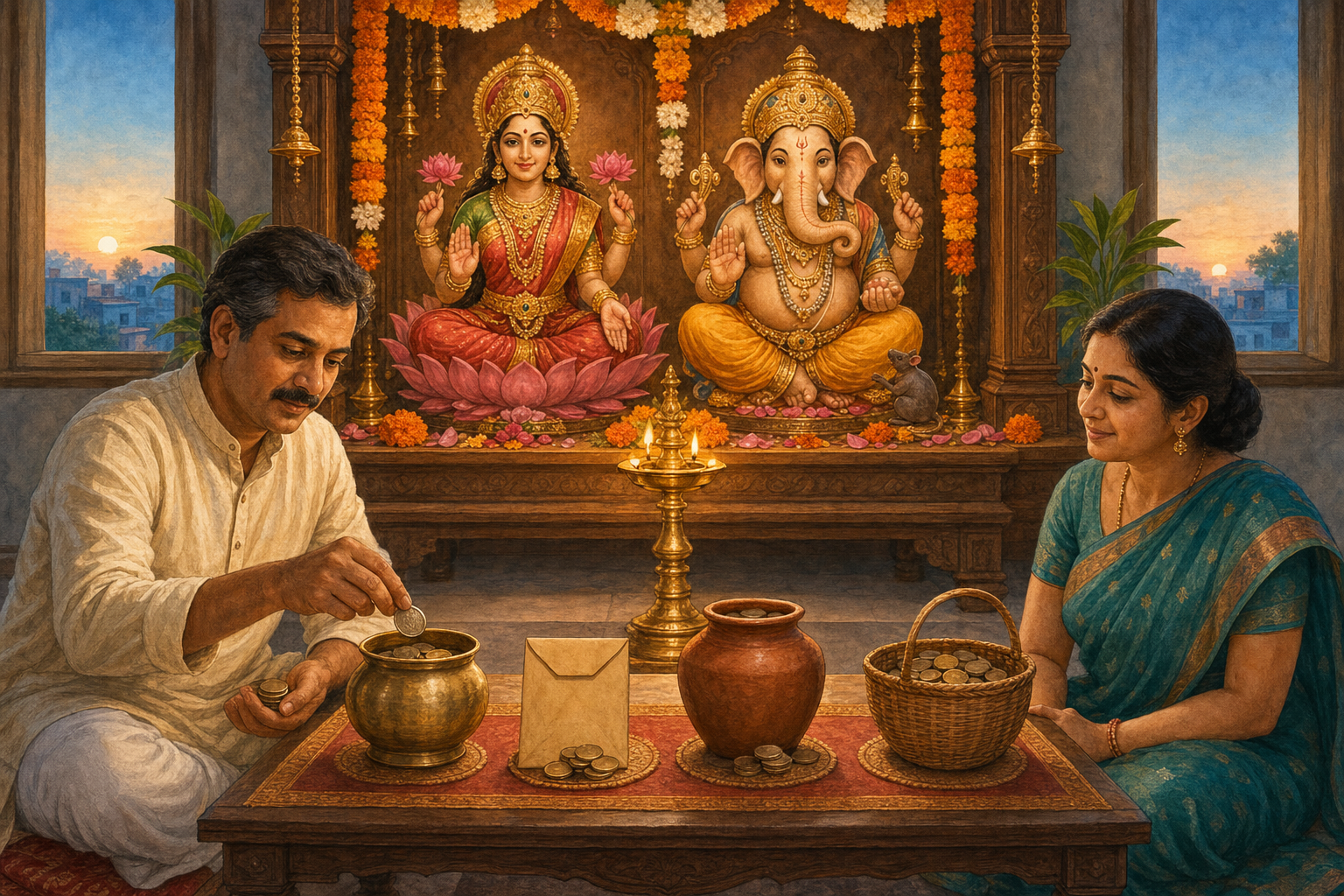
You may already light the lamp, offer sweets, and ask Lakshmi and Ganesha to bless your home or business. The harder question comes after the arati: what would it mean for tomorrow’s invoice, salary, purchase, investment, or contract to honour that prayer?
The answer is more demanding than a wish for higher income. Lakshmi-Ganesha worship joins aspiration to discernment. It asks you to earn cleanly, account truthfully, spend without becoming captive to desire, protect the relationships that wealth is meant to support, and share before generosity becomes an afterthought.
The pairing asks what wealth is for

Lakshmi represents more than accumulated money. She embodies shri: abundance joined to beauty, order, nourishment, dignity, and auspicious well-being. Ganesha represents buddhi, the discriminating intelligence that sees consequences, and is worshipped as Vighnaharta, the remover of obstacles. Their companionship therefore places artha under the guidance of dharma: prosperity is a legitimate aim, but neither the method of acquiring it nor the use made of it is morally neutral.
This is especially relevant to the grihastha, the householder. A household needs food, shelter, education, reserves, tools, and the means to fulfil obligations. Hindu thought does not require you to pretend these material needs are unspiritual. It asks you to pursue them without allowing artha to injure dharma, distort kama into compulsion, or make moksha disappear from view.
The familiar imagery sharpens the lesson. Lakshmi’s lotus suggests flourishing without being stained by the environment in which one must act. Ganesha’s mouse points to appetites that must be governed rather than obeyed, while the modaka evokes the sweetness of contentment. The owl associated with Lakshmi is often read as a warning: wealth without illumination can move blindly. Put plainly, getting more does not ensure that you will see more clearly.
Joint worship is therefore not a promise that piety will produce profit, nor does a financial loss prove deficient devotion. Puja cannot convert a deceptive transaction into a dharmic one. Its purpose is to form the person who decides, records, spends, and shares. Lakshmi is the desired flourishing; Ganesha is the intelligence and discipline required to steward it.
Turn the prayer for prosperity into five vows

A sankalpa becomes useful when it governs conduct after the shrine has been put away. Before your next Lakshmi-Ganesha puja, choose vows precise enough that you can tell whether you kept them.
- Choose clean means before asking for good results. Examine how the income is produced, not only how much it pays. Ask whether the offer depends on concealment, coercive terms, preventable harm, false claims, unpaid obligations, or the exploitation of someone with less bargaining power. If the method would embarrass you when described plainly, the obstacle is ethical rather than ritual.
- Make the ledger tell the whole truth. Record liabilities, refunds, promises, taxes, delayed payments, and money held for others as carefully as revenue and assets. Do not use auspicious symbols to decorate accounts that conceal inconvenient entries. In Chopda Pujan and related commercial observances, consecrating a new ledger can be treated as a vow that every later entry will remain intelligible and honest.
- Put discernment between desire and purchase. When an unplanned expense appears, pause long enough to name the need it supposedly serves. Then ask what it will cost beyond the price: maintenance, debt, attention, storage, anxiety, or pressure on other commitments. Ganesha’s buddhi interrupts impulse; Lakshmi’s shri asks whether the purchase will add durable well-being or merely display acquisition.
- Plan dana while the money is still being allocated. Choose a portion or amount appropriate to your actual circumstances, identify its purpose, and record the commitment alongside other obligations. The tradition does not supply one compulsory percentage for every household. A modest gift made reliably and without humiliating its recipient is better than a dramatic promise that is never fulfilled.
- Protect peace as part of prosperity. Money that increases resentment, secrecy, arrogance, or constant conflict carries the shadow traditionally called Alakshmi. Treat trust, orderly habits, cleanliness, fulfilled promises, and calm discussion as forms of household wealth. When a financial decision affects others, let those who bear its consequences understand it before you commit them to it.
These vows make ethical failure easier to notice. You no longer have to ask only whether a venture succeeded. You can ask whether the means were truthful, the records complete, the appetite governed, the benefit shared, and the household left more stable.
A simple home observance that ends in action
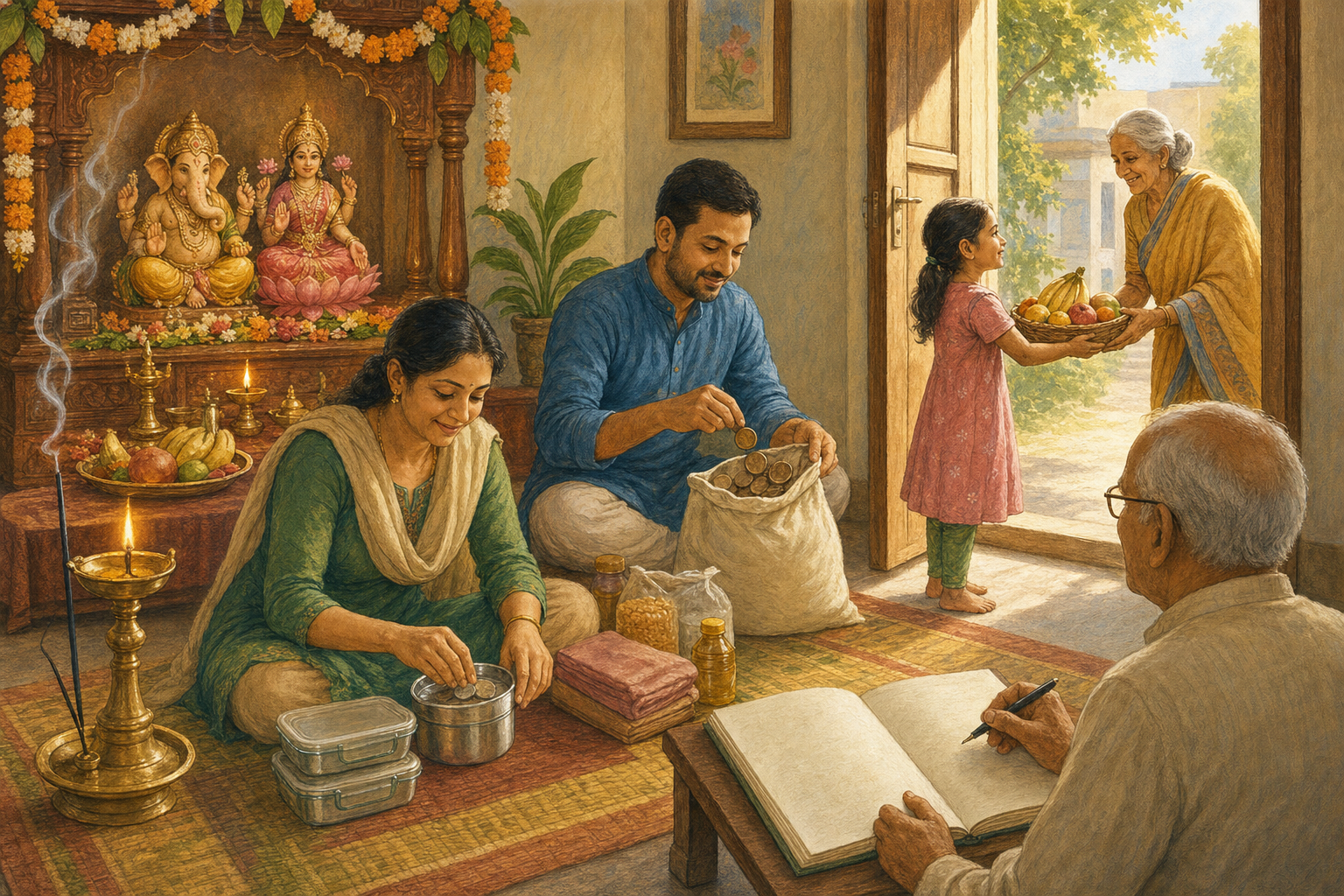
You do not need an elaborate display to practise this discipline. If your family, sampradaya, or priest follows a particular paddhati, honour that sequence. Otherwise, a concise household observance can preserve the central grammar: establish intention, invoke Ganesha, welcome Lakshmi, make the offerings, and carry the resolve into material life.
- Clean the place of worship and the place where money is recorded. Prepare a stable surface, a clean cloth, images or murtis, a lamp, flowers, incense, and modest naivedya. If you maintain household or business accounts, place the ledger or a representative page nearby. Cleaning the altar while ignoring confused accounts misses half the practice.
- State a concrete sankalpa. Name the occasion and the ethical quality you intend to cultivate. Instead of asking only for wealth, resolve to correct an overdue payment, disclose a material condition in a transaction, restrain a recurring excess, begin orderly accounts, or establish regular dana.
- Invoke Ganesha first. Many domestic liturgies begin with Vinayaka Puja before Lakshmi’s avahana. You may offer durva and a modaka where these are customary and available, and recite Om Gam Ganapataye Namah. Let the invocation focus your attention on the obstacles within the decision-maker: haste, confusion, fear, vanity, and rationalisation.
- Welcome Lakshmi with gratitude rather than demand. Offer flowers, kumkum, a lamp, and food according to your practice. Om Shreem Mahalakshmyai Namah is a commonly used invocation. Those familiar with the Sri Sukta may include it; those trained in the Ganapati Atharvashirsha may include that recitation during Ganesha worship. There is no benefit in turning an unfamiliar text into a performance. Follow a trusted family or teacher-guided practice when precise recitation matters.
- Use the five offerings as a complete minimum. Panchopachara consists of gandha, pushpa, dhupa, dipa, and naivedya: fragrance or sacred paste, flowers, incense, light, and food. Each offering can carry an inner counterpart: good character, gratitude, purified intention, clear awareness, and nourishment shared.
- Conclude with arati, prasad, and a written next action. Write the resolve in the ledger or on a page you will see again. If the sankalpa includes dana, identify its recipient and timing. If it concerns an account, name the entry to be corrected. Ritual memory becomes ethical continuity when the action is visible after the festival ends.
Regional diversity should not become a contest over authenticity. Lakshmi-Ganesha worship is prominent on Kartika Amavasya in much of North and Western India; Bengal gives special emphasis to Lakshmi at Kojagari Purnima; and Varalakshmi Vrata in parts of South India commonly begins with Vinayaka worship. These different calendars and household forms converge on the same ethical relationship without requiring every family to use an identical image, narrative, or sequence. If your inherited observance differs, learn its logic before trying to correct it from a festival print or social-media checklist.
Bring Ganesha’s questions into financial decisions
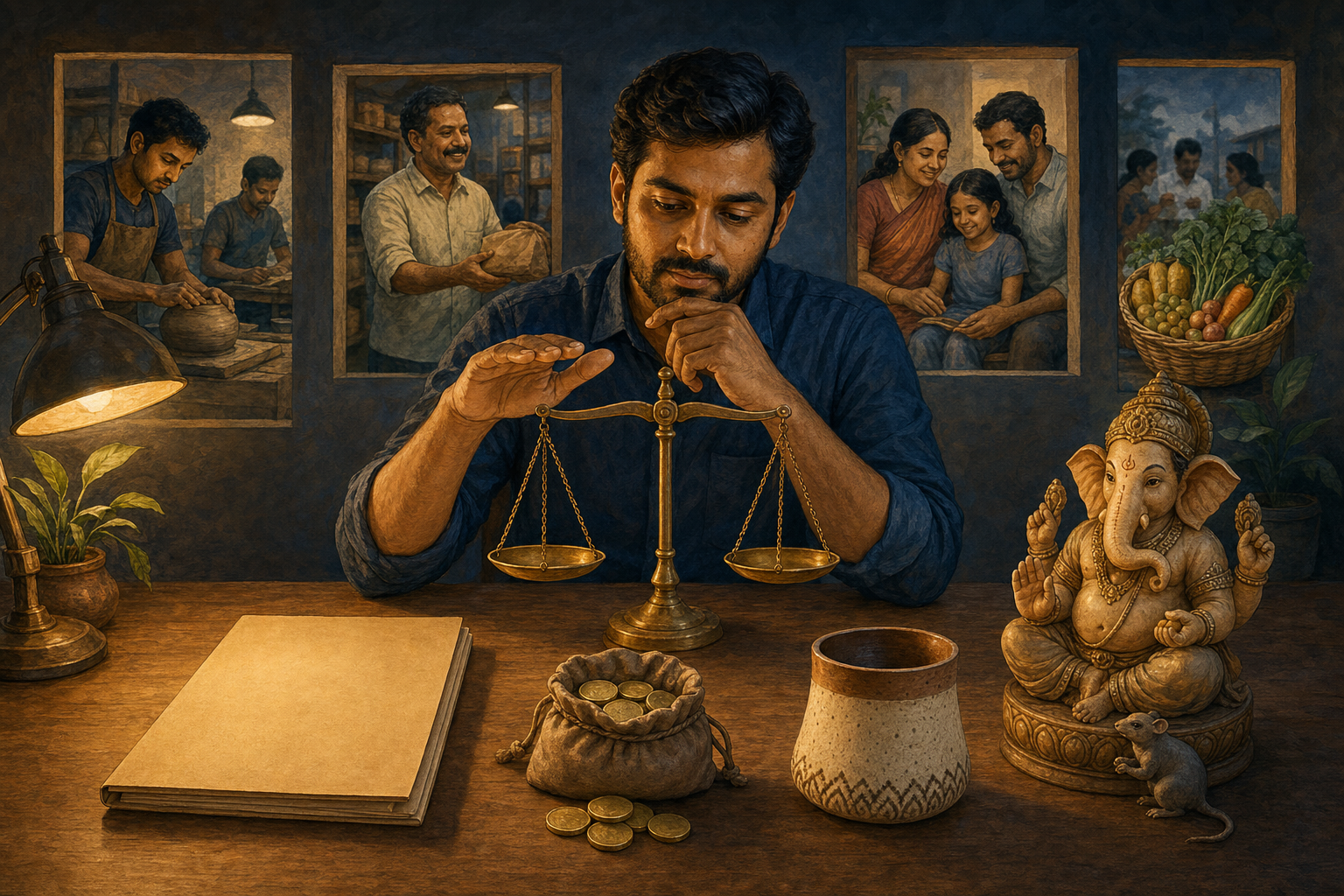
The easiest way to separate puja from conduct is to reserve sacred language for the altar. A better practice is to use the pairing as a decision framework whenever money changes hands. The questions below translate buddhi and shri into evidence you can actually inspect.
| Decision | Ganesha’s buddhi asks | Lakshmi’s shri asks | Action you can verify |
|---|---|---|---|
| New job, client, or business opportunity | Are the claims, terms, duties, and risks understood? | Will this income sustain life without requiring deception or avoidable harm? | Put the scope, payment terms, responsibilities, and material conditions in writing. |
| Purchase or investment | Do you understand the downside, or are urgency and imitation making the choice? | Will the decision support durable well-being and existing obligations? | Review written costs and risks, compare alternatives, and seek qualified advice where the stakes warrant it. |
| Debt | Is repayment realistic under less favourable conditions? | Does the borrowing protect a real need, or finance status and compulsion? | List the full obligation and its effect on essential household commitments before agreeing. |
| Business or household accounts | Can an authorised person trace each significant entry? | Does the apparent gain rest on trust that has actually been honoured? | Reconcile invoices, money owed, money held for others, and unresolved promises. |
| Dana | Is the giving considered, effective, and free of self-display? | Does prosperity circulate toward genuine nourishment and dignity? | Choose the recipient, amount, purpose, and timing, then confirm that the commitment was completed. |
Use one firm boundary: if a gain depends on deceiving an authorised stakeholder, hiding a material fact, or transferring a foreseeable loss to someone who did not knowingly accept it, do not call the problem a vighna to be removed. The resistance may be dharma doing its work.
Devotion is not a substitute for due diligence. For investments, debt, contracts, taxes, or legal obligations, a mantra, omen, auspicious time, or peaceful feeling cannot replace written terms, risk analysis, accurate records, and advice from an appropriately qualified professional. Ritual should improve the quality of your judgement, not exempt a consequential decision from examination.
This discipline also gives people from other Dharmic traditions a point of recognition without pretending the traditions are interchangeable. Buddhist dana and right livelihood, Jain ahimsa and aparigraha, and the Sikh disciplines of kirat karo and vand chhako each connect material life to conscience in their own theological settings. The shared civilisational insight is that earning, restraint, remembrance, and sharing belong in the same moral field.
Key takeaways
- Lakshmi-Ganesha worship joins the desired end of flourishing to the wisdom required to pursue and steward it.
- Ethical prosperity requires clean earning, complete accounts, restrained consumption, protected relationships, and deliberate dana.
- A simple puja can follow sankalpa, Ganesha worship, Lakshmi worship, Panchopachara, arati, and a written commitment.
- An auspicious ritual cannot make a deceptive transaction ethical or replace professional financial, tax, or legal advice.
- Regional forms differ, so preserve your family or sampradaya’s practice while making its ethical purpose visible in daily conduct.
At your next observance, place a blank page beside the lamp. Before the arati ends, write one financial action that wisdom requires and one act of sharing that prosperity makes possible. Complete both. That is where Lakshmi-Ganesha worship moves from an auspicious image into a way of life.
References
