
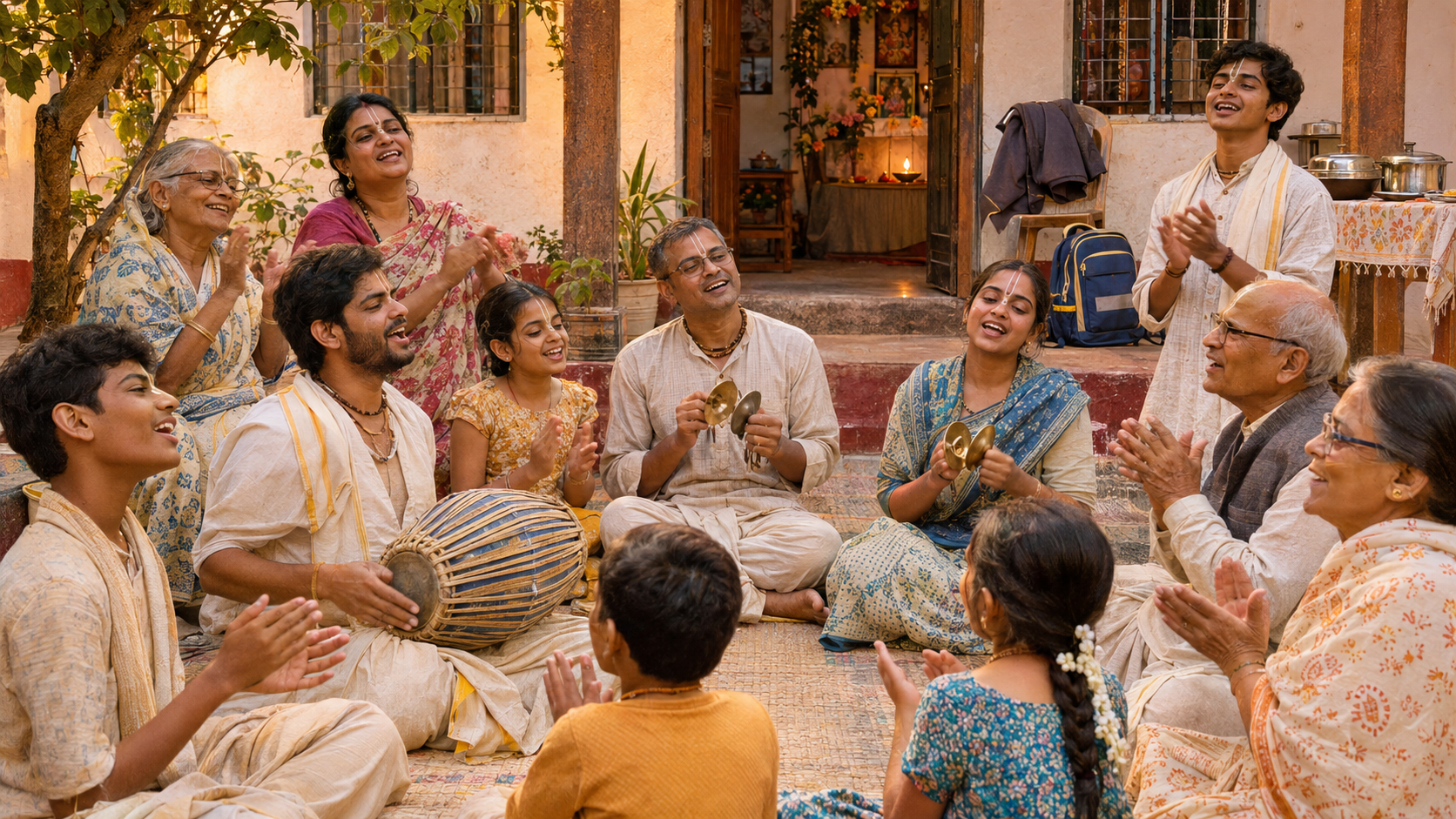
You want Krishna to be present in your ordinary day, not only during a festival, temple visit, or rare morning when everything is quiet. Yet work, family obligations, a restless mind, and an unpredictable schedule keep pushing devotional practice to the edge.
The way forward is not to wait for a more spiritual lifestyle. Give the holy name a stable place in the life you already have. A modest practice that survives busy days will take you further than an elaborate routine you repeatedly abandon.
Let the holy name organize your day
In ordinary Vaishnava usage, japa is personal repetition of a divine name or mantra, while kirtana is audible glorification, often through call and response. Sankirtana brings that remembrance into shared space. The forms overlap, but they solve different practical problems: japa develops personal steadiness, kirtana engages the voice and senses, and sankirtana prevents devotion from becoming entirely private.
If you follow a particular sampradaya, use the mantra and method you have received there. In Gaudiya Vaishnava practice, the familiar maha-mantra is:
Hare Krishna, Hare Krishna, Krishna Krishna, Hare Hare
Hare Rama, Hare Rama, Rama Rama, Hare Hare
The practical principle is simple: choose a sacred name you can return to consistently. Constantly changing chants because novelty feels stimulating trains the mind to seek variety. Repetition trains it to return.
The traditional description of harinama-sankirtana as the dharma of Kali Yuga emphasizes accessibility. The holy name does not depend on wealth, elaborate equipment, musical expertise, or an ideal location. That makes it suitable for a distracted age, but accessibility should not be confused with casualness. You still have to offer attention.
Do not make spiritual emotion the entry fee. Some days the name will feel close; on others, chanting may feel dry or mechanical. Begin anyway. Your immediate task is not to manufacture a mood. It is to hear the name you are uttering and return when the mind wanders.
Build a rhythm that can survive an ordinary week
The appeal of a peaceful morning at Prabhupada Village lies partly in its ordinariness. Devotional life is carried by repeated actions, a settled environment, and unhurried attention. You may not live in an ashram or rural community, but you can reproduce the underlying structure.
Anchor the morning to a cue, not a mood
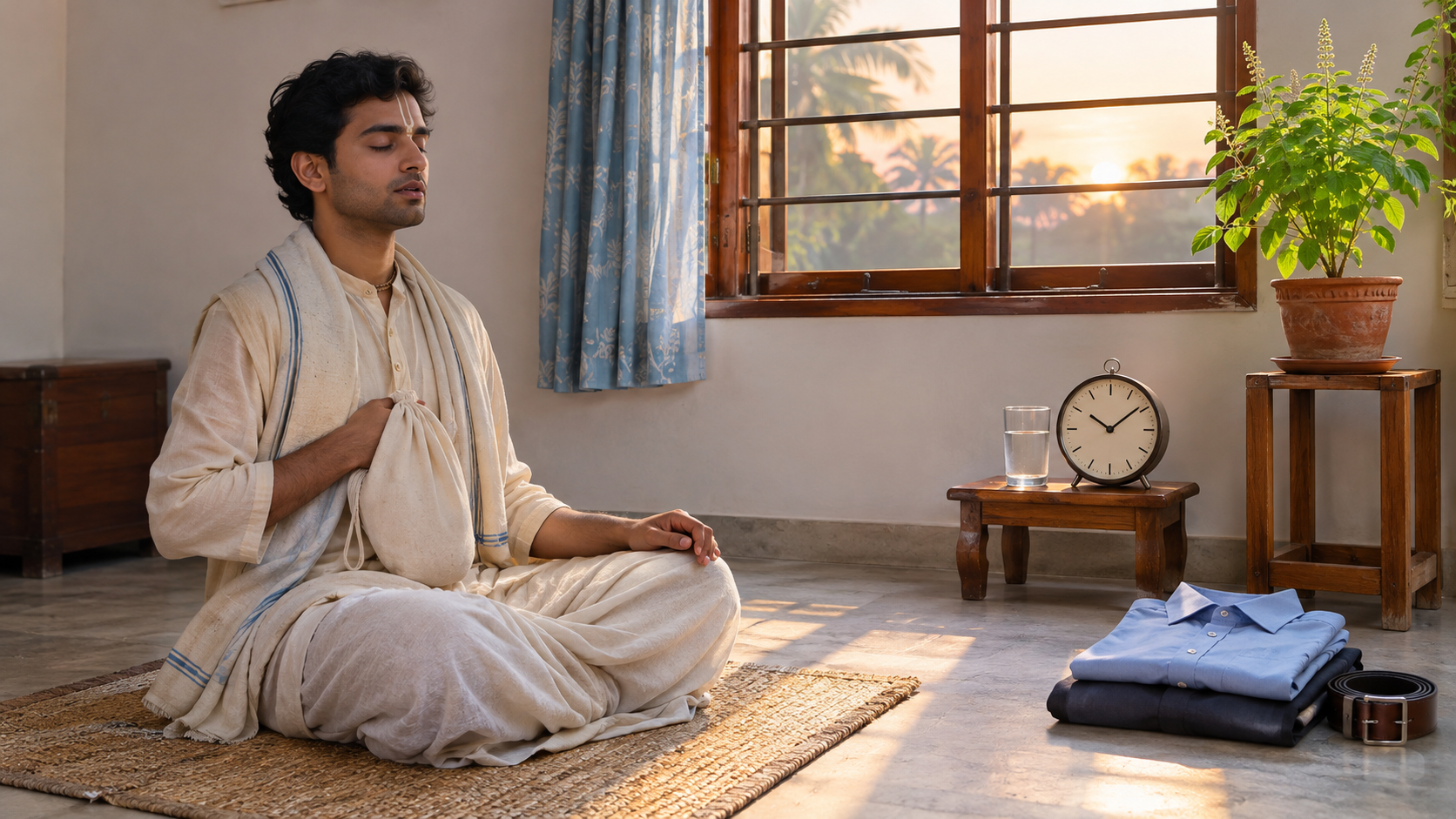
Choose an event that already happens every morning: after washing, after dressing, or before breakfast. Let that event trigger your chanting. A clock time can fail when the day starts early or late; a stable sequence is often harder to lose.
- Prepare the place beforehand. Keep your beads, cloth, seat, or devotional text where you will use them.
- Move the phone out of reach unless it is genuinely needed for the practice.
- Offer pranama or state a simple devotional intention in the language accepted by your tradition.
- Chant clearly enough to hear yourself. When attention leaves, return to the next name without turning distraction into a drama.
- End by identifying one duty you will perform as seva rather than as an interruption to devotion.
If the routine keeps collapsing, reduce the preparation before questioning your sincerity. A practice with too many preliminary steps creates more opportunities to postpone it. Keep the sacred center intact and remove avoidable friction.
Carry remembrance across transitions
A morning practice can become an isolated spiritual compartment. Prevent that by using natural transitions during the day. Recall Krishna’s name before beginning work, entering a difficult conversation, eating, commuting, or moving from one task to another. These brief returns do not replace attentive japa or kirtana. They connect formal practice with conduct.
Choose transitions that already exist instead of creating a complicated reminder system. The point is not to interrupt every activity. It is to stop moving through the entire day without remembering whom the activity can serve.
Close the day without keeping a spiritual score
Before sleep, notice where remembrance held and where it disappeared. Do not convert this review into self-condemnation. Ask a practical question: what cue, environment, or choice made chanting easier, and what repeatedly displaced it? Adjust the next day accordingly.
A missed session should lead to the next available return, not to an ambitious compensatory vow. The mind often uses perfectionism to turn one interruption into a long absence.
Enter sankirtana as a participant, not a performer
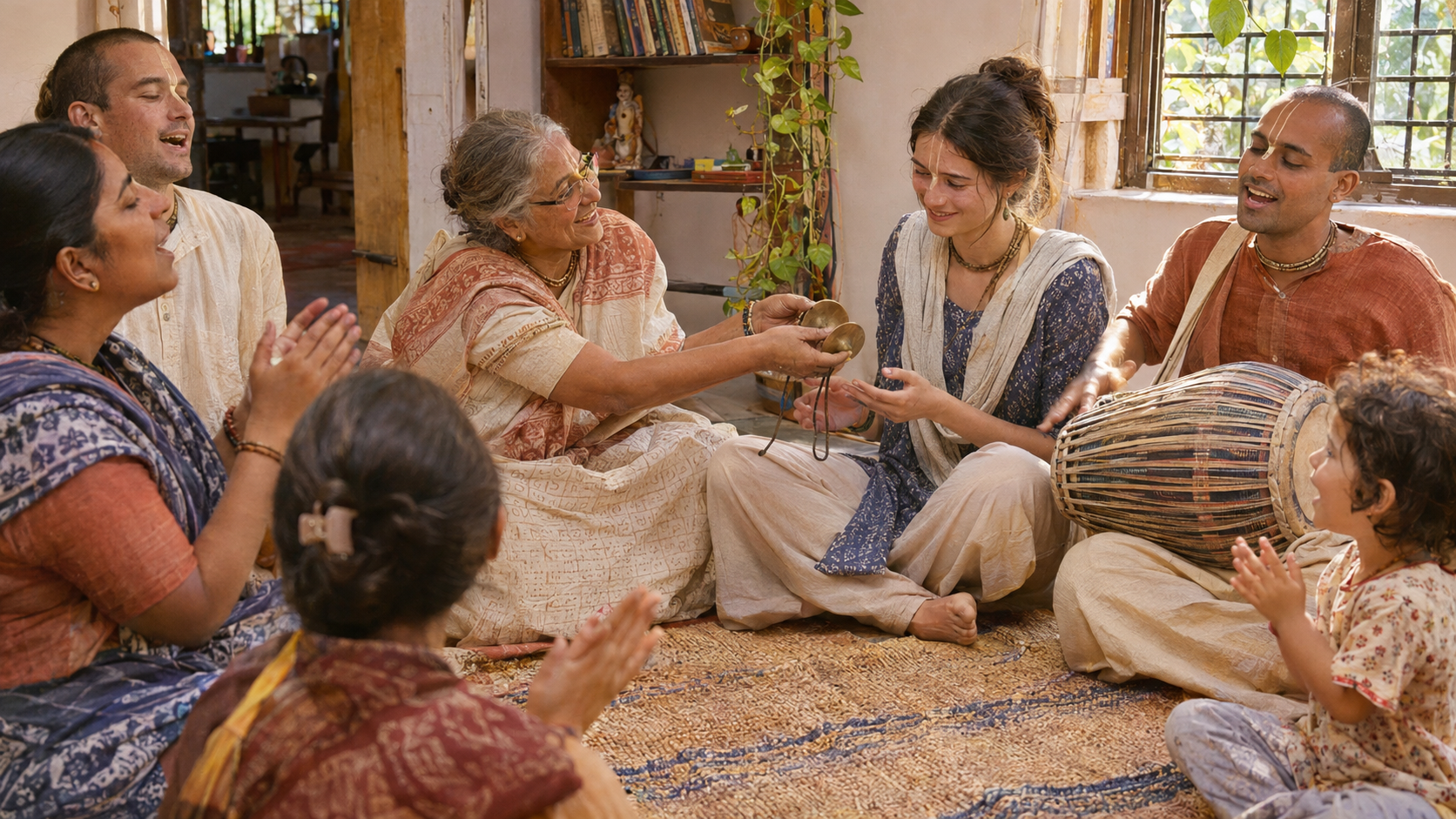
Public or congregational chanting can feel intimidating when you do not know the melodies, responses, etiquette, or people. That discomfort does not mean sankirtana is unsuitable for you. It means you need a modest first role.
- Choose an established gathering whose devotional orientation is clear. You should be able to ask which tradition it follows and what is being chanted.
- At first, stand or sit where you can hear both the leader and the congregation. Follow the response rather than trying to anticipate every change.
- Sing at a volume that lets you hear the group. Sankirtana is shared remembrance, not a contest between voices.
- If instruments are available, do not assume you must play. Steady participation is more valuable than adding rhythm you cannot yet maintain.
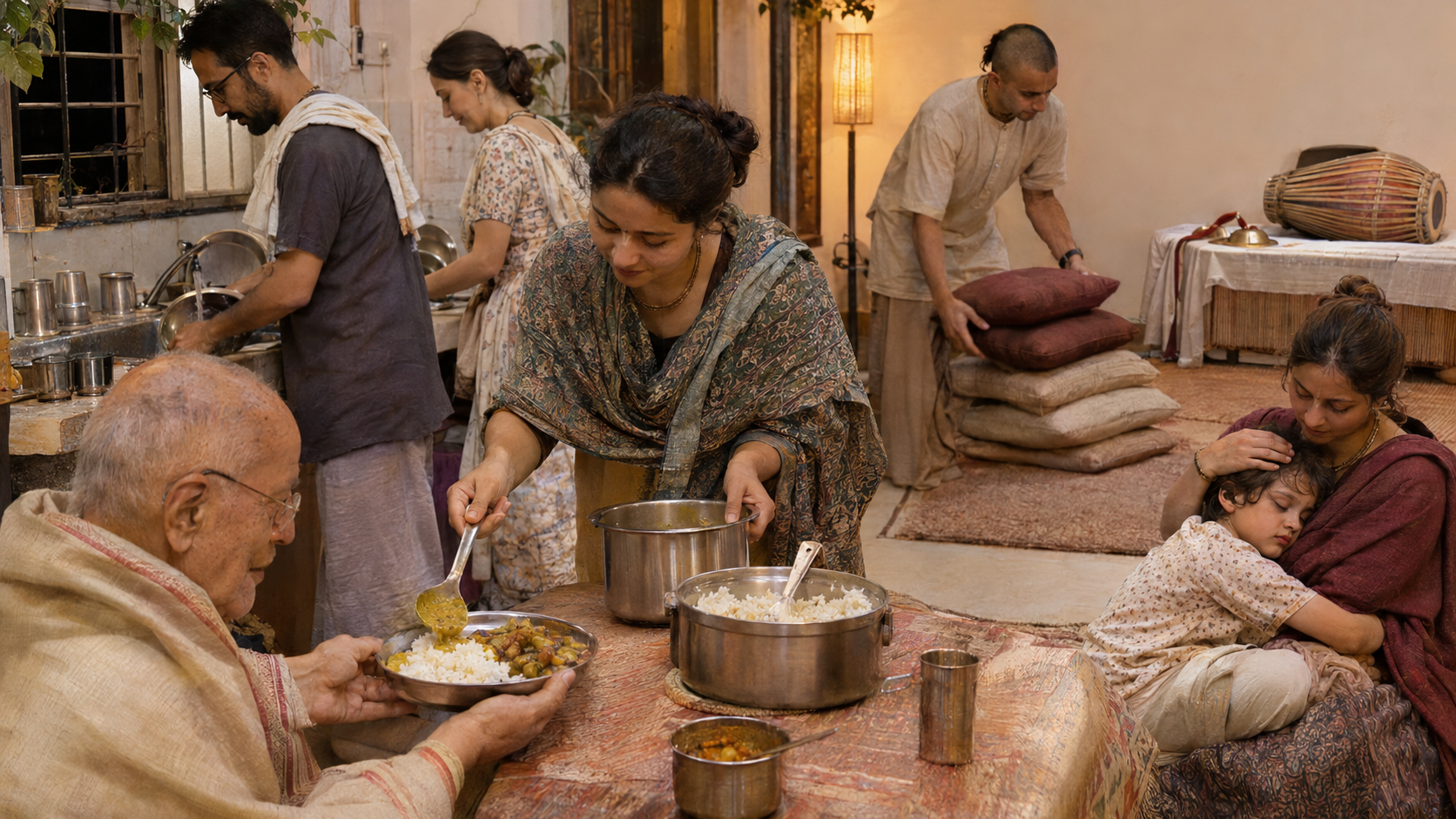
- Afterward, learn one practical detail that will make returning easier: the regular meeting place, the expected etiquette, or how participants help with setup and cleanup.
A healthy gathering makes room for congregational response. Skilled musicianship can support kirtana, but it should not turn everyone else into an audience. If you consistently leave impressed by a performer yet rarely drawn into remembrance, the musical form may be overshadowing the devotional purpose.
You should also retain ordinary discernment. Devotional language does not excuse coercion, humiliation, financial pressure, unsafe behavior, or demands for unquestioning loyalty. Seek mature guidance if a group treats reasonable questions as disobedience. Sangha is meant to support surrender to Bhagavan, not surrender of conscience to a charismatic personality.
If no suitable gathering is nearby, begin at home. Chant audibly at a respectful volume, particularly in shared housing, and invite family or a trusted friend when appropriate. Keep the melody simple enough that everyone can join. The purpose is not to imitate the scale of a temple festival; it is to make Krishna-katha and the holy name a shared reality.
Measure progress by what happens after the chanting
A powerful kirtana can bring tears, energy, stillness, or joy. None of these experiences should be mocked, but none is a dependable spiritual scoreboard. Temperament, music, fatigue, memory, and group atmosphere can all influence emotion.
Look instead for changes that are harder to display:
- You return to the holy name more readily after distraction.
- You become less preoccupied with how your voice, knowledge, clothing, or devotion appears to others.
- You carry more restraint into speech, especially when irritated or contradicted.
- You treat routine responsibilities as possible service rather than as enemies of spiritual life.
- You become more willing to support sankirtana without needing to lead it.
- You notice hypocrisy in your conduct without using that discovery as a reason to abandon practice.
This test protects you from two opposite errors. The first is sentimentalism: assuming an intense feeling proves deep realization. The second is cynicism: dismissing chanting because transformation is gradual. Keep the standard demanding but humane. The holy name should reshape attention and conduct, while abhyasa requires repeated return.
When practice feels dry, simplify rather than dramatize. Chant more slowly, pronounce the names clearly, and listen to the sound you are making. When the mind is agitated, do not argue with every thought; return to the next name. When musical self-consciousness appears, remain with the congregational response. Each difficulty is answered by the same basic movement: notice, return, continue.
Key takeaways
- Give chanting a fixed cue in your existing routine instead of waiting for free time or devotional emotion.
- Use personal japa for steady attention and sankirtana for shared remembrance; neither has to compete with the other.
- Choose one received or tradition-appropriate mantra and return to it consistently.
- Enter congregational chanting through listening and response. You do not need to lead, perform, or play an instrument.
- Judge progress by remembrance, conduct, humility, and service rather than by musical intensity or emotional display.
- After a lapse, resume at the next opportunity. Do not let perfectionism turn interruption into abandonment.
Begin with the next natural opening in your day. Prepare the place, chant the name attentively, and carry one act of remembrance into the duty that follows. Let sankirtana grow from that dependable center until Krishna is no longer reserved for special occasions.
References
- Dandavats — A Peaceful Morning | ISKCON | Prabhupada Village | Nature Sounds | Silent Vlog
- Hindu Blog — Harinama Sankirtana as the Dharma of Kali Yuga

Leave a Reply
You must be logged in to post a comment.