

You can know the right thing and still lose patience, shade the truth, chase recognition, or postpone a needed apology. The problem isn’t always a lack of moral information. Often, your attention and desire have moved before your conscience gets a vote.
Krishna consciousness helps close that gap. Its practical value lies in training remembrance until devotion shapes the choices you make under pressure. You don’t have to choose between inner life and social responsibility. You need a daily discipline that joins them.
Key takeaways
- Use regular remembrance to train attention, not merely to create a devotional mood.
- Test each important choice by its relationship, method, and intended end.
- Judge spiritual progress by truthfulness, restraint, humility, repair, and service.
- Pair inward practice with an outward act so devotion doesn’t become an escape.
- Support good character with accountability; sincere motives don’t eliminate the need for sound institutions.
Give remembrance a fixed place in your day

Ethical failure usually begins before the visible act. Attention settles on an object, desire supplies a justification, and the mind edits inconvenient duties out of view. Attentive nama-japa, kirtana, scriptural reflection, and sadhu-sanga interrupt that chain by repeatedly returning attention to Krishna.
Srila Bhaktisiddhanta Saraswati Thakur (1874–1937), who led the Gaudiya Math, placed disciplined devotion at the root of enduring reform. This wasn’t an argument against laws, institutions, or public service. It was a warning that every system eventually expresses the motives of the people operating it.
Gaudiya Vaishnavism makes this connection practical through three questions. They arise from sambandha, abhidheya, and prayojana: relationship, devotional practice, and the ultimate end of love.
- Relationship: Who is before you, and how would you treat this person if you remembered that every being has a relationship with Krishna?
- Method: Does your proposed action express devotion through honesty, restraint, courage, or care?
- End: Are you seeking service and spiritual growth, or victory, possession, applause, and control?
Turn those questions into a modest rule of life:
- Choose a fixed morning cue. Begin japa, kirtana, or reflection after an action that already happens every day, such as bathing or preparing tea. When possible, practice before messages and news claim your attention.
- Name one virtue for the day. Select truthfulness, non-violence, self-restraint, non-possessiveness, or service. Identify one situation in which it will probably be tested.
- Pause before consequential choices. Ask the relationship, method, and end questions before sending the message, signing the agreement, spending the money, or confronting the person.
- Review conduct in the evening. Name one lapse, one repair, and one reason for gratitude. Make the repair promptly when it is safe and possible.
Record whether you showed up, not whether every session felt elevated. A stable practice that exposes impatience or vanity is doing useful work. Add a regular point of sadhu-sanga and recurring seva so that private impressions meet wise guidance and real human needs.
Use the stages of bhakti to diagnose the next step

The devotional path isn’t built on instant moral perfection. Rupa Gosvami’s developmental sequence moves through shraddha, sadhu-sanga, bhajana-kriya, anartha-nivritti, nishtha, ruchi, asakti, bhava, and prema. Read it as a diagnostic map, not a rank to display.
- If practice rarely begins: Strengthen trust, association, and your daily cue. Don’t expect inspiration to repair an unreliable schedule.
- If practice begins but remains erratic: Reduce avoidable friction. Prepare your space beforehand, protect the chosen cue, and let a trusted practitioner know what commitment you are trying to keep.
- If practice reveals an unwanted habit: This is anartha-nivritti territory. Name the habit precisely, identify its common trigger, and change the conditions that keep feeding it.
- If practice is stable but dry: Attend more carefully rather than hunting for novelty. Improve listening, study, and the quality of association.
- If devotion feels emotionally rich: Look for its ethical fruit. Deeper attachment should make exploitation, deception, and contempt harder to tolerate in yourself.
The decisive movement is from obeying a value because you must to loving what is truthful and compassionate. Until that maturation is complete, safeguards remain necessary. If your spiritual life feels advanced but people close to you experience dishonesty, volatility, or neglect, invite specific feedback instead of defending your intentions.
Let devotion govern money, recognition, and power
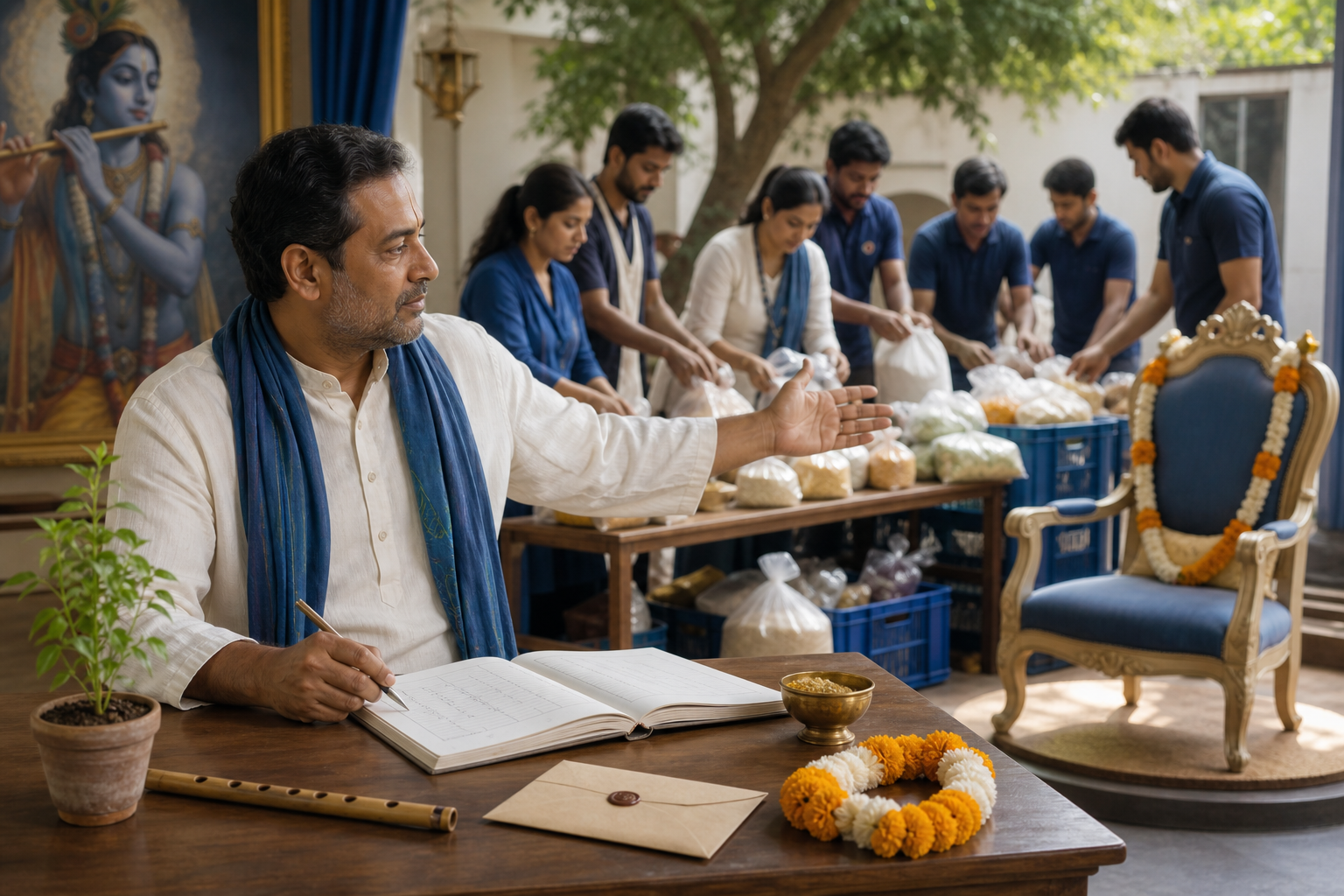
Devotion becomes ethically credible when it survives contact with incentives. Status can make service look like a means to admiration. Money can turn a calling into a rationalization. Institutional loyalty can tempt you to protect reputation at another person’s expense.
A remembered act of service can steady you at that moment. Havi das regarded washing Srila Prabhupada’s feet in Venezuela in 1975 as more significant than professional acclaim. You don’t need to reproduce that gesture. Recall an occasion when service made your ambition smaller, and use that memory before a choice involving prestige.
A five-question test for creative and professional opportunities
Artists face especially visible versions of this test. Master ownership, recoupment, cross-collateralization, broad revenue-sharing agreements, opaque royalty accounting, and sponsor demands can separate public success from creative and ethical freedom. Before agreeing to an opportunity, ask:
- Who will own or control the work after the agreement ends?
- Which costs must be recouped, from which income streams, and how will the accounting be checked?
- Does the other party receive income from touring, merchandise, sponsorships, or unrelated work?
- Are the sponsor’s products and conduct compatible with the values you publicly claim?
- Would you still consider this work worthwhile if your name received little attention?
Get every material promise into clear language and have a competent adviser explain what you don’t understand. Walking away can be dharmic, but so can negotiating better terms and creating good work within public culture. The question is whether you remain free to serve without selling the center of your life.
Apply the same scrutiny outside the arts
- Truthfulness: Are you relying on a misleading omission that you wouldn’t accept from someone else?
- Ahimsa: Who bears the hidden harm or risk if your plan succeeds?
- Non-possessiveness: What title, asset, relationship, or public image are you afraid to release?
- Accountability: Who has enough information and independence to challenge you?
- Seva: Who actually benefits, especially when no publicity follows?
When you fail one of these tests, don’t confuse remorse with renewal. Correct the statement, return what isn’t yours, compensate a preventable loss where possible, change the process, and invite oversight. Repair is devotion expressed in consequences.
Turn inner discipline into public trust

Inner-first does not mean outer-later. You don’t wait to become pure before serving. You practice while you act, allowing action to expose the motives that still need purification.
- Pair remembrance with conduct. After japa or reflection, choose one same-day expression: a truthful conversation, a restrained response, an unadvertised service, or a neglected duty completed well.
- Build accountability into the institution. Clarify decision rights, disclose conflicts, preserve records, and give affected people a safe route to question conduct. Krishna consciousness should strengthen these protections, not substitute for them.
- Track visible consequences. A community can monitor complaints, harmful incidents, volunteer participation, trust, institutional reliability, and well-being over time. Such indicators can reveal patterns worth examining, although they don’t prove that a single practice caused every change.
This approach also gives Dharmic communities a strong basis for cooperation without pretending their paths are identical. Yoga’s yama and niyama, Buddhist ethics, concentration and wisdom, Jain vows, and Sikh remembrance and seva differ in theology and discipline, yet each demands that inward formation bear outward fruit.
- Protect the distinct practices and spaces of temples, gurdwaras, viharas, and other communities.
- Choose shared seva with a defined need, such as education, health support, or environmental care.
- Agree beforehand on a civic code of truthfulness, non-violence, discipline, generosity, and financial transparency.
- Set roles, decision procedures, and a way to handle complaints before launching the work.
- Serve without making aid conditional on competitive proselytism or theological uniformity.
At your next period of practice, name one relationship in which your conduct needs to change. Remember Krishna, inspect your motive, and make one concrete repair that day. Then keep the next practice appointment. Ethical renewal grows through that repeated movement from remembrance to responsibility.
References
- DharmaRenaissance Blog — Reforming the Reformer: Bhaktisiddhanta on Krishna Consciousness and Enduring Social Renewal
- DharmaRenaissance Blog — Havi das on Devotion Over Fame: Hare Krishna Bhakti vs. the Music Industry’s Allure